


Toamasina is better known for cranes and cargo than for tree frogs and orchids, yet within an hour of the port I managed to swap exhaust for the smell of wet earth and ginger leaves. Over several days based in the city, I pieced together a realistic picture of how much wildlife and forest you can experience without committing to a long inland journey to the big national parks. This report focuses on what I actually saw on the ground and on the water, not on the brochures: the trails I walked at Parc Ivoloina, the stretch of Pangalanes Canal I reached by boat, and the wilder edges that still press right up against Madagascar’s busiest east-coast city.
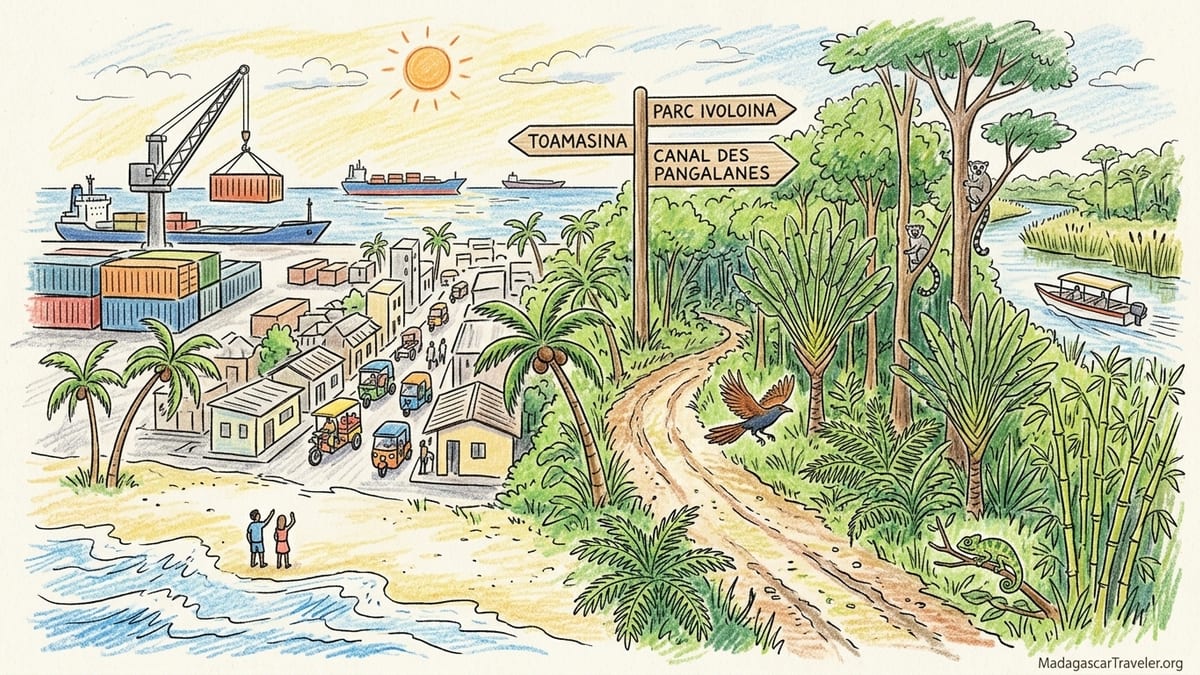
First Impressions of a Port City with a Green Back Yard
I arrived in Toamasina by road from Antananarivo, dropping out of the highlands into a band of humid air that felt more like a greenhouse than a city. The first view was all shipping containers and the constant movement of pousse-pousse and tuk-tuks, with surf breaking against a beach that locals warned was better admired than entered because of currents and pollution. Yet even inside the city limits, the eastern Madagascar climate announced itself in small natural details: coconut palms bending over side streets, Indian Ocean squalls blowing through in the late afternoon, and the metallic chorus of frogs drifting in from drains after dark.
Staying near the city center put me within easy reach of the regional tourism office and local agencies that arrange day trips. Staff consistently described Parc Ivoloina as the closest “green lung” of the region and a practical way to get a feel for east-coast biodiversity in a single outing. They also mentioned the Pangalanes Canal as the classic water-based escape, but made clear that a proper canal excursion would take the best part of a day and involve early departures from the port or nearby landing points. That framing helped me structure my time: one dedicated day at Parc Ivoloina, one day on the canal, and smaller slices of urban nature in between.
Weather shaped everything. I visited in the local dry season, when rain is lighter but humidity still high and midday sun surprisingly strong once clouds burn off. Mornings brought low mist over roadside rice paddies and over the flat, marshy outskirts of town. By mid-afternoon, scattered showers slicked the red earth again. Anyone hoping to see wildlife around Toamasina should plan their main excursions for the cooler, calmer morning hours and expect the forest to feel several degrees warmer than the seafront once you step away from the breeze.
Transport logistics were straightforward but less casual than they look on a map. Pousse-pousse and tuk-tuks work for short hops in town, but for nature outings I relied on pre-arranged cars through local agencies. Distances are short in kilometers but long in minutes once you hit patched tarmac, potholes and muddy side roads. That matters when you are trying to catch the early morning window when birds and lemurs are most active, or hoping to be back before evening downpours make tracks slower and more slippery.
Getting from Toamasina to Parc Ivoloina
Parc Ivoloina lies about 12 kilometers from central Toamasina, inland along a road that quickly swaps concrete for villages and low, damp forest. Local conservation staff and the Regional Tourism Office both described it as a 30 to 40 minute drive in normal conditions, which matched my own timings on a dry morning. I arranged a round-trip transfer through a Toamasina-based operator that partners with the park, paying the equivalent of around 25 to 30 US dollars for a private car, driver and waiting time. Shared taxi options exist, but for early starts and flexibility a hired car gives you a better shot at productive wildlife time.
The route out of town set the tone for the day’s nature. Within fifteen minutes, the landscape softened into a mosaic of smallholdings, banana clumps and ponds fringed with pandanus. Roadside stalls sold litchis and jackfruit in season. In low spots, I could see narrow drainage canals edged with Typha reeds where egrets picked through the shallows. The humidity intensified as we left the breeze of the port behind, and by the time we reached the entrance road to Ivoloina the car windows were fogging lightly.
The final two-kilometer access road to the park is unpaved and, after heavy rain, deeply rutted. In my case the surface was mostly dry, but the driver still slowed to walking pace in a few spots where recent showers had left slick patches of orange mud. Arriving with a vehicle that has reasonable clearance is more important than four-wheel drive, but I would avoid attempting the stretch in a low-slung city car after a major storm. On the way in, I noticed secondary forest on both sides: young Ravenala (traveler’s palm), clumps of bamboo, and patches of denser canopy rising above small farms.
At the visitor center, entry formalities were simple. I paid a modest admission fee in local currency and arranged a guide through the park itself, rather than bringing one from town. Staff recommended at least half a day to combine the zoological area, education center and a loop on the forest trails. They also pointed out a basic picnic area and a lakeside viewpoint that becomes busier with local families later in the day. With humidity already climbing, I opted to start with the forest trails to maximize the cooler early hours for walking and wildlife.
Walking the Trails at Ivoloina: Conditions, Insects and Atmosphere
Parc Ivoloina manages around nine kilometers of signed trails that weave through lowland forest and former plantations. Guided by one of the park’s staff, I followed a route that combined sections of the main forest loop with a side spur climbing gently to a ridge and another track skirting the lake. Altogether, the walking portion took about three hours at a relaxed pace, including frequent stops for plants and occasional wildlife sightings.
Trail conditions changed constantly. In shaded gullies, the ground stayed damp and slippery even several days after rain, with exposed roots polished by hundreds of feet. On ridges, the path was dry, dusty and scattered with leaf litter that crackled under boots. Footwear with decent grip is important; I saw a couple of local visitors in flip-flops hesitating on steeper patches. Elevation gain is modest, and anyone of general fitness can manage the loops, but the combination of heat and humidity makes the walking more tiring than the map suggests. I carried two liters of water, which was enough for the morning but would have been tight if I had stayed on trail into the afternoon.
Insects were present from the first step. Mosquitoes appeared anywhere the trail approached standing water, especially at the start and around the lake. A strong repellent with DEET or an equivalent active ingredient made a clear difference. Underfoot, lines of small ants crossed the path at regular intervals, and my guide pointed out several termite mounds at the base of larger trees. In open glades, butterflies moved between flowering shrubs, with pale yellow and white species quickly noticeable even to a non-specialist eye. I also brushed past a few leeches in wetter patches when I stepped off the main track to peer into a ravine, but on the maintained path itself they were not a major issue during my visit.
The forest itself felt like a compressed introduction to eastern Madagascar’s lowland habitats. I walked under the fan-shaped crowns of traveler’s palms, past fruiting trees attracting bulbuls and other small birds, and through stands of bamboo where the light turned green and cool. Tree ferns and lianas draped some of the older trunks. The guide pointed out Asian-introduced clove and cinnamon trees near the start of the trail and contrasted them with native understory plants and orchids that cling to branches higher up the slope. On a steep segment, we passed the moss-covered ruins of old plantation structures, where geckos scattered into cracks as we approached.
Wildlife I Actually Saw at Parc Ivoloina
Ivoloina has a dual identity. On one side, it functions as a small zoological and conservation center, housing rescued and captive-bred animals from eastern Madagascar. On the other, its forest station offers more natural habitat where wildlife moves more freely but remains harder to see on any fixed schedule. To respect that distinction, this account sticks closely to what I personally observed during one long visit, rather than listing every species the park is known for.
On the forest trails, the first animals I clearly saw were birds. A Malagasy coucal flapped low across the track and dove into dense vegetation, its rust-colored wings very obvious against the green. Later, we watched a small mixed flock of forest birds moving through the mid-canopy: greenish sunbirds visiting flowers, a heavily streaked ground-level bird scratching in the leaf litter, and at least one vangid-like silhouette higher up that my guide identified to family level but not to species. Calls were constant in the background, from simple whistles to more complex phrases I could not match to names. Birdwatchers with binoculars and field guides would extract much more from the same route than I did.
In terms of mammals, I did not encounter completely wild lemurs on the forest trail during that particular morning. Vocalizations suggested distant groups in the trees, but the animals themselves remained invisible in the dense foliage. Instead, the most reliable close views came within the managed enclosures of the zoological section, where I observed several lemur species at short range. Keepers emphasized that many individuals here were rescues or part of breeding programs linked to broader conservation work on the east coast. Watching them up close provided clear views of fur patterns, hand structure and social behavior, but the context was closer to a small, conservation-focused zoo than a purely wild forest encounter.
Reptiles required more patience. I did not see a chameleon until late in the morning, when my guide noticed one resting in low vegetation beside the trail. Without his trained eye, I would have walked straight past; at a casual glance, the animal looked like a knot on a twig. We observed it from a respectful distance for several minutes. In the zoological area, I also saw several native snakes and turtles housed in display enclosures, which helped me connect the abstract idea of “eastern Madagascar herpetofauna” with real animals and body shapes. Around the lake, small skinks warmed themselves on sunlit rocks.
Amphibians made themselves known more by sound than by sight. Near small streams and shaded pools, the air throbbed with frog calls, particularly toward the end of the trail walk as clouds thickened and humidity increased. With patience and guidance, I eventually picked out a few small frogs clinging to leaves just above the waterline, their skin damp and bright in the filtered light. They were tiny and well camouflaged, and without a guide familiar with local species groups I would have struggled to notice them at all. The cumulative effect of these glimpses was less about ticking species boxes and more about understanding just how much life hums beneath the larger conservation headlines of lemurs and orchids.
Learning About East Coast Biodiversity at Ivoloina
Beyond the animals themselves, Parc Ivoloina functions as a classroom on how eastern Madagascar’s ecosystems fit together and how fragile they have become. After the trail walk, I spent more than an hour at the environmental education center and in discussion with staff, connecting what I had just seen with broader patterns. Exhibits explained how lowland rainforest along this coast once formed an almost continuous band, and how agricultural expansion and fuelwood collection have fragmented it into smaller blocks, including the forest station I had just hiked through.
One of the most useful parts of the visit was listening to staff describe the park’s role as both a rescue center and a training site for Malagasy conservation workers. They walked me through examples of confiscated animals that had arrived in poor condition and the challenges of rehabilitating and, when possible, releasing them. In this context, the enclosures ceased to feel like mere tourist attractions and instead read as a compromise between animal welfare, visitor education and the realities of limited resources. The staff were transparent that some animals would never return to the wild but played an important role in outreach and in maintaining genetic lines of threatened east-coast species.
The forestry station and orchards added an applied side to that narrative. Demonstration plots showed mixed plantings that combine food crops with native trees, offering local farmers models that could reduce pressure on remaining forest while still supporting livelihoods. Walking through these areas after the morning in the wilder sections of the park underlined how human and non-human life are interwoven around Toamasina. This is not pristine wilderness, but a working landscape where conservation has to mesh with daily subsistence and a growing port economy.
Reflecting on the day as a whole, Ivoloina absolutely worked as a half-day or three-quarter-day escape from the city. I left central Toamasina around 7:30 in the morning and was back in town by mid-afternoon, tired, damp with sweat and far more informed than when I set out. A guide significantly improved the experience, not only by spotting otherwise invisible animals but by interpreting plant communities, land-use history and the realities of east-coast conservation today. Without that context, the forest would still have been beautiful, but it would have been harder to understand what was at stake.
On the Water: A Day Trip Onto the Pangalanes Canal
If Parc Ivoloina offers a compact introduction to east-coast forest, the Pangalanes Canal delivers the water side of the story. This long waterway, formed from linked natural lagoons and man-made cuts, runs parallel to the Indian Ocean for hundreds of kilometers. From Toamasina it is possible to join short excursions that head south from the port area into quieter stretches lined with villages, mangroves and patches of low forest. I arranged a small motorboat through a local agency based in town, joining a mixed group of travelers and Malagasy families for a shared outing.
The day began at a small riverside embarkation point on the edge of Toamasina, reached by tuk-tuk from my hotel in about 15 minutes. We boarded a metal motorboat with wooden benches and a canvas canopy. Life jackets were provided, and the guide gave a safety briefing in French and Malagasy, with key points translated into English on request. The cost for the full-day excursion, including the boat, guide and a simple lakeside lunch, was quoted at the equivalent of around 40 to 60 US dollars per person depending on final group size, in line with other operators working from Toamasina.
Once we left the port area, the character of the waterway changed quickly. Industrial cranes and cargo ships gave way to small wooden pirogues paddled by local fishers, the hum of our outboard mixing with bird calls from reedbeds and forest fragments. The canal here was relatively narrow, with floating vegetation gathered in quiet corners and occasional sandy banks where children waved as we passed. Weather again shaped the experience. The morning was calm and overcast, ideal for photography and avoiding glare. By early afternoon the sun punched through, and the breeze off the water became essential relief from the heat.
Wildlife sightings on the canal were modest but meaningful. I saw several species of herons and egrets along the banks, including birds stalking through shallows and others roosting in low trees. Kingfishers flashed ahead of the boat in short blue bursts, too fast for many of us to photograph well but unforgettable in the moment. In sheltered coves, we passed patches of mangrove-like vegetation whose roots braided into the water, and our guide pointed out crabs and small fish in the shallows. At one sandspit where we stopped to stretch our legs near the ocean side of the canal, we watched a line of terns working the surf just beyond the bar, a reminder of how close the open sea runs to this inland route.
The focus of this canal outing was less on ticking off rare species than on absorbing the interplay between water, villages and remnants of natural habitat. We visited one Betsimisaraka village, stepping carefully out of the boat onto a simple wooden jetty, and walked among houses raised slightly above flood level. Kitchen gardens with cassava, bananas and breadfruit trees climbed the bank just behind. Chickens scratched in the sand while ducks moved between canal and puddles. Compared with the forest of Ivoloina, this was a working landscape where wildlife had adapted to life alongside humans. The guide was candid that larger mammals are scarce here now and that anyone seeking more dramatic encounters with lemurs or rainforest birds would need to travel farther south along the canal or inland to larger protected areas.
Urban Nature: Green Pockets Within Toamasina Itself
Between formal excursions, I looked for smaller windows onto the region’s nature within the city. Toamasina is not a park in its own right, but it does offer glimpses of east-coast biodiversity for travelers with limited time or mobility. The broad, tree-lined boulevards shelter common urban birds like mynas and weavers, which gather in noisy flocks on telegraph wires at dusk. Drainage ditches and small ponds on the outskirts attract frogs that start calling loudly as soon as the evening humidity deepens, a natural soundtrack that easily drowns out traffic on back streets.
In the early morning, before the city fully stirs, the beach promenade becomes an informal nature corridor. While the ocean itself is not recommended for swimming near the port because of currents and pollution, the zone behind the sand holds scattered casuarina and coconut trees, and I repeatedly saw small groups of shorebirds probing the wet sand for food. Local joggers and walkers shared the space with feral dogs and the occasional zebu cart heading toward the market. The contrast between industrial port and living coastline felt sharpest at these hours, when soft light and cooler temperatures made it easier to notice small details.
Markets provided another indirect window onto regional biodiversity through the products on display. Piles of fruits from the humid east coast, including lychees in season, jackfruit and clusters of green bananas, testified to the productivity of nearby orchards like those at Ivoloina. Fish stalls stacked with reef and lagoon species reminded me that the Pangalanes Canal links not only lakes and rivers but also the livelihoods of countless small-scale fishers plying both inland and coastal waters. Asking vendors about the origins of their produce and catch, through an interpreter where needed, helped me map the city’s food system onto the landscapes I had visited.
For travelers with only a day or two in Toamasina between cruises or flights, these urban encounters will not replace a proper forest or canal excursion. They can, however, sharpen your sense of place and make even short walks feel connected to a broader ecological story. The trick is to step away from main traffic arteries when safe to do so, seek shade, and take time to listen and look up at the canopy and the power lines instead of treating the city purely as a transit hub.
How Much Nature Can You Realistically Experience from Toamasina?
After several days based in Toamasina, moving between port, forest and canal, a pattern emerged about what the city can and cannot offer to nature-focused travelers who are not ready to commit to long drives or multi-day treks. In simple terms, you can absolutely gain a grounded sense of eastern Madagascar’s lowland environments from here. You can walk through real though fragmented forest at Parc Ivoloina, learn about conservation challenges from local staff, and see a meaningful sample of native animals at close range in a responsible zoological setting. You can ride part of the Pangalanes Canal, watch herons and kingfishers along the banks, and observe how water and village life interlock.
What you cannot reasonably expect from Toamasina alone is the sort of dense, largely intact rainforest experience that eastern flagship parks like Andasibe-Mantadia or Masoala provide. The forest at Ivoloina is precious and evocative, but it sits within a heavily modified, human-dominated landscape. Sounds of distant traffic and chainsaws occasionally filter through. Larger, shyer mammals remain elusive on short visits, even at the best times of day. Anyone whose primary goal is maximum wild lemur encounters or extended primary forest hiking will be happier building Toamasina into a longer itinerary that includes deeper inland or northern stops.
In terms of time commitment, a half or full day at Parc Ivoloina and a long day on the canal represent realistic investments for most travelers passing through. Each outing involves roughly 30 to 40 minutes by car or tuk-tuk to the starting point, several hours of walking or boating, and a flexible return window. Combined with a few early-morning or evening walks in town, this gives you a compact but vivid snapshot of east-coast biodiversity. You will return to your hotel tired, likely a little muddy and mosquito-bitten, and carrying a much more concrete understanding of how life persists around Madagascar’s busiest east-coast port.
The decision then becomes one of appetite. If you are content with a curated but honest encounter with the region’s wildlife and ecosystems, Toamasina’s green surroundings will satisfy. If your expectations lean toward multi-day hikes under continuous canopy, dawn choruses booming from all sides and lemurs crossing the trail at regular intervals, then treat Toamasina as your stepping stone. Either way, using the city as a base allows you to support local conservation initiatives like Parc Ivoloina and canal communities while calibrating how much deeper into the island you wish to go.
The Takeaway
Traveling to Toamasina with an eye on nature rather than on shipping schedules reveals a city framed by living systems. Parc Ivoloina offers a structured, guide-led immersion into lowland forest, its conservation challenges and its emblematic animals, within an easy morning’s reach. The Pangalanes Canal adds a watery counterpoint, showing how wetlands, villages and remnant habitat interweave south of the port. Together, these experiences demonstrate that you can gain a real feel for eastern Madagascar’s biodiversity without disappearing into the backcountry for a week.
At the same time, my days in and around Toamasina underlined the limits of what a port-adjacent landscape can provide. Forest fragments, managed enclosures and canal edges are meaningful, but they are not substitutes for large, protected tracts of rainforest if your dream is deep wilderness immersion. Recognizing that distinction before arrival will help set realistic expectations and reduce the risk of disappointment.
If you have one full free day in Toamasina, I would put Parc Ivoloina at the top of the list, start early with a local guide, and keep your plans flexible enough to adapt to weather. With an additional day, I would add a small-boat trip on the Pangalanes Canal, prioritizing operators who emphasize safety, community respect and realistic wildlife promises. Everything beyond that should be framed as bonus time: extra dawn walks along the seafront, quiet moments listening to tree frogs near your guesthouse, or market visits that tie city life back to the region’s farms and waters.
In the end, what I took away from Toamasina was not a long species list but a layered understanding of how nature persists, adjusts and sometimes thrives in and around Madagascar’s busiest east-coast city. For many travelers, that blend of access, education and modest adventure will be enough to justify at least a few extra days in port before chasing the deeper forests farther inland.
FAQ
Q1. Is Parc Ivoloina really doable as a half-day trip from Toamasina?
Yes. With a 30 to 40 minute drive each way, you can leave Toamasina around 7:30 or 8:00 in the morning, walk several forest trails, visit the zoological and education areas, and comfortably return to the city by mid-afternoon.
Q2. Do I need a guide at Parc Ivoloina to see wildlife?
Hiring a local guide at the park is strongly recommended. Trails are signed, but guides dramatically increase your chances of spotting reptiles, frogs and discreet birds and provide context about conservation work and local plants that you would likely miss alone.
Q3. What kind of wildlife should I realistically expect to see around Toamasina without a long inland trip?
On a short stay, you can expect reliable views of a few lemur species in managed enclosures at Ivoloina, a variety of birds such as herons, egrets and kingfishers along the Pangalanes, smaller reptiles like chameleons and geckos if a guide can locate them, and a chorus of frogs in wetter areas, rather than large numbers of wild, free-ranging lemurs.
Q4. How bad are insects on the trails and canal near Toamasina?
Mosquitoes are common around standing water, particularly near the lake at Ivoloina and quiet coves along the canal. Ants, butterflies, small biting midges and occasional leeches in very wet forest patches are also present, so good repellent, long sleeves, and closed shoes with decent grip are advisable.
Q5. Is the Pangalanes Canal day trip from Toamasina suitable for families?
Yes for most families, provided children can handle several hours on a small motorboat with limited shade and basic facilities. Life jackets are typically provided and stops at villages or sandbanks break up the day, but parents should be prepared for strong sun, humidity and simple sanitary conditions.
Q6. How much should I budget for nature excursions from Toamasina?
As of recent seasons, a private car transfer to Parc Ivoloina with waiting time may cost in the region of 25 to 30 US dollars, plus modest park entry and guide fees, while a shared Pangalanes Canal day trip commonly starts around 40 to 60 US dollars per person including the boat, guide and a simple lunch.
Q7. What is the best time of day to explore nature around Toamasina?
Early morning is generally best for both wildlife activity and human comfort. Temperatures are cooler, birds and some mammals are more active, and light is softer for photography. Afternoon outings can still be rewarding but are hotter and more prone to sudden showers.
Q8. Can I see meaningful nature in Toamasina itself without leaving the city?
Yes, at a modest level. Dawn and dusk walks along the seafront and in quieter residential streets can reveal urban birds, frogs calling from drains and small pockets of coastal vegetation, though these experiences are more atmospheric than wildlife-rich compared with Ivoloina or the canal.
Q9. How physically demanding are the nature activities near Toamasina?
Parc Ivoloina’s main trails involve gentle slopes, occasional muddy or rooty sections and high humidity but do not require technical hiking skills. Canal trips mostly involve sitting, with short walks at village or sandbank stops. Travelers in average health can usually participate with sensible pacing and hydration.
Q10. If I want deeper wildlife experiences, should I still include Toamasina in my trip?
Yes, if time allows. Toamasina works well as a coastal base and introduction to east-coast ecosystems before heading on to larger rainforest parks or more remote canal sections. Its mix of conservation education, manageable logistics and light adventure can help you decide how ambitious your next step into Madagascar’s wild areas should be.