


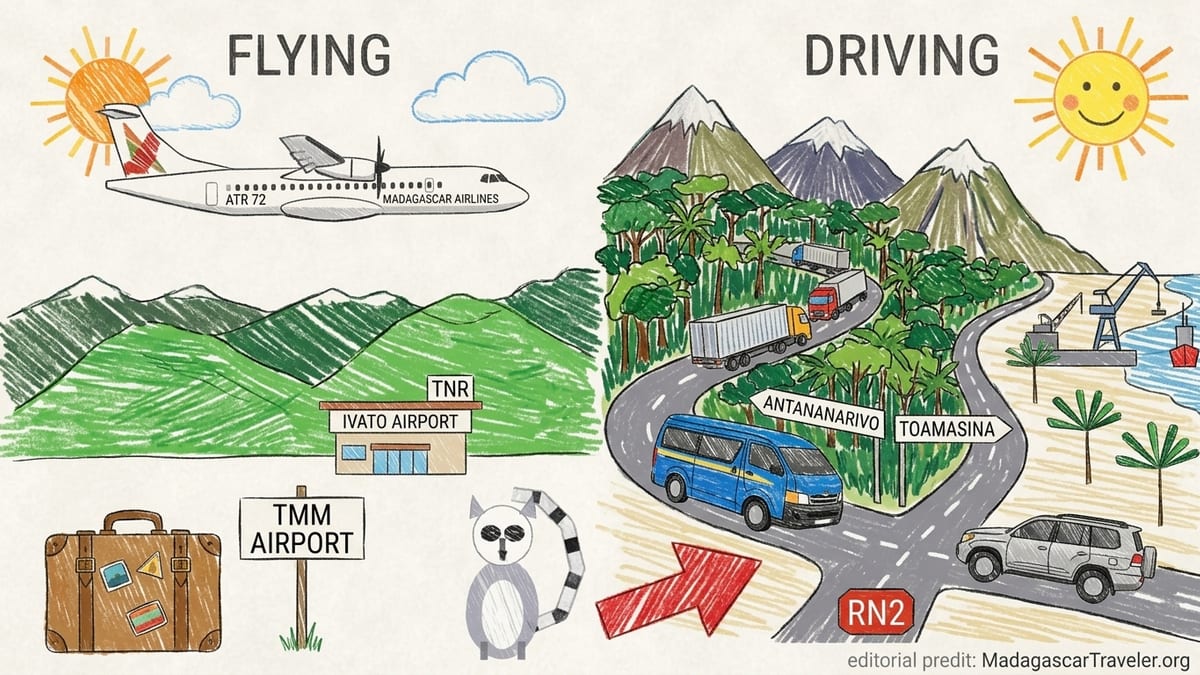
My journey from Antananarivo to Toamasina started like many Madagascar travel plans do, with a deceptively simple question: should I fly or take the road along RN2. I ended up doing both on different trips, first flying with Madagascar Airlines into Toamasina Airport, then later returning overland with a combination of private car and taxi brousse. The contrast between a 50 minute hop and a long, winding day on the road completely reshaped how I think about this route and whether the overland journey is part of the Madagascar experience or simply a tiring necessity.
Understanding the Antananarivo to Toamasina Route
Antananarivo and Toamasina are linked by one of Madagascar’s most important transport corridors. By road the distance along Route Nationale 2 is about 360 to 370 kilometers, depending on where you start and finish in each city. The RN2 is the country’s main artery between the political capital and its biggest commercial port, so it carries a constant flow of heavy trucks, buses and taxi brousse vehicles. Several World Bank and government reports still describe the RN2 as being in fair to good condition compared with other national roads, which is one reason it remains so heavily used.
At the same time, Madagascar’s domestic air network connects Antananarivo’s Ivato International Airport to Toamasina Airport, listed under the IATA code TMM. Madagascar Airlines currently publishes Antananarivo–Toamasina flights of about 50 minutes using turboprop aircraft, typically ATR 72s, which are well suited to short domestic hops. Recent schedule aggregators show early morning departures around 06:00 or 07:00 on some days, but frequencies and flight numbers change seasonally and must be checked live when you book.
The third piece of the puzzle is ground public transport. Taxi brousse companies and scheduled minibus operators such as Cotisse Transport run daily services between Antananarivo and Toamasina, departing mainly from Ambodivona in the north and east of the capital. Recent price guides and local directories list Cotisse tickets from roughly 25,000 to 60,000 ariary one way, depending on whether you choose the basic “Lite” service or more comfortable “Premium” and “VIP” vans, with an advertised travel time of about eight hours. Other cooperatives often sit in a similar price range, while some recent travel blogs note that inflation has pushed certain Antananarivo–Toamasina tickets as high as about 80,000 ariary.
On paper, the decision seems straightforward: fly for speed or take the road for savings. In reality the choice is more nuanced, because your door to door time, fatigue level and experience of Madagascar all depend on how each leg of the journey plays out.
Flying Antananarivo to Toamasina: My Door to Door Experience
My first trip from Antananarivo to Toamasina was by air with Madagascar Airlines. I booked through a regional booking platform that was listing one way fares in October around the equivalent of 170 to 220 US dollars for foreigners on standard economy tickets for the TNR–TMM sector. A few Malagasy and resident travelers on the same flight mentioned paying less by buying directly in ariary through a local agency, so there is a real price gap between local and international channels.
Getting to the airport in Antananarivo set the tone. I left a guesthouse in Isoraka at 04:15 for an early morning departure and prebooked a city taxi at 70,000 ariary, which aligns with the flat airport fare several recent travelers have reported when negotiating taxis at Ivato. It took about 45 minutes at that hour, with only light traffic until we neared the airport turnoff. By the time I walked into the terminal it was 05:00, roughly two and a quarter hours before takeoff, which felt about right for domestic check in in Madagascar where queues can swell unpredictably.
Check in for Madagascar Airlines’ Toamasina flight opened roughly two hours before departure. The airline currently operates under the Madagascar Airlines brand inherited from Air Madagascar, and on my flight they used a single economy cabin with free checked baggage of 20 kilograms plus a small cabin bag. I checked a 15 kilogram duffel and carried a daypack. The process was slower than a typical European domestic flight because of manual document checks, but still smooth. Security at Ivato was straightforward, with one baggage scanner and a basic walk through metal detector. I was airside by 05:50.
Boarding was called about 20 minutes before our scheduled departure. The aircraft was an ATR 72 with two seats on each side of the aisle and a 2–2 layout throughout the cabin. Seat pitch felt tight but manageable for such a short flight. We pushed back almost exactly on time and spent another 10 minutes taxiing. Once airborne, the crew offered bottled water and a small snack. The flight itself felt like a single continuous climb, level and descent. Turbulence over the forested highlands east of Antananarivo was noticeable but brief. We landed in Toamasina around 50 minutes after takeoff, consistent with current timetable data that quotes a block time of 0:50 between TNR and TMM.
The arrival experience in Toamasina was quick. Toamasina Airport has a small terminal with one baggage belt. Our bags started arriving less than 10 minutes after we left the aircraft, and I was outside the building with my duffel by about 08:10. Local taxi drivers were waiting just beyond the exit. I agreed on 20,000 ariary for a ride to a midrange hotel near Boulevard Joffre, a price that several hoteliers in town later confirmed as typical for airport transfers within central Toamasina. The ride into town took less than 15 minutes along a straight road past warehouses and low residential neighborhoods. From hotel door in Antananarivo to hotel lobby in Toamasina, the full journey took almost exactly four hours, including generous buffer time at departure.
What Can Go Wrong When You Fly
My flight happened to run almost perfectly on schedule, but when you look at recent tracking data for Madagascar Airlines’ MD500 and MD502 Antananarivo–Toamasina services you see a more complicated picture. Some days the early morning departure leaves on time and lands within an hour of its schedule. On other days, flights are rescheduled to afternoon or evening slots or show departure delays of an hour or more. A recent tracking snapshot lists an MD502 rotation that left Ivato at 20:00 instead of the daytime slot published in a seasonal timetable, then landed in Toamasina well after dark.
This unpredictability matters because the TNR–TMM route is often served only once per day on the days it operates. It is not a high frequency shuttle where you can simply roll onto the next flight. If Madagascar Airlines cancels a rotation due to weather, technical issues or low loads, your rebooking options are limited and may involve staying overnight in Antananarivo. That is an important risk if you are trying to connect onward from Toamasina, for example to a boat departure north along the coast or a business meeting at the port.
There is also the question of cost versus service level. Even without hard numbers from the airline itself, current aggregator listings suggest that a one way domestic ticket for a foreign traveler is generally many times more expensive than a single seat in a taxi brousse or Cotisse van on the same route. While my fare in October fell in the 170 to 220 US dollar range, the cheapest Cotisse ticket for Antananarivo–Toamasina that I saw published in late 2026 was around 25,000 ariary in Lite class, with VIP vans listed at about 60,000 ariary. Converting at roughly 4,000 ariary to the dollar, the premium for flying can easily exceed tenfold on a per person basis.
On the other hand, the intangible benefits are real. You skip the stress of crossing Antananarivo traffic to reach the RN2, you avoid eight to ten hours of dodging potholes and trucks, and you significantly reduce your exposure to road accidents, which remain a serious concern on Madagascar’s highways. For families with children, business travelers or anyone on a tight schedule, those qualitative gains may matter more than the raw difference in price.
My Road Journey: Private Car and Taxi Brousse on RN2
My return from Toamasina to Antananarivo, a few weeks later, was overland. I started with a private car and driver arranged through a local agency, then later repeated the trip in the other direction using Cotisse Transport’s scheduled minibus to compare the experience. Both shared the same backbone, the RN2, a sinuous two lane highway that climbs from sea level to the central highlands.
On the first overland trip, we left a hotel near the Toamasina waterfront at 07:15 in a Toyota Land Cruiser. The driver had quoted 600,000 ariary for the one way journey to Antananarivo, including fuel and his accommodation back in Toamasina, a figure consistent with recent quotes of about 50 to 60 US dollars per day plus fuel for private drivers on other national routes. Traffic out of Toamasina was already heavy with port trucks, but once we cleared the last roundabout the flow became steadier. The first hour passed through coastal plains and small villages, with a mix of smooth asphalt and occasional patched sections.
As we began to climb into the hills near Brickaville and later around Moramanga, the character of the RN2 changed. The road narrowed, curves tightened, and trucks slowed to a crawl on steep grades. Overtaking required patience and a strong horn, and average speeds dropped below 50 kilometers per hour. We stopped twice for breaks: once in Brickaville for coffee and mofo gasy, and once near Moramanga at a roadside restaurant popular with taxi brousse drivers. Each stop lasted about 20 minutes. By the time we approached the outskirts of Antananarivo, we had been on the road for a little over seven hours.
Reaching central Antananarivo was the hardest part. Afternoon traffic into the capital can be punishing. It took almost 90 minutes to cover the final 20 kilometers, including the long slog through the industrial suburbs before climbing up to the upper city. I was dropped at a hotel near Anosy just after 17:00, roughly ten hours after leaving Toamasina. That timing roughly matches the common eight hour guideline often cited for RN2 road journeys, once you add food stops and city traffic at either end.
The second overland run, with Cotisse, felt similar but more communal. I bought a Premium ticket for the Toamasina–Antananarivo line two days in advance at the Cotisse office near the Toamasina taxi brousse station, paying 36,000 ariary, which matches the prices listed on Cotisse’s own published tariff grids. Boarding started in the early morning at a fenced depot, with numbered seats assigned. The minibus, a late model Toyota Hiace, had air conditioning, reclining seats, and limited onboard charging. We left almost exactly on time, a point of pride for Cotisse compared with more ad hoc taxi brousse companies that tend to wait until every seat and sometimes the aisles are full.
The trade off was less flexibility. Unlike in a private car, where we could stop as needed for photos or a stretch, Cotisse scheduled only two short breaks during the entire journey. The driving style was cautious but assertive, necessary on a road dominated by heavy trucks. By early afternoon we were still only just past Moramanga. We finally rolled into Cotisse’s Ambodivona station in Antananarivo in a little under eight hours of pure driving time, but many passengers then needed an additional hour in city taxis to reach guesthouses across the capital. Door to door, my day with Cotisse took about nine and a half hours, and I arrived stiff but safe.
Road Conditions, Fatigue and Safety on RN2
Several recent studies and infrastructure reports still describe the RN2 as one of Madagascar’s better maintained national roads, and visually it does look more intact than routes in the south and west where deep potholes and washouts are common. However, “better” is relative. The RN2 is narrow, winding and shared with high volumes of heavy trucks heading to and from the port of Toamasina. At many points there is little to no hard shoulder. When it rains, visibility drops quickly and mud can encroach onto the asphalt.
The biggest fatigue factors on RN2 are the constant curves and the need to stay alert for oncoming overtakes. As a passenger in both the private car and the Cotisse van I felt the strain after about five hours. For drivers, especially visitors unused to Malagasy roads, the mental load is heavy. Police checkpoints add to the stop start rhythm, though on my journeys formal checks were brief and polite, focused on vehicle documents. Local and foreign travelers have reported that driving this road after dark feels particularly stressful because of poorly lit trucks and pedestrians along the margins.
There is also the question of night safety. Some taxi brousse services on other routes leave in the evening and arrive at dawn, but along the Antananarivo–Toamasina corridor, a mix of police advice and practical experience still pushes most reputable operators toward daytime schedules. Recent traveler discussions mention that while night travel on major routes can be possible, the combination of driver fatigue, livestock and broken down vehicles without lights makes it more hazardous. For that reason, if you plan to self drive or hire a private driver, it is sensible to leave early enough from either city to avoid the last two hours of your journey taking place in full dark.
On the positive side, the RN2 offers constant glimpses into Malagasy daily life that you simply do not see from a plane. Roadside markets in villages like Beforona, peanut sellers balancing trays on their heads, families carrying bundles of lychees during the fruit season and schoolchildren in uniform walking along the verge all turn the journey into a cultural lesson. For some travelers, that immersion is worth the discomfort. For others, particularly those with limited time or mobility issues, the cumulative fatigue and safety considerations tip the scales toward flying.
Is There Still a Train Between Antananarivo and Toamasina
Older guidebooks sometimes talk about taking a train between Antananarivo and Toamasina, usually referring to the TCE line historically used to move both freight and passengers between the capital and the coast. In practice, this is no longer a viable passenger option for reaching Toamasina. Current information about rail in Madagascar confirms that regular freight trains still operate between the port of Toamasina and the highlands, but that passenger services are limited to other segments and special tourist or local runs.
Recent rail sector updates describe a planned or partial passenger revival closer to Antananarivo, such as services from the Soarano station to nearby towns, but these are not through services all the way to Toamasina. None of the current public timetables or booking channels for domestic travel from Antananarivo list a practical, scheduled passenger train that would carry travelers from the capital to Toamasina city. The reality in 2026 is that you will either fly or travel by road, whether by private car, charter, taxi brousse or a scheduled minibus service like Cotisse.
If a future government backed highway project between Antananarivo and Toamasina is completed, it may change the road dynamics, but it will not replace the underlying fact that the RN2 corridor is road and air based for passenger movement. For now, any claim that you can simply buy a passenger train ticket from Antananarivo to Toamasina should be treated with caution. Always verify on the ground with the national rail operator or local agencies before assuming any train option exists for this route.
This lack of a rail alternative is important in the purchase decision. In many countries, an intercity train offers a middle ground between the stress of driving and the cost of flying. Along the Antananarivo–Toamasina axis, that middle ground does not exist. Your choice is effectively between paying a significant premium for speed and comfort in the air, or accepting a long, sometimes tiring day on the RN2 as part of the Madagascar experience.
Costs, Time and Choosing What Fits Your Trip
Putting my two journeys side by side clarifies the trade offs. Flying from a midrange hotel in central Antananarivo to a similar hotel in Toamasina took around four hours door to door. That included a generous two hour buffer at Ivato Airport, check in, security, boarding, the 50 minute flight, baggage claim and a quick taxi ride into town. It cost the equivalent of roughly 170 to 220 US dollars for the ticket bought online, plus about 70,000 ariary for the taxi to Ivato and 20,000 ariary for the taxi from Toamasina Airport to the city, adding another 25 US dollars in local transfers.
The private car journey from Toamasina to Antananarivo consumed about ten hours door to door and cost approximately 600,000 ariary, which at current exchange rates sits in the range of 150 US dollars for the vehicle, divided between however many passengers are in your group. A couple or family of four could effectively match or undercut the per person cost of flying while enjoying much greater flexibility. The Cotisse van option, meanwhile, took about nine and a half hours door to door including a city taxi at each end but cost only 36,000 ariary for the ticket plus perhaps 30,000 to 40,000 ariary in local taxis in each city. For a solo backpacker, the road saves enough money to fund several extra days of travel.
Time, however, is not neutral. Arriving by plane mid morning in Toamasina, I had almost a full day left to explore the market, walk the seafront and arrange a side trip to nearby beaches. After arriving by road in late afternoon or early evening, I wanted nothing more than a shower and sleep. If you plan to connect from Toamasina to places like Foulpointe, Mahavelona or the Pangalanes Canal, that difference in energy can shape your entire itinerary.
When deciding, think about your priorities. If you have fewer than 10 days in Madagascar and intend to visit multiple regions, it may be worth absorbing the cost of at least one domestic flight to save energy for your destinations. If you have more than two weeks and enjoy overland travel, the RN2 drive adds texture to your trip, introduces you to Malagasy roadside life and is much cheaper. A hybrid strategy often works best: fly one direction to save time, and take the road in the other direction when your schedule is more relaxed.
The Takeaway
Traveling between Antananarivo and Toamasina in 2026 means choosing between the speed of Madagascar Airlines’ short domestic hop and the long, winding reality of the RN2. In my experience, the flight condensed the journey into a compact four hour door to door window, at a high but predictable cost, while the road stretched it into an eight to ten hour commitment that alternated between captivating and exhausting.
If your budget allows and your time is short, flying is usually worth it. You protect yourself from a full day of fatigue, lower your exposure to road risks, and arrive with enough energy to enjoy Toamasina or onward excursions the same day. Make sure to check live schedules close to your travel date, since domestic frequencies and departure times do change, and build in a buffer in case of delays or occasional cancellations.
If you are traveling on a tighter budget or want a deeper sense of the country, the overland trip belongs on your itinerary. Hiring a private car and driver gives you control over stops and departures at roughly the same total cost as a flight for two or more people. Booking a seat with Cotisse or another reputable taxi brousse company keeps costs dramatically lower while maintaining reasonable comfort and safety. In both cases, planning to drive only in daylight, allowing for slow sections near Moramanga and factoring in city traffic at either end will make the day more manageable.
There is no operational passenger train between Antananarivo and Toamasina that can serve as a practical third option, so your decision rests squarely on air versus road. My own conclusion, after doing both, is that the flight is a smart investment at least one way if you can afford it, especially at the start of a trip when you are still adjusting to Madagascar’s rhythms. The road, meanwhile, is best treated as an experience in itself rather than just a transfer, something to tackle when you can spare a full day and approach the journey with patience.
FAQ
Q1. How long does it really take to travel from Antananarivo to Toamasina by road?
In practical terms you should plan on eight to ten hours door to door, including short breaks and heavy traffic when entering or leaving Antananarivo.
Q2. How much does a flight from Antananarivo to Toamasina cost?
Recent aggregator listings suggest one way fares for foreign travelers often sit around 170 to 220 US dollars, though residents booking locally may pay less.
Q3. How often do flights operate between Antananarivo and Toamasina?
Madagascar Airlines operates direct ATR flights that schedule at roughly 50 minutes, but frequencies and departure times vary by season and must be checked live.
Q4. Is it safe to drive the RN2 between Antananarivo and Toamasina?
The RN2 is considered one of Madagascar’s better national roads, but it is narrow, winding and busy with trucks, so daytime travel with a rested, experienced driver is strongly recommended.
Q5. What does a Cotisse or taxi brousse ticket cost on this route?
Recent tariffs show Cotisse tickets from about 25,000 ariary for basic seats up to around 60,000 ariary for VIP vans, with similar ranges for other reputable cooperatives.
Q6. Can I still take a passenger train between Antananarivo and Toamasina?
No practical scheduled passenger train currently runs the full distance; rail services on that corridor are focused on freight and limited local or tourist segments.
Q7. Is a private driver worth the extra cost compared with taxi brousse?
For couples or small groups, a private car at roughly 600,000 ariary one way can match or undercut the per person cost of flights while providing comfort, flexibility and safer driving.
Q8. Should I worry about arriving after dark by road?
Yes, it is better to avoid night driving on RN2 due to fatigue, poorly lit trucks and pedestrians; plan departures early enough to arrive before sunset.
Q9. How much should I budget for airport and city taxis at each end?
Recent traveler reports indicate around 70,000 ariary for taxis between central Antananarivo and Ivato Airport, and roughly 20,000 ariary between Toamasina Airport and central hotels.
Q10. For a short trip to Madagascar, is flying or driving the better choice?
If you have less than 10 days, flying at least one way is usually wise to save time and energy; with longer itineraries, adding the RN2 journey by road enriches the overall experience.