


Toamasina, still widely called Tamatave, is not a manicured resort town. It is a working Malagasy port city on the Indian Ocean, with noisy pousse-pousses, cargo trucks, market stalls and an ever-present smell of salt and diesel. I spent several days here using it as a base for day trips and slow explorations on foot and by boat. Some experiences felt essential and I would happily repeat them. Others, including a couple that feature in almost every brochure, turned out to be skippable or at least in need of better planning. What follows is exactly what I actually did in and immediately around Toamasina, what I paid, how I got there, what I learned on the ground, and whether each experience was worth my time.
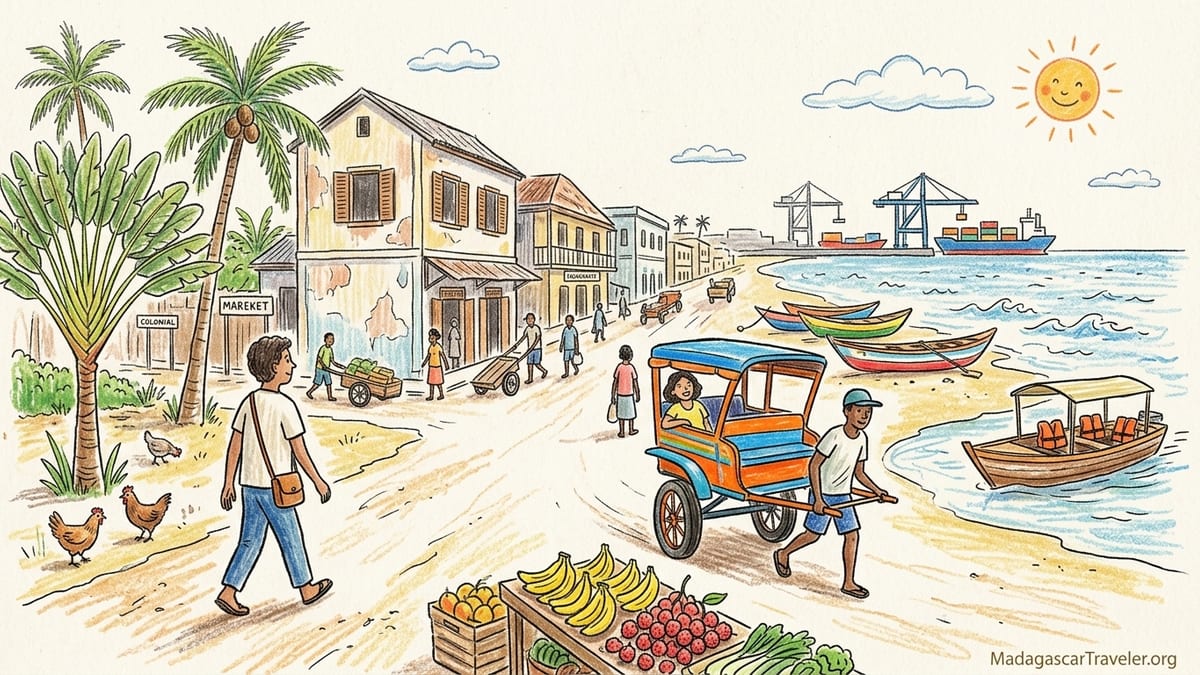
Walking Old Toamasina On Foot
My first real sense of Toamasina came from a slow walk through the older part of town, roughly between Boulevard Joffre, Rue du Lieutenant Berchon and the streets behind the old railway station. I started at around 8.30 in the morning, when the air was still relatively cool and the light was soft on the colonial buildings. I reached the area on foot from my guesthouse near Boulevard de l’Europe, a simple 10 minute walk that cost nothing except attention to traffic. I spent about three hours wandering, backtracking and stopping for small coffees in local snack bars. I kept to busy streets, carried nothing visible except a small crossbody bag, and felt reasonably safe, though I stayed alert around crossroads and quieter corners.
What struck me most was how layered Old Toamasina felt rather than any single must-see landmark. I passed pale, slightly crumbling two-storey buildings with wooden shutters, many now housing phone shops, hair salons and small groceries. There were stretches of sidewalk shaded by tall coconut and traveler’s palm trees, then abrupt gaps where a building had clearly been demolished. I walked past the exterior of the old train station, its rail lines now quiet, and watched children kicking a ball on the dusty patch where freight once moved. Along Rue Colbert I paused at a simple café for a small filtered coffee that cost the equivalent of about 3,000 ariary, roughly 0.70 to 0.80 US dollars at recent rates, and watched pousse-pousses and handcarts roll by.
Was it worth it? Yes, with tempered expectations. Old Toamasina is not postcard pretty in the way of some preserved colonial centers. Paint peels, drainage ditches smell, and rubbish collects in places. But walking the grid of streets made the city feel legible and human. I learned how residents actually move around, where schoolchildren cluster, and how commerce flows toward the market at certain hours. If I returned, I would repeat this walk, ideally again in the morning and again near late afternoon to see the light change, with the same strategy of staying on main streets and leaving any camera mostly in my bag.
Riding A Pousse-Pousse Around Town
Riding one of Toamasina’s brightly painted pousse-pousses was non-negotiable for me. On my second day I hailed one on Avenue de l’Indépendance near the main market, intending to loop through town and end at the waterfront. Before getting in, I agreed a price with the puller for a roughly 25 minute ride with a couple of photo stops. We settled on 8,000 ariary, just under 2 US dollars, which locals later told me was a slight visitor premium but not outrageous for a dedicated ride without other passengers. I made a point of confirming that the price covered the whole ride, not per person.
The route took us past the main covered market, down a side street packed with small clothing stalls, and then slowly along Boulevard Joffre toward the sea. From the high, slightly rattling seat I could see over traffic toward balconies, façades and laundry lines I had missed at street level. We passed other pousse-pousses piled high with sacks of rice and crates of green bananas, weaving between parked taxis and pedestrians. The pace was slow but constant. At one point my driver stepped aside to drink water in the shade, which I took as a natural break rather than a delay. I handed him a small extra tip of 2,000 ariary at the end, partly out of respect for the physical effort.
In terms of value, the experience sat somewhere between novelty and practical transport. It was a memorable way to see the city and photograph a few wider street scenes without drawing too much attention, since locals barely looked twice at another passenger. At the same time, I felt self-conscious about a human pulling me in the humid heat, and I would not use pousse-pousses for long distances. If I repeated it, I would keep rides short, negotiate clearly, and prefer using them for targeted hops, such as from the market back to accommodation in the midday heat when walking feels punishing.
Exploring The Markets And Everyday Food
The markets around Avenue de l’Indépendance and the large covered market building became my default orientation point in Toamasina. I first visited late morning on a weekday, having walked from my guesthouse along the main boulevard in about 15 minutes. There is no entrance fee, just a gradual transition from regular shops to dense stalls. I spent almost two hours on my first visit, then returned twice more at different times of day because each visit felt slightly different. The concrete market hall was busy but manageable, while the streets immediately outside were packed tight with vegetable sellers, clothing racks and piles of second-hand shoes.
I bought a bunch of small bananas for around 1,000 ariary and a bag of lychees for 2,000 ariary, using a mix of basic French and gestures. Inside the covered section I walked slowly past stalls selling rice in open sacks, live chickens, fish laid out on tables with blocks of ice, and spices in small plastic bags. I noticed that prices were almost always written in ariary and not negotiable for everyday produce, which made interactions simpler. There was a separate area for household goods where I picked up a simple plastic rain poncho for 5,000 ariary after light bargaining. The air was thick with the smell of dried fish, wood smoke drifting in from street grills, and the occasional waft of diesel from nearby traffic.
On one of my visits I bought lunch from a vendor grilling brochettes on a metal drum near the market’s edge. For about 6,000 ariary I received several skewers of zebu meat, a scoop of rice and a spoonful of tomato-based condiment, served in a basic plastic dish. I ate standing in the shade, watching the flow of shoppers and transport. The meat was slightly chewy but flavorful, and the seller was quick to wave off any attempt to sit on his crates, which he clearly needed for business. It was not the cleanest environment to eat in, so I used hand sanitizer afterward and stuck to cooked items rather than salads.
Among the city’s attractions, the market felt more rewarding than many guide descriptions suggest. It was undeniably chaotic and could feel overwhelming in the early afternoon heat, but it gave me a more grounded sense of Toamasina than any viewpoint. I would repeat it with the same basic precautions: keep valuables hidden, carry small notes, accept that you will brush shoulders constantly, and step into a quieter side street or a nearby café if the press of bodies becomes too much.
Walking The Waterfront And Viewing The Port
Toamasina’s position on the Indian Ocean is obvious on a map, but it was only when I walked the waterfront that the city’s relationship with the sea really registered. One late afternoon I set out on foot from the market, heading east along Avenue de l’Indépendance until the smell of saltwater grew stronger and the wind picked up. Within 10 to 15 minutes I reached the beachfront area near the wide sandy strip that faces the ocean, with simple snack stalls and small bars scattered behind the dunes. There is no entry fee for the beach front itself. I spent about an hour walking a loose loop along the sand and then back along the parallel road.
The sea here is powerful. Waves broke with real force, and locals I spoke with made it clear that swimming is often unsafe because of currents and lack of lifeguards. I limited myself to walking barefoot at the edge of the water, where the sand felt surprisingly coarse and dotted with bits of driftwood. Fishing pirogues rested higher up the beach, their hulls patched and painted, while groups of teenagers played football closer to the dunes. Looking back toward the city, tall palm trees lined sections of the main road, framing views of older low-rise buildings and the slow constant movement of traffic.
Curious about the port, I continued north along the waterfront road toward public viewpoints where the commercial harbor becomes visible. Access is restricted, and visitors cannot simply wander into the secure area, but from certain points along the road you can see cranes, stacked containers and bulk carriers at anchor. I spent about 20 minutes watching a pair of tugs guide a ship slowly toward a berth, the sound of engines and cranes providing a constant low background noise. For me, seeing Toamasina function as a real working port reinforced how central it is to Madagascar’s economy, far beyond its role as a tourist stop.
As an experience, the waterfront walk was worth repeating, but with nuance. The ocean views near sunset were beautiful, especially as the light turned golden on the white spray, yet rubbish accumulated in some corners and stray dogs wandered the sand. I never felt directly threatened, but I kept my phone mostly out of sight and avoided walking too far after dark, preferring to catch a short taxi ride back to my guesthouse for around 10,000 ariary. I would recommend the same approach to others: enjoy the light and the breeze, respect the sea’s power by not swimming unless local conditions are clearly calm and supervised, and treat the port views as a reminder you are visiting a living, working city rather than a curated resort.
Visiting Parc Ivoloina From Toamasina
One of my main reasons for staying in Toamasina was to visit Parc Ivoloina, a combination of small zoo, forest trails and education center about 12 kilometers inland from the city. I arranged the visit through my guesthouse, which booked a round-trip taxi for the half-day. The driver charged me 80,000 ariary for the return journey, including waiting time, which after converting and comparing with other travelers’ comments felt reasonable for a private car on rougher local roads. The drive took about 35 to 40 minutes each way. We left just after 8.00 in the morning to avoid midday heat, and I spent about three hours at the park itself.
At the entrance I paid a visitor fee of roughly 25,000 ariary in cash. This included suggested access to the small interpretive center and the main trail circuits. I opted to pay an additional tip directly to a local guide who offered to walk with me for about an hour, explaining the different lemur species in French and basic English. His help made the visit more meaningful. We followed a loop that passed several enclosures with black-and-white ruffed lemurs, crowned lemurs and bamboo lemurs, many of them rescues that cannot be released back into the wild. In between we walked short forest paths where he pointed out traveler’s palm, medicinal plants and bird calls I would have otherwise missed.
I appreciated that Parc Ivoloina felt modest rather than flashy. Enclosures were simple, often built from wood and wire with dense vegetation, and there were no theatrical feeding shows during my visit. I saw a few school groups using the picnic areas and classroom buildings, which underscored the park’s role in local environmental education. At the same time, some infrastructure looked worn and in need of maintenance, such as faded signage and sections of the trail where erosion had eaten into the steps. Anyone expecting a polished international-standard zoo would likely be disappointed.
Was it worth half a day and the taxi cost? For me, yes, with realistic expectations. Ivoloina gave me a chance to see lemurs closely while also understanding some of the conservation challenges Madagascar faces. The partly wild forest setting made the experience feel less like a city zoo and more like a field center. If I repeated the visit, I would again go in the morning, wear good walking shoes, bring insect repellent and carry enough cash in small notes. I would also plan my lunch around town instead of relying on the basic kiosk near the entrance, which offered only simple snacks and soft drinks on the day I visited.
Taking A Day Excursion On The Pangalanes Canal
The experience I was most curious about, and most cautious of over-planning, was a day excursion on the Canal des Pangalanes. From Toamasina, several local operators and hotels organize boat trips along the quieter stretches of the canal behind the coastal dunes. I booked through a locally based agency that my guesthouse recommended, walking into their small office near the city center late one afternoon. They were able to add me to a scheduled mixed group for the next day. The advertised price for the full day, including road transfer to the embarkation point, boat ride, village visits and lunch, was 250,000 ariary per person. After a brief conversation they offered a small discount because the group was not full, and I ultimately paid 230,000 ariary in cash.
The next morning I was picked up at around 7.30 from my guesthouse in a shared minivan. We drove south along the coastal road for just under an hour, then turned onto a sandy track that led to a small lakeside jetty. From there our group of eight boarded a simple motorized wooden boat with benches and a canopy. Life jackets were provided and actually worn, which I appreciated. We spent about four and a half hours on the water in total, broken into several segments. The canal itself was calm, with flat water edged by reeds, pandanus and occasional stands of forest. We passed small villages where children waved from the banks and fishermen paddled narrow pirogues loaded with firewood or charcoal.
Our main stops included a lakeside village where we walked past houses on stilts and a simple primary school, and a strip of dune-backed beach where the canal lies only a short walk behind the ocean. Lunch was served at a basic riverside camp: grilled fish, rice, a vegetable side and bottled water, all included in the trip price. Toilet facilities were extremely simple. The guide explained in French and English how the canal had been used historically to move goods along the coast and why many communities still rely on it, but he also emphasized that schedules can be unpredictable in bad weather and that water levels sometimes make certain stretches difficult for motorboats.
In practice, the day was slower and more contemplative than spectacular. There were no dramatic cliffs or showpiece waterfalls, just long perspectives of still water, palms and village life. I found this rewarding, especially in the late afternoon when the light softened and reflections doubled the palms, but travelers who expect constant action might find it underwhelming. The long return drive to Toamasina in early evening traffic, which took over an hour and a half, felt tiring after a day in the sun. If I repeated the experience, I would consider a one-night stay at a lodge along the canal to break up the travel and enjoy the quiet after day-trippers leave. I would also pack a light scarf and extra sunscreen, since the breeze on the boat masked how strongly the sun was burning.
Easting Local Seafood And Street Food In The City
Given Toamasina’s status as a coastal city, I made a point of seeking out seafood on several evenings. I alternated between very simple local eateries near the market and slightly more formal restaurants closer to the waterfront. One night I ate at a small, family-run place on a side street off Avenue de l’Indépendance. There was no printed menu, just dishes listed verbally in French and Malagasy. I chose grilled fish, likely a type of local snapper, served with rice, tomato and onion salad and a slice of lime. The plate cost 18,000 ariary, to which I added a small tip. A large bottle of local beer added another 7,000 ariary. The fish arrived whole, charred in spots but moist, with a smoky flavor that suggested it had been cooked over charcoal rather than gas.
On another evening I joined a friend to try street food at a cluster of stalls a short walk from the beachfront, where vendors set up simple grills and fryers from late afternoon. Over about an hour we shared skewers of prawns and small fish, pieces of fried bread and a kind of savory crêpe prepared on a flat metal plate. None of the individual items cost more than 3,000 ariary, and many were closer to 1,500. We ate standing or perched on plastic stools, watching as families stopped by after their beach walks and teenagers arrived on motorbikes. I carried hand sanitizer and avoided raw garnishes and ice. Neither of us felt unwell afterward, though this is always a calculated risk when eating street food.
I also tried one of the more established seafood restaurants along the main beach road, chosen partly because several locals mentioned it. There I ordered grilled lobster with garlic butter, rice and vegetables. The price was noticeably higher, at around 60,000 ariary for the plate, but still lower than what I would pay for a comparable dish in Europe or North America. The service was slower and more formal, and there were other travelers at surrounding tables speaking French, German and English. The food was good, though not dramatically better than the simpler grilled fish I had inland. What the restaurant offered instead was a more controlled environment, with proper tables, tablecloths and a wine list.
As an overall category, Toamasina’s seafood and street food were worth seeking out, but not every meal felt like a revelation. A few dishes were overcooked or heavily salted, and one evening’s fried fish tasted more like old oil than fresh catch. If I returned, I would repeat the pattern that worked best for me: use daylight hours to identify busy stalls and small à la carte restaurants that seem popular with local families, ask for recommendations at my accommodation, and keep a small budget for one or two slightly nicer seafood dinners by the water without assuming that higher prices always equal better flavor.
Using Toamasina As A Base For Nearby Coastal Outings
Although Toamasina is sometimes presented primarily as a stopover between the capital and beach destinations further up the coast, I used it as a base for a couple of short coastal outings without turning those into separate long-stay destinations. One day I arranged a simple half-day escape to a quieter stretch of beach north of the main city area, beyond the busier public sands. My guesthouse helped me book a taxi for the round trip at 60,000 ariary. The drive took around 25 minutes each way, following the coastal road and then a sandy side route to a small collection of beachside huts and an informal parking area.
There was no formal entrance fee, but one of the hut owners asked for a modest contribution of 5,000 ariary to use their shade, which I paid willingly. I spent about three hours there, reading under the palms, walking along the sand and wading ankle-deep in the water where it felt calmer than in front of the main city. A couple of small makeshift bars offered cold soft drinks and basic snacks like grilled corn and fried bananas. I purchased a soda for 3,000 ariary and a plate of fried bananas for 4,000, speaking mostly French with the owners. There were fewer people than on the central city beach, and the atmosphere was more relaxed, though the same cautions about currents and the absence of lifeguards applied.
This kind of simple outing highlighted Toamasina’s role as a functional base. I could enjoy a quiet slice of coast without needing to move hotels or commit to a multi-day beach stay further north. On another day, I considered organizing a trip toward Foulpointe, a better-known beach area up the coast, but realized that turning it into a rushed day trip from Toamasina would mean several hours in a vehicle and very limited time on the sand. I decided against it, preferring to keep my coastal experiences close enough to return easily by taxi and daylight. That trade-off felt right. Toamasina worked best for me as a hub where I could alternate slow city days, short beach breaks and specific excursions like Ivoloina or the canal, rather than as a place from which to sample every nearby resort area.
If I returned, I would again resist the urge to turn Toamasina into a launchpad for distant day trips that really deserve at least one night. The city itself, its markets, streets and waterfront, plus one or two nearby quiet beaches and a canal excursion, provided plenty to do over several days without the fatigue of constant transfers. With that approach, Toamasina becomes a place you live in briefly rather than simply pass through.
The Takeaway
My time in Toamasina left me with a layered impression of Madagascar’s east coast. The experiences I would most readily repeat are the ones that connected me to the city as it actually functions: walking Old Toamasina at street level, weaving through the markets, riding a short pousse-pousse loop, eating grilled fish at a small local restaurant and watching the port’s cranes work from permitted viewpoints along the waterfront. Parc Ivoloina and the Pangalanes canal excursion both justified the time and cost when I approached them with realistic expectations and some flexibility around weather and schedules.
Not everything felt essential. The waterfront, while atmospheric at sunset, suffered from litter in places and never quite became the idyllic promenade I had imagined. One or two seafood meals in higher-priced restaurants felt more about setting than cuisine. The long road segment bookending the canal day trip left me tired enough that I would consider a one-night canal stay next time instead of compressing everything into a single day. Yet even these mixed experiences added clarity. They helped me understand how distances, infrastructure and local rhythms shape what is comfortable and worthwhile in and around Toamasina.
If you come to Toamasina expecting a polished resort city, you are likely to be disappointed. If you treat it as a working port with pockets of charm, practical access to lemur conservation at Ivoloina, a gateway to the quiet waters of the Pangalanes and a base for simple coastal outings, it rewards curiosity and patience. Walk its streets, look up at its old façades, ride at least one pousse-pousse, eat something grilled over charcoal, then step onto the canal or into the forest to see why this corner of Madagascar keeps drawing travelers back.
FAQ
Q1. How many days should I spend in Toamasina itself?
Based on my experience, three full days in Toamasina worked well: one for walking the city and markets, one for Parc Ivoloina or the canal, and one flexible day for the waterfront and a short coastal outing or a second excursion.
Q2. Is Toamasina safe to walk around as a visitor?
I walked Old Toamasina, the market area and the waterfront during daylight without trouble, keeping valuables out of sight and avoiding very quiet streets. After dark I used taxis for longer distances and stayed on well-lit main roads, which felt like a sensible balance.
Q3. How much cash do I need for a typical day?
On most days I spent the equivalent of 80,000 to 120,000 ariary on meals, short taxis or pousse-pousses, small purchases and occasional entry fees. Larger costs like a Pangalanes excursion or the Ivoloina taxi pushed the daily total higher, so I withdrew extra cash before those days.
Q4. Are pousse-pousses in Toamasina expensive?
My short sightseeing ride of about 25 minutes cost 8,000 ariary plus a small tip, which locals later described as fair for a private, visitor-oriented journey. Shorter point-to-point rides can cost less if you negotiate clearly before getting in and carry small notes.
Q5. Is Parc Ivoloina suitable for children?
During my visit I saw Malagasy school groups enjoying the lemur enclosures and picnic areas, and the main trails were manageable, though sometimes uneven. With supervision, basic insect precautions and good shoes, it looked suitable for families who are comfortable with simple facilities.
Q6. Can I swim in the sea at Toamasina?
When I visited, locals repeatedly warned me about strong currents and the lack of lifeguards on the main city beach. I chose to paddle only at the water’s edge and saved real swimming for calmer, better-supervised stretches of coast reached on separate outings.
Q7. How did you book your Pangalanes canal excursion?
I arranged my day trip through a local agency recommended by my guesthouse, by visiting their office in person and paying in cash. They added me to a mixed group, which kept the price lower than a private charter and included road transfers, the boat, guiding and lunch.
Q8. What should I wear for walking around Toamasina?
I was most comfortable in light, modest clothing that covered shoulders and knees, sturdy sandals or trainers for uneven pavements, a hat and a small daypack. I also carried a lightweight rain layer because showers on the east coast can appear quickly, even on otherwise bright days.
Q9. Is English widely spoken in Toamasina?
I got by with a mix of French, a few Malagasy phrases and occasional English. In markets and small eateries, French helped most. In some hotels, agencies and better-known restaurants, staff spoke workable English, but I did not rely on it everywhere.
Q10. Are day trips to further beaches like Foulpointe worth it from Toamasina?
I chose not to visit Foulpointe as a rushed day trip because of the time spent in transit relative to time on the beach. From what I learned locally, those areas are better enjoyed with at least one night’s stay, while Toamasina serves as a base for closer, simpler coastal outings.