


When I first rolled into Toamasina, Madagascar’s busy east coast port, I expected a practical stopover before heading farther along the coast. Instead, I ended up using the city as a road trip base for more than a week, testing out day trips and onward journeys in every direction. What I learned, between tuk-tuks to Ivoloina, shared vans along the RN5 and a rutted track down to Manambato, is that Toamasina works brilliantly for some outings and poorly for others. If you are trying to decide whether to keep one hotel here or move along the coast, the real answer lies in the roads, the rain and the time it takes to get anywhere.
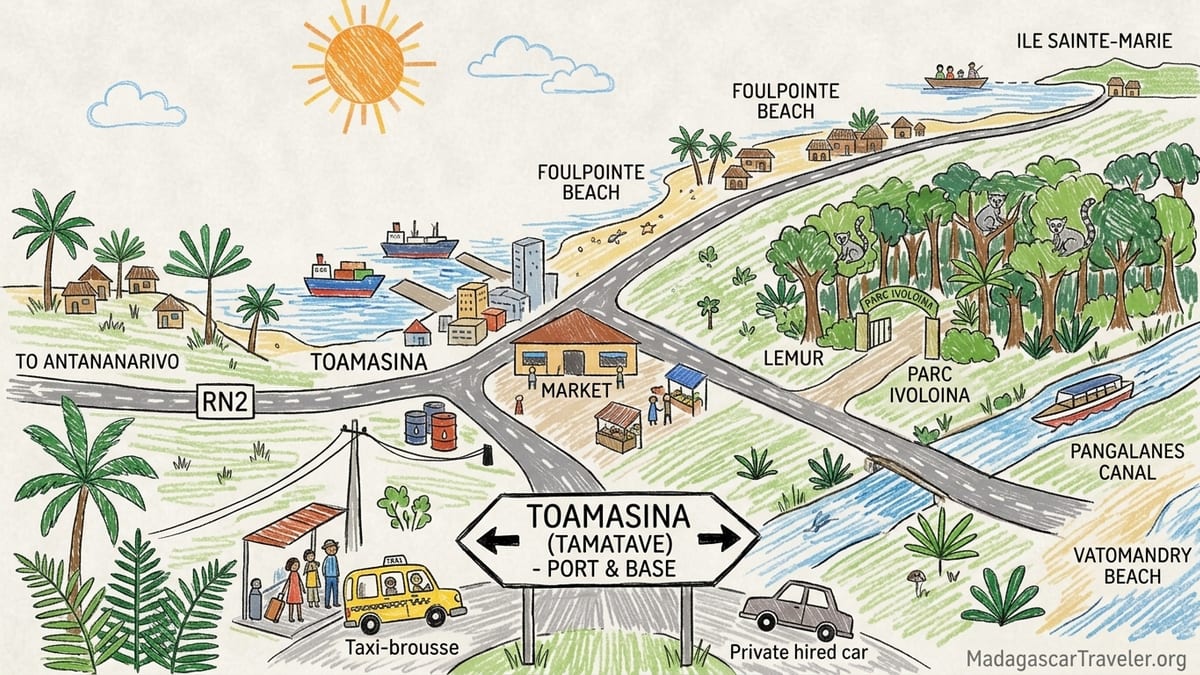
Why Toamasina Works as a Base in the First Place
Toamasina, still widely called Tamatave, is the main port on Madagascar’s east coast and the official gateway to the Atsinanana region. The regional tourism office leans into that role, promoting the city as a starting point for the Pangalanes Canal, for forest reserves like Ivoloina and for laid-back beach towns including Foulpointe and Mahambo. On paper, keeping one hotel here and fanning out on day trips looks efficient. In practice, it depends very much on how far you plan to push along the coast.
Within and around the city, basing in Toamasina makes life easy. There is an airport with regular domestic flights from Antananarivo, and the RN2 highway, Madagascar’s main artery between the capital and the coast, literally ends at the port. That means more reliable fuel supplies than in small towns, a reasonably good choice of mid-range and business hotels and a concentration of taxi-brousse stations and private drivers. I found it far simpler to negotiate trips from here than from smaller coastal villages where options shrink after dark or in bad weather.
Toamasina itself also justifies a couple of nights, which matters when you are deciding whether to unpack or keep moving. Mornings at Bazary Be, the sprawling central market, and late afternoon walks along the seafront break up the driving. I appreciated returning to a place with working ATMs, pharmacies and restaurants serving fresh seafood after bumpy excursions on the regional roads. That comfort factor became a key argument for sleeping in Toamasina when distances were short enough.
The trade-off is that Toamasina is not on a ring road. Every day trip means going out and back along the same axis, on roads that can be slow in rain or after cyclones. The more ambitious your plans, the more you need to weigh the predictability of a city base against the fatigue and daylight you burn commuting back each night.
How I Got Around: Self-Drive, Hired Drivers and Shared Transport
Before looking at specific routes, it helps to understand how I actually moved. Around Toamasina I used a mix of tuk-tuks, city taxis and hired cars with drivers. For longer stretches, I tested both private 4x4 hire and taxi-brousse, Madagascar’s shared minibus system that runs along the national roads like RN2, RN5 and RN11a. I deliberately did not self-drive. Technically you can rent a vehicle in Antananarivo and bring it to Toamasina, but most agencies on the east coast still prefer renting cars with drivers, in part because of insurance and the reality of potholes, stray animals and night driving.
For day trips such as Ivoloina or Foulpointe, hiring a local driver from Toamasina worked best. Several hotels keep a list of regular drivers and will quote a flat daily rate that includes fuel within a radius, quoting extra if you go farther. On my visits in 2025 and 2026, quotes I heard for a full day to Foulpointe in a basic sedan or older 4x4 tended to cluster in the low hundreds of thousands of ariary, with fuel on top, while a short half-day out to Ivoloina was considerably less. Exact numbers fluctuate often with fuel prices and exchange rates, so I always confirm the total in writing before starting the engine.
Taxi-brousse enters the picture once you head south on RN2 toward Antsampanana and Vatomandry, or farther north on RN5 toward Mahambo and the ferry for Sainte-Marie. Shared vans leave from Toamasina’s main gare routière and typically wait to fill before departing. On my Toamasina to Vatomandry run, I paid a modest per-seat fare and shared the minibus with families carrying sacks of rice and crates of chickens. The comfort level was basic, but I did not have to worry about fuel or navigation, and it gave me a clear sense of realistic travel times without the benefit of a private vehicle.
If you are comfortable with local traffic patterns and speak some French or Malagasy, combining a couple of targeted private-day hires with taxi-brousse for one-way hops is cost-effective. If you prefer more control and comfort, basing yourself in Toamasina and hiring the same driver for multiple days lets you adapt quickly to the weather and road conditions, which can change overnight during the cyclone season.
Day Trip Close to Town: Parc Ivoloina
Parc Ivoloina sits inland from Toamasina and is often the first excursion that visitors try from the city. The regional tourism office presents it as an easy morning or afternoon outing that pairs wildlife viewing with short forest walks. The park lies roughly a dozen kilometers north of town as the crow flies, but the last portion involves a rural track. Recent visitor reports describe the approach road as bumpy and eroded in places, passable for tuk-tuks and higher-clearance vehicles but uncomfortable for low-slung cars, especially after heavy rain.
My own visit from Toamasina started with an early tuk-tuk ride out of town, followed by a slow, jolting approach on the final unpaved stretch. In dry conditions the journey took around 40 minutes door to gate, matching several guide and park descriptions that estimate the same travel time. In the wet season this can stretch longer, and drivers sometimes ask passengers to walk the worst few hundred meters if deep ruts form. Inside the park, I spent about four hours between the small zoological area, lemur enclosures and the start of one of the forest trails, which would have been difficult to fit in if I had lost more time on the approach road.
Fuel was not an issue here, because the distance from Toamasina is short and drivers can fill up in the city before leaving. What did matter was timing around the rain. The east coast gets frequent showers, and a downpour can quickly turn a dusty track into a muddy slide. By leaving right after breakfast and heading back in mid-afternoon, I avoided the heaviest showers and was back at my hotel in Toamasina in time to rinse off and walk to dinner. In this case, returning to the city the same day made absolute sense, and I would not recommend trying to sleep closer unless you are specifically volunteering at the park.
The key lesson from Ivoloina is that short, bumpy approaches from Toamasina are manageable if the overall distance is small and the main road sections are paved. The city works perfectly as a base for this outing, and the convenience of having your own shower, restaurant options and cash machines back in town far outweighs any benefit of moving accommodations.
North Along RN5: Foulpointe and Mahambo
Heading north from Toamasina, RN5 follows the coast toward Foulpointe, Mahambo and eventually, after a transition to rough track, to Soanierana Ivongo and Maroantsetra. The regional tourism office highlights Foulpointe, about 50 to 60 kilometers away, as a classic beach escape, with Mahambo another 80 or so kilometers beyond. Distances may look modest on a map, but the real question is how long they take and whether you can comfortably return to Toamasina at the end of the day.
On my first run up to Foulpointe, I hired a local driver in a compact sedan. We left Toamasina late morning, hit moderate traffic leaving the city, then settled into a rhythm of about 40 to 50 kilometers per hour on a section of RN5 that alternated between intact asphalt and stretches marked by potholes and short repair zones. That meant roughly one and a half to two hours each way in good weather. Other recent travelers have reported similar timings, with occasional delays when roadworks or heavy trucks slow traffic. For a full day of swimming and a late lunch on the beach, then a return to Toamasina for the night, the route worked well.
Once in Foulpointe, I noticed that fuel availability dropped compared with Toamasina. There were small roadside sellers with plastic containers and a basic station on the outskirts, but nothing like the multiple service stations clustered near Toamasina’s port and main roundabouts. If you are driving your own vehicle, it is safer to fill the tank before leaving the city and treat Foulpointe as a top-up option at best. Sudden rain showers came and went along the coast, but because the road is paved in this section, it stayed passable even when wet, though braking distances increased and some potholes turned into muddy pools.
Mahambo is a different story. Continuing north from Foulpointe, RN5 eventually degrades, and drivers talk about sections where the asphalt disappears into long, broken patches. Several coastal itineraries place Mahambo around 85 to 90 kilometers beyond Foulpointe along this road, and recent discussions among guides and travelers put realistic travel times from Toamasina to Mahambo at four to five hours, sometimes more in the rainy season. One discussion about reaching the ferry for Sainte-Marie mentioned taking about eight hours from Toamasina to Soanierana Ivongo, which lies still farther north beyond Mahambo. Even at the conservative end of those estimates, a Toamasina to Mahambo day trip would mean up to ten hours in the vehicle if you insisted on returning the same night.
After driving up to Foulpointe and talking with taxi-brousse drivers who regularly run the RN5, I concluded that Toamasina is an excellent base for Foulpointe as a day trip, but a poor base for Mahambo. For Foulpointe, the two-hour radius works, and going back to Toamasina each evening keeps you close to the airport and main services. For Mahambo, the road conditions and travel times quickly tip into overnight territory. If your goal is surfing, quiet beaches or catching the boat to Sainte-Marie, you are better off spending at least one night in Mahambo or farther north instead of commuting from Toamasina.
South Toward Manambato and the Pangalanes Canal
South of Toamasina, the RN2 leads toward Antsampanana, where the RN11a branches off to Vatomandry and other coastal towns. At Brickaville, a side road heads east to Manambato on the shore of Lake Rasoabe, a key access point for boat trips on the Pangalanes Canal. The regional tourism office includes Manambato in its list of regional destinations, but it is rarely a there-and-back outing from Toamasina, and my own attempt to plan it that way confirmed why.
The paved segment from Toamasina south to Brickaville is part of the same RN2 that connects the port with Antananarivo, and traffic includes heavy trucks. Distances between Toamasina and Brickaville fall roughly in the 100-kilometer range by road, and operators running Antananarivo to Manambato tours routinely quote four to five hours of driving for around 160 kilometers of asphalt, plus a final short earth road. That converts to an average speed of about 30 to 40 kilometers per hour. In my taxi-brousse from Toamasina toward the RN11a junction, progress felt similar: segments of smooth asphalt interrupted by sections where we slowed for potholes, police checks or clusters of roadside villages.
From Brickaville to Manambato, the paved surface yields to an earth road. Recent tour descriptions and local drivers describe this last stretch as a seven kilometer track that can be deeply rutted in the rainy season, sometimes allowing only 4x4 vehicles to pass. A few guide itineraries between Andasibe and Manambato explicitly factor this extra hour onto their estimated driving times, on top of several hours spent on the main highway. Even with a private vehicle leaving Toamasina at first light, by the time you reach Manambato and arrange a boat along the canal, you have already used up much of the day.
Because of these realities, most travelers and tour operators treat Manambato not as a day trip from Toamasina, but as a staging point. They combine it with at least one night at a lodge along the Pangalanes Canal, often at Akanin’ny Nofy or Palmarium, and then continue either by boat to Toamasina or by road back toward Antananarivo. During my own east coast loop, I followed that pattern. After talking with several drivers in Toamasina and comparing costs, I chose to overnight near the canal instead of trying to return the same day. That decision removed the stress of clock-watching on roads where unexpected delays from rain or minor accidents are common.
From a base-camp perspective, this means Toamasina is a practical starting or ending point for Pangalanes journeys, but not a sensible place to sleep if you want to enjoy the canal rather than just see it in passing from a boat. The journey to Manambato deserves an overnight elsewhere, and you should plan your hotel bookings accordingly.
Farther South: Antsampanana and Vatomandry
Pushing even farther south from Toamasina takes you into territory where keeping a fixed base in the city stops making sense. Antsampanana, the junction where RN11a branches off RN2 toward the Indian Ocean, lies a substantial drive away, and Vatomandry, a coastal town promoted by the regional tourism office, is around 185 to 190 kilometers by road from Toamasina, depending on the exact route you follow through the junction. Recent distance calculators and regional guides give figures in that range, which matches the hours it took my taxi-brousse to reach the RN11a area from Toamasina.
On my run south, I started in Toamasina shortly after sunrise in a shared minibus that filled slowly near the gare routière. The road out of the city was busy with trucks bound for Antananarivo, and we rarely topped 60 kilometers per hour for long. Potholes, occasional police checks and frequent slowdowns through villages kept our average speed closer to 40 kilometers per hour. By the time we reached the RN11a turn-off, several hours had passed, and the light had already shifted into mid-afternoon. Continuing on to Vatomandry on RN11a, we passed yet more patches of aging asphalt and a handful of rivers, reaching the town later in the day than the raw distance would suggest.
Vatomandry itself felt very different from Toamasina. Where the port city has multiple fuel stations, banks and large supermarkets, Vatomandry offered fewer of each. There were small fuel pumps and informal sellers, but nothing on the scale of the east coast’s main port. That does not make it a bad destination; in fact, the beach promenade and slower pace appealed to me after time on the highway. It does mean, however, that you should not count on easily grabbing a late taxi-brousse all the way back to Toamasina after sunset, and you should not expect to drive the route in the dark at the same pace you managed in daylight.
Because the one-way travel time between Toamasina and Vatomandry stretches toward a full day once you count loading, stops and weather, I did not consider this a viable day trip. The real choice is between using Toamasina as a starting point for a southbound journey that includes Vatomandry, then moving on along the coast, or accepting that you will spend most of a very long day in a vehicle if you insist on returning to your Toamasina hotel at night. Based on my experience and on the accounts of drivers who run the route regularly, Vatomandry deserves at least one night locally if you decide to go.
Weather, Petrol and Practical Considerations When Returning to Toamasina
Beyond distances and destinations, two practical factors shaped how well Toamasina worked as my base: the reliability of petrol supplies and the impact of east coast weather on the roads. On the fuel front, Toamasina’s status as an international port matters. In and around the city I consistently found multiple service stations selling petrol and diesel, including along RN2 and RN5 as they enter town. Prices shifted over time with national adjustments, but availability was more consistent than in smaller coastal towns, where deliveries can be disrupted by weather or infrastructure issues.
North of the city toward Foulpointe, petrol stations become less frequent, and many drivers fall back on buying fuel in plastic containers from informal sellers. South toward the RN11a junction and Vatomandry, fuel is available in larger towns like Brickaville and Vatomandry itself, but stations may run low if supply convoys have been delayed. When I rented a car with driver out of Toamasina, the drivers invariably insisted on starting with a full tank at a city station before leaving, regardless of our direction. That habit allowed us to complete there-and-back trips to places like Foulpointe without hunting for fuel along the way.
Weather is the more unpredictable variable. Madagascar’s east coast faces the Indian Ocean and receives heavy rainfall, especially between January and March, when cyclones can strike and temporarily disrupt RN2 and coastal routes. In early 2026, for example, sections of RN2 between Antananarivo and Toamasina were temporarily closed after storms, then reopened once emergency repairs made them passable again. While my own stays in Toamasina fell outside peak cyclone weeks, I still experienced intense, short-lived showers that transformed potholes into pools and made the unpaved approach to Ivoloina slick and slow.
This is where returning to Toamasina each night can be both a comfort and a risk. On short runs like Ivoloina or Foulpointe, having a fixed base meant that if a morning started with heavy rain, I could simply leave later or switch days without worrying about a booking in a small resort with difficult access. On longer itineraries like Manambato or Vatomandry, however, banking on returning to Toamasina at night would have left me vulnerable to any delay from weather or accidents. Getting stuck on a dark RN2, with heavy trucks and limited lighting, was a scenario every local driver I met wanted to avoid.
In the end, my rule of thumb became simple. If the one-way drive was under two hours in decent weather, Toamasina worked as a base and returning each night made sense. If the one-way journey pushed beyond three hours or involved known trouble spots, I planned to sleep closer to the destination, even if it meant moving hotels more often. That approach balanced the convenience of a well-served city with the realities of east coast road travel.
The Takeaway: When Toamasina Should Be Your Base
By the time I left Toamasina, I no longer saw it just as a gateway, but as a tool. Used carefully, it can anchor a week of explorations without forcing you to live out of a suitcase. Misused, it can trap you in a pattern of long, exhausting commutes along the same potholed roads. The difference lies in how you match your ambitions to the actual conditions on the ground.
For short excursions such as Parc Ivoloina and Foulpointe, Toamasina is an excellent base. You can leave after breakfast, adjust for passing showers, and still be back in the city by late afternoon for a proper meal and a comfortable bed. Fuel is easy to find, drivers are available through hotels and the regional tourism office, and if plans change you are in a city with options, not a village with one guesthouse and a single evening taxi-brousse.
For more ambitious east coast plans involving Mahambo, the Sainte-Marie ferry, Manambato on the Pangalanes Canal or Vatomandry and points south, Toamasina should be treated as either a starting point or a waypoint, not a nightly base. The combination of slower average speeds, patchy road surfaces and east coast weather means that what looks like a reasonable day trip on a map becomes a dawn to dusk mission in reality. In these cases, booking at least one night closer to your end goal allows you to enjoy the destination rather than simply ticking it off between long drives.
If you have a week on Madagascar’s east coast, one practical pattern is to spend several nights based in Toamasina for city time, Ivoloina and Foulpointe, then move for one or two nights to a beach town like Mahambo or a Pangalanes lodge reached from Manambato, and finally break the return journey on the RN2 or with a domestic flight. That way, you benefit from Toamasina’s infrastructure without asking it to solve problems of distance and weather that no port city can control. Ultimately, whether you keep one hotel here or move along the coast should be dictated less by marketing brochures than by the hours you are willing to spend in the passenger seat.
FAQ
Q1. Is Toamasina a good base for day trips on Madagascar’s east coast?
Yes, Toamasina works well as a base for short outings such as Parc Ivoloina and Foulpointe, where one-way driving times are around one to two hours in reasonable conditions. For farther destinations like Mahambo, Manambato or Vatomandry, travel times become long enough that an overnight stay closer to the destination is more comfortable.
Q2. Did you rent a car, hire a driver or use public transport?
I combined methods. Around Toamasina and for day trips to Ivoloina and Foulpointe I hired local drivers through hotels. For longer southbound segments toward the RN11a junction and Vatomandry I used taxi-brousse, the shared minibus system. I did not self-drive, because most rental agencies in Madagascar still prefer including a driver, and local knowledge of road conditions proved valuable.
Q3. What are the road conditions like on RN5 north of Toamasina?
Between Toamasina and Foulpointe, RN5 is paved but marked by potholes and intermittent repairs, so average speeds are moderate and journeys can take one and a half to two hours. Beyond Foulpointe toward Mahambo and Soanierana Ivongo, the surface becomes increasingly broken, and travelers report much longer travel times, especially in the rainy season, making day trips from Toamasina impractical that far north.
Q4. Can I visit Parc Ivoloina as a half-day trip from Toamasina?
Yes. Parc Ivoloina lies a short drive from Toamasina, reached by a combination of paved road and a bumpy dirt track. In dry conditions it took me around 40 minutes each way, leaving enough time for several hours in the park before returning to the city. In heavy rain the track can slow things down, but it still functions as a comfortable half-day or day trip from a Toamasina base.
Q5. Is Foulpointe manageable as a day trip or should I stay overnight?
Foulpointe is realistic as a day trip if you leave Toamasina in the morning, since recent experiences suggest one and a half to two hours of driving each way. Spending the night becomes more attractive if you want a very relaxed beach break or if you prefer not to drive back along RN5 in late afternoon rain, but you do not have to move hotels if your time is limited.
Q6. Does it make sense to base in Toamasina for Mahambo and Sainte-Marie?
Not really. Although Mahambo and the ferry point for Sainte-Marie lie along the same RN5 corridor as Foulpointe, deteriorating road conditions and increasing distance push travel times into the four to five hour range or more. Trying to return to Toamasina the same day would mean spending most of your time in the vehicle. For these trips, an overnight in Mahambo or near the ferry makes far more sense than commuting from Toamasina.
Q7. How about Manambato and the Pangalanes Canal as day trips?
Manambato involves several hours on the RN2 followed by a rough earth road, plus additional time for boat connections along the Pangalanes Canal. Because of that combination, it is usually treated as an overnight or multi-night excursion tied to a stay at a canal lodge, not as a quick outing from Toamasina. Using the city as your starting or ending point works well, but returning the same night would be rushed and vulnerable to delays.
Q8. Is Vatomandry too far for a day trip from Toamasina?
Yes for most travelers. Vatomandry lies roughly 185 to 190 kilometers by road from Toamasina via the RN2 and RN11a, a distance that translates into a long, slow journey once you account for traffic, village speed reductions and potholes. My shared taxi-brousse run south took most of the day, leaving little time for anything but a quick look around town. If you want to experience Vatomandry properly, plan on at least one night there instead of treating it as a return day trip.
Q9. How reliable is petrol supply if I base myself in Toamasina?
Petrol is generally more reliable in Toamasina than in smaller coastal towns because of its role as the country’s main east coast port. There are several service stations along the main roads in and out of the city. North toward Foulpointe and south toward Vatomandry, fuel remains available but stations are less frequent and can be affected by delivery delays, so starting each excursion with a full tank in Toamasina is advisable.
Q10. In the end, should I keep one hotel in Toamasina or move along the coast?
If your plans focus on Toamasina itself, Parc Ivoloina and Foulpointe, then keeping one hotel in the city and using it as a base is practical and comfortable. If you aim to reach Mahambo, travel along the Pangalanes Canal from Manambato, or spend time in Vatomandry and farther south, it is wiser to move your base along the coast. Splitting your nights between Toamasina and two or three key stops lets you spend more time in places you came to see and less time watching potholes slide past your window.