


I landed in Toliara at the end of a long RN7 journey, dusty, slightly dazed, and with one big question: should I sleep in the city or push straight on to the beach. Over five nights split between central Toliara and the coast, with boat trips to Anakao and a drive up to Ifaty, I learned that where you stay around this busy southwest hub completely changes how smooth or stressful your trip feels. This guide breaks down what actually worked on the ground, based on what I used and what I went out to inspect, so you can pick the right base for your own plans.
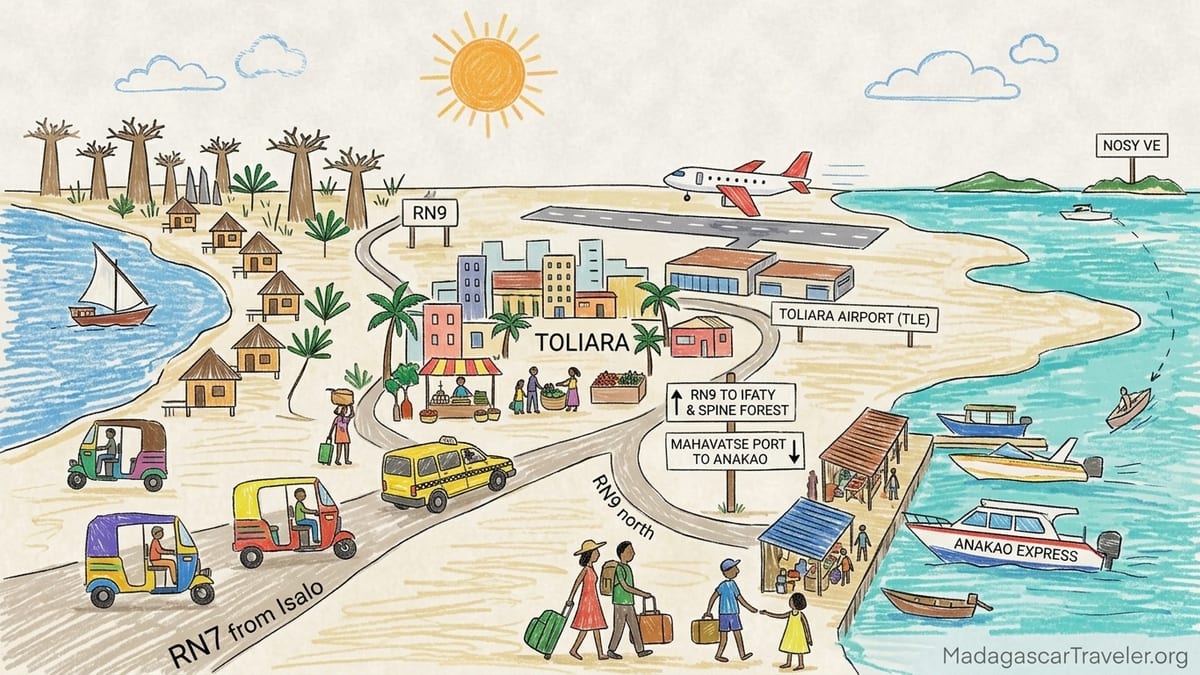
Understanding Toliara as a Hub, Not Just a Destination
Toliara, sometimes written Tuléar, is the main city in southwest Madagascar and the practical hinge between inland routes and three different coasts: the accessible beaches around Ifaty to the north, the wilder boat-access shores of Anakao and Nosy Ve to the south, and the remote tracks that continue on toward Salary Bay. The airport sits on the edge of town, close enough that you can reach most central hotels by car in roughly 15 to 25 minutes depending on traffic and road conditions. Once you factor in baggage, paying for a taxi and a quick check-in, you are usually looking at about one hour from plane door to hotel room if your luggage comes out promptly.
I split my time between a simple but functional guesthouse in central Toliara, a waterfront hotel within walking distance of the Mahavatse embarkation area where boats to Anakao depart, and a beach lodge in the Ifaty area reached by the RN9. That meant two nights in the city first, one night by the port before an early boat, and two nights up by Ifaty. This mix let me compare travel times in real conditions, test how early breakfasts really are before departures, and see how reliable Wi Fi and power felt in each zone.
It quickly became clear that Toliara is not a single “best base,” but a set of micro locations that work for different stages of a trip. The right choice for a one night transit after an evening flight is not the same as the best place to stay if you want to poke around markets and museums for a full day, or if you want to be first on the boat to Anakao. In practice, you often combine at least two bases over a week, and sometimes three if you are linking both Ifaty and Anakao.
Because roads, power and even boat schedules can shift with the season, I will give approximate timings and highlight where things may change. What does not change is the basic geography: the airport sitting just outside town, the city grid with restaurants and ATMs, the port and Mahavatse seafront where many boats leave, and the RN9 pointing north to the Ifaty and Mangily beaches. Thinking in terms of those four anchors is the key to choosing a smart base.
Staying in Central Toliara: Practical for Admin and Urban Exploring
My first two nights were in central Toliara, a few blocks back from one of the main avenues where you find banks, phone shops and casual restaurants. The taxi from the airport cost roughly the same as what official cooperatives now charge for city center rides in other Malagasy cities, and the journey took about 20 minutes in late afternoon traffic. From this base I could walk to several local eateries in under 10 minutes, and a small supermarket in around 5 minutes, which made it an easy place to restock cash and snacks at the end of RN7.
For a city focused stay, this area worked well. By tuk tuk or regular taxi, most restaurants I tried in the center were within about 5 to 15 minutes’ ride of my guesthouse, using side streets when the main road was crowded. Reaching the small museum and craft stalls took a similar amount of time, so nothing practical felt out of reach. What did require more planning was the port and Mahavatse seafront. In morning traffic it took just under 25 minutes from my central guesthouse to reach the embarkation point for boats to Anakao, and that included a short delay at one busy junction.
In terms of room practicalities, my central guesthouse offered air conditioning in some rooms and strong ceiling fans in others. Night time temperatures in Toliara can stay warm and the air can feel heavy, so if you are sensitive to heat and noise it is worth paying extra for AC and a room that does not face the street. Mosquito screens on the windows were fitted but not perfect, so I still used a plug in repellent and a treated net provided over the bed. Wi Fi was usable for messages and simple research but not consistent enough for video calls, and there were at least two short power cuts each day that lasted between 5 and 30 minutes. Staff had a generator that kicked in for lights and a few sockets, which meant charging cameras and phones was never a problem.
Breakfast in central Toliara hotels often does not start very early. At my guesthouse, the advertised 6:30 start was closer to 6:45 to 7:00, which is fine if you are wandering around town but tight for a 7:00 or 7:30 transfer. Hot water was reliable in the evenings, but one early morning shower was only lukewarm after a night of heavy use. Security felt low key but adequate, with a night guard at the gate, simple locks and a courtyard layout that makes it hard for non guests to wander in unnoticed. Staff could readily call trusted taxi drivers and had numbers for operators running day trips to the Arboretum d’Antsokay and further inland parks, which is one reason a central base can make sense at the start of a longer route.
Near the Waterfront and Port: Best Launchpad for Anakao and Nosy Ve
Before my boat trip to Anakao I shifted for one night to a mid range hotel closer to the waterfront, about 10 minutes’ walk and a shorter taxi hop from Mahavatse, where operators such as Anakao Express and Anakao Transfert base many of their departures. In the cool of early morning, it took me around 12 minutes to walk from my hotel to the check in point at a relaxed pace with a small backpack. For a heavier suitcase or if rain threatens, a quick tuk tuk or taxi ride from this zone to the pontoons adds another 5 to 10 minutes including the inevitable pause to negotiate the fare.
This waterfront stay completely changed the feel of my Anakao excursion. Instead of a pre dawn taxi across town and the anxiety of a traffic delay, I had a simple check out, a coffee by 6:00, and was standing at the boat office by 6:30 for a departure just after 7:00. The return was equally smooth: the speedboat from Anakao took around one hour to reach Toliara in moderate seas, and within 20 minutes of docking I was back at my hotel rinsing off salt water. If I had chosen to push straight to the airport, the drive from the seafront to the terminal would have taken roughly 20 to 25 minutes in the late morning.
Rooms in this area tend to catch more sea breeze but also more ambient noise from the port and seafront road. My room had air conditioning that struggled a bit in the hottest part of the afternoon, so the ceiling fan was still necessary. The mosquito situation felt similar to central Toliara, with a few insects finding their way in at dusk, so a proper net was indispensable. Wi Fi was a touch more stable here, perhaps thanks to a better router and fewer thick walls, and power cuts followed the same pattern: short, semi regular interruptions cushioned by a backup generator that the staff knew how to use.
Breakfast timing near the port seemed better tuned to boat schedules. The hotel was willing to serve a simple early breakfast from around 5:30 for guests heading to Anakao, and they prepared takeaway snacks the evening before on request. Staff here were particularly experienced at logistics, from booking boat tickets and confirming departure times to arranging transfers to the airport after a return from the islands. If your main purpose in Toliara is to reach Anakao or Nosy Ve efficiently, a base within a short ride or walk of Mahavatse is the most stress free option.
Airport Fringe and Outskirts: Functional for Late Arrivals and Early Flights
The area around Toliara Airport itself is not a classic tourist district, but it can make sense if your priority is a quick sleep after a late flight or an easy transfer before an early departure. The airport sits a short drive from town, and reaching a nearby motel like property on the fringe took around 10 to 15 minutes for friends I spoke with who had tested this option. Taxi fares from the terminal to such places tend to be similar to the base city fares that official taxi cooperatives apply in other Malagasy airports, with some room for negotiation, especially at night.
What you gain in speed you sometimes lose in atmosphere and choice. Around the airport you will find fewer independent restaurants and hardly any nightlife, so evening meals are often taken at the in house restaurant of your accommodation. For a quick transit that can be comfortable enough, but if you are staying more than one night or want to explore markets and seafront bars, you soon end up paying for taxis back and forth to the center, which takes around 20 minutes each way once you factor in waiting time.
Room practicalities on the outskirts are mixed. Some properties closer to the airport prioritise large car parks and simple, durable rooms over charm. That can be perfect for travelers arriving with a rented 4x4, because parking is usually secure and free, and there is space to repack bags or meet a driver. Air conditioning is often available because buildings here can be more exposed to sun, but check whether it runs on the generator during power cuts, since not all budget properties have the capacity to keep AC running when the grid drops.
For a one night airport stay I would aim for a place that explicitly offers 24 hour reception, early or flexible breakfast and airport shuttle or reliable taxi contacts. Security is usually focused on vehicle gates and simple perimeter walls. Staff are often used to handling late night check ins and arranging wake up calls, but they may be less geared toward arranging complex day trips or boat connections compared with central or seafront hotels. If your itinerary includes both an early flight and an early boat departure on different days, I would not try to base entirely near the airport. It is more efficient to switch: one night near the terminal, then one night closer to Mahavatse.
Using Toliara as a Launch Point for Ifaty and the RN9
North of Toliara, the RN9 heads toward the coastal villages and beach lodges grouped under the name Ifaty and Mangily. The distance by road is roughly 25 to 30 kilometers depending on where exactly you stay, and on the current alignment of the partly improved road. Recent travelers and transport guides report driving times between about 30 minutes and one hour by car or taxi, depending on vehicle, road conditions and how often you slow down for villages and livestock along the route. These figures matched my own experience on a mid morning drive in dry weather.
From a central Toliara guesthouse to a mid range lodge just back from the beach at Mangily, I spent just under 50 minutes door to door, including a short pause to pay a small local toll and a photo stop by the roadside. On the way back a few days later, leaving Ifaty around 8:30, we hit slightly heavier traffic near Toliara and took just over an hour to reach the city center. Direct transfers arranged by lodges can be more streamlined, but even then I would allow about an hour to travel between Toliara airport and most Ifaty area hotels under normal dry season conditions.
This means Toliara can either be a brief staging point or the true start of your beach time. Some travelers arrive on an early flight, meet a pre booked driver at the airport and head straight up the RN9, eating a late lunch with feet in the sand by early afternoon. Others, like me, prefer to spend a night or two in Toliara first, to recover from travel, pick up cash from city ATMs, finalise guides for inland parks and only then head to the coast. If you have any complicated errands, such as changing a large amount of currency, buying a local SIM card or meeting a private driver, the city base first approach is less stressful.
In Ifaty itself, room comforts are more about sea breeze and shade than heavy air conditioning, particularly in simpler beach bungalows. My lodge offered fans, mosquito nets and plenty of open windows with shutters, and I only needed AC briefly in the middle of the day. Wi Fi was present but weaker and more intermittent than in Toliara, and power cuts were slightly less frequent but sometimes longer. What you gain at the beach is of course peace, sand and quick access to coral reef excursions and the spiny forest, but you lose the quick access to the port and airport that Toliara offers. That is why many itineraries now suggest returning to Toliara for at least one night between Ifaty and Anakao or before an outbound flight.
When It Makes Sense to Sleep in Toliara Instead of the Beach
After testing different combinations of bases, certain patterns became clear. Staying in Toliara itself is smartest when you have multiple moving parts to line up in a short space of time. For example, if you land from Antananarivo in the late morning, need to buy or confirm your ticket for a boat to Anakao, pick up cash and possibly meet a driver for a later road trip, central Toliara solves all of that in one or two walks and a few short taxi rides. If you tried to do the same while based in Ifaty, you would be adding at least an extra hour or two of driving to every errand.
I also found that the night before a very early boat is much calmer in Toliara than on the beach, at least when the boat leaves from the city. Boats to Anakao tend to go early in the morning, and operators ask guests to check in in town well before departure. From a seafront or central hotel in Toliara, you can be at the office or embarkation point in 10 to 25 minutes. From Ifaty, you would need to leave at dawn, hope the road is in good condition and still have a margin for any delays. That is not how most people want to start a supposedly relaxing beach extension.
Toliara also makes sense if you are planning a series of day trips that head in different directions. The Arboretum d’Antsokay, Zombitse National Park, and the first stretches of the RN7 back toward Isalo all use different road exits or tracks. From a city base you can meet drivers easily, leave early, and return in time for a proper dinner at one of the restaurants in town. A beach base works for excursions that run almost entirely up or down the coast, but it is less efficient for inland parks that already involve significant driving.
Finally, there is pure risk management. Flights in Madagascar can be rescheduled, roads can degrade after heavy rain, and boat departures may shift with sea conditions. Sleeping in Toliara the night before an onward domestic flight gives you a buffer against delays from Ifaty or Anakao. In my case, adding one extra night in the city before flying out of Toliara saved a connection when sea conditions pushed my boat back from Anakao by almost an hour. Because my hotel was only 20 minutes from the airport, we still made the flight comfortably.
When a City Base Becomes Unnecessary
On the other hand, there are scenarios where a stay in Toliara is nice but not essential. If your only goal is a week of sand and sea at a single beach base in Ifaty or Anakao, and your flight into Toliara lands reasonably early in the morning, you could head straight out. For Ifaty this means arranging a private transfer or taxi in advance and expecting about an hour on the RN9 before checking into your lodge. For Anakao it means coordinating a boat that matches your flight arrival time or, more commonly, planning your flight a day earlier and accepting one short overnight in Toliara near the waterfront.
The other time a full city stay becomes less necessary is at the very end of a slow road trip that already includes several inland towns. If you have come down RN7 with overnights in places like Isalo and perhaps Ranohira, and you are now simply ready to stop moving, it can be more rewarding to spend those final three or four nights entirely at the coast. In that case, you treat Toliara more as a junction than a destination: you drive in, pick up cash and fuel, maybe have lunch, then continue directly to Ifaty or the port for an Anakao boat, only returning to the city if your outbound flight time demands it.
My own sense, after walking and driving through different quarters, is that Toliara is more enjoyable as a short, practical pause than as a long slow city break. It lacks the layered historic quarters of larger Malagasy cities, and much of its energy is tied to port traffic, markets and transit. Two or three nights is usually enough to eat well, visit the key urban sights, and organise logistics. Anything beyond that, unless you have business in town, is better spent by the lagoon or under the spiny forest trees.
In all of this, remember that road and sea conditions in southwest Madagascar can vary with season, storms and maintenance. Bridges can be damaged in cyclones, and local drivers often report longer travel times than what mapping apps suggest. Planning your bases with healthy margins and accepting one or two short, functional stays in Toliara can save you missed connections later. If in doubt, stay in or close to the city the night before any critical flight or boat departure.
The Takeaway
After five nights split between central Toliara, the waterfront and the beaches to the north, I would think of the region in terms of bases that match trip stages, rather than specific hotel names. For a one night transit stay linked to a flight, I would choose a simple, reliable hotel either in central Toliara with good taxi access or on the airport fringe if my arrival or departure was very late or very early. The key features would be working air conditioning, a generator for at least basic power during cuts, early or flexible breakfast and staff who can organise a taxi on demand. Being able to reach the terminal in about 15 to 20 minutes matters more than a sea view for that kind of night.
For a city focused visit of two or three nights, aimed at exploring markets, eating out, arranging guides and visiting nearby attractions like the arboretum, I would base myself in central Toliara again. Walking access to restaurants and shops, shorter taxi rides in different directions, and a slightly more lived in neighbourhood feel all help. I would pay for AC, check that rooms have proper mosquito nets and accept that Wi Fi will be functional rather than fast. Parking inside a courtyard would be a bonus if I were meeting a rental car or long distance driver.
If the goal is a beach extension around Ifaty, with snorkeling trips by boat, visits to the spiny forest and a generally slower rhythm, I would move out of Toliara as soon as my city errands were complete. For most people that means one or two nights in town to recover from flights and organise logistics, then three or more nights entirely based at the beach. I would only break that pattern if a flight schedule or road issue forced me to sleep in Toliara again on the way back. The one place I would not stay for a beach holiday is in an isolated outskirts property between the city and the sea, because you get the long drives without the atmosphere of either.
For a wider southwest road trip that links inland parks, Ifaty and Anakao, the strategy I would repeat is a triangle of bases. I would start with one or two nights in central Toliara to gather everything I need and meet my driver, then move to Ifaty for a beach break, return to a seafront hotel near Mahavatse for one night to line up an early boat, continue to Anakao, and finally sleep again in Toliara the night before flying out. In this pattern, Toliara appears at the start, middle and end, but always for short, sharply defined stays that keep connections realistic. Think of the city as your toolkit and switchboard, not your final goal, and you will appreciate its rough charm much more.
FAQ
Q1. Is it better to stay in Toliara or Ifaty right after arriving by plane
For an early or mid morning arrival with no urgent admin to handle, it can work to go directly to Ifaty, since the drive along the RN9 usually takes around 45 minutes to an hour. If your flight lands later, or you still need to organise cash, drivers or boat tickets, a first night in Toliara is safer and less rushed.
Q2. How long does it take to get from central Toliara to the port for boats to Anakao
From most central guesthouses and hotels, allow around 20 to 25 minutes by taxi to reach the Mahavatse seafront embarkation area in normal morning traffic. From hotels closer to the waterfront, walking can take about 10 to 15 minutes, or 5 to 10 minutes by tuk tuk or taxi.
Q3. Can I go straight from the airport to a boat for Anakao on the same day
In theory yes, if your flight lands very early and the boat departure is slightly later than usual, but in practice sea and flight schedules do not always align. Most travelers prefer to spend at least one night in Toliara near the waterfront, confirm their boat time in person, and then travel to Anakao the following morning.
Q4. Are there reliable ATMs and phone shops in Ifaty, or should I do everything in Toliara
There are a few basic services around Ifaty and Mangily, but the most reliable ATMs, currency exchange options and mobile phone shops are concentrated in Toliara. It is wise to withdraw cash, buy or adjust your SIM card, and settle any major payments while you are still in the city.
Q5. How bad are power cuts in Toliara compared with the beach areas
Short power cuts are common in both Toliara and the coastal villages. In the city, many mid range hotels have generators that cover lights and key sockets, while on the beach some lodges rely more on solar systems and ask guests to charge devices at specific times. Wherever you stay, bring a power bank and ask how the property handles outages.
Q6. Do I really need air conditioning, or are fans and sea breeze enough
In central and waterfront Toliara, air conditioning makes sleep more comfortable during hot and humid nights, especially in rooms facing busy streets. In Ifaty and Anakao, many travelers are happy with fans, mosquito nets and sea breeze, although AC is still worth paying for if you are heat sensitive or visiting in the warmest months.
Q7. Is parking easy if I have a hired 4x4 or driver
Many city guesthouses and mid range hotels in Toliara offer secure courtyard parking included in the room rate, and airport fringe properties often have even more space for vehicles. At beach lodges, parking is usually possible inside the compound or just outside the gate, and staff are used to coordinating overnight stays for vehicles and drivers.
Q8. How early can I get breakfast before a flight or boat
City hotels in Toliara often start breakfast around 6:30 or 7:00, but many are willing to prepare something simpler earlier if asked the day before. Properties near the port are used to Anakao departures and may offer coffee and a light bite from around 5:30. At the airport, options are limited, so eating at your hotel is usually more reliable.
Q9. Are staff in Toliara hotels able to arrange trustworthy drivers and guides
In my experience, reception staff at central and seafront hotels keep contact lists for regular taxi drivers, longer distance drivers with 4x4s and licensed guides for nearby parks. They can usually arrange a car within an hour or two for city rides, and with more notice for day trips along RN7 or RN9.
Q10. If I have only one night in the region, where should I stay
If you are simply in transit and flying in or out of Toliara, a central or airport fringe hotel is most practical. If your flight schedule and transport allow, and your priority is the sea, it can be more satisfying to go straight to Ifaty and spend that one night by the beach, then return to Toliara only long enough to catch your onward flight.