


The first thing that hit me in Toliara was the air. It was not the heavy, humid coastal air I had braced for, but a hot, dry blast that smelled of dust, salt and diesel. After a week tracing Madagascar’s RN7 from Antananarivo through Isalo, my driver eased our tired 4x4 past a sun-faded "Toliara" sign and into streets that felt immediately different from the green highlands and sandstone canyons I had just left behind. I had planned only one night here before continuing to the beaches of Ifaty and Anakao. Instead, I found a city that worked its way under my skin and deserved more than the quick stop most itineraries give it.
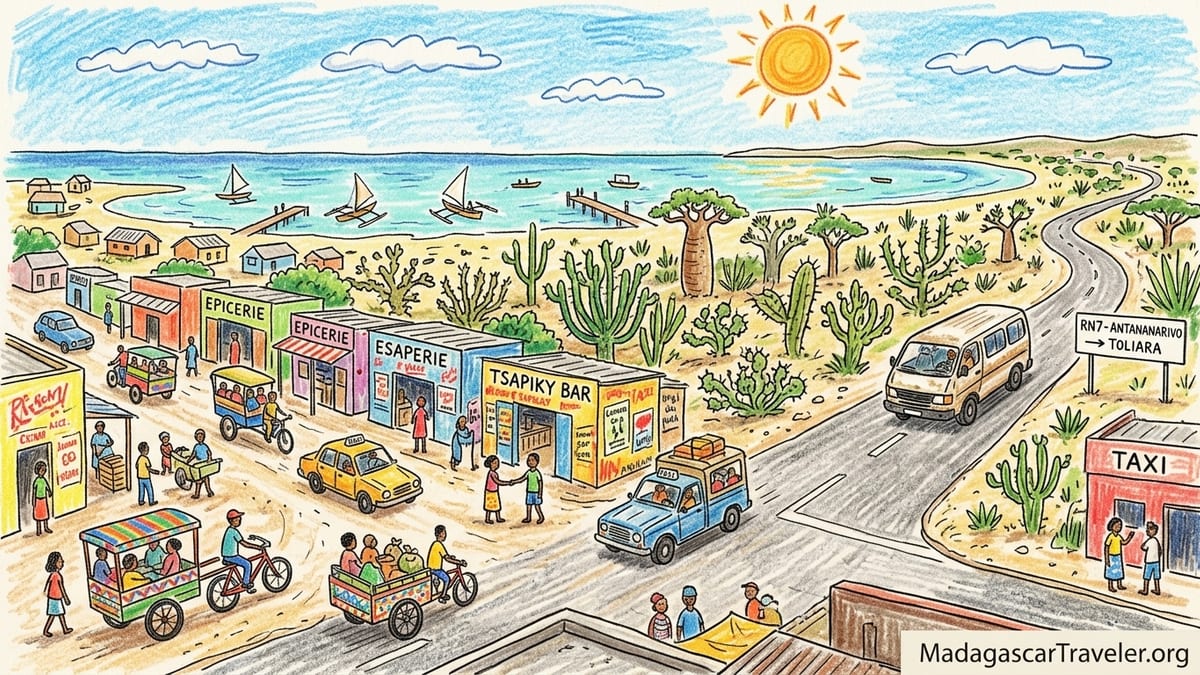
Arriving in Toliara: End of the Road, Beginning of a Different Madagascar
I arrived in Toliara at the end of the RN7, the 900-plus kilometre asphalt spine that runs from Antananarivo to Madagascar’s southwest coast. We had left Ranohira, the village near Isalo National Park, early in the morning, expecting a straightforward seven-hour drive. Road works and slow truck convoys stretched it closer to nine. By the time we rolled into Toliara in late afternoon, my expectations were fuzzy: I imagined a sleepy port where most people would immediately escape to the beaches. Instead, I saw a low, sprawling city humming in the heat, its streets filled with pousse-pousse carts, battered taxis and music spilling from bars long before sunset.
Many travelers will meet Toliara by air rather than overland. As of late 2026, Madagascar Airlines runs regular non-stop flights between Antananarivo (TNR) and Toliara Airport (TLE), typically taking about one hour and forty-five minutes on turboprop aircraft. The airport sits roughly 7 to 10 kilometres southeast of the city centre, and the transfer by taxi usually takes around 20 minutes depending on traffic. Several hotels can arrange pick-ups, and informal airport taxis wait outside the tiny terminal for arriving passengers. The airport is functional rather than pretty, but if you have come down the long RN7 by road, it feels almost luxurious.
I booked three nights in Toliara, which already made me an outlier compared with most people I met on the road. My original plan was simple: use the first afternoon to recover from the RN7, take a boat to Anakao for an overnight stay, then transfer to Ifaty for a couple more days on the beach before flying back to the capital. I had a private driver for the RN7 stretch, but in Toliara I switched to walking, pousse-pousse and the occasional taxi. That switch, along with my decision not to rush immediately to the lagoons, is what let the city itself start to make sense.
Expectation-wise, I had pictured Toliara as a dusty transit hub where I would worry mostly about timetables, boat departures and checking my onward ticket. The reality was messier and more interesting. What I found was a hot, gritty, genuinely Malagasy city that tied together the semi-arid southwest, the Mozambique Channel and the national road system in a way no brochure had prepared me for.
First Impressions: Heat, Dust and Tsapiky in the Streets
The heat in Toliara is not a side note; it shapes everything. By late October, when I visited, afternoon temperatures in the city regularly reached the mid-30s Celsius. The air felt drier than anywhere else I had been in Madagascar, and the wind carried fine red dust that settled on my backpack within minutes. Walking from my guesthouse toward the centre just after midday was my first mistake. The streets shimmered; shade was patchy; even locals hugged the narrow shadows of walls and awnings. I had underestimated how draining that dry coastal heat could be coming straight from the relatively cooler plateau.
That same heat and dust give Toliara its particular look. Many of the streets are wide and unpaved, churned to powder by passing taxis and zebu carts. Low, concrete shopfronts painted in fading Telma and Orange phone ads line the main arteries, while side streets are a mix of corrugated metal kiosks, wooden stalls and houses behind high walls. The light is harsh in the middle of the day, then turns honey-coloured in the late afternoon, when the city seems to relax and people emerge from deeper shade.
My first evening, tsapiky music became the soundtrack that anchored Toliara to my memory. This fast, guitar-driven style from the southwest pours out of bars, mobile speakers and sometimes just a scratchy radio on the sidewalk. I followed one particularly hypnotic riff to a small bar on a corner where plastic chairs spilled out onto the sandy pavement. Inside, the air smelled of Three Horses Beer, fried snacks and sweat. A live band took over from the recorded tracks around 9 p.m., and suddenly the place was packed with couples and groups of friends dancing with a joyful intensity that felt at odds with the sleepy reputation Toliara sometimes has among foreigners.
That first night taught me one of Toliara’s quiet truths: whatever else it may be, it is very much a living city. People come to work, study, ship cargo, shop, dance and drink, not just to pass through for a beach transfer. You can feel that in the soundscape alone, from the calls of pousse-pousse drivers to the low thud of tsapiky basslines rolling down the streets long after sunset.
Getting Around: Pousse-Pousse, Taxis and the Rhythm of Traffic
Traffic in Toliara has its own tempo. Compared with Antananarivo, it is less choked but still chaotic at times, particularly around the central market streets and the taxi-brousse stations. The dominant vehicles are old Renault and Toyota taxis, mid-sized trucks carrying goods from the port, motorbikes and an army of human-powered pousse-pousse. These hand-pulled or cycle-powered carts, painted in bright colours with religious slogans or football logos, are both practical transport and a window into the city’s micro-economy.
For short hops within the city, pousse-pousse are cheap and omnipresent. I used them to get from my guesthouse to the market and from the market to the university area, where several cafes and snack bars cluster around students from the local institutes. Fares are negotiable and vary with distance, time of day and your language skills. I found it useful to ask my hotel staff for a baseline price, then agree clearly with the driver before climbing in. A short ride across central Toliara might cost only a small amount in ariary, while longer trips to outlying neighbourhoods or the northern taxi-brousse station are more.
Regular taxis are more comfortable for longer distances, such as between the city centre and Toliara Airport or the port embarkation point for Anakao. The airport is close enough that fares remain reasonable, especially if you arrange a price in advance through your hotel or a trusted driver. Around the port, traffic becomes a slow shuffle of trucks, bicycles and pedestrians navigating around piles of cargo, fish crates and the odd goat. It is here, more than anywhere, that Toliara’s role as a working port becomes visible.
My mistake was assuming that I could rely entirely on walking. On paper, central Toliara is compact. In practice, the combination of heat, dust and minimal shade makes even a 20-minute walk at midday feel punishing. After one overheated stumble from my accommodation to a restaurant that looked “close” on the map, I started factoring in pousse-pousse or taxis for anything beyond a few blocks between about 10 a.m. and 4 p.m. Planning your day around early mornings, late afternoons and after-dark strolls is much more pleasant.
Markets, Museums and Everyday Culture in Toliara
The main reason to spend at least a full day in Toliara is not a single blockbuster attraction but the cumulative effect of its markets, institutions and street life. The city’s principal markets fan out across several blocks of stalls selling everything from sacks of rice and cassava to second-hand clothes, mobile phone accessories and vivid plastic buckets. Fish markets closer to the shore add another layer, with rows of small pelagic fish, octopus and larger species laid out on tables, attended by vendors calling out prices in rapid-fire Malagasy and French.
One morning, I watched as Vezo fishermen unloaded narrow pirogues, their lateen sails folded against masts, and carried woven baskets full of their catch through a maze of puddles and potholes to waiting buyers. Women in bright lamba wraps haggled intently; children threaded through the crowd carrying smaller trays of fried fish to sell as snacks. The smell was a mix of sea, fish and charcoal smoke. It was not prettified for visitors, but it was the best place I found to understand how the port and the surrounding coastal communities feed into the city.
For a glimpse of the region’s history and natural environment, the Rabesandratana Museum is an often-overlooked stop in Toliara. Run in connection with the city’s marine and fisheries institutes, it focuses on archaeology, ethnology and marine sciences relevant to the southwest. Exhibits include traditional fishing gear, models of local pirogues, and displays on the unique spiny forest ecosystem that surrounds the city. Opening hours can change, and access is sometimes limited during academic breaks or maintenance periods, so it is worth asking locally or through your accommodation before you go. When I visited, entry was paid in cash at a small desk by the door, and a staff member walked with me through several of the rooms, pointing out items linked to the Vezo and Masikoro communities.
In the late afternoon, I often gravitated to the streets around the university and certain central avenues where small bars, kiosks and street food stands cluster. Here you find grilled brochettes, samosas, banana fritters and mofo gasy, along with stalls selling mobile data top-ups and SIM cards for local networks. This everyday commercial bustle reminded me that Toliara is also a student city and a regional administrative centre, not just a tourist gateway.
Eating, Sleeping and the Lesson of Location
On my first night, tired from the RN7 drive, I was relieved to drop my bags at a mid-range hotel on a relatively quiet residential street. The room was clean, the courtyard had a few frangipani trees, and the desk staff could arrange taxis and confirm boat times. What I had not fully appreciated when I booked was how far it sat from most of the city’s restaurants and evening activity. On the map, the distance looked small. In reality, I found myself either walking 25 minutes in the dark or negotiating taxis and pousse-pousse after every dinner.
This became my second big practical mistake. In Toliara, unless you plan to self-cater or eat only at your hotel, it is worth paying attention to walking distances and the character of the surrounding streets after dark. Several restaurants serving seafood, zebu steaks and pizza cluster closer to the main thoroughfares and the seafront. Staying within a short, well-lit walk of at least a couple of these made later evenings feel more relaxed when I changed hotels for my third night. The food itself was one of Toliara’s highlights: grilled fish caught that morning, rougail sauces, and large plates of rice served alongside cold bottles of THB or fresh fruit juice.
Accommodation in Toliara covers a wide range, from basic guesthouses aimed at locals and long-term volunteers to more polished hotels that cater to tour groups arriving by air. Prices reflect this spread, with simple rooms starting at modest amounts and mid-range properties charging more, particularly if they have a pool or reliable backup power for frequent outages. In most cases, you will pay in cash, sometimes in advance. Which brings me to the cash problem.
I arrived in Toliara on a public holiday weekend with just enough Madagascan ariary for one night’s lodging and a meal, assuming I would top up at an ATM in town. Several machines in the centre were either out of cash or temporarily offline. By the time I found a working ATM, the queue stretched down the street. It eventually dispensed money, but the experience taught me not to cut it so fine. While Toliara does have functioning ATMs from major banks, outages are common enough that carrying a buffer of cash from Antananarivo, Fianarantsoa or Toliara Airport is a wise precaution.
Toliara as a Transport Hub: RN7, Taxi-Brousse and the Sea
On the map, Toliara sits like a hinge at the end of Madagascar’s RN7 and the beginning of a coastal network of roads and boat routes. Overland, the city marks the southern terminus of the country’s best-known road trip. The RN7 is paved all the way from Antananarivo to Toliara and passes through Antsirabe, Ambositra, Fianarantsoa, Ambalavao, Ihosy and Sakaraha. That road is the spine of many itineraries, and you feel the cumulative wear of trucks, taxi-brousse and private cars in Toliara’s taxi-brousse yards, where vehicles wait in dusty lots for their next trip back inland.
If you travel by taxi-brousse, you will probably arrive or depart through these stations. Companies running the route between Toliara and Antananarivo, or shorter legs like Toliara to Ranohira (for Isalo National Park), generally leave in the morning, often once enough passengers have filled the seats. One fellow traveler I met who had come down by taxi-brousse described a 22-hour run from the capital with brief food and toilet stops and a dawn arrival in Toliara. Comfort is basic, but the cost is significantly lower than a domestic flight. Services change over time, so checking current departure patterns when you arrive is important.
On the air side, domestic services have gone through several branding changes, passing from Air Madagascar to Tsaradia and now operating under Madagascar Airlines. At the time of writing, there are multiple weekly flights linking Antananarivo and Toliara, usually in the morning. Schedules and reliability can fluctuate, with some travelers reporting delays or last-minute changes. Booking a flexible day on either side of a domestic flight, especially if you have an international connection, remains prudent. Buying tickets through reputable agents in Antananarivo or online in advance gives more security than hoping for a last-minute fare at the airport.
The real magic of Toliara’s position, however, is at sea level. The city is the main jumping-off point for boats to Anakao, a Vezo fishing village turned small resort area about an hour away by speedboat, and to the bird-rich islet of Nosy Ve beyond. Several operators and hotels run regular morning departures from the small port south of central Toliara. Fast speedboats take roughly an hour to reach Anakao in calm seas, sometimes longer in rougher conditions. Shared transfers bookable through accommodation in Anakao commonly cost the equivalent of around twenty to thirty-five US dollars per person one way, paid in local currency at prevailing rates. Departures are usually scheduled between about 7 a.m. and 9 a.m. to take advantage of calmer water and lighter winds.
Ifaty and Mangily, the beach villages north of Toliara known for their reef and sunsets, are easier to reach overland via the paved RN9. You can arrange a private car transfer through hotels or local agencies in Toliara, or negotiate a place in shared taxis that run the route. Travel times vary with roadworks and weather, but the drive typically takes around 90 minutes to two hours. This is where Toliara’s status as a transport hub becomes sharply clear. In a single day, you might see tourists loading surfboards and dive gear onto Anakao-bound boats, volunteers waiting for a pick-up to Ifaty, and locals bargaining for seats in taxi-brousse headed back inland along the RN7.
Urban Grit vs Semi-Arid Wilderness: Toliara’s Surroundings
Step just beyond the built-up grid of Toliara, and the city gives way quickly to a semi-arid landscape of scrub, baobabs and the iconic spiny forest of Madagascar’s southwest. From a rooftop terrace, you can sometimes see that contrast at a glance: a low sprawl of concrete roofs ending in flat land dotted with thorny didierea plants and Euphorbia, under an enormous sky.
One of the easiest ways to experience this natural transition without leaving Toliara far behind is to visit the Antsokay Arboretum, located a short drive south of the city along the main road. Created to protect and showcase the unique flora of the southwest, it offers guided walks through well-maintained paths lined with endemic succulents, spiny forest species and medicinal plants. Several tours include explanations of how local communities use these plants and how fragile the surrounding ecosystems are under pressure from firewood cutting and climate shifts. Getting there typically involves arranging a taxi or private car, and, as with many activities, it is wise to confirm current opening hours locally since they can change with staffing and the season.
Other nearby excursions, often arranged from Toliara, include day or overnight trips to Saint-Augustin at the mouth of the Onilahy River, which combines mangroves, dunes and fishing villages, and to offshore reefs for diving and snorkelling. While many visitors choose to base themselves in Ifaty or Anakao for these marine experiences, Toliara remains the logistical heart. Dive shops and tour agencies often keep their offices here, and boats require coordination through the city’s port and supply chains.
What struck me was how different the feeling of the surrounding countryside was compared with the more densely settled plateau. The air grew even drier, the vegetation lower and more spiky, and the villages more spread out. Coming back into Toliara after a morning in the spiny forest, the city’s dust, traffic and noise suddenly felt almost urban in the global sense, rather than just another Malagasy town. That contrast between gritty port and stark semi-desert landscape is one of the reasons I now recommend giving the city at least two nights rather than treating it as a mere transfer point.
Mistakes, Surprises and What I Would Do Differently
In travel planning, Toliara often appears as a comma between better-known names: “Isalo, Toliara, Ifaty, Anakao.” Spending time in the city itself exposed several mistakes in how I had approached that comma, and those missteps are worth sharing because they are easy to replicate.
The first was timing coastal excursions too tightly after arrival. On my original schedule, I intended to reach Toliara by late afternoon, sleep one night, then catch an early morning speedboat to Anakao. Any delay on the RN7, a late check-in, or difficulty finding cash and confirming my boat would have made that plan stressful at best and impossible at worst. I watched another traveler arrive on an afternoon flight from Antananarivo and attempt the same thing in reverse, trying to squeeze a boat back from Anakao, a taxi across town and a check-in for an afternoon flight into one day. Any hiccup would have cascaded. Next time, I would build in at least one full buffer day in Toliara before or after any boat-based plans.
The second mistake, as mentioned, was arriving short on cash and trusting ATMs to behave. Between boats, taxis, tips, market snacks and entrance fees for smaller attractions like the Rabesandratana Museum, cash disappears faster than you expect. Card acceptance is expanding slowly but remains patchy, especially for local-owned establishments, taxi-brousse tickets and port-related fees. I now aim to arrive in Toliara with enough ariary to cover at least two or three days of expenses without needing an ATM.
The third was underestimating the midday heat and overestimating how walkable my accommodation choice would feel under a merciless sun. Even if distances are not huge, radiant heat from asphalt and dust from unpaved sections make long midday walks uncomfortable. I would either choose lodging closer to my preferred restaurants and evening areas or accept from the start that I will be using pousse-pousse and taxis throughout the day. Sun protection and hydration are not optional here.
Finally, I packed too many ambitions into too short a stay. My notebook sketches show bold arrows to Antsokay Arboretum, Ifaty, Anakao, Saint-Augustin and a half-dozen markets and music bars, all over three nights. In reality, each of those coastal destinations merits at least an overnight stay, and simply absorbing Toliara’s rhythms takes time. If I were planning again, I would either commit to exploring Toliara for two or three full days before choosing one coastal base, or I would accept that the city would be a brief, functional stop and not pretend otherwise. Trying to do both led to unnecessary rushing.
The Takeaway
So, does Toliara deserve more than a night as a transport hub? For me, the answer is yes, provided you are curious about Madagascar beyond its postcard beaches and national parks. Toliara is not conventionally beautiful. Its streets can be dusty, its infrastructure stretched, its heat unforgiving. Yet within that framework it holds a dense concentration of what makes the southwest distinct: tsapiky music rolling through open-air bars, fishermen landing pirogues at dawn, students and traders crowding markets, and the immediate transition from urban grit to spiny forest just beyond the last houses.
Official tourism material increasingly frames Toliara as both a cultural stop and the practical base for the southwest’s beaches, lagoons and dry-land nature. That dual identity matches what I experienced on the ground. The city is where you negotiate boat departures for Anakao and Nosy Ve, arrange vehicles for Ifaty and Antsokay, stock up on supplies before a long taxi-brousse ride, and, if you allow yourself the time, watch a band play tsapiky late into the night.
If you are traveling the RN7, I would recommend at least two nights in Toliara, with one day dedicated to the city itself and another used for a nearby excursion such as Antsokay Arboretum. If your focus is beaches, you could still benefit from a night here to settle logistics and get a first taste of the southwest before continuing to Ifaty or Anakao. Whatever your plan, treat Toliara as a destination enough to be curious: walk its markets in the early morning, listen for music after dark, talk to pousse-pousse drivers, and watch the city breathe between land and sea.
FAQ
Q1. How many nights should I spend in Toliara itself?
For most itineraries, two nights works well: one full day to explore the city and another to organize or enjoy a nearby excursion such as Antsokay Arboretum, Ifaty or boat logistics for Anakao.
Q2. Is it better to reach Toliara by road along RN7 or by air?
Both options have advantages. The RN7 road trip offers varied landscapes and towns but takes several days, while flights with Madagascar Airlines from Antananarivo to Toliara take under two hours and save significant time if your schedule is tight.
Q3. How reliable are domestic flights between Antananarivo and Toliara?
Flight frequencies and reliability have improved in recent years but delays and schedule changes still occur. It is wise to leave at least one buffer day before any long-haul international flights and to monitor updates from Madagascar Airlines or your booking agent.
Q4. What are the main local transport options inside Toliara?
Within the city, you will mostly use pousse-pousse carts for short trips and regular taxis for longer distances such as the airport, port or northern taxi-brousse station. Walking is possible but can be uncomfortable during the midday heat.
Q5. How do I arrange boats from Toliara to Anakao?
Most travelers book speedboat transfers through their accommodation in Anakao, which works with established operators using the small port area south of central Toliara. Boats generally leave in the morning, and payment is usually in cash in ariary.
Q6. Are there ATMs and card payments available in Toliara?
Toliara has several ATMs operated by major Malagasy banks, but they occasionally run out of cash or go offline. Card acceptance exists in some hotels and larger restaurants, yet cash is essential for taxis, markets, smaller eateries and many excursion payments.
Q7. Is Toliara safe to walk around, especially at night?
Like many cities, Toliara is generally manageable if you use basic precautions: avoid poorly lit back streets after dark, keep valuables out of sight, and use taxis or pousse-pousse for longer night-time distances. Asking hotel staff about current local advice is sensible.
Q8. What is the best time of day to explore the city on foot?
Early morning and late afternoon are most comfortable for walking, visiting markets and taking photos. Midday hours can be very hot and dusty, so it is better to rest, eat, or use motorized transport during that period.
Q9. Besides beaches, what nearby attractions are worth visiting from Toliara?
Antsokay Arboretum, just south of the city, is an excellent introduction to the spiny forest and endemic flora of the region. Trips to Saint-Augustin, inland rock formations and various community-led visits can also be organized through local agencies.
Q10. Can I organize onward taxi-brousse travel from Toliara without a tour?
Yes, you can buy tickets directly at the taxi-brousse stations for destinations such as Ranohira, Fianarantsoa or Antananarivo. Departures are usually in the morning, and vehicles often wait to fill before leaving, so going early and confirming details the day before is helpful.