


My first time in Toliara, I tried to make the southwest coast do too much in too little time. I arrived on an afternoon flight from Antananarivo, spent three nights in town, and attempted to squeeze in the Arboretum d’Antsokay, a city wander, a quick half-day look at the mangroves, and a scouting drive toward Ifaty. It was just enough to sense the region’s rhythm, but not enough to truly rest after the long RN7 or to commit to a proper coastal or park experience. Some moments felt perfect, like a cool early morning in the arboretum. Others were clearly rushed, such as a midday museum visit when the streets shimmered in the heat and everyone sensibly retreated indoors. That stay became my reference point for what 2, 3 or 5 days in and around Toliara realistically allow after you have either driven the RN7 or landed here by air.
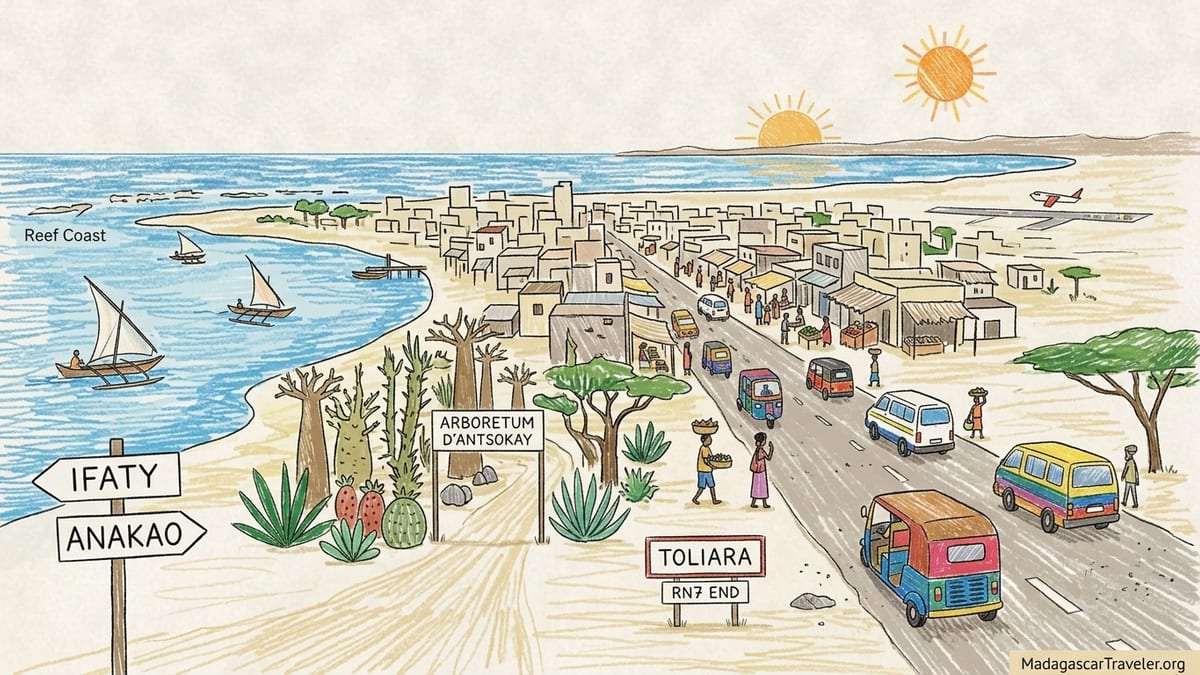
Understanding Toliara at the End of the RN7
Toliara, also written Tuléar, is the southwest terminus of Madagascar’s RN7, roughly 950 to 980 kilometers from Antananarivo depending on which guide you consult. After a week or more of lava plateaus, rice terraces, and Isalo’s sandstone canyons, reaching this dusty port city feels like arriving at the end of a story and the beginning of another. For many travelers, Toliara is either the place where the RN7 road trip finishes and a flight home begins, or the city where they land before transferring straight to nearby beaches like Ifaty or Anakao.
On the ground, Toliara itself is not a polished resort town. It is a working coastal city with tuk-tuks, cargo trucks, and market stalls under ragged sunshades. There is a modest beachfront, a small central museum, and the excellent Arboretum d’Antsokay about 12 kilometers out of town. The atmosphere is relaxed but practical. You feel that this is a hub for people moving onward to the reef coast north of town, the Vezo fishing villages across the bay, or the more remote south toward Tsimanampetsotsa and beyond.
The big planning challenge is that almost everything memorable outside Toliara happens on a different schedule from your flight or long-distance taxi-brousse. Boat transfers to Anakao usually run in the morning when seas are calmer. The arboretum and nature reserves are more comfortable early or late in the day before the sun becomes harsh. Museums and offices keep conventional daytime hours. Road journeys to satellite areas are slow, and the midday heat can make even a short walk feel draining. The question is less “What is there to do?” and more “How many transitions and transfers can you handle after a demanding RN7?”
My own three-night stay in Toliara, without heading to Ifaty or Anakao, taught me that while the city deserves more than an overnight crash, it is also not where you want to stack a full checklist of coastal experiences. That is where the 2, 3 and 5 day scenarios become useful frames rather than rigid itineraries.
What Two Days in Toliara Really Allow
Two calendar days, often one or two nights, is what many travelers accidentally end up with in Toliara. You arrive late afternoon off the RN7 or on an Air Madagascar or Tsaradia flight, spend a night, then have a partial day before your onward flight or boat. Think of this window as time to decompress, handle practicalities, and add one or two well-chosen experiences rather than racing off to every nearby highlight.
If your priority is simply recovering from the RN7 and positioning yourself for a beach finale, day one is mostly about arrival. You meet your driver at the bus station or airport, check into a city hotel near the center, and perhaps walk to the seafront as the sun drops. A basic but decent room in Toliara often falls somewhere in a wide band roughly between the cost of a simple guesthouse inland and the higher rates you will pay at sea-view lodges in Ifaty or Anakao. You notice how the air feels heavier and saltier than in Isalo, and how quickly the light fades after about 5:30 or 6 p.m., depending on season.
With one full day, you realistically have time for two substantial outings if you respect the heat. A popular pattern is to start early with breakfast at your hotel, then take a taxi out to the Arboretum d’Antsokay as soon as it opens. Local agencies and guides often recommend arriving around 7:30 or 8 a.m. when the spiny forest plants, baobabs, and succulents catch soft light and the temperature is still reasonable. You can spend two hours walking shaded paths with a guide who explains which species are endemic and which have medicinal uses, then retreat to the on-site café for a cold drink before the sun becomes fierce around late morning.
Back in town by late morning or lunchtime, the day divides naturally. Between roughly 11 a.m. and 3 p.m., the streets can feel oppressively hot, especially in the austral summer from around November to March. This is the time to retreat indoors: an air-conditioned room, a quiet restaurant, or the city’s modest museum where you can browse exhibits on Vezo culture, local history, and marine life. After 3 or 4 p.m. the light softens again, and you might take a short tuk-tuk loop through the market area or down to the seafront, but you will not want to start a long excursion at this hour if you have an early departure the next day.
What two days do not comfortably allow is a serious day trip to either Ifaty or Anakao while also coordinating flights or buses. Yes, Ifaty is only about 25 to 30 kilometers north along a road that is now partly paved, and drivers talk about one hour by car in fair conditions. But a return trip still means arranging a vehicle, dealing with checkpoints and roadworks, and spending much of the cooler morning in transit rather than walking the beach. Anakao is more demanding. Boat transfers usually depart mid-morning from the embarkation point south of town and return earlier in the afternoon when seas are calmer. Trying to fit Anakao into a single spare day in Toliara, sandwiched between travel days, means you experience it mostly as a timetable rather than a place. With only two days, Toliara itself, the arboretum, and your onward logistics deserve to come first.
Three Days: Adding Coast or Culture Without Overstretching
Three days, whether that is two or three nights, is where your Toliara stay stops feeling like a transit stop and starts to resemble a small chapter of your trip. You can keep one full day focused on the city and arboretum, then add either a relaxed coastal experience or a deeper cultural look without everything collapsing into heat and hurry.
One approach is to stay in Toliara all three nights but dedicate your second day to a partial coastal foray. For instance, you might arrange an early departure for Ifaty or Mangily, about 27 to 30 kilometers north. A private car or organized transfer can whisk you there in roughly an hour or a bit more, depending on current road conditions, which local operators describe as mostly paved with some rougher sections after heavy rain. You arrive by around 9:30 a.m., find shade at a beachfront café, and then walk the sand or swim behind the reef. Snorkeling here often does not require a boat because the reef lies relatively close to shore; local pirogue owners will still offer rides further out or along the lagoon if you wish.
The key is to avoid treating this as a frantic “beach sampler.” If you want to be back in Toliara before dark, you probably leave Ifaty by about 3:30 or 4 p.m., which gives you a comfortable six hours on the coast. That is enough to swim, share a grilled fish lunch, and, if tides allow, hire a local guide for a short spiny forest walk in the Reniala Reserve near Mangily. It is not enough to explore multiple lodges, attempt a long reef snorkel and a forest loop, and still be back in Toliara in time to pack for a next-morning flight. In practice, most travelers will be happier choosing one primary focus for the day: either a lazy beach and swim day with a good lunch, or a half-day forest visit followed by a shorter swim.
The alternative three-day pattern is to keep everything urban and cultural. This suits travelers who might already have coastal time booked later in Ifaty, Anakao or even on a different island like Nosy Be. You can give yourself an easy first day of arrival and orientation, then a second day split between the arboretum in the morning and museums, markets and craft shops in the afternoon and early evening. A third day remains flexible in case of flight changes, vehicle issues, or the need to rearrange domestic tickets, which is not unusual in Madagascar. It is also a buffer for weather. If a rare coastal storm or high winds disrupt boat departures or make outdoor walking unpleasant, that extra day lets you shift plans without sacrificing your one chance to see the spiny forest or the lagoon.
With three days, Anakao starts to become thinkable, but only if you dedicate at least one night there. A common pattern is to spend your first night in Toliara, transfer by boat to Anakao on the second morning, spend that second night on the beach, and then either return by speedboat on the third morning to catch an afternoon flight, or stay longer and let Toliara recede into the background. What three days still cannot do well is a full Anakao experience plus Tsimanampetsotsa plus Ifaty while also retaining flexibility for travel snags. The southwest distances and timetables simply do not bend that far.
Five Days: A Gentle Introduction to the Southwest, Not a Full Circuit
Give yourself five days in and around Toliara and the region opens up, but it is important not to immediately turn this into an ambitious circuit that tries to fold in every coastal and inland highlight. Five days can be a perfect buffer between an intense RN7 road trip and a long-haul flight home, or a soft landing before you carry on to wilder corners of the southwest on a separate leg.
A balanced five-day framework might look like this in broad strokes. You spend your first night in Toliara to arrive without the pressure of catching a boat or arranging road transfers straight off a flight or long drive. Your second and third nights might be on the coast: either two nights in Ifaty for easier road access and ready-made reef and spiny forest experiences, or two nights in Anakao for calmer beaches and a Vezo village feel, reached by one of the morning boats across the bay. You then return to Toliara for a final night or two to visit the arboretum, wrap up errands and enjoy one more seafood dinner while still being close to your departure point.
In this window, a visit to Tsimanampetsotsa National Park becomes possible, but only as a significant side trip, not as a casual outing. The park lies roughly 90 kilometers south of Toliara in the Mahafaly plateau zone. Official and guide information describes two broad access routes. One is by land along the RN7 east from Toliara to Andranovory, then south on RN10 and a long rough track. The other combines sea and land: you cross the bay by boat from Toliara to villagers such as Anakao or Ambola, then continue inland by four-wheel drive. Either way, it is a demanding journey that tends to suit multi-day excursions rather than a quick look.
Many operators and independent travelers therefore fold Tsimanampetsotsa into an Anakao stay instead of treating it as a day trip from Toliara. From Anakao, a 4x4 transfer to the park entrance can still take around two hours each way along sandy tracks. Once inside, distances within the park and slow speeds make for a long, hot day. A five-day Toliara-based stay can support this, but only if you are comfortable devoting one very long day to the park or, better, adding an extra night closer to it and effectively creating a mini-trip within your stay. For most first-time visitors, five days around Toliara are better spent deepening coastal time and enjoying one or two high-quality nature outings rather than rushing down to Tsimanampetsotsa and back.
Where five days genuinely shine is in allowing early morning and late afternoon rhythms to set your schedule. You can plan dawn walks in the arboretum or Reniala Reserve to hear birds and gaze at baobabs in golden light, then protect the central hours of the day for rest, shade, or water-based activities where the heat feels less punishing. You can also afford to lose half a day to issues like a rescheduled domestic flight or a delayed taxi-brousse without your whole southwest experience collapsing.
Heat, Hours and Logistics: Designing Your Days Around Reality
Whether you choose two, three or five days, Toliara planning lives and dies by a handful of practical constraints: midday heat, boat and bus schedules, road quality, and opening hours for small museums and reserves. Each of these plays a larger role than many first-time visitors expect, especially those used to temperate climates or more predictable public transport.
The sun is the most obvious factor. In the austral summer, shade can feel scarce by late morning, and even in the cooler months of June to August the light at midday is stark. Walking unshaded streets between 11 a.m. and 3 p.m. can be physically draining, particularly after a week on the RN7. Locals adapt by napping, lingering over lunch, or pacing their errands. Travelers who try to use these hours for energetic sightseeing often end up exhausted by late afternoon. This is why early nature visits matter. A 7 a.m. start for the arboretum or a spiny forest reserve not only means softer light for photography, but also cooler air and more wildlife activity.
Boat departure times dictate the shape of any trip to Anakao or other coastal villages across the bay. Shared speedboats usually leave Toliara in the morning, often mid-morning, when seas are calmer and visibility is good. Return boats tend to depart Anakao by late morning or early afternoon, again to avoid choppy late-day conditions that make crossings uncomfortable or occasionally impossible. If you land in Toliara after lunch or arrive by road in the late afternoon, you have already missed that day’s connection. This is why I now advise travelers to plan at least one night in Toliara before and after any Anakao segment, instead of trying to connect directly from an inland leg or an inbound flight.
Road journeys north to Ifaty or south and east toward junctions like Andranovory are subject to both surface condition and informal delays such as police checkpoints or roadworks. While the distance to Ifaty is short, drivers report that heavy rain can chew up sections and slow speeds. Similarly, the inland leg toward Tsimanampetsotsa along RN7 and RN10 is significantly longer and rougher than the map alone suggests. If your schedule has no slack, a single mechanical issue or a longer-than-expected checkpoint stop can steal the hours you had earmarked for a reserve walk or lagoon swim.
Museum hours have their own quiet influence. Small institutions in Toliara generally keep conventional daytime openings, often closing for lunch and always closing by late afternoon. That means you cannot rely on them as evening activities when the heat is more bearable. Planning one of your middays as an “indoor” block, with the museum and a long lunch, turns a problem period into an asset. It also keeps your early mornings free for the outdoor sites that are at their best when the city is just waking up.
Should You Move Hotels, or Use Toliara as a Fixed Base?
Another key decision is whether to keep a single hotel in Toliara and use it as a base for day trips, or to split your stay between the city and the coast. My first visit, when I stayed in town all three nights, showed the strengths and weaknesses of a fixed base. On the plus side, I only unpacked once. I could leave non-essential luggage in my room while taking a half-day excursion and keep easy access to banks, pharmacies and the airport. On the minus side, driving out and back in the heat for even modest excursions ate time that would have felt richer waking up directly by the sea or spiny forest.
For two days, keeping a single hotel in Toliara makes the most sense. You likely do not have enough time to justify moving, especially if you are mostly handling onward flights or buses. Adding the check-in and check-out process at a second property could easily cost you an hour of usable time, and you risk spending a meaningful percentage of your short stay in vehicles or waiting rooms rather than in arboretums or markets.
Once you reach three or five days, however, changing hotels becomes a way to align your sleeping location with your goals. If your heart is set on the lagoon and reef north of town, consider one night in Toliara on arrival for logistics, then two nights in Ifaty or Mangily where you can roll out of bed onto the sand and book reef trips or spiny forest walks at short notice. If you crave the calmer beaches and Vezo village atmosphere to the south, do the same with Anakao, accepting that boat times and weather will dictate your exact schedule.
What usually does not work well is using Toliara as a day-trip hub for destinations that are already established bases in their own right. Ifaty, Anakao, and especially Tsimanampetsotsa reward slow mornings and long evenings more than frantic mid-days bookended by transfers. You will enjoy a lagoon sunrise, a spiny forest dawn chorus, or a quiet drink at sunset far more if you are already there, rather than eyeing your watch and wondering whether you will make the last boat or the city’s evening traffic.
Destinations That Deserve Their Own Stays, Not Day Trips
Some nearby names appear close enough on a map that travelers are tempted to treat them as simple side trips from Toliara. In practice, a few destinations clearly work better as dedicated stays. Tsimanampetsotsa is the obvious example. The national park protects a shallow, mineral-rich lake ringed by arid forest and limestone formations. It lies roughly 90 kilometers south of Toliara on the Mahafaly plateau and sits near remote coastal villages with limited infrastructure. Reaching it involves either the long road combination of RN7 and RN10 followed by a rough track, or a maritime approach via coastal villages like Anakao or Ambola and then an inland leg by 4x4. This is not a park you “pop into” between breakfast and dinner in town.
Even Ifaty and Mangily, which are comparatively close and have numerous lodges, feel more rewarding as overnight stays. Day trippers often find they spend the best light of the day driving in one direction or the other. Those who sleep there instead can walk the shore at dawn as pirogues slide silently into the lagoon, take advantage of early morning winds for sailing or kitesurfing in season, and return to their bungalows during the harshest hours before heading out again in late afternoon. Attempting to shoehorn this into a return trip from Toliara reduces the experience to a single hot afternoon and a hurried seafood lunch.
Anakao sits roughly an hour across the bay by speedboat, but the true time cost includes hotel check-out, transfer to the embarkation point, loading and unloading, and any delays due to swell or wind. If you go only for a day, your window on the beach can easily shrink to three or four hours. That barely covers a relaxed meal and a short swim, let alone a boat trip to Nosy Ve for birdwatching or a walk through the village. Moreover, you remain tied to the clock, anxious not to miss the return crossing. Staying at least one night replaces the timetable with tides and sunsets as your main points of reference.
Thinking of these destinations as later dedicated stays also respects the emotional pace of travel. After a long RN7, few people truly enjoy leaping straight into another sequence of dawn transfers, long, hot tracks and tightly timed boat rides. Breaking your southwest journey into chapters, such as one visit that introduces you to Toliara and a nearby beach, and a later trip focused on deeper exploration of the Mahafaly plateau and Tsimanampetsotsa, often produces more lasting memories than trying to conquer everything in a single push.
The Takeaway
Looking back on my first compressed stay in Toliara and subsequent visits, my rule of thumb has shifted. I once treated Toliara mostly as a point on a map, the logical end of the RN7 or a necessary flight connection. Now I see it as a gentle transition zone between the structured days of a long road trip and the timeless, tidal rhythms of the southwest coast and plateau.
If Toliara is primarily a stop at the end of RN7 or between flights, two days are a functional minimum to rest, visit the Arboretum d’Antsokay early in the morning, walk the markets in late afternoon, and manage your onward logistics without panic. With three days, you can add either a relaxed taste of the coast or a deeper city and spiny forest focus, ideally by spending at least one night by the sea instead of forcing everything into day trips. Five days give you permission to breathe. They support a small combination of Toliara, one coastal base such as Ifaty or Anakao, and one or two carefully chosen nature experiences, all paced around morning coolness and sensible respect for heat and boat timetables.
What five days do not need to become is a mini-expedition that piles Tsimanampetsotsa, multiple beach bases and long inland tracks into a single arc. Those belong to a wider southwest journey in their own right. My revised rule is simple: Toliara itself deserves at least two nights, three if you want to actually see it, and five days in the area should favor depth over distance. Save the far south and the full Anakao or Tsimanampetsotsa immersion for a trip that begins with them, not one that treats them as afterthoughts to an already rich RN7.
FAQ
Q1. Is two days in Toliara enough after driving the RN7?
Two days is just enough to rest from the RN7, visit the Arboretum d’Antsokay early one morning, take a gentle walk around the markets, and organize onward travel without rushing.
Q2. Can I visit Ifaty as a day trip from Toliara?
Yes, Ifaty is roughly an hour or a bit more by road from Toliara, so a day trip is possible, but it will feel compressed. An overnight stay on the beach gives you a much richer experience.
Q3. Is a day trip from Toliara to Anakao realistic?
In practice it is not ideal. Boat transfers usually run in the morning and return by early afternoon, so you would only have a few hours on the beach and remain tied to the boat timetable.
Q4. How many days do I need if I want both Toliara and Anakao?
Plan at least three days, with one night in Toliara for logistics and at least one or two nights in Anakao so you are not squeezed by boat schedules and midday heat.
Q5. Should I try to include Tsimanampetsotsa in a short Toliara stay?
Tsimanampetsotsa involves long, rough access by road or a combination of boat and 4x4, so it works better as part of a longer southwest trip rather than a quick add-on to two or three days in Toliara.
Q6. When is the best time of day to visit the Arboretum d’Antsokay?
Go as early as possible in the morning, ideally around opening time, when temperatures are cooler, the light is softer, and both plants and birds are at their most active.
Q7. Do I need to move hotels, or can I stay in Toliara the whole time?
For two days, staying put in Toliara makes sense. With three to five days, splitting your time between a city hotel and a beach lodge in Ifaty or Anakao usually leads to a better overall experience.
Q8. How does the midday heat affect sightseeing plans?
From late morning to mid-afternoon the heat can make walking and outdoor visits exhausting. It is wiser to schedule nature outings at dawn or late afternoon and reserve the hot hours for rest, indoor museums, or shaded cafés.
Q9. Can flight delays or schedule changes easily disrupt a Toliara itinerary?
Domestic flights in Madagascar can and do shift. Building at least one buffer night in Toliara before or after coastal segments helps protect your beach time and avoid missed boat connections.
Q10. Overall, how long should I allocate to Toliara itself versus the wider southwest?
As a rule of thumb, give Toliara at least two nights, three if you want to see more than the basics, and reserve separate, longer stays for more ambitious southwest goals like extended time in Anakao or a focused Tsimanampetsotsa trip.