


Arriving in Toliara for the first time, I had deliberately boxed myself into a corner: no rental car, no pre-booked tour vehicle, just a couple of hotel reservations and the intention to move like most locals do. Over several days split between the city itself and boat-linked stays on the nearby coast, I relied on a patchwork of taxi rides, pousse-pousse, hotel drivers and fast boats. What follows is a ground-level account of how those pieces actually worked in practice, what they cost, and how realistic it is to explore Toliara and its surroundings independently without ever getting behind the wheel.
First Impressions: Landing in a City Built Around the Road and the Sea
The shape of Toliara heavily influences how you move. The city stretches between the airport inland and the port and waterfront on the Mozambique Channel, linked by a broad main avenue where most taxis, pousse-pousse and motorized tuk-tuks circulate. When my morning flight from Antananarivo landed at Toliara Airport, I stepped out into the dry, bright heat that defines the southwest for much of the year. There are no big international chains or shuttle desks here, just a small parking area with a loose cluster of taxis and hotel drivers waiting with handwritten signs.
I had arranged my first night at a midrange hotel in town and confirmed in advance that they could send a car. The driver was waiting just outside the terminal with a simple printed board. On other arrivals I tested the alternative and walked past the hotel drivers to the public taxi line. Negotiation started immediately. A couple of drivers quoted me a fare to the center in ariary, usually a round figure in the low tens of thousands, and there was no meter in sight. What I quickly learned is that in Toliara, you should treat every ride as a mini-contract agreed aloud before any door closes.
The drive from the airport into town took around 15 to 20 minutes depending on traffic and the state of the roadworks. Using a hotel-arranged car, the price was folded into my room rate or billed as a simple line item on checkout, which removed the need to haggle while half-asleep from an early flight. Using a regular taxi from the rank was only slightly cheaper after negotiation, but required a little more Malagasy or French and a firm, polite tone. In both cases, the pattern for the rest of my stay was clear: Toliara is workable without a car, provided you are comfortable talking money up front and do not expect meters or official tariff boards.
Heat and dust were the two constants from the first hour. By mid-morning the temperature was already well into the thirties Celsius for much of the dry season, and each passing truck kicked a fine film of powder across the roadside. That climate shapes which transport options feel realistic at different times of day, especially if you are carrying luggage.
Pousse-Pousse and Taxis: How I Actually Got Around Town
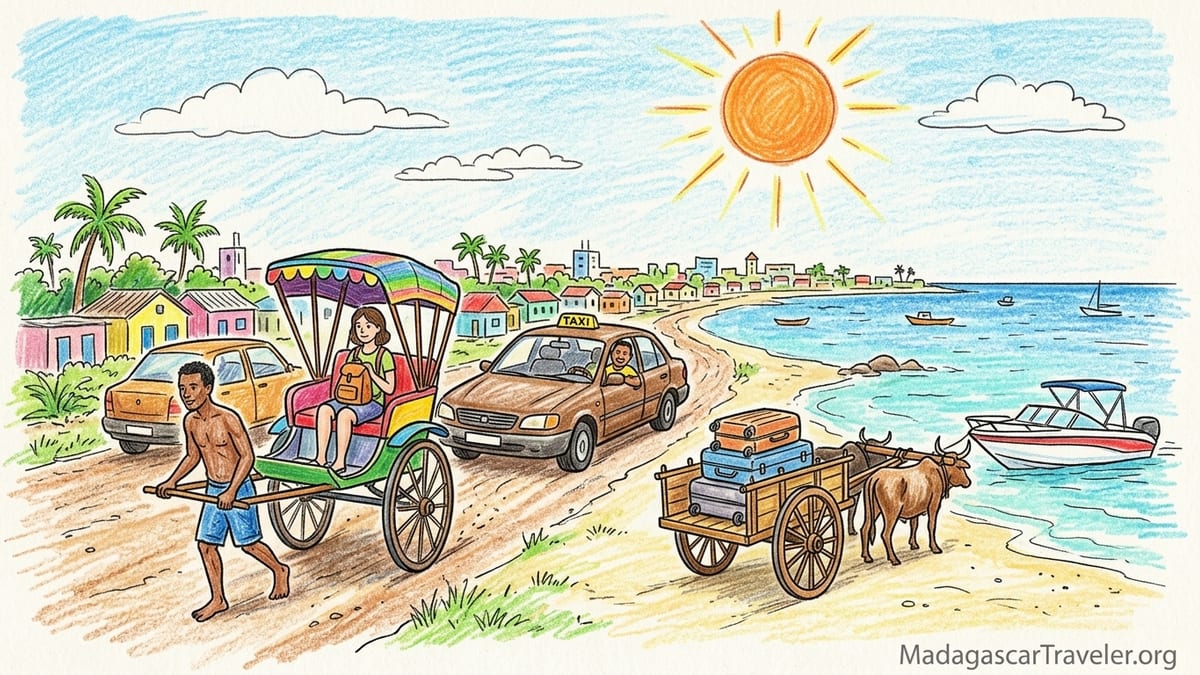
Once checked in, my main tools for moving around central Toliara were pousse-pousse and ordinary taxis. Pousse-pousse are human-powered rickshaws pulled by men who often walk barefoot through the hot streets, weaving between shops, street food stands and market stalls. For very short hops between my hotel, the central market and the seafront, they were usually the quickest and cheapest option. In the mid-afternoon sun, sitting in the shaded seat of a pousse-pousse felt much kinder than walking along streets with very limited tree cover.
Agreeing a pousse-pousse fare always came before I set foot on the step. I would say where I was going, the driver would propose a price, and I learned to answer with a slightly lower counteroffer, smiling and steady. For example, when I wanted to go from my hotel near the main avenue to the busy bazaar area, one driver called out a price equivalent to a few thousand ariary. Another day, with a small backpack and a quick stop at a roadside stall, the price was similar. In practice, for short rides of 5 to 10 minutes inside the core of Toliara, I found that a modest note in local currency usually covered the journey without drama.
Taxis came into play when distance, time of day or luggage changed the equation. For trips that involved the bus station area, an evening dinner out on the edge of town, or an early morning run to the port office, I flagged or called a regular car taxi. Again, there were no meters. I would open the conversation through the passenger window, state my destination, and ask "how much" before getting in. For simple cross-town routes without luggage, the fare I agreed was only mildly higher than a couple of short pousse-pousse legs. With luggage or at odd hours, the starting ask climbed, but the final price after gentle negotiation still felt reasonable compared with many capital cities.
In both pousse-pousse and taxi rides, waiting time was rarely charged formally unless I asked the driver to stay put while I ran an errand. When I wanted to grab cash from an ATM or buy fruit at a market stall, I explained and offered a small extra amount. Drivers appreciated the clarity. If I knew I would be an hour or more, I released them and found another ride later rather than paying to have a vehicle idle in the heat.
Weather, Walking and the Reality of Moving With Luggage
Moving through Toliara on foot sounds appealing on paper. The city is relatively flat, and the main commercial and administrative areas are not far apart. The reality at ground level, especially under the noon sun, is more nuanced. On my first full day, I tried walking a few stretches that Google Maps made look easy: from the hotel cluster near the seafront into the inner neighborhoods, then across to the taxi-brousse area. Within twenty minutes under a high, cloudless sky, the combination of direct sun, reflected heat from pale sand and unshaded pavement made the experiment feel unwise.
For short morning or late-afternoon strolls, walking worked. I could wander along the waterfront, detour through a side street to buy phone credit, or explore a small market on foot without discomfort. However, at midday, the lack of shade and the dusty surface meant that I quickly defaulted back to pousse-pousse or taxis. Seeing local residents crowd into the shade of awnings and the undersides of balconies underlined that this was not just a tourist overreaction but a shared adaptation to the climate.
Luggage changed everything again. When I first arrived with a wheeled suitcase and a daypack, I made the mistake of dragging the suitcase a few hundred meters along a sandy, uneven side street to avoid negotiating a very short ride. The wheels clogged with grit, and I found myself sweating far more than the distance justified. After that, I simply factored a small transport cost into every move with bags. Pousse-pousse, in particular, shone here. Their small platforms and benches are designed to carry loads as well as people, and drivers helped lift my suitcase aboard, balanced it expertly, and trotted through traffic while I sat under the canopy.
In the rainy season, which in this part of Madagascar typically runs through the southern summer months, brief but intense showers can turn dust to mud. Talking with local drivers and hotel staff, I learned that during these months they recommend even more strongly that visitors rely on vehicles rather than walking, especially outside the better-drained central area. In those conditions, the ability of pousse-pousse wheels and taxi tires to cut through shallow water and mud becomes more than just a comfort issue.
Moving Beyond the Center: Stations, Hotels and the Edge of the City
Most visitors do not come to Toliara to stay only in the center. They are passing through on the RN7 road, connecting to beaches like Ifaty and Anakao, or eyeing national parks such as Isalo and Tsimanampetsotsa. Without a rental car, your first task is simply reaching the various departure points that sit at the edge of the city: the taxi-brousse stations on the RN7, the port area for boats, and the strip of coastal hotels that handle many transfers.
Reaching the taxi-brousse station by local transport was straightforward but required patience. I took a pousse-pousse from my hotel to the general area, then walked the last block or two through crowds of vendors and vehicles. The station area is chaotic, with minibuses heading back up the RN7 toward towns like Ranohira and Fianarantsoa. For someone without strong French or Malagasy, arranging long-distance seats here can be intimidating. That was the moment I most appreciated having previously traveled the RN7 in an arranged car with a driver and only using the station now as an observer rather than as my sole option.
By contrast, getting to the port area for coastal boats was simpler. Hotels that work regularly with Anakao or Ifaty transfers either have their own driver or cooperate with a known taxi. When I booked a boat crossing, the hotel simply gave me a pick-up time and announced that their driver would take me "to the beach" or "to the office by the shore". The distances within town were short enough that even if the hotel had not offered this, a pre-arranged taxi would have done the job without much effort.
One detail that surprised me was the presence of small motorized tuk-tuks in some parts of Toliara. These three-wheeled vehicles coexist with pousse-pousse and taxis, often filling the gap for slightly longer local journeys where a traveler might not want to pay for a full car. I used one for a cross-town run with only a daypack, enjoying the airflow through the open sides. Again, the fare was fixed by conversation before the ride, with a price that sat somewhere between a short pousse-pousse hop and a proper taxi.
Toliara vs the Wider Southwest: Two Very Different Transport Problems
After a couple of days using local transport within Toliara, one key distinction became impossible to ignore. Getting around the city without a car is one challenge. Reaching the wider southwest coast and inland attractions without one is a completely different question. Inside the city, human-powered and motorized taxis are everywhere, waiting times are short, and anything within a few kilometers feels accessible. The moment you want to go beyond the city limits, the options narrow sharply.
The road north toward Ifaty is a sandy track that peels away from the paved RN7 and follows the coast. There is no scheduled city bus that shuttles tourists up and down this strip. Instead, transfers are typically handled by hotel-arranged vehicles, informal shared taxis, or private cars with drivers hired for the day. On previous trips I had covered this stretch in a 4x4 organized by a coastal lodge, leaving Toliara after breakfast and arriving at Ifaty in the late morning, with the driver handling every negotiation for fuel stops and police checkpoints.
South and west of Toliara, toward Anakao and the fringes of Tsimanampetsotsa National Park, the land routes become slower and more seasonally affected. The presence of the wide Saint-Augustin Bay and several river mouths means that a relatively short distance on the map can translate into a long and unpredictable overland drive. That is why, when you ask how to reach Anakao in 2026, virtually every tourism office, hotel and national guide points to the same answer: by boat from Toliara.
Recognizing this split is crucial when planning two or three days in the area without a rental car. You can rely almost entirely on local taxis and pousse-pousse for movements inside Toliara itself, but to meaningfully explore the wider southwest coast in that short window, you will almost certainly need either a pre-arranged driver or a boat transfer coordinated through your accommodation. The do-it-yourself spirit that works inside town has to be tempered by practical realities outside it.
Crossing to Anakao: Boat Logistics, Luggage and the Role of Hotels
My most instructive experience of car-free travel in the Toliara region came on the crossing to Anakao. Anakao is a Vezo fishing village turned low-rise resort strip about 35 kilometers south of Toliara, and the standard way in and out is a fast motorboat. Tourism authorities highlight this sea route as the primary access, and in practice it has become the backbone of Anakao tourism.
I arranged my crossing through a beachfront lodge in Anakao, which simplified almost every step. The hotel confirmed my dates by email, added the boat transfer to my reservation, and specified a pick-up time at my Toliara hotel on the morning of departure. On the day itself, a hotel driver collected me and two other guests just after sunrise in a simple but well-kept car. We drove through the quiet streets to a stretch of shore south of town where the boat operator keeps its base.
There, the choreography of movement switched from wheels to hooves and hulls. Our luggage was lifted from the car by porters and placed on a wooden zebu cart, the traditional ox-drawn platform common in this region. The cart rolled slowly across the sand toward the waterline, where a fiberglass speedboat sat in the shallows. One of the crew walked alongside, holding the corner of my bag to steady it over bumps. I waded the last few meters barefoot through calf-deep water while the crew passed bags hand-to-hand into the boat, wrapping them under a plastic sheet near the bow to protect against spray.
The boat itself was a long, narrow speedboat with benches down each side and a sunshade over the middle section. Boarding involved timing a small wave and taking the crew’s outstretched hand. Once seated, with life jackets handed around, the captain explained the approximate duration of the crossing and reminded us to keep valuables in waterproof bags. In calm conditions the run to Anakao took around an hour to an hour and a half, with the flat coastal landscape of southwest Madagascar unrolling to one side and the darker line of the coral reef offshore.
Crucially, every piece of this sequence was smoothed by the fact that my Anakao lodge handled the arrangements. I did not need to visit the boat office in person before travel, haggle over ticket prices on the beach, or find my own way from the city to the departure point at dawn. On the return journey a few days later, the process reversed. The lodge coordinated my place on the early morning boat back to Toliara, staff carried bags from bungalow to beach, and at the Toliara landing point a pre-booked taxi was waiting to take me directly to my hotel for one last night.
Why Arranged Drivers and Boats Matter for Ifaty, Anakao and Beyond
After combining these experiences, I came away convinced that there is a fundamental line between urban and regional movement in the Toliara area. Inside the city, improvisation works. Between Toliara and coastal or park destinations, it is far more efficient to let hotels and operators handle the heavy lifting, especially if you have only a couple of days and no private car.
For Ifaty, about 20 kilometers north of Toliara along that sandy track, several beachfront hotels routinely organize transfers for guests. When I stayed at one of them on an earlier visit, the reception simply asked what time I wanted to leave Toliara and arranged a car and driver. On the morning of departure, the driver met me at my Toliara hotel lobby, loaded my bag, and navigated out of town toward the dunes. The cost was quoted in advance, paid through the hotel, and felt reasonable given the road conditions and the lack of alternatives.
The same pattern holds for more remote points like the small coastal settlement of Ambola, used as a base for visiting Tsimanampetsotsa National Park. Access often involves a mix of road and track that would be challenging to tackle independently in a short stay, so most visitors either join multi-day RN7 itineraries that already include a vehicle, or arrange a custom 4x4 with driver through a Toliara agency or lodge. Again, the work happens behind the scenes. From the traveler’s point of view, a driver and vehicle simply appear at the hotel at the appointed hour.
By contrast, the Anakao boat is visible and tangible, but the underlying principle is the same. Whether your lodge works with a specific named operator or a looser fleet of local boats, they coordinate times, ensure your name is on a passenger list, and line up the connecting drives between hotel, shore and landing points. Luggage is handled mostly by staff used to carrying heavy suitcases across sand and shallow water. In both Ifaty and Anakao cases, the hotel’s role is less about luxury and more about efficiency and risk reduction in a region where official schedules and public signage are limited.
The Takeaway: Two or Three Days in Toliara Without a Car
Looking back on my time in Toliara and along its nearby coast without a rental car, a realistic pattern emerges for travelers planning a short two or three day stay. Day one can be focused on arrival and orientation. Let your hotel arrange an airport pick-up so that your first contact with local transport is calm rather than contested. Use the afternoon to move around the center by pousse-pousse and on foot during cooler hours, visiting the market, the waterfront and any small museums or craft shops that interest you. Treat these rides as low-stress training in fare negotiation and in reading drivers’ body language.
If you have a second full day based in Toliara itself, you can start to stretch slightly beyond the core. Arrange with your hotel or a trusted taxi driver to visit points on the edge of the city, whether that is a beach further from the center, a botanical site, or a favored restaurant cluster. Keep in mind the midday heat and plan walking segments for early morning or late afternoon, using vehicles for the exposed middle of the day. For meals, remember that come evening, taxis remain available but pousse-pousse numbers thin slightly, and most drivers prefer to complete rides earlier rather than much later at night.
For those whose two or three days in Toliara are really a gateway to Anakao, Ifaty or another coastal base, the most efficient car-free approach is to treat the city as a transfer hub and book combined packages. Stay one night in Toliara so that you are not racing a same-day domestic flight and dawn boat. Ask your Anakao or Ifaty lodge to include both the city hotel pick-up and the onward boat or road transfer in your booking. Then use your limited free time in town for short explorations rather than trying to independently engineer complex legs along sandy tracks or through tidal estuaries.
What you should not expect, at least as of 2026, is a seamless web of scheduled public buses and clearly marked ferry terminals that you can plug into at the last minute. Toliara’s local transport is personal, negotiated and tightly linked to the city’s climate and geography. Within town, that can actually feel liberating, as pousse-pousse drivers and taxi operators get you where you want to go for modest fares agreed face to face. Beyond town, it means recognizing when to lean on hotel-arranged drivers and established boat routes, especially for the signature crossing to Anakao. Accept that division from the start, and two or three days in Toliara without a rental car becomes not a compromise, but an engaging way to meet the southwest on local terms.
FAQ
Q1. Is it realistic to stay in Toliara for a few days without renting a car?
Yes, for two or three days it is entirely realistic. Within the city you can rely on taxis, pousse-pousse and occasional tuk-tuks, and for any coastal stays such as Anakao or Ifaty you can arrange transfers through your accommodation rather than driving yourself.
Q2. How do I agree fares with taxis and pousse-pousse in Toliara?
Always discuss the price before you get in. State your destination, listen to the driver’s proposed fare, and if needed counter with a slightly lower but still fair amount. Once you agree, there are rarely surprises at the end of the ride.
Q3. Are pousse-pousse suitable if I am carrying luggage?
Yes, pousse-pousse are very practical for short distances with bags. Drivers help load suitcases onto the platform or seat, balance them carefully and move you and your luggage together, which is often easier than dragging wheels through sand and dust.
Q4. Can I walk around Toliara safely during the day?
You can walk in central areas, especially in the morning and late afternoon, but midday heat and limited shade make longer walks uncomfortable. Most visitors quickly combine short walks with transport rather than relying on walking alone during the hottest hours.
Q5. How do I reach Anakao from Toliara without a car?
You travel by boat, usually a fast motorboat arranged through your Anakao lodge or a local operator. A hotel driver or taxi takes you from your Toliara hotel to the departure point, luggage is moved by staff to the boat, and the crossing takes around an hour or more depending on conditions.
Q6. What happens to my luggage during the boat transfer to Anakao?
At the beach, porters load your bags onto a zebu cart or carry them by hand to the boat, where crew stow them under covers near the bow. At arrival in Anakao, staff pass them to shore and on to your lodge, so you rarely carry heavy luggage through deep sand yourself.
Q7. Are there evening transport options in Toliara if I go out for dinner?
Yes, taxis continue to operate into the evening, especially along the main avenues and between hotel zones and restaurant areas. Pousse-pousse are fewer after dark, so for late dinners most travelers arrange a taxi pick-up through their hotel or hail one near well-lit streets.
Q8. How do I organize a transfer to Ifaty without renting a car?
The simplest way is to ask your Ifaty hotel to organize a car and driver from Toliara. The vehicle collects you at your city hotel, follows the sandy coastal track north and drops you at your lodge, with the cost confirmed in advance through the hotel.
Q9. Is there public transport between Toliara and nearby beaches?
There are occasional local vehicles and informal shared taxis on the roads north and south, but schedules are irregular and not oriented to tourists. For limited time stays, hotel-arranged cars and scheduled boats are usually safer and more predictable choices.
Q10. What is the biggest challenge of visiting Toliara without a car?
The main challenge is not moving inside the city, which is straightforward, but reaching and combining outlying destinations. You need to accept that for places like Anakao or Ifaty, arranged drivers and boats are the practical backbone of any short itinerary.