


When I planned my days in Andasibe, I thought picking a lodge would be the easy part. It was only when I started mapping driving times to Analamazaotra Special Reserve and Mantadia National Park, reading about power cuts and muddy tracks, and trying to understand which hotels were actually near the park gate instead of “in the Andasibe area,” that I realised the choice of base can make or break your experience. In Andasibe, location is not a detail. It is the main decision.
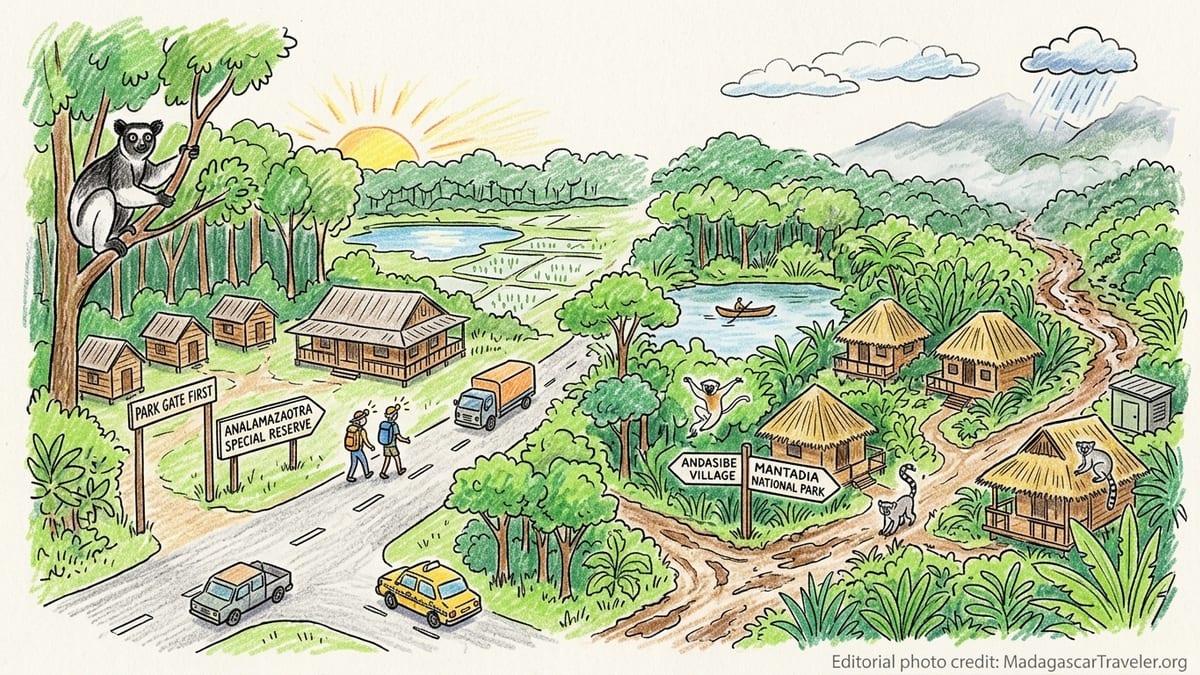
Where I Stayed, Why I Chose It, and What Worked in Reality
For my last visit I based myself at a simple lodge on the RN2 side of Analamazaotra, very similar in setup and location to Feon’ny Ala and the cluster of small hotels near the reserve entrance. The appeal was straightforward. I wanted to walk or take a very short drive to the Analamazaotra gate for dawn starts, avoid long transfers in the dark, and have a restaurant on site, since Andasibe village is spread out along the highway and not really built for evening strolling between eateries.
On paper, the decision was all about shaving minutes off each early start. In practice it paid off even more than I expected. From my room it took about 5 to 10 minutes by car to reach the Analamazaotra ticket office, or around 20 to 25 minutes on foot if I left a little early. That meant I could sit down to a quick breakfast at 5.30 am and still be meeting my guide at the entrance by 6.00 am for the first indri calls, without needing to negotiate transfers or wait for a driver to arrive on muddy backroads.
What surprised me was how much this location changed my evenings. Night walks in Andasibe generally happen along the road between the Analamazaotra gate and the village, often near the community-managed VOIMMA and Mitsinjo forests. Staying near the park entrance meant I could finish dinner at the lodge restaurant, step outside with a headtorch, and be in the right area within a few minutes’ walk or a very short drive. Guides were easy to arrange through the lodge reception, which maintained contact with several local guides and drivers.
Some trade-offs came with this convenience. Being close to the highway meant occasional truck noise at night, especially in a room closer to the RN2. Power cuts were frequent enough that I was glad I had a torch and a power bank, although the lodge ran a generator in the evening for lights and hot water. Wi-Fi existed, but only at reception and it slowed dramatically when several guests tried to use it at once. Mosquitoes and humidity were constant companions, so the mosquito net and the chance to dry damp clothes near a basic radiator-style heater became as important as any luxe amenity. Still, for Analamazaotra-focused days with very early starts and night walks, this park-side base worked very well.
Understanding Andasibe’s Geography Before You Book
To make sense of where to stay in Andasibe, it helps to picture the area as three main zones rather than a single compact town. First, there is Route Nationale 2, the main highway between Antananarivo and Toamasina, with the village of Andasibe loosely strung along it. The entrance to Analamazaotra Special Reserve sits just off this highway, a few minutes from the roadside. Many simple lodges and midrange hotels cluster within a short drive of this gate.
Second, there is the forested valley north of the highway that leads toward Mantadia National Park. Access to Mantadia involves a rough track of around 15 to 20 kilometres. Depending on rain and recent maintenance, this drive can take 45 minutes to well over an hour in a high-clearance vehicle or 4x4. Some lodges sit partway up this side road or in forest clearings beyond the village, giving more immersion in the rainforest but adding time and complexity to each trip to Analamazaotra or into town.
Third, there are the isolated forest lodges positioned deeper between Analamazaotra and Mantadia, such as Vakona Forest Lodge, set several kilometres off the RN2 along its own access road through the trees. These properties feel like self-contained rainforest retreats with private walking trails, small lakes and on-site activities. They are not in the village and you rely on lodge-organised transfers for almost everything, from park visits to dinner options.
The distances involved are not huge on a map, but road quality and weather stretch them. From a hotel close to the Analamazaotra gate, you might spend 5 to 10 minutes reaching the reserve for a morning walk. From an out-of-town forest lodge, you should allow roughly 15 to 20 minutes each way to Analamazaotra on mixed paved and dirt road, and around an hour or more each way to Mantadia if you are travelling all the way up the park access track. This distinction matters if you are planning back-to-back early starts or combining Analamazaotra, Mantadia, and night walks in a short stay.
Staying Near Analamazaotra: The “Park Gate First” Strategy
If your priority is maximizing time in Analamazaotra Special Reserve, staying as close as possible to its entrance is a very defensible choice. Lodges near the RN2 section opposite the reserve, including well-known budget and midrange places like Feon’ny Ala and Analamazaotra Hotel, sit only a few hundred meters from the turnoff to the park. Some, like Andasibe Sifaka Lodge and nearby guesthouses, are within a 5 to 10 minute walk of the main gate, depending on the exact location of your bungalow.
The main advantage here is predictability. Even in heavy rain, the short stretch of access road from the RN2 to the Analamazaotra entrance remains passable by ordinary vehicle, and if all else fails you can walk. For a typical morning, I left my room before first light, grabbed a simple breakfast at the lodge restaurant, and was at the park office within minutes to pay my fee and meet the guide arranged through reception the day before. That rhythm made two long morning walks in Analamazaotra feel relaxed instead of rushed.
Restaurants and supplies are also easier in this zone. Several of the park-side lodges have on-site restaurants serving Malagasy and basic international dishes, and some include dinner and breakfast in a half-board rate. When meals are not included, prices tend to be moderate by local standards, with main dishes around the equivalent of modest European cafe pricing rather than luxury-hotel levels. Because the RN2 carries traffic to the coast, small shops and market stalls near the village stock simple snacks, bottled water and fruit, although you should not count on finding specialist items or Western brands.
The trade-offs are noise, atmosphere and amenities. Truck and taxi-brousse traffic on the RN2 can continue late into the evening, and horn blasts or engine brakes carry through the valley, especially in lodges with bungalows closer to the road. Power cuts are common, with some hotels running generators for a few hours in the evening and others relying on the grid alone. Hot water may be limited to certain time windows, and Wi-Fi is usually available only around reception or the restaurant, if at all. Rooms are functional rather than luxurious, with mosquito nets, concrete or wooden walls that may show some humidity, and basic bathrooms. If your focus is sightings, photography and long hours in the forest, these compromises are often worth the convenience.
Forest Lodges Between Analamazaotra and Mantadia
For travellers who want more seclusion and a stronger sense of being inside the forest, the lodges set off the main road between Analamazaotra and Mantadia offer a different balance. Properties like Vakona Forest Lodge occupy private tracts of rainforest several kilometres from the village, accessed by a turnoff from the RN2 followed by a dirt road that winds through secondary forest, rice paddies and small settlements. The sense of arrival is very different from stepping off the highway into a cluster of roadside hotels.
From these forest lodges, travel times become more of a factor. Vakona, for example, sits roughly 7 kilometres from the Analamazaotra entrance and around 8 kilometres from the village. In dry conditions, lodge-organised vehicles often make the trip to Analamazaotra in around 15 to 20 minutes each way. To reach Mantadia National Park from this area, you still need to drive further along the rough access track beyond the village, so most visitors budget around an hour or a little more to reach the Mantadia trailheads by 4x4. If you plan a pre-dawn departure, that means breakfast very early or packed to go, and a willingness to bump along muddy or rutted sections in the half-light.
The reward for that extra movement is a much calmer atmosphere between activities. In my own experience visiting friends staying at a forest lodge, stepping out of the bungalow at dusk meant hearing tree frogs and the distant calls of indri or other lemurs, rather than trucks changing gears on the RN2. Many forest lodges have their own networks of short walking paths, small lakes or rivers for canoeing, and observation decks with views into the tree canopy. On rest afternoons, it is easy to sit with binoculars and see parrots, couas or sifakas without leaving the property.
Meals, power and services are generally more consolidated in these semi-isolated lodges. Because there is no realistic way to walk to independent restaurants, dinner and breakfast are usually served in the main restaurant and either included or offered at fixed prices per meal. The standard tends to be higher than in the basic park-side hotels, with more variety and better presentation, although this varies by lodge and season. Many of these properties invest in solar panels or backup generators to stabilise power, but outages can still occur during storms. Wi-Fi, when available, often works in shared areas rather than in rooms, and speeds depend on the underlying mobile network.
The key question is whether you mind being tied into the lodge’s schedule and transport. Guides and drivers to Analamazaotra and Mantadia are usually arranged by the lodge, which is convenient, but it does make impromptu village visits, roadside night walks or trying a different restaurant more complicated. If you prefer flexibility, a park-side base or a lodge nearer the village may suit you better, even at the cost of less rainforest immersion between walks.
Resort-Style Properties and Mantadia-Focused Bases
A small number of properties in the Andasibe area lean into a more resort-like experience, with larger rooms, landscaped grounds and amenities such as pools, spa services and panoramic terraces. Mantadia Lodge, for example, is set on a hill overlooking the forest, a short drive from the RN2 but positioned to give broad views across the canopy. Relais de Mantadia also brands itself as blending comfort and nature, with an emphasis on on-site dining and organised excursions to the nearby reserves.
In terms of location strategy, these properties are usually within a 10 to 20 minute drive of the Analamazaotra entrance, depending on the exact track and weather, and a similar distance from the village. They are not on the main highway itself, so you trade direct access for quieter surroundings. To reach Mantadia National Park you still need to commit to the longer, rough-road transfer, and most guests book guided day trips that leave right after an early breakfast and return mid-afternoon, combining hiking with picnic lunches.
If your main target is Mantadia, rather than Analamazaotra, there is a case for choosing a base on the side of the village closer to the Mantadia access track. The absolute difference in driving time from Andasibe to Mantadia is usually measured in tens of minutes rather than hours, but when you are waking early several days in a row and dealing with wet red mud, that can still feel significant. Some midrange lodges and guesthouses market themselves as “gateways” to Mantadia by virtue of being closer to the turnoff, while still remaining accessible to Analamazaotra and the village.
From my conversations with guides and drivers, a realistic time budget from a hillside lodge near Andasibe to Mantadia is around 45 to 75 minutes each way in a suitable vehicle, depending on rain and ongoing track repair. Count on the higher end during the wettest months, when ruts deepen and small streams can cut across the road. Compared with the 5 to 10 minutes required to reach Analamazaotra from the same lodge, that gap explains why many travellers choose to dedicate a full day to Mantadia and spend the rest of their time around Analamazaotra and the community reserves.
Practical Details: Power, Mosquitoes, Hot Water and Wet Clothes
Whichever part of Andasibe you choose, there are a few practical realities that should shape your expectations more than any marketing photos. First, power reliability. Andasibe is connected to the national grid, but outages are common, especially in the evening or during storms. Simpler lodges close to Analamazaotra may rely entirely on the grid, with candles or solar lamps as backup, while higher-end lodges and forest resorts often run generators on schedules or use solar with batteries. In practice that means it is wise to carry a headtorch, charge camera batteries whenever the power is on, and not assume that plugs will work all night.
Second, Wi-Fi and mobile data. Coverage around the RN2 and Andasibe village has improved, but it is still far from urban standards. Many hotels advertise Wi-Fi, yet in my experience the signal in rooms was weak or unavailable, with the best connection near reception. Forest lodges deeper off the main road can be more dependent on a single mobile network, so speeds drop sharply when several guests go online at once. If you need to upload large photo files or take work calls, Andasibe is not the ideal place; treat any connectivity as a bonus rather than a guarantee.
Third, mosquitoes, humidity and hot water. Andasibe is a rainforest region with high annual rainfall and cool, misty mornings. Rooms can feel damp, especially in budget bungalows with less insulation. Most lodges provide mosquito nets over beds, but the nets sometimes have small tears, so bringing a small roll of tape to patch holes and a travel-sized repellent is sensible. Hot water is usually available at least in the mornings and evenings, but during power cuts or at very basic guesthouses you may find only lukewarm water at off-peak times. After wet hikes, drying clothes can take a full day or more. I found that rooms with a small electric heater or a covered veranda rail were invaluable for hanging damp jackets and trousers between walks.
Finally, laundry. Few Andasibe lodges have self-service laundry facilities, but many offer hand-wash services charged per item or per kilo. Turnaround times vary with weather; when rain lingers over the valley, drying can be slow. For short stays focused on trekking, packing quick-drying layers and accepting that some clothes will stay damp is more reliable than planning daily laundry.
Guides, Drivers and Getting Around Once You Are There
One advantage of Andasibe is that you do not need to arrive with every transfer and guide pre-booked, but where you stay does influence how easy it is to arrange everything. Lodges near the Analamazaotra gate usually have established relationships with local guides who specialise in the reserve and nearby community forests. On my stay, I confirmed my first morning’s guide at check-in, specifying that I wanted a slow-paced walk focused on birdwatching, and was introduced to my guide at breakfast. For night walks, reception took my preferred start time and arranged for a guide to meet me at the roadside near the park.
Forest lodges and resort-style properties often package guiding and transport together. For example, you might book a two-night stay that includes one guided morning in Analamazaotra, one afternoon visit to a private lemur island, and a night walk on the access road. This bundled approach simplifies logistics but can also steer you toward the lodge’s preferred schedule. If you have specific interests such as herpetology or macro photography, it is worth asking in advance whether they work with specialist guides and whether private guiding can be arranged at extra cost.
Reaching Mantadia always requires more planning. The park is not served by public transport in a useful way for day visitors, and the access road demands at least a robust high-clearance vehicle, especially outside the driest months. Many visitors book a 4x4 and guide for a full day through their lodge or tour operator. Departure is usually around 6.00 or 6.30 am from most Andasibe-area accommodations, with arrival at Mantadia roughly an hour later, followed by several hours of hiking and a return by mid-afternoon. From isolated lodges, that day can be long, so it helps to pack snacks, a rain jacket, and a dry bag for electronics.
If you arrive in Andasibe by taxi-brousse or shared car from Antananarivo, staying near the RN2 and the Analamazaotra gate is significantly simpler. Drivers are familiar with the main cluster of hotels, and some will drop you near your lodge entrance. From a deeply forested lodge, you will usually need to arrange a private transfer in advance, either through the lodge itself or with a driver from the capital, which adds cost but avoids confusion on arrival.
The Takeaway: What I Would Choose Next Time
Having now stayed in a park-side lodge near Analamazaotra and spent time visiting friends at an isolated forest property, I see the Andasibe accommodation choice as a question of what kind of tired you want to be. If my main goal were to see and photograph indri at first light, join multiple night walks and perhaps add one long day in Mantadia, I would again choose a base within a 5 to 10 minute drive of the Analamazaotra entrance. The ability to wake up, have coffee, and be at the park gate without a long transfer makes those early mornings feel sustainable, and the proximity to the night-walk route removes most friction from evening plans.
If I were returning for a slower, more atmospheric trip, perhaps after already visiting Andasibe once, I would seriously consider a forest lodge between the two parks. The quiet, the on-site trails and the feeling of being enveloped by rainforest are powerful draws, especially for travellers who care as much about the mood of a place as about ticking off species. In that case I would plan at least three nights, to absorb the extra transfer times without feeling rushed and to give myself a margin in case heavy rain made the Mantadia access road difficult.
Either way, I would pay less attention to individual hotel names in brochures and more to three specific questions. First, how long does it really take to get from my room to the Analamazaotra gate at dawn, in the dark and possibly in rain. Second, how often does the lodge lose power, and what backup do they provide. Third, does the location make it easy or awkward to join night walks and reach Mantadia for a full day. In Andasibe, those hidden logistics matter more than decor.
Next time, knowing how much I value flexibility and early starts, I would probably split my stay: two nights close to Analamazaotra for concentrated park time, followed by two or three nights at a forest lodge for quieter mornings and slower afternoons. That combination uses location strategy as part of the itinerary design instead of treating the hotel as a simple commodity, and in a place where the rainforest begins at your doorstep, that choice shapes almost every hour of your trip.
FAQ
Q1. How long does it take to drive from Antananarivo to Andasibe?
Most travellers take around three to four hours by private car in normal conditions, although crossing Antananarivo’s traffic can add extra time, especially at rush hour.
Q2. Do I need a 4x4 vehicle to visit Analamazaotra Special Reserve?
No, the access to Analamazaotra from the RN2 is on paved and short dirt sections that regular cars can handle, though a higher vehicle is helpful in heavy rain.
Q3. Is a 4x4 necessary for Mantadia National Park?
Yes, Mantadia is reached via a rough track of roughly 15 to 20 kilometres where conditions can be muddy and rutted, so a high-clearance 4x4 and experienced driver are strongly recommended.
Q4. Can I stay without full board, or are meals always included?
Park-side lodges near Analamazaotra often offer bed and breakfast with optional dinners, while more isolated forest lodges usually include dinner and breakfast or encourage guests to book half-board because there are no nearby restaurants.
Q5. How reliable is electricity in Andasibe hotels?
Power cuts are frequent across the region, so even better lodges experience outages. Many run generators or have solar backup, but it is wise to bring a headtorch and power bank.
Q6. Is Wi-Fi good enough for remote work in Andasibe?
Wi-Fi is generally limited, slower than urban standards and often only available in reception or restaurant areas, so Andasibe is not a reliable base for video calls or heavy online work.
Q7. Are mosquitoes a serious problem around the lodges?
Mosquitoes are common due to the rainforest climate, especially at dusk and after rain. Most lodges provide bed nets, and using repellent and covering up in the evening is important.
Q8. How easy is it to arrange guides once I arrive?
Most hotels maintain contact with local guides and can arrange daytime walks in Analamazaotra, night walks along the road and full-day trips to Mantadia with relatively short notice.
Q9. Is it better to base in one lodge or split the stay?
For short visits focused on Analamazaotra, one convenient base works well, but with four or more nights many travellers enjoy splitting between a park-side lodge and a deeper forest property.
Q10. When is the best time of year to visit Andasibe for wildlife?
Wildlife is present year-round, but many operators recommend the drier months roughly from April to November for more comfortable hiking and slightly easier access to Mantadia’s rough road.