


I had been in Madagascar barely forty-eight hours when I set an alarm for 4:45 a.m. and laid out my camera gear on the bed of a simple bungalow in Andasibe. Analamazaotra Special Reserve loomed somewhere in the dark beyond the village, sheltering the largest living lemur, the indri, whose rising, siren-like calls had drawn me across an ocean. Official park brochures describe the reserve as famous for those daily calls and for the indri as its signature species. That sounded enticing, but I arrived determined to find out what actually happens on a real early morning indri-tracking walk, and how much of the legend survives contact with wet boots, slippery trails, and an animal that very much does not work on a tourist schedule.
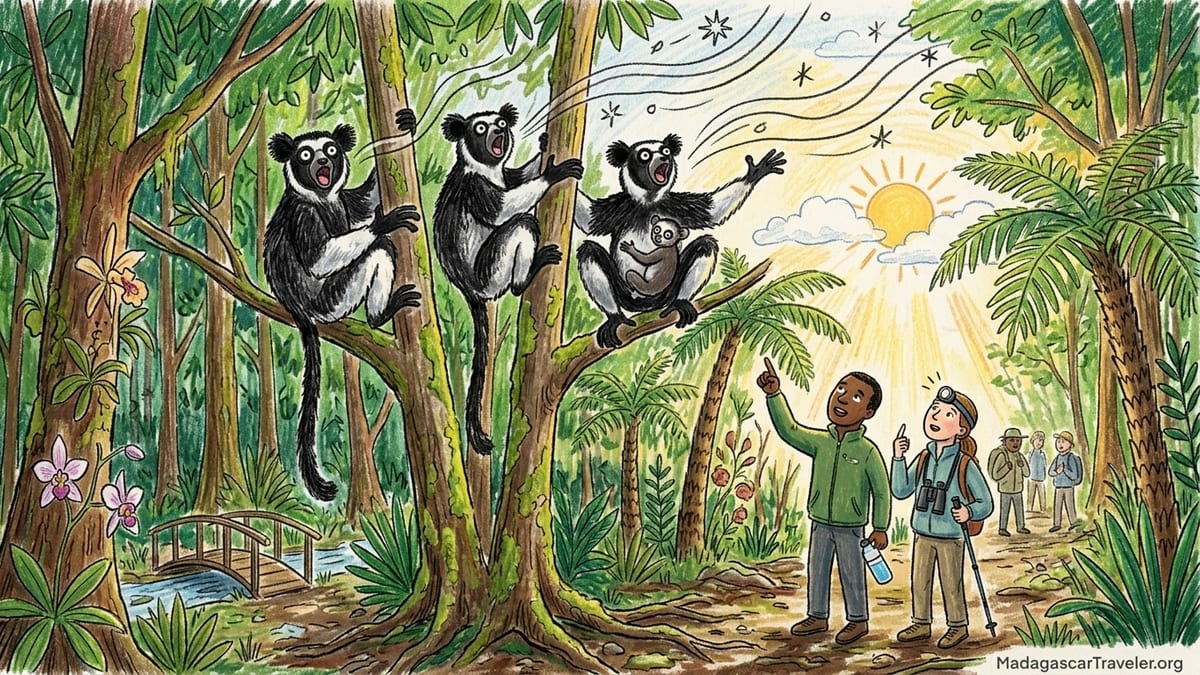
Setting Out: Early Morning In Andasibe
I met my guide, Tojo, at 5:45 a.m. in the gravel parking area opposite the Analamazaotra ticket office. It was still blue-dark, the kind of damp highland chill that seeps through a fleece. The drive from Antananarivo the previous afternoon had taken just under five hours with traffic, so I was glad I had chosen to sleep in Andasibe village rather than attempt a pre-dawn dash from the capital. Inside the small office a park staff member noted my passport details and collected the current foreign visitor fee, which in late 2026 was a bit under the equivalent of 20 to 25 US dollars in ariary, plus a separate guiding fee paid directly to the community guide association.
Analamazaotra is managed as part of the larger Andasibe-Mantadia complex, but the morning’s walk was entirely inside the Analamazaotra Special Reserve, the place most visitors mean when they say “Perinet.” Park signage outside the office mentions the indri by name and calls the species the emblem of the reserve, highlighting its haunting vocalizations that often echo through the forest in the early hours. Reading that text with a headlamp while waiting for the first hint of dawn made me keenly aware that the forest beyond the gate was not a generic patch of trees. It was a soundscape people travel here specifically to hear.
By 6:05 a.m., daylight had reached the pale stage where the silhouettes of tree ferns and traveler’s palms separated from the sky. Tojo checked my footwear and water, reminded me that leeches are rare on these particular trails but mud is not, and then led the way across a small bridge into the reserve. The path entered dense, dripping forest almost immediately. The air smelled of wet earth and orchids, and despite the nearby RN2 highway, the dominant sound was the overlapping calls of bulbuls and couas waking up, with the occasional crack of bamboo shifting in the breeze.
From the start, Tojo set a deliberate but unhurried pace. He explained quietly that indri often call shortly after first light, especially in the cool season, but that there are no guarantees. Heavy rain, strong wind, or simple indri disinterest can lead to mornings where visitors never hear or see them at all. “We listen first,” he said, tapping his ear, “then we walk.”
Waiting For The First Call
The first half hour felt like a lesson in attention. We walked no more than ten or fifteen minutes from the gate before Tojo stopped, motioned me to silence, and turned his head slightly the way people do when trying to locate the source of a faint sound. The forest around us was thick with understory shrubs and pandanus, and the main trail widened slightly at a junction that he referred to as a good “listening place.” Here we stood in near-stillness for almost twenty minutes, shifting our weight occasionally, while the bird chorus intensified.
I recorded the time on my watch out of curiosity. We had entered the forest shortly after 6:10 a.m. The first indri call rolled across the canopy at 6:47 a.m., roughly forty minutes later. It did not begin dramatically. At first it sounded like a distant, drawn-out whoop, somewhere between a humpback whale’s opening note and a police siren muffled through trees. Then a second animal answered, higher and shorter, followed by a series of rising phrases that overlapped. The sound arrived in the forest like a slowly expanding wave, building and receding but never fully fading as different family groups responded from different directions.
The physical sensation of that first chorus is the part I still remember most vividly. The calls seemed to grab the air in my chest and vibrate it, the same way standing near an organ pipe feels less like hearing a note and more like having it pass through your ribs. Each rising phrase cut through the insect hum and bird chatter, then broadened and softened at the edges as it bounced off trunks and lianas. It lasted perhaps two or three minutes in total, long enough that my initial surprise settled into a kind of focused amazement. When the last phrase died away, the forest felt briefly, oddly, quieter than before.
Tojo smiled without speaking, then pointed uphill with his chin. Now that we had a bearing, the real tracking would begin.
How The Guides Actually Track Indri
From the listening point we left the main path and followed a narrow side trail that climbed gradually into steeper, older forest. This is where a local guide becomes essential. There are official circuits in Analamazaotra that visitors can walk, but finding indri on any given morning involves more than wandering those loops and hoping for luck. Tojo carried no radio and used no playback recordings. Instead, he combined the direction of the calls we had just heard with knowledge of which family groups tend to rest or feed near particular fruiting trees in a given week.
We moved in short bursts. Every few minutes he would stop, listen again for branches shaking or second-round calls, and adjust our line slightly to the left or right. Sometimes he consulted another guide by soft whistle and hand signals when our paths intersected. Guides here know individual indri groups by the shapes of their territories and by certain distinctive behaviors, rather than by formal names tattooed in a notebook, but they carry a mental map of which areas are occupied in a given month. At one point, he pointed out stripped bark on a specific tree and explained that this group had been feeding here recently, a small but concrete sign that we were not simply chasing echoes.
The forest floor was uneven but not punishing, with a few short, slippery descents where I used tree roots as handholds. We never hacked or pushed through untouched vegetation. Instead, we followed faint but established footpaths used daily by community guides. After about twenty-five minutes of this stop and go progress, Tojo froze mid-step and raised a hand. A soft series of contact calls, lower and shorter than the full territorial wail, drifted from just ahead and slightly downslope. He motioned for me to step quietly and stay directly behind him.
We emerged into a small opening where younger trees had let in a bit more light. At first I saw nothing but tangled branches. Then one “branch” shifted position, revealing the pale inner thigh and black fur of a resting indri about twenty meters up. We had found a family group.
First Sight: Distance, Height, And Movement
Our first clear views of the indri came at 7:20 a.m., more than an hour after entering the forest, and roughly thirty minutes after the first call. There were four animals in this family: an adult pair, a subadult, and a smaller youngster that clung to the belly of one of the adults. All of them were relatively high, somewhere between fifteen and twenty meters above the ground, sitting in classic indri posture with bodies upright and legs dangling, clutching vertical trunks and thicker branches.
We watched initially from a distance of about twenty-five to thirty meters horizontally, close enough to see the expressive white patches on their ears with binoculars, but not so close as to cause them to shift position. Park regulations here prohibit approaching wildlife so closely that you alter their behavior, and the guides are firm about enforcing that. At this first vantage point, the animals mostly rested and groomed. One adult indri chewed methodically on leaves, reaching out with a surprisingly human-like hand to strip foliage, while the juvenile explored short hops between neighboring branches, practicing its balance.
Over the next ten minutes, the group began to move slowly along a line of connected canopies, still high but shifting laterally through the trees. Tojo anticipated their path and quietly repositioned us twice, choosing places where small gaps in the mid-story made viewing easier without stepping off established ground. At no point did the indri descend lower than about ten meters. This particular family stayed firmly in the mid to upper canopy throughout the entire sighting, which is consistent with their reputation as vertical trunk specialists. Any hope I might have had of eye-level portrait photography evaporated quickly, but the view from below had its own drama.
The most dynamic moment came when the adult carrying the youngster decided to cross a slightly wider gap between trees. It planted both feet on a vertical trunk, coiled its legs, and then launched in a powerful sideways bound, arms extended, tail nub stiff. For a split second, the pair hung almost horizontal against the background of white sky, then landed with a muffled thump of leaves. The younger animal clung effortlessly throughout. Watching that jump in real time, rather than in a nature documentary, underscored both how athletic and how perfectly adapted these animals are to their three-dimensional world.
How Long We Watched, And What The Calls Felt Like Up Close
We stayed with this family group for just over an hour. I checked the time again when we finally moved on and noted that it was 8:32 a.m. During that period, the group alternated between long periods of quiet rest and shorter bouts of feeding and movement. There were no dramatic territorial confrontations, no intergroup chases, and no obvious alarm events. What we saw instead was the ordinary, absorbing rhythm of an indri morning.
About twenty minutes into the observation, the adult male suddenly straightened in his vertical sit and began to vocalize. We were still roughly twenty meters below, but now almost directly underneath the central calling animal. The experience differed instructively from the earlier, more distant chorus. At close range, each note separated into components. The initial rise of the main phrase had a sharp, trumpet-like attack, followed by a sustained tone that wavered slightly in pitch, as if the call were being shaken mid-note. The sound did not simply wash through the forest at this distance. It pressed into my eardrums with enough intensity that I felt it in my teeth and throat.
As the call continued, the other adult joined, weaving in higher phrases, while the subadult contributed shorter, less forceful notes around the edges. I could see the male’s chest expand visibly before each of the longer phrases, and fine droplets of moisture caught the light near his muzzle when the sound burst out. The call lasted about ninety seconds this time, shorter than the first long-distance chorus but more encompassing. When it ended, both adults immediately resumed their previous activities, one grooming, one feeding, as if this extraordinary vocal display were just another routine check-in with neighboring families.
Our final twenty minutes with the group were quieter but no less compelling. The juvenile engaged in brief play with the subadult, including gentle pawing and mock bites, while the adults maintained stiff, watchful postures between bouts of feeding. The calls did not resume during this period. When the group eventually moved further upslope into denser canopy, the gaps that had allowed our views closed, and Tojo made the call to leave them in peace rather than push further in hopes of another angle.
It is worth noting that we did not see any other lemur species during this particular hour with the indri, although earlier on the trail we had heard distant movements that Tojo suggested might have been diademed sifakas. What stands in my memory from this morning, however, is entirely indri behavior that I actually watched: resting, grooming, leaf feeding, one spectacular gap-crossing leap, juvenile play, and two sequences of powerful vocalizations.
The Reality Of Photography And Optics
If you come to Analamazaotra dreaming of perfect indri portraits, be prepared for a technical challenge. On this morning, the sky was bright white overcast, typical of the highlands outside the peak rainy months. That meant plenty of diffuse light, but also strong backlighting from above. The indri, with dark faces and contrasting white patches, were often perched against the pale sky. My primary camera was a mirrorless body with a 70–200 mm f/2.8 lens. In the closer moments, when the animals were perhaps fifteen meters away horizontally and twenty meters up, 200 mm on a full-frame sensor allowed for reasonably tight framing of a single animal. In wider positions, I sometimes wished for a 300 mm or 400 mm lens to reduce cropping later.
Shutter speed was another constraint. Indri move in short, explosive bursts. To freeze even moderate motions like grooming or tail swishes, I found speeds of 1/500 to 1/800 of a second worked best. To capture their leaps cleanly, 1/1000 of a second felt barely sufficient. Combined with the shade of the forest and the need to keep some depth of field, this pushed my ISO into the 3200 to 6400 range despite the early hour. Noise was manageable on a modern camera body, but the files clearly showed the trade-offs involved. For many visitors using smartphones or travel zooms with smaller sensors, the conditions will be more limiting.
Autofocus struggled at times as branches and leaves crossed the faces of the animals. Back-button focus and single-point AF helped, but even then I lost frames when an indri moved behind a trunk mid-burst. A lightweight monopod or even a trekking pole with a camera clamp would have helped stabilize framing while still allowing fast repositioning. I had neither with me and felt the lack during the longer periods of waiting with the camera raised.
Binoculars, on the other hand, were a joy. I carried an 8x32 pair, which struck the right balance between magnification and field of view. Through them, the indri’s eyes, outlined in dark fur, became far more expressive than any LCD screen could convey in real time. I found myself alternating between quick photographic attempts and longer spells of simply watching through glass. If forced to choose, I would rather have good binoculars than a long lens here. Photography is possible and rewarding with effort, but the forest and the heights at which the indri live mean that the most satisfying moments are often the ones you do not try to capture.
Most importantly, I left the sighting with fewer “perfect shots” than I had hoped for, but with a series of imperfect, slightly blurred frames that still transport me back into that column of humid air under the singing trees. That feels truer to the experience than a portfolio of clean studio-like images would have.
Other Visitors, Crowds, And The Value Of An Early Start
When we first located the family group, it was just Tojo and me under the trees. For the first twenty minutes or so of observation, we shared the forest only with distant bird calls and the rush of our own breathing after small climbs. Around 7:45 a.m., another guide and a pair of European visitors arrived on a parallel path, having clearly also tracked the same calls from a different starting point. They moved quietly and kept a respectful distance, settling about fifteen meters away on the same contour. At no point did anyone jostle for position or push in front of one another. Instead, we rotated slightly along the path when one angle offered a clearer view, guided by discreet hand signals from the guides.
By the time we left at 8:30 a.m., a third small group had appeared lower on the slope, making a total of perhaps seven visitors and three guides watching the same family from different angles. That felt like the upper limit before crowding might have become an issue. Tojo explained that during busy holiday weekends or when large tour groups arrive from Antananarivo mid-morning, particular sightings can become congested, especially along narrower trails. On those days, guides sometimes coordinate to distribute groups among different families if several are within reach, but overlapping interest in the most accessible animals is hard to avoid.
The timing of our sighting underscored the practical advantage of an early start. When we walked back toward the gate after 9:00 a.m., we passed at least four more visitor groups heading inward, some with children, some with telephoto lenses ready. Park rangers at the entrance mentioned that they see a distinct spike in arrivals between 8:30 and 10:00 a.m., as day trips from the capital arrive and travelers who stayed in Andasibe finish breakfast. In contrast, our pre-dawn wake-up meant that we were in position to hear the first calls in the relative stillness of the early morning, with only one other small group sharing the experience at first.
Did the early morning “meaningfully” improve the experience? Based on this single visit, I would say yes, though not for guaranteed animal behavior. We could easily have had a silent forest even at 6:47 a.m. What the timing did provide was a quieter soundscape, cooler walking temperatures, and a better chance of encountering indri before the main flow of visitors reached their section of forest. It also gave us a buffer in case the first hour had passed with no calls at all, allowing time to extend the walk without running into midday heat or scheduling conflicts.
That said, I spoke with another traveler back at the lodge who had started a guided walk around 9:30 a.m. the same day and still heard strong indri calls an hour later, followed by a brief ten-minute sighting. Their experience was shorter and apparently shared with more people, but no less emotionally powerful. Early morning stacks the odds slightly in your favor in terms of atmosphere and solitude, but it does not function as a magical switch that guarantees sightings or vocalizations.
Managing Expectations: No Guarantees In Analamazaotra
Analamazaotra’s official promotion of the indri and its famous calls is based on long observation. In many seasons, visitors do hear indri on most days, especially during the cooler months when sound travels further and the animals are more vocally active. It would be easy, as a traveler reading blogs and brochures, to slide into thinking of that soundscape as a promised element of the trip. Guides and park staff in Andasibe work hard to push back against that assumption.
On the day before my walk, heavy afternoon rain had soaked the village and forest alike. When I met Tojo briefly that evening to confirm our start time, his first comment was not about photo opportunities. It was a gentle warning that if similar rain continued overnight, the indri might stay quiet into the next morning or move deeper into less accessible parts of the forest. In those conditions, visitors sometimes complete entire three or four hour walks hearing only distant, indistinct calls or none at all, and might see no indri. They may still encounter other lemurs, chameleons, or birds, but not the emblem species they traveled for.
Even on my relatively successful morning, much depended on a string of contingencies. We could hear multiple family groups at a distance, but only one was in a place where our path and theirs intersected under workable light. Another family called from an area that would have required a much steeper climb and potentially unsafe off-trail movement to reach in time, so we did not attempt it. Had the calling patterns been slightly different, we might have spent the entire morning hearing indri without ever seeing them. Had we started later, we might have arrived at the listening point after that first chorus had subsided, leaving us guessing where to begin.
It bears repeating clearly. Analamazaotra is rightly known for its indri, and the reserve is famous for their daily calls, but sightings are never guaranteed. Even hearing the calls is not guaranteed. Forest wildlife operates according to its own needs, not to visitor timetables. The most reliable way to enjoy a visit is to treat the indri as a hoped-for highlight layered onto an already rich forest experience, rather than as a box to be ticked. That shift in mindset does not reduce the thrill when you do finally stand under a calling indri. If anything, it heightens it.
What I Would Change Next Time
Reflecting on that morning a few months later, several small adjustments come to mind that might improve both my chances and the quality of the experience on a future visit, without chasing illusions of certainty. The first would be to allow at least two full mornings in Analamazaotra instead of one. Many organized itineraries already build in two nights and two main walks here, and having that extra dawn means that if one outing is quiet for indri, the second may still deliver. On a tight schedule, I squeezed my visit into a single early start sandwiched between travel days. Next time, I would accept the additional cost of another night in a local lodge in exchange for that added flexibility.
From a photographic standpoint, I would bring a slightly longer but still manageable lens, perhaps something in the 100–400 mm range, paired with a body that handles high ISO gracefully. I would also pack a small, collapsible monopod or at least a clamp to turn a trekking pole into a stabilizer, knowing now how long I might stand with the camera raised toward the canopy. Most importantly, I would make a conscious choice at the start of each sighting about when to put the camera down for several uninterrupted minutes and simply watch, rather than letting every behavior trigger a reflex to shoot.
In terms of field craft, I would invest even more time in listening before walking. One lesson from this visit was how effective a patient, ears-first approach can be in a forest where visibility is often limited. On a second trip, I would be inclined to ask my guide to extend the initial listening period, even if that meant walking a shorter overall loop. I would also consider visiting outside the busiest local holiday periods, when both the trails and the animals may be slightly less pressured by human presence, though that would need to be balanced against seasonal weather patterns that affect access and comfort.
Finally, I would adjust my expectations to leave more space for whatever the forest offers on a given day. If I arrive again to a morning of quiet trees and distant, untraceable calls, I hope I will remember how fortunate I was this time to watch a family of indri leaping, feeding, and singing above me for more than an hour. That memory is the result of timing, skill from a local guide, and plenty of luck, not a formula that can be reproduced on demand.
The Takeaway
Indri tracking in Analamazaotra Special Reserve is not a simple matter of ticking off a species on a list. It is an immersion in a specific forest, at a specific hour, under specific weather and social conditions that you cannot fully control. My morning there unfolded over several stages: the sleepy signing of permits near dawn, the quiet walk into a darkening mass of trees, the long, anticipatory wait at a listening point, the sudden arrival of those otherworldly calls, and the careful, knowledge-driven approach to a family resting high in the canopy.
What I actually witnessed was modest in narrative terms and unforgettable in felt experience. Four indri moved through their morning routines: feeding on new leaves, grooming, practicing leaps, and twice filling the air with calls that shook the space around us. There were no chases, no visible predators, no scientific revelations. There was only time spent under their trees, guided by someone who has grown up reading this forest, layered with my own awareness that such encounters are gifts rather than entitlements.
If you come to Andasibe determined to “see indri,” you may or may not leave with that wish fulfilled. If you come prepared instead to walk slowly, listen carefully, accept uncertainty, and allow local expertise to guide you, you increase both your chances of meeting these remarkable animals and your capacity to appreciate the rest of what the forest offers along the way. That, more than any single photograph or checklist, is what stays with you once the calls have faded and the path leads you back toward the village and its human sounds.
FAQ
Q1. What time should I start an indri-tracking walk in Analamazaotra?
I began my walk just after 6:00 a.m., and we heard the first calls around 6:47 a.m. Starting near dawn gives you a quieter forest, cooler temperatures, and a better chance of being in position if the indri call early, though it does not guarantee sightings.
Q2. How long did it take to see the indri once I entered the forest?
On my visit, we entered the forest a little after 6:10 a.m., heard the first calls roughly forty minutes later, and obtained our first clear views of a family group about thirty minutes after that, at around 7:20 a.m.
Q3. How close did we get to the indri, and how high were they?
We watched the indri from an estimated horizontal distance of twenty-five to thirty meters, while they stayed between ten and twenty meters above the ground in the mid to upper canopy, never descending to eye level.
Q4. How long did the actual indri sighting last?
We spent just over an hour with a single family group, observing resting, feeding, one notable leap across a gap, juvenile play, and two sequences of powerful calls before they moved into denser forest.
Q5. What did the indri calls sound and feel like in person?
The calls sounded like a blend of whale song and a rising siren, with long, wavering notes that filled the forest. Up close, the sound felt physical, vibrating through my chest and throat as much as through my ears.
Q6. How difficult was photography of the indri?
Photography was challenging because the indri stayed high and were often backlit against a bright sky. I used a 70–200 mm lens, fast shutter speeds, and high ISO, and still ended up with many imperfect images. Good binoculars proved at least as valuable as a camera.
Q7. Were there many other visitors during the sighting?
For the first twenty minutes it was just my guide and me. Later two more small groups arrived, bringing the total to about seven visitors watching the same family from different angles, which was manageable but close to feeling crowded.
Q8. Does visiting early in the morning guarantee better indri sightings?
My early start provided a calmer soundscape and fewer people, and it likely helped us hear and follow the first calls. However, even at dawn there are days when indri remain quiet or stay out of view, so there is never a guarantee.
Q9. Can I visit Analamazaotra without a guide to look for indri?
Access to the reserve for wildlife tracking is organized through local guides who know the terrain and the current locations of family groups. In practice, hiring a guide is expected and is the most realistic way to find and observe indri responsibly.
Q10. What would I do differently next time to improve my experience?
Next time I would plan at least two early morning walks instead of one, bring a slightly longer lens and a simple stabilizer, and consciously balance photography with time spent just watching, while still accepting that seeing or hearing indri is never certain.