


When I started planning a quick escape from Antananarivo to Andasibe in May 2024, every source gave me the same vague promise: “Madagascar is affordable if you travel simply.” That was not nearly specific enough for someone trying to decide between a taxi-brousse and a private driver, a basic bungalow or a lodge with its own forest, and one or three separate lemur walks. What finally helped was tracking every ariary I spent over three nights in the Andasibe area and then comparing it against what other recent travelers were actually paying. This article walks through that real bill line by line so you can see where the money went, which costs were worth it, and what will really drive your own budget up or down.
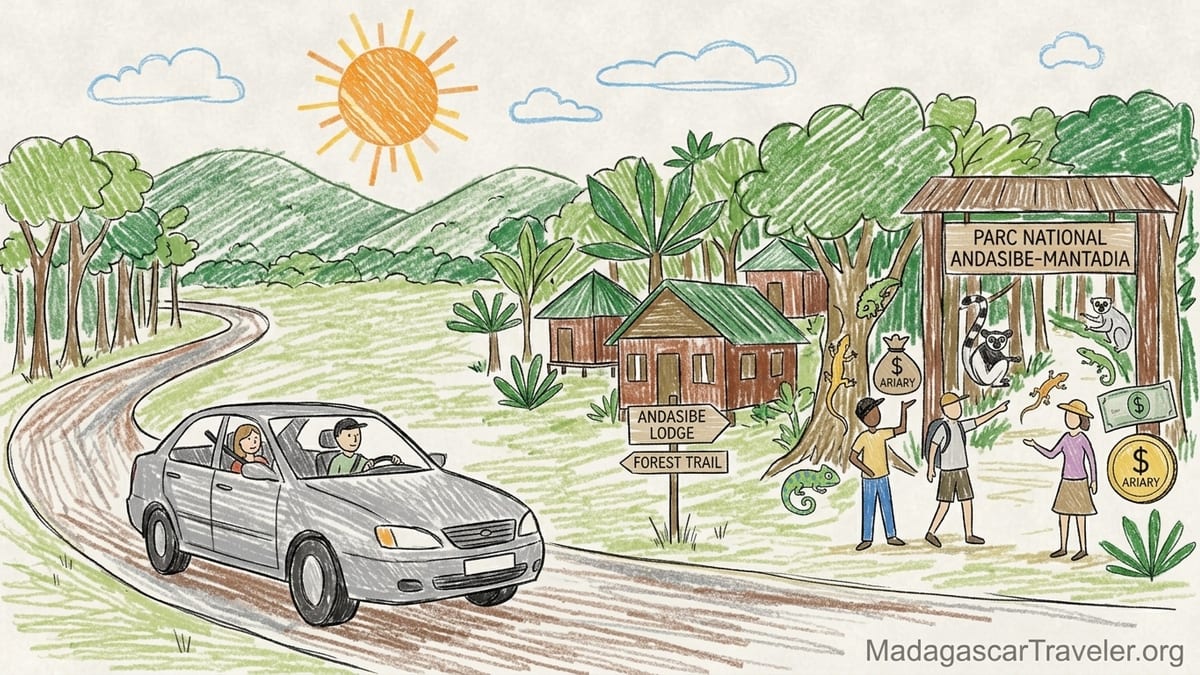
When This Trip Happened and Why Prices Move
My Andasibe trip ran from May 11 to May 14, 2024. All the figures in this story come either from my own receipts from those dates or from cross-checking against recent 2023 and 2024 trip reports, specialist cost breakdowns and current fee tables made available through Madagascar’s tourism ecosystem. In the 18 months around my trip, the key pattern was clear: official national park entrance fees and local guide tariffs were adjusted several times, especially between late 2022 and mid 2024, and many lodges quietly updated their rates in euros while the ariary weakened.
Because of that volatility, Andasibe is the sort of place where two travelers doing almost the same itinerary a year apart can pay noticeably different amounts. Park entrance for foreigners to Andasibe Mantadia National Park, for example, clustered around 45,000 ariary per person in 2023 and early 2024, with day-walk guide fees for standard circuits usually quoted in the 25,000 to 80,000 ariary range depending on circuit length and party size. Some private reserves in the area, like the community-run VOIMMA and the conservation-focused Mitsinjo, had night walks priced around 20,000 ariary per person as of late 2023.
Given how quickly those numbers can move, what matters most is not a universal “daily budget” but understanding which pieces of the Andasibe puzzle actually cost money: the road transfer from Antananarivo, park and guide fees, how many different protected areas you layer in, your lodge category, and whether you share a driver and guide costs with others or keep them private. My own decisions on each of these points shaped the final bill more than exchange rates did.
Throughout this article, I keep prices in Malagasy ariary and give approximate euro and US dollar equivalents based on the working rate I used on the ground in May 2024, which was about 4,000 to 4,500 ariary to 1 euro and roughly 4,300 to 4,800 ariary to 1 US dollar. Exact conversion will depend on the rate you get when you arrive.
Getting From Antananarivo to Andasibe: What Transport Really Cost
Every Andasibe trip starts with the same question: taxi-brousse or private car. When I visited, the shared taxi-brousse from Antananarivo’s eastern station to Andasibe village was quoted in local agencies and traveler reports at around 25,000 to 35,000 ariary per person one way in 2023 and 2024, not including a taxi to the station and the extra tuk-tuk or pousse-pousse from where the bus drops you on RN2 to your lodge.
I decided to book a private car and driver through a small Antananarivo-based agency. For May 11 to 14, 2024, I paid 400,000 ariary per day for a Toyota sedan with air conditioning, fuel included, and the driver’s food and accommodation covered by the agency. Because I combined the transfers with some short detours and kept the car with me in Andasibe, I was billed for three full days, for a total of 1,200,000 ariary, which converted to a little under 270 to 300 euros at the rate I used.
On the road, the driver’s value was obvious. The run from central Antananarivo to Andasibe took just under four and a half hours with a coffee stop and a quick roadside fruit purchase, which matched most recent reports describing it as a three-and-a-half to five-hour trip depending on traffic and truck congestion on RN2. I did not lose extra time waiting for a bus to fill or making repeated roadside drop-offs in the villages along the way, and I could stop for photos when I wanted. For a solo traveler that price felt like a stretch, but for two or three people sharing the car, it would have undercut many mid-range organized tour quotes for the same route.
The real surprise on transport was not the day rate itself but how strongly it shaped everything else. Because I knew the car and driver were available, it became easy to add a late-afternoon side visit to a private reserve and to slip into Andasibe village for dinner without worrying about finding a tuk-tuk in the rain. Had I taken the taxi-brousse, I would almost certainly have stayed closer to the main village and cut at least one of the side trips simply because getting around would have been slower and less predictable.
Where I Slept: Lodge Costs and What They Included
Andasibe has a wide spread of accommodation. In 2023 and 2024, simple guesthouses in or near Andasibe village often charged in the region of 60,000 to 150,000 ariary per night for a double room, while mid-range lodges in the forest belt between the village and the park gate ran more in the 200,000 to 400,000 ariary range, and the best-known lodges with on-site forest and pools priced some of their rooms in euros from roughly 80 to 160 euros per night.
I chose a mid-range forest lodge about ten minutes’ drive from the Andasibe national park entrance. For May 11 to 14, 2024, I paid 250,000 ariary per night for a simple bungalow, booked directly by email. Breakfast was included, hot water was reliable but came with brief power cuts during thunderstorms, and there was mosquito netting over the bed. For three nights, the room bill came to 750,000 ariary.
What added hidden value here was location. The lodge sat near several different trailheads, and local guides used it as a starting point for both early morning bird walks and post-dinner chameleon searches in the community forest. That meant I could roll out of bed at 5:15 a.m., meet a guide on the terrace at 5:30, and be hearing indri calls echoing from the valley by six. Friends who stayed in Andasibe village itself on different dates in 2023 and 2024 paid less per night, closer to 120,000 to 180,000 ariary including breakfast, but they consistently had to add a 20,000 to 40,000 ariary round-trip tuk-tuk or lodge car transfer every time they wanted to enter the park, do a night walk, or eat at a different restaurant.
If I had wanted a “destination lodge” experience with landscaped grounds and a private patch of forest frequented by semi-habituated lemurs, I would have been looking at nightly rates in the equivalent of 80 to 120 euros or more, often quoted in euros in advance and then converted to ariary at check-in. Some travelers I spoke to in Andasibe in May 2024 had taken that route and paid about 250,000 to 300,000 ariary per person per night for half-board, which bundled breakfast and dinner into the room price. My cheaper room-only choice meant I had more flexibility to eat in the village and at smaller roadside grills.
Eating in Andasibe: Meals, Drinks and the Quiet Extras
Food in Andasibe in 2023 and 2024 was rarely the budget shock people fear when they hear “remote rainforest.” In practice, dinner in a mid-range lodge restaurant or one of the larger village eateries usually landed between 30,000 and 50,000 ariary for a main dish, which matched several recent visitor reports that set average meal costs around 35,000 ariary without drinks. Simple plates of rice with meat or vegetables at very local spots could be found for less, typically under 20,000 ariary, while imported items like pizza or pasta at tourist-oriented restaurants drifted higher.
Over three nights I averaged just under 80,000 ariary per day on food and non-alcoholic drinks. Breakfast was included with my room and usually consisted of coffee, bread, jam and occasionally eggs. Lunch inside the national park on my first full day cost around 25,000 ariary for a plate of zebu skewers and rice, plus a 5,000 ariary soft drink. That same evening I spent approximately 35,000 ariary on a curry and rice dish at the lodge restaurant, again plus about 6,000 ariary for a large bottle of mineral water.
Beer and wine shifted the numbers quickly. A large bottle of local Three Horses Beer or Gold was often around 8,000 to 10,000 ariary, and a glass of imported wine in lodge restaurants could easily reach 18,000 to 25,000 ariary. Over the three days I kept alcohol to two beers total, adding roughly 20,000 ariary to the bill. Someone drinking a couple of beers every evening or ordering cocktails at the pricier lodges could see their daily spend jump by 40,000 ariary or more without noticing.
The real extra that crept up on my budget was bottled water. Park walks in humid forest meant I was drinking more than usual, and even with the driver stocking a cooler from cheaper supermarkets near Antananarivo before we left, I still spent around 24,000 ariary over three days on extra bottles picked up at lodges and roadside stalls at 4,000 to 6,000 ariary each. It was a small piece compared with park fees or the driver, but it shows how a string of minor purchases can quietly add to the total.
What I Actually Paid Inside Andasibe Mantadia National Park
Park costs in Madagascar are layered: there is an entrance fee, then a mandatory local guide fee that is separate, and sometimes additional payments for spotters, night walks or private reserves. In Andasibe, that structure was very clear by May 2024, even if the exact numbers had recently shifted.
On my first full day, May 12, 2024, I did a half-day walk on one of the standard circuits in the Analamazaotra section of Andasibe Mantadia National Park. I paid 45,000 ariary for park entrance as a foreign visitor, a figure that was consistent with both earlier 2023 examples and more recent cost tables, then 80,000 ariary for a local guide for a little over three hours on the trail. I joined with another solo traveler I met at the lodge reception, so the two of us split the guide fee and each paid 40,000 ariary in cash at the park office.
Later that afternoon, I arranged through my lodge to visit the park’s small museum and do a very short additional circuit focused on orchids and frogs. The museum visit was included in the same day’s entrance ticket, but the extra walking time involved an informal top-up of 30,000 ariary for the guide, which we again split. By the end of the day, my share of Andasibe Mantadia costs was 45,000 ariary for entrance plus 55,000 ariary in guide fees, or 100,000 ariary in total for about five hours of actual walking and wildlife watching.
From a value perspective, this was money well spent. Within the first hour we had seen and heard multiple family groups of indri calling, and later we watched diademed sifakas leaping through a splash of late-morning light between tree trunks. A sharp-eyed spotter who tagged along with my guide pointed out a well-camouflaged leaf-tailed gecko and several lineated day geckos, which I might have completely missed on my own. For a one-off forest experience in Madagascar, this was the core of what I had come for, and it delivered.
What did surprise me slightly was how little flexibility there was on the guide fees. Rates were posted on tariff boards at the park office, and although guides could be shared between strangers to bring individual costs down, there was no real option to walk independently. Anyone expecting to explore alone to save money needs to reset their expectations for Madagascar’s national parks, not just Andasibe.
Night Walks and Community Reserves: Extra Lemurs, Extra Ariary
Andasibe’s daytime walks are famous, but many travelers leave talking most enthusiastically about the night walks in the community and private reserves that fringe the national park. Unlike some parts of Madagascar where night walks happen along public roads beside the forest, in Andasibe organizations like VOIMMA and Mitsinjo manage their own strips of forest and run structured nocturnal walks with local guides.
On May 12, 2024, I booked a night walk at a community-managed forest adjacent to the national park through my lodge. The total cost came to 25,000 ariary for the forest entry and 40,000 ariary for the guide for a group of four people, which worked out at just under 15,000 ariary per person. The walk lasted around an hour and a half and covered a loop of perhaps two kilometers, headlamps bobbing between tree trunks as we scanned for eye-shine.
We saw two species of mouse lemur, multiple sleeping chameleons, a large tree frog and a fat-tailed dwarf lemur wedged in the crook of a branch. The pace was gentle and the experience felt intimate, not like being swept along in a massive group. For that combination of price and wildlife, this was arguably the best-value activity of the trip.
The next evening, May 13, 2024, I opted for a second night walk at a different nearby reserve that focused more on reptiles and amphibians. Prices were similar: around 20,000 ariary to enter, 40,000 ariary for the guide, divided among participants. The sightings overlapped more than I expected, and although it was satisfying to spot a different species of chameleon and another mouse lemur, the additional walk did not fundamentally change my experience of Andasibe’s nocturnal wildlife. In hindsight, if I had been on a tighter budget, I could easily have skipped the second night walk and saved about 35,000 ariary without feeling I had missed out.
What these visits did underline was how quickly multiple paid forest entries add up. Between one national park day walk and two night walks in adjacent reserves, I spent roughly 155,000 ariary on forest access and guides over two days, which was more than my three-night accommodation bill and close to half the daily cost of the private driver. Anyone planning to visit both the Analamazaotra and Mantadia sectors of the national park, plus one or two community forests, should plan park and guide fees as a core budget pillar rather than a small add-on.
Tips, Drivers, and All the Small Line Items
Beyond official prices, a realistic Andasibe budget needs to acknowledge tips and the many small services that smooth a trip in Madagascar. Tipping is not formally compulsory in parks, but by 2023 and 2024 it had become an expected way to recognize guides and spotters who worked hard to find wildlife.
On my main park day, I tipped my guide 30,000 ariary and the spotter 10,000 ariary, handed directly in cash at the end of the walk. After each night walk, I added 10,000 ariary for the guide. Over three days that brought my total tips for guiding to 60,000 ariary, which was not enormous compared with the driver or lodge, but it pushed the effective cost of each activity a little higher than the headline tariff.
My driver, who stayed with me from the moment we left Antananarivo until I was dropped back at my guesthouse there, received the most substantial tip at the end of the trip: 150,000 ariary, a figure I had pre-decided after comparing what other travelers were describing for multi-day driver-guide arrangements. Because the agency covered his accommodation and meals, I did not need to pay those directly, though in other cases in Madagascar, travelers with independent drivers often pay for the driver’s room at a reduced “staff” rate and a modest daily food allowance on top of the car’s day rate.
Other small costs included about 20,000 ariary in total for tuk-tuks and short lodge car transfers when I chose to eat dinner at a restaurant in Andasibe village instead of at my own lodge, 10,000 ariary for basic laundry done by lodge staff, and a few thousand ariary here and there for roadside snacks. None of these were individually significant, but together they added around 60,000 to 70,000 ariary to the three-day tally.
What surprised me here was how invisible many of these line items were when I looked back at my notes. Travelers often focus on headline prices like the driver and lodge, but tips, transfers and snacks can quietly account for the difference between a theoretical budget and the real spend you see on your last day.
What Drove My Total Andasibe Cost and What I Would Change
Adding everything up, my three-night Andasibe trip in May 2024 broke down roughly as follows. The private driver and car, including fuel and his own accommodation, cost 1,200,000 ariary. Accommodation in a mid-range lodge came to 750,000 ariary. Meals, water and a small amount of alcohol over three days added approximately 240,000 ariary. Park entrance and guide fees for one main day walk, one supplementary afternoon circuit and two night walks, plus the associated forest entry charges, totaled around 255,000 ariary before tips. Tips to guides, spotters and my driver reached about 210,000 ariary, and miscellaneous transfers, laundry and snacks added another 60,000 to 70,000 ariary.
All told, the Andasibe portion of the trip landed just under 2,700,000 ariary in direct on-the-ground costs, which at the rates I was using in May 2024 translated to roughly 550 to 650 euros. That worked out to something near 180 to 210 euros per day if you average it across the three days and ignore the fact that the driver and lodge costs were somewhat front-loaded on the travel days.
Two decisions drove that number more than any other: keeping a private driver instead of taking the taxi-brousse, and staying in a mid-range forest lodge instead of the cheapest guesthouse in Andasibe village. Without the driver, my transport might have dropped from around 1,200,000 ariary to perhaps 150,000 to 200,000 ariary total for return taxi-brousse tickets, some local taxis in Antananarivo and a handful of tuk-tuks. Without the forest lodge, three nights of accommodation could easily have cost half what I paid or less.
Would I change anything? If I were on a tight budget and traveling with more time to absorb delays, I might skip the private driver and travel out by taxi-brousse, then hire local transport for the short hops to and from the park. The trade-off would be less comfort, more time in crowded vehicles, and probably one fewer structured forest visit simply because of energy levels. On the other hand, I would not cut the main national park day walk or the first night walk; both were the core experiences that made Andasibe feel special. The second night walk at a different reserve was enjoyable but not essential, and dropping it would have saved a modest but real sum in entry, guide fees and tips.
FAQ
Q1. How much did your entire Andasibe trip from Antananarivo cost in May 2024?
My three-night Andasibe trip cost just under 2,700,000 Malagasy ariary in on-the-ground expenses in May 2024, including a private driver, mid-range lodge, meals, park and guide fees, night walks, tips and small extras.
Q2. What was the single biggest expense on your Andasibe trip?
The private car and driver from Antananarivo were the largest line item. At 400,000 ariary per day for three days, the driver and car totaled about 1,200,000 ariary, which was nearly half of everything I spent in Andasibe.
Q3. How much did you pay for park entrance and guide fees at Andasibe Mantadia?
On May 12, 2024, I paid 45,000 ariary for foreign visitor entrance to the Analamazaotra section of Andasibe Mantadia National Park and 80,000 ariary for a three-hour local guide, shared with another traveler so my personal share of guide fees was 40,000 ariary.
Q4. Are night walks and community reserves around Andasibe worth the extra cost?
For me the first night walk in a community forest, which cost roughly 25,000 ariary for entry and a 40,000 ariary guide fee split between four people, was absolutely worth it for close views of mouse lemurs and chameleons. A second night walk in a different reserve offered similar sightings and felt more optional, so budget travelers might choose just one.
Q5. How much did you spend on accommodation per night and what did it include?
I stayed in a mid-range forest lodge and paid 250,000 ariary per night in May 2024, which included breakfast but not other meals. Over three nights that came to 750,000 ariary and covered a simple bungalow with hot water, mosquito netting and easy access to nearby forest trails.
Q6. What did you typically spend on food and drinks each day in Andasibe?
Because breakfast was included with my room, my daily food and drink costs averaged around 80,000 ariary per day, usually covering a park-side lunch, a lodge or village dinner, several bottles of water and the occasional beer or soft drink.
Q7. How important was sharing guides with other travelers for keeping costs down?
Sharing guides made a noticeable difference. On my main park day I split the 80,000 ariary guide fee with another solo traveler, and on night walks the 40,000 ariary guide fee was divided among four people, which brought my per-person activity costs significantly lower than if I had insisted on private guiding.
Q8. Could you have done Andasibe more cheaply without sacrificing too much?
Yes. Taking the taxi-brousse instead of a private car and staying in a simpler guesthouse in Andasibe village could have cut my transport and accommodation costs by half or more, at the price of less comfort, longer journey times and needing to organize extra transfers for each park visit and night walk.
Q9. Which costs surprised you most once you added everything up?
The two surprises were how high the share of the budget taken by the driver and lodge actually was, and how quickly smaller items such as tips, bottled water, tuk-tuks and snacks added up once they were all listed together, even though none of them seemed expensive at the time.
Q10. How should travelers plan for changing park and guide prices in Andasibe?
Because national park and guide tariffs in Madagascar have changed several times in recent years, the safest approach is to check the latest official fee documents and recent trip reports just before you travel, then treat your own budget as a flexible estimate rather than a fixed promise, especially for activities involving guides and private or community reserves.