


By the time the last indri calls faded into the dusk above Andasibe, I had already spent a full day in Madagascar’s humid eastern rainforest. Analamazaotra Special Reserve had delivered exactly what it promised: close views of indri families, mossy trails, and a steady curtain of drizzle. What I really wanted to know, though, was whether one of Andasibe’s famous night walks would add enough new wildlife to justify heading back out into the dark, damp forest instead of collapsing at the lodge. So I booked a guided nocturnal walk in a community-managed reserve and went to see for myself what actually emerges after dark.
Where My Night Walk Took Place
The night walk I joined did not take place inside Andasibe-Mantadia National Park or on the official Analamazaotra Special Reserve trail network. The national park gates close in the late afternoon, and visitors are not permitted to wander national-park trails at night. Instead, all legal nocturnal excursions here are run in community or private forest parcels, or along the public roadside where forest still clings to the verge.
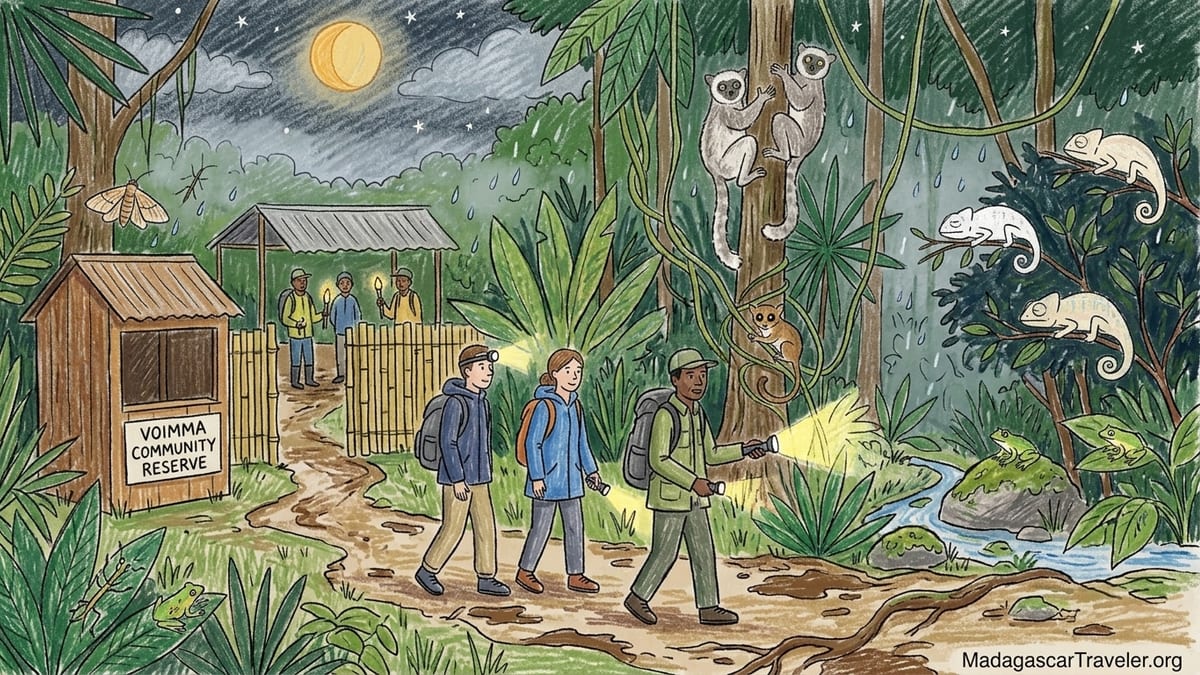
On my visit, I chose a guided night walk inside the VOIMMA Community Reserve, a locally managed patch of humid evergreen forest directly bordering the park near the village of Andasibe. VOIMMA stands for “Vondron’Olona Ifotony Mitia Manasina Ala,” roughly “Local people who love and respect the forest,” and the reserve was established by villagers as a way to protect remaining forest while earning income from responsible tourism. The site is a short drive, about 10 minutes, from most of the lodges that cluster along the RN2 highway.
VOIMMA, like the nearby Mitsinjo Reserve and Analamazaotra Forest Station, has become one of the main bases for organized night walks in the Andasibe area. Operators and drivers who bring guests from Antananarivo often build these nocturnal humid-forest visits into their itineraries as a separate activity from the daytime Analamazaotra trek. The result is a network of community forests that complement the national park without duplicating it.
When I arrived at the VOIMMA entrance, the set-up felt simple but structured. There was a small wooden ticket hut with a hand-painted sign listing entry and guiding fees, a basic shelter where guides waited with their torches, and a short set of steps leading down into shadowy forest. The path into the reserve began just beyond a bamboo gate, clearly separating this managed area from the unmarked roadside forest where some independent travelers choose to walk after dark with local guides.
Getting Started: Timing, Weather and Trail Conditions
My driver dropped me at the reserve around 18:15, just as the last usable light was draining from the sky. In Andasibe, organizers often recommend starting night walks between 18:00 and 18:30, soon after sunset, to catch lemurs and reptiles becoming active while it is still possible to see silhouettes against the canopy. On this early dry-season evening, the air was cool and damp. A light mist hung in the air from showers earlier in the afternoon, and the forest dripped steadily from leaves overhead.
Rain is a constant possibility in Andasibe’s humid forest. Even in drier months, pavements and soil rarely fully dry out. On my walk the ground underfoot was soft, with slick patches of mud where previous groups had trodden. The VOIMMA trail network, however, is short and deliberately kept accessible. For most of our 90-minute circuit, we followed a gently undulating loop on compacted earth, with short wooden steps and simple boardwalks over the wettest sections near a stream. There were no steep climbs and no scrambling. Anyone comfortable with an unpaved path and occasional roots should manage this walk, assuming they have reasonable balance and can cope with low light.
Because of the dampness, I was grateful for waterproof trail shoes with a decent tread and a light rain jacket. The reserve staff recommended that I carry a small backpack with a dry bag liner for electronics, since passing showers are common. Leech socks, which some travelers associate with Asian rainforests, are not essential in Andasibe in the same way, but long trousers tucked into socks are still sensible to avoid ticks and biting insects brushing against bare skin.
Guides, Gear and How Animals Were Spotted
At the gate, I was introduced to my VOIMMA guide, a soft-spoken Andasibe local who had been leading walks here for several years. Night walks are always guided in this reserve. Independent visitors are not allowed to enter the forest without an accredited local guide, which helps keep people on the paths and reduces disturbance to wildlife. My guide carried a powerful rechargeable flashlight in one hand and a smaller backup torch in the other. I brought my own headlamp, with a low red-light mode, at his suggestion from earlier in the day.
Before we stepped beyond the entrance, my guide set clear expectations. He explained that our main targets were nocturnal lemurs and reptiles, especially mouse lemurs, woolly lemurs and chameleons, but that nothing was guaranteed. He asked me to walk directly behind him, keep conversation at a whisper, and avoid shining my headlamp directly into animals’ eyes for more than a few seconds. He also set a policy on photography: flash was allowed for still photos, but he encouraged using a reduced power setting and taking only a few shots per animal to limit stress. Continuous bright video lights were discouraged.
The way he actually found animals turned out to be half the fascination of the evening. He swept his main torch slowly from side to side, scanning branches and undergrowth for the unmistakable twin pinpoints of eye-shine, which reflect white or orange when the beam hits them at the right angle. For chameleons, he aimed lower, towards the outer twigs of shrubs and saplings, where the pale bodies of sleeping individuals can stand out ghostly against the dark foliage. Several times he paused and simply listened, explaining that the soft rustle of a lemur moving or the repetitive peeping of a tree frog can guide him in long before he sees anything.
My role was mostly to follow, adjust my pace, and stay quiet. I kept my headlamp on a low setting, tilted down to read the trail and avoid roots rather than to search independently. In practice, the guide’s experience far outstripped anything I could have spotted on my own. Through the evening, every meaningful sighting came from his careful scanning and local knowledge of where certain species rest or feed at night.
What I Actually Saw: Lemurs After Dark
The first mammals we encountered were a pair of eastern woolly lemurs, known locally as avahi. About fifteen minutes into the walk, my guide froze and signaled for me to halt. High in a sapling about eight meters off the trail, two soft orange glows reflected back from his torch beam. After a moment of adjustment, the shapes resolved into a small, dense-bodied lemur clinging vertically to the trunk, with woolly grey-brown fur and a darker facial mask. A second individual shifted behind it.
We edged closer off the main path, but only by a meter, stopping when we were about five to six meters from the tree. The guide kept his beam slightly off-center to avoid blinding the animals, using the softer spill of light to outline their shapes. For a few minutes we watched in silence as one of the woolly lemurs flexed its powerful hind legs and made a surprisingly long sideways jump to a neighboring trunk, vanishing almost instantly into a mess of leaves. The other remained pressed against the bark, half camouflaged, before following.
Later, further along the loop, we found a Goodman’s mouse lemur, one of the tiny nocturnal lemurs that are often emblematic of Madagascar night walks. This individual was much lower down, no more than two meters above the trail in a tangle of lianas. Its presence was betrayed by rapid movements among the leaves and quick, darting eye-shine. My guide traced its path patiently until the lemur paused, clinging to a branch with its enormous eyes facing us. From about three meters away, I could make out its reddish-brown back and pale underside, along with the slightly elongated snout that distinguishes mouse lemurs from the even tinier dwarf lemurs found elsewhere on the island.
We stayed with the mouse lemur for perhaps two minutes, just long enough for me to take a single flash photo on low power and to watch it leap away in a series of short, energetic hops. There was no baiting or coaxing involved. My guide was careful not to imitate calls or shake branches to keep the animal in view. He treated it as a brief, fortunate encounter rather than a guaranteed spectacle, which left the whole interaction feeling controlled and respectful.
Larger nocturnal lemurs, such as the indri itself, are seldom seen at night in this area, and we did not encounter any. Nor did we see the more elusive aye-aye, which requires dedicated searches elsewhere in the country. What we did gain was a sense of how different the forest feels when dominated by small, swift, dark shapes rather than the more visible diurnal sifakas and brown lemurs of daytime hours.
Reptiles, Frogs, Insects and Other Nightlife
If the lemurs provided the emotional highlights, the herpetofauna and invertebrates filled out the bulk of our species list. Within ten minutes of entering the forest, my guide pointed out our first chameleon, a small Calumma species sleeping on a slender twig at shoulder height. In the torch beam its body appeared almost white, a common nighttime coloration that helps these lizards blend in with pale branches. We stepped in to about a meter, careful not to brush vegetation. From that distance I could clearly see the delicate casque on its head and the curled tip of its tail.
Over the course of the walk, we found several more chameleons in similar positions, each clinging to an exposed outer branch. One larger individual, perched about three meters up, showed the heavier build and longer tail associated with Parson’s chameleons that inhabit the Andasibe region, though my guide was cautious about confirming an exact subspecies in the field at night without close inspection. We did not touch or move any of them. The rule here is simple: observe from a short distance, never handle or reposition animals for photography.
Frogs were even more abundant. Near a small stream crossing, the air vibrated with calls. My guide’s torch picked up several bright green tree frogs on low leaves overhanging the water, including at least one Boophis species, identifiable by its smooth skin, bulbous eyes and long, slender limbs. We watched one individual inflate its throat as it called, the dewlap ballooning like a small translucent bubble. Just beyond, on a mossy rock, another frog with a more mottled brown and green pattern sat motionless, its camouflage almost perfect until illuminated at close range.
Insects, too, claimed their share of attention. A large stick insect clung to a trunk at about head height, so convincing as a twig that even with the torch beam directly on it I needed my guide’s finger, pointing just shy of contact, to appreciate its outline. A massive moth fluttered past, briefly caught in the circle of light before settling on a fern with wings the color of damp bark. Every few minutes, spiders’ eye-shine sparked bright points from the leaf litter, though we did not examine them closely.
What struck me was how little of this I would have noticed alone. The frogs, in particular, required careful listening first, then triangulation of sound and reflections on wet leaves. The chameleons, pale as they were, still blended well enough that my untrained eye would have slid past them. The night walk did not just reveal more animals; it revealed an entirely different way of reading the forest that depended on the guide’s practiced senses.
Insects, Comfort and Physical Difficulty
Many travelers worry that a rainforest night walk will mean clouds of biting insects. In Andasibe’s cool, often breezy evenings, the reality on my walk was more manageable, though still something to prepare for. Mosquitoes were present, especially in lower, wetter sections near the stream, but not in overwhelming numbers. A liberal application of repellent on ankles, wrists and the back of the neck kept actual bites to a minimum. I wore a light long-sleeved shirt and long trousers, which helped keep both insects and thorny vegetation at bay.
Humidity was high, but because air temperatures after dark here often drop to the mid-teens Celsius, the walk never felt oppressively hot. I carried a thin fleece jacket and ended up wearing it for most of the route. A light rain shower halfway through briefly intensified the chill, but it passed quickly and the forest canopy absorbed most of the drops before they reached us. The main discomfort factor was wet underfoot conditions. Mud caked the soles of my shoes, and in some sections I needed to place each foot carefully to avoid slipping.
From a physical standpoint, the VOIMMA night circuit ranks as easy to moderate. Our total distance was perhaps two to three kilometers over 90 minutes, with frequent stops to look at wildlife. There were no extended climbs, and the short staircases built into steeper sections broke up elevation changes into small steps. For anyone with knee issues, walking poles could be helpful, though they are not essential. The main prerequisite is a reasonable sense of balance, especially when stepping over roots in the half-light.
Because the walk takes place in near darkness, travelers with poor night vision or who feel uneasy in confined, shadowy environments should think carefully before committing. Guides are patient and can slow the pace, but they cannot change the fact that light is limited and that the forest can feel enclosing. It is important to be honest with yourself about your comfort level before heading out, especially after a long travel day.
Ethics, Distance and How Controlled It Felt
Andasibe’s night walks have grown in popularity in recent years, and the way they are run has a direct impact on the welfare of the animals that draw visitors. In VOIMMA, my experience felt broadly ethical and controlled. Group size was limited. On my evening, I walked with just one other visitor and our guide. We occasionally passed other pairs or trios led by different guides, but encounters were brief and each group respected the others’ viewing space, taking turns at particularly good sightings.
Distance from animals was kept reasonable. For lemurs, we rarely approached closer than three to five meters, and often watched from slightly further away. For chameleons and frogs, distances were shorter, around one to two meters, but we never crossed the final branch line or attempted to touch them. Guides here are used to enforcing a “no handling” rule, and when one visitor from another group edged too near a chameleon, their guide quietly asked them to step back without drama.
Light discipline was also managed with care. When several groups converged, guides sometimes asked one another to dim or angle torches away from animals’ faces. Flash photography was used sparingly. I was encouraged to take a couple of quick shots per animal, then turn the camera off and simply watch. There was no sense that animals were being repeatedly spotlighted for a constant flow of groups, at least on this relatively quiet night early in the season.
Equally important was the broader context. VOIMMA’s income helps fund local community projects and provides an incentive for villagers to protect rather than log the remaining forest. Night walks are part of that model. My guide explained, without prompting, that for many families in the village, tourism fees help offset the temptation to clear land for agriculture. Knowing that my presence on the trail supported that equation made the experience feel more defensible than a roadside walk with no direct conservation link.
Did The Night Walk Justify Going Out After A Long Day?
By the time I returned to the entrance shelter around 19:45, my shoes were muddy, my hands slightly chilled from holding my camera, and my day had already included a pre-dawn departure from Antananarivo and several hours of hiking in Analamazaotra. The question I had started with was still relevant: had the night walk truly added enough to justify pushing through that fatigue, instead of resting at the lodge after dinner.
The answer, in my case, was yes, but for specific reasons. The animals we saw after dark were not simply repeats of daytime species in dimmer light. Goodman’s mouse lemur and eastern woolly lemur do not normally appear on daytime circuits. Several of the frogs we encountered are most vocally active at night, and their behaviors, from calling to moving between leaves, are distinct nighttime phenomena. The sight of a pale chameleon coiled like a small ghost on a twig is very different from a daylight view of a basking individual, even if it is technically the same species.
The atmosphere of the forest also changed profoundly. In daylight, Analamazaotra’s trails can feel busy, with other groups chattering ahead or behind and the indri’s dramatic calls dominating the soundscape. At night in VOIMMA, our group often walked in near silence, with just the drip of water and the soft peeping of frogs. The sense of intimacy and immersion was much stronger. For travelers who value solitude and a slower pace, that alone can be worth the extra effort.
That said, a night walk is not essential for everyone. If your itinerary already includes multiple night excursions elsewhere in Madagascar, such as in Kirindy’s dry forest or along the edge of Ranomafana, you may find that Andasibe’s offering duplicates some of those experiences. If you are very tired after a long drive from the capital and a full day on Analamazaotra’s trails, it may be smarter to prioritize rest and schedule the night walk for your second evening instead. The key is to recognize that a nocturnal humid-forest visit here is a separate activity, with its own rhythms and rewards, rather than an automatic add-on.
Practical Tips for Booking an Andasibe Night Walk
Most visitors arrange their Andasibe night walk through a local tour operator, lodge, or directly at the community reserves. In my case, the walk was booked that morning via my Andasibe guesthouse, which called ahead to VOIMMA to confirm guide availability and a start time. The cost was paid in cash at the reserve entrance, split between an entry fee and a guiding fee that went directly to the local association and guide.
Prices can change from season to season, but at the time of my visit, the combined cost for a roughly 90-minute night walk for one or two people in a small group fell into the range of what many travelers would recognize as a modest but meaningful expense, especially given the conservation and community role of these forests. Lodges often add a small transfer fee for the round-trip drive, which is worth confirming when you book. Because Andasibe has limited ATMs and card facilities, it is sensible to bring enough ariary in cash from Antananarivo to cover several activities, including the night walk.
Departure times are usually set shortly after dinner service begins at lodges, with many guests leaving between 18:00 and 18:30. It is wise to eat something light beforehand, whether an early meal or a snack, as there are no facilities inside the forest itself. Most night walks finish by around 20:00, leaving time for a late plate of rice and laoka back at your accommodation before bed. Anyone prone to low blood sugar should pack a small snack and a bottle of water in their daypack.
Finally, pack thoughtfully. Closed shoes with grip, a waterproof or at least water-resistant jacket, a headlamp with fresh batteries, and insect repellent are all basic essentials. If you are bringing a camera, consider a lens that can handle low light and focus quickly, and plan to keep it in a simple dry bag between sightings. Above all, arrive with realistic expectations. Night walks are about patient searching and quiet observation, not about ticking off a guaranteed list of charismatic species.
The Takeaway
Stepping out into the Andasibe forest after dark is not simply a continuation of a daytime visit to Analamazaotra. It is a different activity, in a different place, with its own logistics and its own mood. In my case, walking inside the VOIMMA Community Reserve with a local guide revealed a side of the humid forest that the daytime trails barely hint at, from the nervous energy of a mouse lemur bounding between vines to the stillness of a chameleon suspended in sleep.
The experience also reminded me that how a night walk is run matters as much as what is seen. A structured, guided circuit in a community reserve, with clear rules on distance, lighting and group size, can deliver intimate wildlife encounters without pushing animals beyond their limits. It can also provide tangible financial support to the people living beside the forest, reinforcing the value of keeping those trees standing.
Is an Andasibe night walk worth doing after a long travel or hiking day. For travelers who are excited by reptiles, amphibians and small nocturnal mammals, and who can summon the energy to venture out after dinner, the answer is likely yes. For others, especially those already saturated with night walks elsewhere or who simply need rest, it may be better saved for another evening. Either way, understanding that these nocturnal excursions occur in managed community and private reserves, not inside closed national-park trails, is essential for planning realistically and traveling responsibly.
FAQ
Q1. Can visitors walk inside Andasibe-Mantadia National Park at night on their own.
Night access to the official national-park and Analamazaotra trails is not permitted. Legitimate night walks take place in nearby community or private reserves such as VOIMMA or Mitsinjo, or along limited roadside forest with local guides.
Q2. Where exactly did your night walk in Andasibe take place.
My night walk took place inside the VOIMMA Community Reserve near Andasibe village, a locally managed humid-forest parcel that borders the national park but is run by villagers rather than park authorities.
Q3. What time do Andasibe night walks usually start and how long do they last.
Most night walks begin shortly after sunset, typically between 18:00 and 18:30, and last around 1.5 to 2 hours, returning guests to their lodges by about 20:00.
Q4. What animals did you genuinely see on your Andasibe night walk.
On my walk I saw eastern woolly lemurs, a Goodman’s mouse lemur, several chameleons, multiple tree frogs around a stream, a large stick insect, spiders by eye-shine and a few large moths.
Q5. How difficult are the trails used for night walks in the VOIMMA reserve.
The VOIMMA circuit I followed was short and gently undulating, with some muddy sections and simple steps or boardwalks, making it easy to moderate for most reasonably fit travelers.
Q6. Do you need a guide, and how do they find animals in the dark.
Guides are mandatory inside community reserves and use powerful torches to scan for eye-shine, pale sleeping chameleons on twigs and frog calls near streams, combined with local knowledge of favorite resting and feeding spots.
Q7. Was flash photography allowed during your night walk.
Yes, flash was allowed for still photographs, but guides asked visitors to use low power, limit shots to a few frames per animal and avoid shining bright light directly into eyes for long periods.
Q8. How bad were insects and what clothing or gear helped most.
Insects were noticeable but manageable. Long trousers, long sleeves, closed shoes, insect repellent and a lightweight rain jacket, plus a headlamp and small backpack, made the walk more comfortable.
Q9. Did the night walk feel ethical and controlled or intrusive for wildlife.
In VOIMMA the walk felt controlled. Group sizes were small, distances were kept respectful, handling animals was not allowed and guides actively managed torch use and visitor behavior around wildlife.
Q10. After a full day in Analamazaotra, is a night walk in Andasibe really worth the extra effort.
For many travelers it is, because it reveals genuinely different wildlife such as mouse lemurs, woolly lemurs, tree frogs and sleeping chameleons, and offers a quieter, more intimate atmosphere than daytime trails, though those who are exhausted may prefer to wait for a second evening.