


Western Madagascar is a place where the map will lie to you. Distances look short, but a 150 kilometer journey can swallow an entire day of driving, two river ferries and a handful of breakdowns. For first-time visitors, this region is less a classic road trip and more an expedition, where tides, track conditions and 4x4 availability dictate what is realistically possible. This guide focuses on the Menabe and Melaky regions around Morondava, Avenue of the Baobabs, Kirindy Forest, Belo-sur-Tsiribihina, Bekopaka and the Tsingy de Bemaraha, with extensions along the Tsiribihina River and south to Belo-sur-Mer.
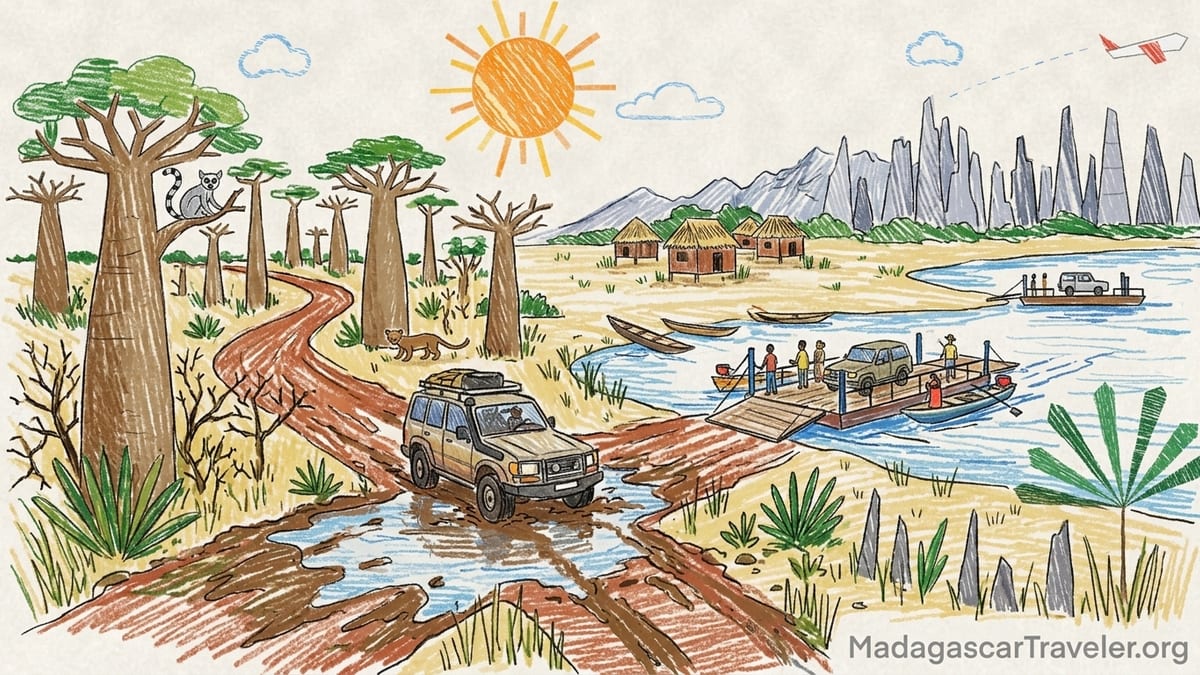
Understanding Western Madagascar: An Expedition, Not a Road Trip
Western Madagascar’s core attractions sit within a band of dry forests, limestone plateaus and coastal mangroves that stretch north and south of Morondava. On a map, Morondava to Bekopaka for Tsingy de Bemaraha is around 200 kilometers. In practice, visitors routinely spend 10 to 12 hours in a 4x4 to cover that distance, including waiting for ferries across the Tsiribihina and Manambolo rivers on the unpaved National Road 8. Travellers who try to compress these journeys into tight itineraries often end up dropping key sights or enduring long night drives that are unsafe and exhausting.
The reason is simple: logistics shape everything in this region. Roads are mostly laterite and sand, cut by seasonal rivers and potholed by trucks. The ferries that carry vehicles across the Tsiribihina near Belo-sur-Tsiribihina and the Manambolo near Bekopaka are basic barges pushed by motorized pirogues. They run when the river level and mechanical condition allow, not according to a fixed timetable. A late start from Morondava can mean reaching Belo-sur-Tsiribihina just as the last barge is loading, forcing either a tense crossing at dusk or an unplanned overnight stop in town.
For first timers, the key mental shift is to treat Western Madagascar as an expedition area. Instead of thinking “What can I see in five days?” start with “How many days of driving and boat time can I accept?” and then line up the highlights that fit within those constraints. A realistic first visit that includes Morondava, Avenue of the Baobabs, Kirindy Forest and a two-day Tsingy de Bemaraha visit will typically require at least six to seven days just in the west, not counting travel from Antananarivo or other regions.
Because of these constraints, many travelers choose to book this region with a local operator or driver-guide, even if they travel independently elsewhere in Madagascar. For example, it is common to hire a Morondava-based 4x4 with driver for four days to cover Morondava, Baobab Avenue at sunset, an overnight at Kirindy Forest, and a return via Baobab Avenue at sunrise. Others join a fixed-departure shuttle-style Tsingy trip from Morondava, typically three or four days round trip, where logistics such as ferry slots and accommodation in Bekopaka are handled centrally.
Morondava, Avenue of the Baobabs and the Dry Forests
Morondava is the practical hub for Western Madagascar. The small coastal town sits on the Mozambique Channel and is reachable by domestic flight from Antananarivo in around one hour, or by a long drive of roughly 12 to 15 hours via Antsirabe and Miandrivazo. For first-time visitors with limited time, flying into Morondava and using it as a base for the surrounding region is usually the most efficient option. In town, mid-range beach hotels along Nosy Kely beach cater to visiting groups, with air conditioning, generators and on-site restaurants that open early enough for pre-dawn departures.
From Morondava, the celebrated Avenue of the Baobabs lies about an hour inland on the road north toward Belo-sur-Tsiribihina and Bekopaka. This is a short stretch of laterite track lined with towering Grandidier’s baobabs, some over 25 meters tall and hundreds of years old. Most drivers will suggest two visits: sunset on the way back from Kirindy or a day trip, and sunrise on a separate morning. Taxi hire for a simple Morondava to Baobab Avenue round trip can be relatively affordable by local standards, while combining the avenue with Kirindy or further travel requires a 4x4 and driver for a full day or more.
Kirindy Forest, about two to three hours beyond the baobabs, is Western Madagascar’s signature dry deciduous forest reserve. In the dry season, trees shed leaves and the forest feels open and dusty, but it teems with wildlife adapted to these conditions. Guided night walks reveal nocturnal lemurs and the fossa, Madagascar’s largest predator, which is occasionally seen near the lodge area and along main trails. Daytime walks focus on diurnal lemurs, giant jumping rats and chameleons. The accommodation is rustic but functional, usually in simple bungalows with mosquito nets and fans powered for part of the evening.
Experiencing these dry forests helps explain why travel is so seasonal. During the November to March rainy season, tracks turn to mud and the Tsiribihina and Manambolo rivers rise, cutting off regular access beyond Kirindy. Even in the shoulder months of April and early May, travelers might find lingering mud holes and partially repaired bridges. Local operators watch the first-hand reports from drivers closely before scheduling Tsingy or Belo-sur-Mer extensions, and it is wise for independent travelers to do the same via current local contacts rather than relying on outdated guidebook information.
Bekopaka and the Tsingy de Bemaraha: Limestone Labyrinths
The Tsingy de Bemaraha, a UNESCO-listed protected area north of Belo-sur-Tsiribihina, is the single most dramatic landscape in Western Madagascar. Here, ancient limestone has been eroded by rainwater into dense forests of razor-sharp pinnacles called tsingy. Visitors access the area from the village of Bekopaka, reached via the sandy National Road 8 and two river ferries. In the dry season, most travelers spend a long day in a 4x4 from Morondava to Bekopaka, typically 10 to 12 hours with a lunch stop in Belo-sur-Tsiribihina and waiting time at each ferry.
Once in Bekopaka, most first-time visitors dedicate at least one full day to the Grand Tsingy and another half or full day to the Petit Tsingy and Manambolo River gorge. The classic Grand Tsingy circuit, such as the Andamozavaky route, involves between four and five hours of hiking, scrambling, metal ladders and suspension bridges threaded through the limestone. You are clipped into a via ferrata harness for sections of the route, and the experience combines exposed viewpoints with narrow canyons and shaded forest patches. Sensible footwear, a light daypack and comfort with heights are essential.
Petit Tsingy, closer to Bekopaka, offers a more compact but still impressive set of circuits with less demanding vertical sections, making it suitable for travelers who prefer shorter hikes. Many visitors pair Petit Tsingy with a half-day pirogue trip along the Manambolo River, drifting below limestone cliffs and past caves and traditional tombs. These excursions are arranged in Bekopaka through the park office and local guides. Park fees, guide fees and harness rental are paid on-site, and prices are usually charged per group plus per-person park entry, so sharing with other travelers can reduce costs.
Accommodation in Bekopaka ranges from basic guesthouses with cold-water showers to simple lodges with pools, fans and en suite bathrooms. During the main season, roughly June to October, demand can exceed capacity, particularly when groups arrive from Morondava on similar schedules. This is where logistics again shape choices: if your 4x4 is part of a pre-booked circuit, your driver will typically already have lodging reserved. Independent travelers who arrive without bookings risk having to accept lower-standard rooms or adjust plans if everything is full on popular dates.
Tsiribihina River and Belo-sur-Mer: Classic West Coast Extensions
Many first-time visitors combine Western Madagascar’s road circuits with river and coastal extensions. The Tsiribihina River descent is a classic route that usually begins near Miandrivazo or a riverside village upstream, ending near Belo-sur-Tsiribihina or a nearby landing spot. Over three days and two nights, travelers sleep in tents set up on sandbanks while local crews prepare simple Malagasy meals over charcoal. Boats range from traditional dugout canoes used for slower, more intimate trips, to motorized barges with basic onboard facilities that cover the distance more quickly and reliably in the dry season.
At the end of a Tsiribihina descent, many itineraries continue by 4x4 toward Bekopaka for Tsingy de Bemaraha, or southward toward Morondava. Because luggage travels with you on the boat and vehicle pickups depend on river conditions and time of arrival, it is vital to coordinate carefully with the operator providing your onward transport. In practice, that means agreeing in advance who meets you, at which landing and with what flexibility if sandbanks, engine issues or weather delay your arrival by several hours.
South of Morondava, Belo-sur-Mer is a remote fishing village and shipbuilding center that feels worlds away from the busy Baobab Avenue. Reached by roughly 3 to 4 hours of 4x4 travel on sandy tracks in the dry season, or by a 2 to 3 hour boat transfer along the coast when conditions allow, it offers long white-sand beaches, mangroves and a famous tradition of wooden dhow construction. Visitors can walk the beach past half-built sailing boats resting on the sand, talk with carpenters working with hand tools, and watch fishermen launching pirogues at dawn.
Accommodation in Belo-sur-Mer is limited to a handful of small lodges and guesthouses, several of which close in the rainy season when the track becomes impassable. During the May to December period, a couple of ecolodges and beach bungalows provide simple but atmospheric stays, usually with solar power, mosquito nets and communal dining. Because the track to Belo-sur-Mer crosses tidal flats and low-lying areas, departures are often timed to the tides. It is common for drivers based in Morondava to schedule a morning departure to avoid crossing soft sand in the afternoon heat, or to choose to go one way by 4x4 and return by boat depending on sea state and traveler preference.
Roads, River Crossings and 4x4 Reality
Western Madagascar’s road network is dominated by the unpaved National Road 8 and seasonal tracks. From Morondava to Kirindy and onward to Belo-sur-Tsiribihina, the surface alternates between compact laterite and deep sand ruts. North of Belo-sur-Tsiribihina toward Bekopaka, the road becomes more rutted, with hollowed sections that fill with water early in the season. Even in peak dry months, travelers report sections that are bone-jarring, with average speeds often below 25 kilometers per hour. This is why a single day from Bekopaka back to Morondava is frequently described as a 10 to 12 hour trip even when distances look modest.
Two river crossings define the Tsingy route. The first is the Tsiribihina near Belo-sur-Tsiribihina, where vehicles drive onto a flat barge platform powered by small engines or pushed by boats. The second is the Manambolo near Bekopaka, served by an even smaller ferry. Neither operates to fixed, published timetables. Instead, they typically cross when enough vehicles have accumulated, when the tide and river depth are suitable, and when the barge is functional. At busy times in July and August, travelers can wait an hour or more in the queue; at quieter times, a driver may negotiate a departure with a handful of vehicles if everyone agrees to share the cost.
Because of these conditions, a high-clearance 4x4 with experienced local driver is not a luxury but a necessity for most routes beyond Kirindy. International rental companies are reluctant to allow their vehicles to be driven to Bekopaka independently, and self-driving foreign visitors regularly encounter insurance restrictions for the western tracks. In contrast, local driver-guides are accustomed to reading the road, negotiating ferry prices and improvising repairs. It is common for 4x4 hire costs for multi-day western circuits to look high compared with other parts of Madagascar, since they factor in the heavy wear and tear on vehicles and the driver’s time on long, slow days.
Travelers who try to cut costs by using taxi-brousse public transport quickly discover the trade-offs. For example, you might find a cooperative minibus from Antananarivo that reaches Morondava in roughly a day and a half, but beyond Morondava, public options to Kirindy or Belo-sur-Tsiribihina are irregular and primarily serve local passengers. They rarely continue all the way to Bekopaka, making the Tsingy de Bemaraha essentially inaccessible by public transport in a reliable time frame. For first-time visitors with finite vacation days, the savings seldom compensate for the uncertainty and lost time.
Seasons, Climate and When to Go
Western Madagascar has a pronounced dry season from about May to October and a hot, wet season from November to March. The key practical question is not simply rainfall, but road and river conditions. Tsingy de Bemaraha’s park access and the National Road 8 generally open sometime between April and early May, once the Tsiribihina and Manambolo have dropped to safe levels and muddy stretches have dried enough for 4x4s to pass regularly. The season typically runs until late October or early November, although early or late rains can shorten or extend this window in any given year.
Within the open season, June through September is considered prime time. Daytime temperatures are warm but not extreme, nights are cooler and skies are often clear. This is also when many European and North American visitors travel, leading to busier trails at the Grand Tsingy, fuller lodges in Bekopaka and more competition for 4x4s and drivers based in Morondava. Booking core elements such as your Tsingy segment and Belo-sur-Mer stays several months ahead is advisable if you are traveling in these peak months.
Shoulder months such as May and October can be rewarding, with fewer visitors and greener landscapes following the rains. However, they also carry more risk of lingering mud, higher river levels and occasional track closures after heavy downpours. For example, a sudden storm can briefly close the Tsiribihina ferry or make sandy sections near Belo-sur-Mer difficult even for experienced drivers. In these months, keeping at least one buffer day in your western itinerary provides insurance against temporary disruptions.
The wet season from roughly November to March transforms the region. Some lodges in Bekopaka and Belo-sur-Mer close entirely, and local operators redirect travelers to other parts of Madagascar such as the east coast or the highlands. While Morondava and the Avenue of the Baobabs can still be visited between downpours, the road to Bekopaka is often considered unsafe or simply impassable for regular tourism. Unless you have specialist support and a high tolerance for uncertainty, it is wise to avoid planning Tsingy or Belo-sur-Mer trips during these months.
Accommodation and Practical Costs
Accommodation standards in Western Madagascar vary widely but tend toward the simple and functional. In Morondava, you can expect mid-range beach hotels with air-conditioned rooms, on-site restaurants serving seafood and Malagasy dishes, and occasionally pools. Prices per night in these properties often sit in the lower to mid-range compared with international beachfront destinations, though exact figures fluctuate with season and exchange rate. Budget guesthouses are available in town as well, though they may lack reliable power and en suite bathrooms.
In Kirindy and Bekopaka, accommodation is more rustic. Forest lodges near Kirindy typically offer wooden bungalows or basic rooms with mosquito nets and shared or private cold-water showers. The priority here is proximity to the reserve for early morning and night walks rather than luxury. In Bekopaka, a couple of lodges offer slightly higher comfort levels, with small pools, fans and occasionally air conditioning in some rooms during generator hours. Travelers should expect intermittent power cuts, limited Wi-Fi and a reliance on bottled or filtered water.
Belo-sur-Mer’s lodgings, when open, emphasize setting over amenities. Beachside ecolodges might offer solar-powered lighting, bucket showers or basic ensuite bathrooms, and shaded terraces facing the sea. Dinner is often a set menu featuring fish and rice or zebu beef, taken at communal tables where travelers and owners swap route information. Because capacity is limited and the track closes in the rains, some properties post seasonal calendars and encourage guests to contact them directly about track conditions before confirming dates.
Day-to-day costs in Western Madagascar are shaped more by transport and park fees than by food. Simple Malagasy meals in local eateries are inexpensive by international standards, and even lodge restaurant prices remain modest for basic dishes. What quickly adds up are 4x4 hire, driver services, fuel, ferry contributions, park entrance fees, obligatory local guide fees in parks like Tsingy and Kirindy, and occasional equipment rental such as harnesses for Grand Tsingy. When budgeting, it is wise to allocate a generous share of your western trip cost to logistics rather than expecting the low daily expenses seen in some urban areas of Madagascar.
Planning Your Itinerary Around Logistics
Because logistics dictate so much in Western Madagascar, planning a realistic itinerary is an exercise in counting driving and river days rather than just listing sights. A common first-time sequence might look like this: fly Antananarivo to Morondava, visit the Baobab Avenue at sunset, overnight in Morondava; drive to Kirindy for a night walk and morning walk; continue the next day via Belo-sur-Tsiribihina and the Tsiribihina ferry to Bekopaka; spend two nights in Bekopaka to visit Petit and Grand Tsingy; then drive back to Morondava in one long day, catching Baobab Avenue again at sunset before an overnight and onward travel the following day.
Even this seemingly simple outline already consumes at least six to seven days from arrival in Morondava to departure. Adding a three-day Tsiribihina River descent upstream or a three- to four-night extension to Belo-sur-Mer south of Morondava quickly stretches a western itinerary to 10 days or more. For many travelers who only have two weeks in Madagascar, this means choosing between an in-depth western focus or a more varied but superficial route that spreads time across multiple regions with many domestic flights.
Another planning factor is the role of shared services. In peak months, some local operators run regular shared 4x4 shuttles or small-group circuits between Morondava and Bekopaka, or between Morondava and Belo-sur-Mer. Joining such a departure can lower your per-person transport cost compared to hiring a private 4x4, especially if you are traveling solo or as a couple. The trade-off is reduced flexibility in timing and accommodation choices, as the group itinerary is fixed to accommodate ferry windows and lodge availability.
Finally, remember that Western Madagascar rewards patience and adaptation. Trying to micro-manage exact arrival times at each ferry or insisting on fitting both Grand Tsingy and a long drive in the same day leads to stress and safety risks. Building in rest afternoons in Bekopaka, slow evenings in Belo-sur-Mer and at least one buffer day in Morondava at the end of your western circuit gives you room to absorb the inevitable surprises without missing flights or cutting short the experiences that brought you here.
The Takeaway
Western Madagascar is one of the continent’s most distinctive expedition regions: baobab avenues glowing at sunset, dry forests alive with nocturnal lemurs and fossas, and vast tsingy plateaus carved into improbable rock cathedrals. Yet these rewards come only to travelers who respect the realities of distance, infrastructure and seasonality. The region operates on its own tempo, set by road conditions, river levels and the ingenuity of mechanics and boatmen rather than by fixed timetables.
For first-time visitors, the most important decision is not which individual sites to see, but how much time and budget you can allocate to the west and how comfortable you are with long 4x4 days and simple lodgings. With realistic expectations, a trusted driver or operator, and a willingness to let logistics guide your route, Western Madagascar delivers experiences that feel far removed from conventional tourism. For those prepared to travel on its terms, the region remains one of Madagascar’s most memorable and genuinely adventurous corners.
FAQ
Q1. How many days do I need for Morondava, Kirindy and Tsingy de Bemaraha?
Most first-time visitors should plan at least six to seven days in the west. That usually allows time for Morondava and the Baobab Avenue, one night in Kirindy for day and night walks, a long 4x4 day to Bekopaka, two nights for Petit and Grand Tsingy, and a full day to return to Morondava.
Q2. Can I visit Tsingy de Bemaraha without hiring a 4x4 and driver?
In practice it is very difficult. Public transport beyond Morondava is sporadic and rarely reaches Bekopaka, and self-drive rentals often exclude this route from their insurance. Most travelers either hire a 4x4 with local driver or join a small-group circuit or shuttle from Morondava that includes transport, ferries and basic accommodation.
Q3. When is the best time of year to visit Western Madagascar?
The dry season from about May to October is the best period, with June to September offering the most reliable road and ferry conditions and comfortable temperatures. Outside this window, especially from November to March, roads to Bekopaka and Belo-sur-Mer may be impassable and some lodges close.
Q4. Is Western Madagascar suitable for children or older travelers?
It can be, but only for those comfortable with long, bumpy 4x4 journeys, simple lodgings and limited medical facilities. Families with younger children often focus on Morondava, the Baobab Avenue and perhaps Kirindy, while skipping the longer and rougher route to Tsingy de Bemaraha. Older travelers with good mobility can enjoy the west, but should choose Tsingy circuits that match their fitness and comfort with heights.
Q5. How physically demanding are the Tsingy hikes?
Petit Tsingy offers shorter, moderately strenuous circuits with some ladders and narrow passages. Grand Tsingy is more demanding, involving several hours of hiking, metal ladders, suspension bridges and exposed viewpoints where you are clipped into a harness. Travelers with severe vertigo, knee issues or limited fitness should discuss options with guides and may choose shorter or less exposed routes.
Q6. What should I budget for transport and park fees in the west?
Exact costs vary by season, exchange rate and how many people share a vehicle, but you should expect transport and park fees to be a significant part of your budget. Hiring a 4x4 with driver for several days, paying for ferries, fuel, Tsingy and Kirindy park entry, mandatory guides and any equipment rental can add up quickly compared with daily food and lodging costs.
Q7. Is it safe to drive at night in Western Madagascar?
Night driving on the western tracks is strongly discouraged. Poor road conditions, lack of lighting, stray animals and the risk of breakdowns far from help make after-dark travel hazardous. Most experienced drivers aim to be off the road by late afternoon, and well-planned itineraries avoid routes that require driving after sunset.
Q8. Do I need to book accommodation in advance in Bekopaka and Belo-sur-Mer?
In the main dry season, especially from June to September, it is advisable to book ahead in Bekopaka and Belo-sur-Mer due to limited capacity. Group tours and operators often block rooms in popular lodges, so independent travelers who arrive without reservations may have to accept simpler options or adjust their plans if everything is full.
Q9. Can I combine a Tsiribihina River trip with Tsingy and Morondava in one itinerary?
Yes, many travelers descend the Tsiribihina over three days, then connect by 4x4 toward Bekopaka for Tsingy before continuing south to Morondava and the Baobab Avenue. This combined route typically takes at least nine to ten days and requires careful coordination with operators for river landings, vehicle pick-ups and lodge reservations.
Q10. What kind of luggage and clothing are best for Western Madagascar?
A soft duffel or backpack is more practical than a hard suitcase for loading into 4x4s and boats. Pack lightweight, quick-drying clothing, a warm layer for cool nights, a hat, sun protection, sturdy closed shoes for Tsingy and forest walks, and sandals for beach and boat days. Include a small dry bag for electronics during river crossings and pirogue trips.