


Western Madagascar’s wild landscapes pull you toward baobab alleys, razor-sharp limestone pinnacles and remote fishing villages. What often surprises first-time visitors is that choosing where to sleep is not simply about browsing hotels and clicking “book now.” On this side of the island, road conditions, park access and power cuts dictate the shape of your trip. Morondava, Kirindy, Bekopaka and Belo-sur-Mer each play a distinct role in the puzzle. Understanding how they fit together will help you build an itinerary that feels adventurous rather than exhausting.
Understanding the Western Madagascar Route
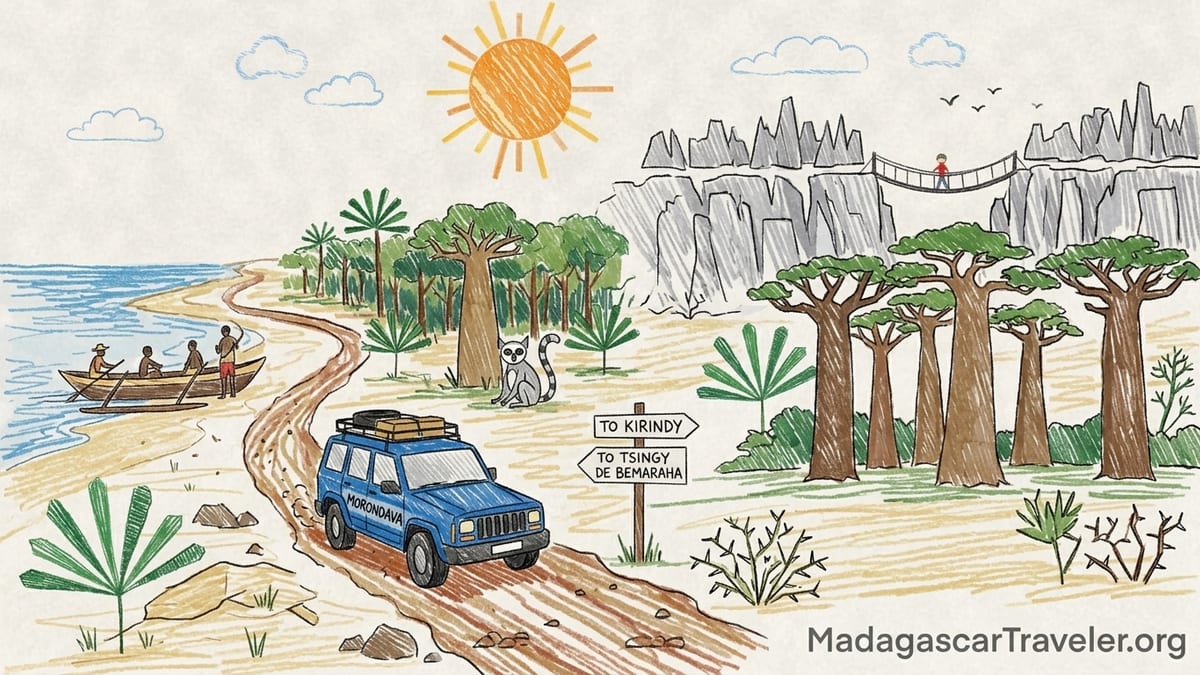
Most journeys in western Madagascar start and end in Morondava, the coastal town served by domestic flights from Antananarivo and connected by the rough RN8 track to Kirindy and Bekopaka. From Morondava, you head north by 4x4 toward Kirindy and the Tsingy de Bemaraha area, or south along sandy tracks to Belo-sur-Mer. The famous Avenue of the Baobabs sits roughly an hour from Morondava, on the same road used for Kirindy and Tsingy trips, so your accommodation choices in and around Morondava directly affect how easily you can reach the baobabs at sunrise or sunset.
The key reality is that distances are deceptive. Morondava to Kirindy is only about 50 km, yet travel can take 1.5 to 2 hours in a 4x4 because of sand, ruts and seasonal mud. Continuing to Bekopaka, the gateway village for Tsingy de Bemaraha, is around 200 km of piste with river crossings and can consume 8 to 10 hours depending on recent rains and ferry queues. Because conditions change from May to November, local drivers and lodges often coordinate departures a day or two in advance, which is why many tour operators insist on packaging accommodations and transport together.
A typical “classic west” loop might look like this: one or two nights in Morondava to rest from flights and see the baobabs, one night near Kirindy for nocturnal wildlife, two or three nights in Bekopaka to explore the Small and Great Tsingy, then back via Morondava with an optional two to three-night extension in Belo-sur-Mer for quiet beaches. Each of the four hubs has a different character and comfort level, from beach hotels with swimming pools in Morondava to solar-powered ecolodges on the sand in Belo-sur-Mer.
Because of the slow roads and limited vehicle options, your choice of where to stay is less about “which town looks nice” and more about “which base makes the most sense for tomorrow’s drive or hike.” That is why guides and drivers usually suggest specific hotels like Chez Maggie or Palissandre Côte Ouest in Morondava, Relais du Kirindy near the forest, or Soleil des Tsingy and Orchidée du Bemaraha in Bekopaka. They know where parking is secure, where the generator hours are reliable and what time breakfast can realistically be served before a dawn departure.
Morondava: Coastal Hub and Baobab Gateway
Morondava is your practical base for flights, supplies and that first taste of the Mozambique Channel. The town offers the widest range of accommodation in the region, from small family guesthouses to mid-range seaside hotels such as Chez Maggie, Palissandre Côte Ouest and Laguna Beach. These options typically have 24-hour electricity thanks to town power backed by generators, private bathrooms with hot water and at least patchy Wi-Fi at reception or in common areas. Rooms in well-located beachfront hotels often fall into a mid-range bracket, with rates broadly in the moderate-per-night category for two people, though simple guesthouses can be cheaper.
Morondava deserves at least two nights for most travelers. On arrival day, delayed flights and baggage issues are common enough that having a buffer before you head onto remote tracks is wise. You can wander the beach, watch Vezo fishermen haul in their pirogues and organize last-minute cash withdrawals and SIM cards. The next day, you can plan a late-afternoon or sunset visit to the Avenue of the Baobabs, timed with your guide so that you are not driving back alone on dark sandy tracks.
Logistically, Morondava is where many guides and 4x4 drivers are based. Hotels such as Chez Maggie or mid-range business-style properties in town frequently collaborate with local operators to arrange multi-day circuits that include Kirindy, Bekopaka and sometimes Belo-sur-Mer. This is where the coordination aspect matters: if your driver knows you are staying at a hotel with secure on-site parking and early breakfasts, they can schedule a 6:00 or 7:00 departure toward Kirindy or Bekopaka. If you book a small guesthouse independently, make sure to confirm whether there is space to park a Land Cruiser, what time the gate opens in the morning, and whether the kitchen can serve breakfast before sunrise.
Electricity and connectivity in Morondava are relatively good for the region but still not on big-city standards. Power cuts can occur, and some properties rely on generators during evening peaks. Wi-Fi may be strong enough for messaging and basic email at better hotels but can struggle with video calls or large uploads. It is best to download offline maps and key documents before leaving Antananarivo. Restaurants are concentrated in town and along the beach; many hotels such as Chez Maggie and Palissandre Côte Ouest have their own dining rooms serving Malagasy and French-influenced dishes, which is convenient when you have an early departure the following day.
Kirindy: One Night for Nocturnal Wildlife
Kirindy is famous among wildlife travelers for nocturnal creatures: the elusive fossa, several lemur species, giant jumping rats and a range of chameleons and owls. The reserve lies roughly a two-hour drive north of Morondava along the same RN8 track that continues to Bekopaka. Most itineraries allocate one night at Kirindy, timed so that you arrive from Morondava in the late afternoon, take a guided night walk, sleep, then join a morning walk before continuing toward Bekopaka or returning to Morondava.
Accommodation near Kirindy is simpler than in Morondava. Lodges such as Relais du Kirindy and more rustic options close to the forest offer basic but comfortable bungalows or rooms with mosquito nets, private or shared bathrooms and limited generator power. A typical pattern is electricity from around early evening until roughly 10:00 or 11:00 at night, and sometimes again briefly before dawn. Hot water is not always guaranteed, and Wi-Fi, if available at all, is usually confined to a small area near the bar or reception and may be slow. Visitors should charge cameras and phones as soon as the generator kicks in and carry a power bank and headlamp for outages.
Meals at Kirindy-area lodges are usually on-site and served at fixed times. Dinner might be a set three-course affair drawing on local produce: zebu steaks, fish from the coast brought in by road, rice and seasonal vegetables. Because supplies arrive by 4x4 on the same rough tracks guests travel on, menus can be limited and prices a little higher than in Morondava. It is common to pay for meals and drinks in cash, so plan to withdraw enough ariary before leaving Morondava, as ATMs are absent around Kirindy.
One of the most important logistical points is that night walks into the Kirindy forest are guided and often organized through your lodge or driver. Guides and spotters know which trails are best on a given evening and coordinate departure times after dinner. If you arrange accommodation on your own, ensure the lodge is within easy reach of the reserve entrance and confirm that they can help book a nocturnal walk. Trying to handle this independently on arrival, particularly in peak season from July to October, can lead to disappointment if guides are fully booked or you cannot safely get back along the track after dark.
Bekopaka: Base for the Tsingy de Bemaraha
Bekopaka is the dusty riverside village that serves as the southern gateway to Tsingy de Bemaraha National Park, a UNESCO World Heritage area of jagged limestone pinnacles, canyons and hanging bridges. Getting here from Morondava is an adventure in itself: travelers typically leave Morondava around dawn, cross the Tsiribihina River on a basic ferry or barge, then continue along RN8, reaching Bekopaka by mid- to late-afternoon. In the dry season from roughly May to November, tour operators treat this as a full travel day.
Because the Tsingy area is large and the trails can be strenuous, Bekopaka merits at least two and preferably three nights. A common pattern is: Day 1 long drive from Morondava and arrival; Day 2 visit the Small Tsingy and possibly a pirogue trip on the Manambolo River; Day 3 tackle the more demanding Grand Tsingy circuit, which starts about 17 km north of the village by 4x4; Day 4 drive back toward Morondava. Doing both Small and Grand Tsingy in a single day is possible only for very fit travelers and still requires a long day with early departure and late return.
Accommodation standards in Bekopaka vary from simple bungalows to relatively polished lodges with swimming pools and manicured gardens. Popular options often cited by travelers include Soleil des Tsingy, Le Grand Hotel du Tsingy, Orchidée du Bemaraha, Tanankoay and a handful of smaller hotels and community-run lodges. These properties typically run on a combination of solar and generator power. Electricity is usually available in the evenings and sometimes early mornings, but rarely 24 hours. Some of the higher-end lodges may offer more continuous power in common areas, but guests should be prepared for scheduled outages and limited air-conditioning.
Wi-Fi in Bekopaka is generally weak and unreliable, even at better hotels. At many places you will find only a basic signal near reception, and connectivity can disappear during storms or load changes on the local system. Think of Bekopaka as a semi-offline stretch of your trip. On the positive side, hotel grounds often have sweeping views over the Manambolo valley, and sunsets over the forest and limestone formations can be spectacular.
Meals in Bekopaka’s lodges are typically half-board or full-board, with set menus that might include soups, grilled fish or chicken, rice and fresh fruit. Supplies arrive via the same rough piste from Morondava, so imported goods and cold drinks are priced accordingly. Because nearly all Tsingy excursions must be done with licensed local guides, most hotels maintain close relationships with the guide and park office. Your driver will often coordinate with the lodge to plan departure times to the park entrance and ensure you have the right permits and gear, including climbing harnesses and helmets for some Grand Tsingy circuits. Booking a hotel here without also confirming park arrangements and transport can lead to days lost waiting for a free vehicle or guide.
Belo-sur-Mer: Quiet Coastal Extension at the End of the Track
Belo-sur-Mer is a small, windswept fishing village south of Morondava, reached by sandy tracks that can become impassable in the rainy season. For travelers with a few extra days, it is an appealing way to end a western Madagascar circuit: long empty beaches, traditional wooden boat-building on the sand, and sunsets over the Mozambique Channel with far fewer tourists than on the east coast resorts. It feels like a place at the end of the road, because it largely is.
Accommodation here is lower-density and more atmospheric than in Morondava. Ecolodge du Menabe and Entremer are two of the better-known lodges, both featuring beachside bungalows, hammocks and shaded gardens. Many properties run fully or mostly off solar power, sometimes with backup generators in the evenings. This means you will usually have electricity in your room at night for lights and device charging, but air-conditioning is rare and fans may switch off in the hottest part of the day if power is limited. Hot showers are common but can depend on solar water heating, so having a slightly lukewarm rinse is not unusual after cloudy days.
Wi-Fi is limited and often only available near the bar or main house, making Belo-sur-Mer more of a digital detox than a working remote base. Meals are generally a highlight: fresh seafood grilled or cooked in coconut sauce, simple vegetable dishes and rice, often eaten at communal tables with other guests. Some lodges bake their own bread and pastries each morning. Prices are typically higher than simple eateries in Morondava but fair given the remoteness and the cost of bringing in non-local supplies by 4x4 or boat.
Because Belo-sur-Mer sits off the main RN8 axis used for Kirindy and Bekopaka, it usually works best as a separate two or three-night side trip, either at the beginning or end of a western loop. Guides and drivers familiar with the route know when tides and recent rains make the tracks passable, and they are used to timing departures to avoid getting bogged in wet sand or stuck at flooded river mouths. Booking a lodge here independently is possible, but you should check directly with them or with your driver about current access conditions before locking in non-refundable dates.
How Many Nights to Spend in Each Place
For most travelers with around 10 to 14 days in Madagascar, a balanced western itinerary might give Morondava 2 nights, Kirindy 1 night, Bekopaka 3 nights and Belo-sur-Mer 2 or 3 nights. That allocation allows time for flight buffers, long road days and at least one full day at both Small and Great Tsingy. It also gives you enough breathing room in Belo-sur-Mer to actually relax on the beach rather than arrive exhausted and leave immediately.
Morondava’s two nights provide a cushion against domestic flight delays and give you time to see the Avenue of the Baobabs at golden hour. If your flight arrives very early and operates on time, some tour operators will drive you straight to Kirindy on the same day, but most still prefer one night in Morondava to recover from travel, adjust to the climate and sort out any last-minute logistics.
Kirindy usually works as a one-night, two-walk stop: a nocturnal walk on arrival day and a morning walk the next day. If you are a serious wildlife photographer hoping for repeat encounters with fossa or rare lemurs, an extra night gives you more chances under different conditions. However, comfort levels are basic enough that many visitors are content with a single sleep before continuing north or back to Morondava.
Bekopaka’s three nights are what make the overland journey to Tsingy feel worthwhile. With only two nights, your schedule might be drive all day, do one long day in the park, then drive all day again, which is exhausting and leaves little margin for bad weather or vehicle issues. A third night lets you spread activities across Small Tsingy, Grand Tsingy and possibly a river pirogue trip, with a spare half-day for rest or contingency. Belo-sur-Mer then works as a slower-paced finale, with two or three nights to walk the beach, watch local boat-builders and decompress before returning to Antananarivo via Morondava.
Electricity, Wi-Fi and On-the-Ground Comfort
Across western Madagascar, the further you get from Morondava, the more you should expect intermittent electricity and limited connectivity. In Morondava, town power and hotel generators usually provide something close to 24-hour electricity, though voltage drops and load shedding can still occur. Many hotels advertise Wi-Fi, and while it may be adequate for messaging and casual browsing, it is rarely as fast or stable as in large cities. If you need to upload photos or work online, plan to do so in Morondava rather than Bekopaka or Belo-sur-Mer.
At Kirindy and Bekopaka, generator schedules are central to your routine. Lodges typically post the hours when power will be available in rooms and common areas, often starting around 6:00 or 7:00 in the evening. Guests adapt by charging everything as soon as the power comes on, using headlamps or torches once generators shut down, and accepting that some comforts, like constant fans or air-conditioning, are simply not realistic. Solar systems at places like Entremer in Belo-sur-Mer provide a quieter, more sustainable alternative but still rely on sunny days to keep batteries topped up.
Wi-Fi should be regarded as a bonus outside Morondava rather than a guarantee. Even higher-end lodges near the Tsingy may depend on mobile data hotspots, which slow dramatically when many guests are connected or during periods of weak signal. If staying in touch is essential, consider purchasing a local SIM in Antananarivo and using your own data when there is coverage, though networks can still be patchy in remote zones.
In terms of overall comfort, Morondava offers the closest experience to a conventional beach resort, with pools, landscaped gardens and larger rooms. Kirindy and Bekopaka are more about proximity to nature and the park experience than about luxury, though some lodges do manage to combine attractive settings with good food and a decent level of service. Belo-sur-Mer leans into its remote, low-key charm: sand underfoot, sea breezes in unfenced gardens, and nights when the only sounds are waves and a distant generator.
Why You Should Coordinate Accommodation with Your Route
In western Madagascar, booking accommodation town by town without thinking through your transport and park logistics can lead to awkward and expensive mistakes. Roads can deteriorate quickly after storms, ferries can stop running without notice, and national park access rules sometimes change between seasons. Local drivers, guides and established lodges monitor these conditions constantly and adjust departure times, rest days and even the order of stops accordingly.
For example, if you book three random nights at a Bekopaka lodge online without securing a 4x4 and park guide, you may arrive to find that every reliable vehicle is already contracted to tour operators in Morondava, or that the only available guide speaks limited English and is already committed to a full group. By contrast, when you arrange a package through a Morondava-based operator or directly with a lodge network, they will typically block the necessary rooms in Morondava, Kirindy and Bekopaka, ensure your driver has accommodation and meals, and pre-book your park visits and guide assignments.
Another frequent pitfall is underestimating road travel times. If you independently reserve a Belo-sur-Mer lodge for specific dates but heavy rains have recently washed out a key section of sandy track, your driver may recommend postponing by a day or skipping the detour entirely. Because many remote lodges have strict cancellation policies due to their small size, that can be costly. Coordinating through a local operator who knows the latest conditions helps align your overnight stops with what is actually feasible.
Finally, security and convenience matter. Lodges that routinely host 4x4-based circuits are set up with secure parking areas, early breakfasts for dawn departures, space for drivers’ rooms and clear procedures for late arrivals. A small guesthouse that rarely sees foreign visitors might not have enclosed parking, sufficient generator fuel for extended hours, or the staff needed to serve meals outside standard times. By treating accommodation as part of your route design rather than as a separate decision, you make the whole journey smoother, safer and more enjoyable.
FAQ
Q1. How many nights should I spend in Morondava if I want to see the Avenue of the Baobabs and continue to Tsingy?
Most travelers should plan on at least two nights in Morondava: one buffer night after arriving by air, and one full day to visit the baobabs at sunset before departing early toward Kirindy or Bekopaka.
Q2. Is one night in Kirindy enough to see nocturnal wildlife?
For most visitors, one night and two guided walks, one after dark and one at dawn, provide a good chance to see key species such as lemurs, chameleons and possibly fossa. Wildlife photographers or enthusiasts may choose to add a second night for more opportunities.
Q3. How long does the drive from Morondava to Bekopaka really take?
In the dry season, the journey usually takes between 8 and 10 hours in a 4x4, including river crossings and breaks. It is treated as a full travel day, so do not plan major activities in Bekopaka on the same afternoon.
Q4. Do I need to book my Tsingy de Bemaraha guides in advance?
It is strongly recommended to organize guides and park permits in advance through your lodge or tour operator, especially in peak months from July to October, as licensed guides are limited and may be fully committed to groups.
Q5. Will I have reliable Wi-Fi in Kirindy, Bekopaka and Belo-sur-Mer?
Wi-Fi outside Morondava is often weak or intermittent, and some lodges have no connection at all. Plan to be mostly offline in these areas and use a local SIM for basic messaging where there is mobile coverage.
Q6. Can I self-drive the route from Morondava to Tsingy and Belo-sur-Mer?
Technically it is possible, but the rough tracks, river crossings and changing conditions mean most visitors are better off hiring a local driver with a 4x4, arranged through a reputable hotel or operator in Morondava.
Q7. Are there ATMs in Kirindy, Bekopaka or Belo-sur-Mer?
No. You should withdraw enough cash in Antananarivo or Morondava to cover park fees, tips, drinks and any meals not included in your package while you are in these remote areas.
Q8. What level of comfort can I expect at Bekopaka lodges near the Tsingy?
Comfort ranges from simple bungalows with basic amenities to mid-range lodges with pools and landscaped gardens, but power is often limited to generator hours and Wi-Fi, if available, is usually weak.
Q9. When is the best season to visit western Madagascar for this route?
The main season runs roughly from May to November, when roads are drier and lodges and park services around Kirindy, Bekopaka and Belo-sur-Mer are fully operational. Access is often very difficult or impossible in the peak rains from December to March.
Q10. Why do many agencies insist on booking hotels and transport together in this region?
Because road conditions, ferry schedules and park access can change quickly, agencies and lodges coordinate rooms, drivers, guides and timing as a single package to minimize delays, avoid overbooking and ensure safe, realistic daily distances for travelers.