


The Tsiribihina River in western Madagascar has become a classic multi-day river expedition, usually paired with Tsingy de Bemaraha National Park and the Avenue of the Baobabs near Morondava. Operators now package this circuit as a single adventure, combining pirogue or riverboat travel, wild camping on sandbanks, lemur spotting and canyon walks with 4x4 transfers to the Tsingy plateaus and back to the coast. This guide explains how these trips work in practice, what to expect day by day, and how to choose the style of descent and onward route that best fits your budget and comfort level.
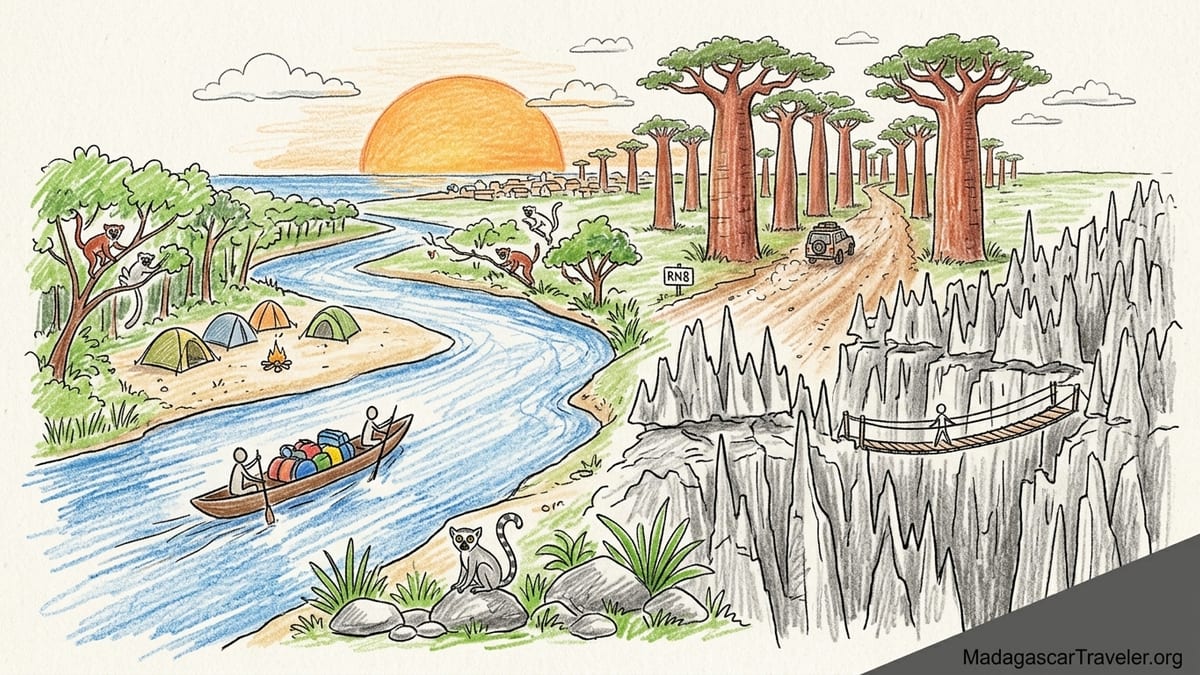
How the Tsiribihina–Tsingy–Baobabs Circuit Fits Together
Most commercial expeditions follow a similar structure: travelers start in Antananarivo, travel by road to Miandrivazo, spend two or three days descending the Tsiribihina River by traditional pirogue or motor barge, then disembark near Belo-sur-Tsiribihina. From there a 4x4 takes over, driving on the rough RN8 track via Belo to Bekopaka, the gateway village for Tsingy de Bemaraha National Park. After one or two full days in the Tsingy, the same 4x4 returns south via Belo and the ferry crossings, stopping at the Avenue of the Baobabs before finishing in Morondava on the Mozambican Channel.
Typical combined itineraries marketed by Malagasy agencies span 8 to 11 days, including overland transfers from Antananarivo. For example, some West Circuit packages run Antananarivo – Antsirabe – Miandrivazo – Tsiribihina River – Belo-sur-Tsiribihina – Bekopaka (Tsingy de Bemaraha) – Morondava – Avenue of the Baobabs, before flying or driving back to the capital. Others extend south along the RN7 after Morondava, but the river descent and Tsingy are usually positioned as the core adventure segment.
In practice this means the river is only one part of a larger loop. Operators market the descent as the wilderness highlight, while the Tsingy and Baobabs serve as iconic “headline” sights that justify the cost of the 4x4 and park fees. When budgeting or comparing quotes, it is worth asking agencies exactly how many nights are spent in tents on the river banks, in basic lodges at Bekopaka, and in hotels at Morondava or Antsirabe, because comfort and price can vary significantly by night.
Travelers with less time sometimes skip the river and travel by 4x4 directly between Morondava and Bekopaka. However, the growth of specialist river outfitters and combined “Tsiribihina + Tsingy + Baobabs” programs has created a clear river-expedition niche for those who want a multi-day journey by water as well as the famous stone forest and baobab vistas.
Pirogue vs Riverboat: Choosing Your Style of Descent
There are two main ways to travel down the Tsiribihina: in a traditional wooden pirogue powered by paddles, or on a flat-bottomed motor barge sometimes marketed as a “chaland” or simple riverboat. Both generally cover the same stretch of river between the Miandrivazo area and the disembarkation point north of Belo-sur-Tsiribihina, but they feel very different in pace and comfort.
Pirogue trips are the purist’s option. You sit low to the water in a dugout-style canoe, usually with two boatmen who paddle and steer while you recline on thin mattresses under a canvas or tarp for shade. Distances each day depend on current and wind, but operators typically plan three days on the water and two nights camping on sandbanks. Because pirogues are narrow and pack light, the setup is simple: dry bags, a small kitchen crate, folding tables and stools, and igloo-style tents. This style appeals to travelers who like slow travel and do not mind basic conditions.
Riverboats or chalands are larger, wooden, motorized barges with a roof deck where travelers sit or lie on mattresses. Many are fitted with a simple galley and rudimentary toilet cubicle. They can carry more supplies and staff, so meals tend to be more elaborate and there is usually a bit more shade and space to move around. These boats sometimes run the descent in two days and two nights instead of three, because the engine makes progress less dependent on currents and paddling stamina.
Prices vary by group size and season, but as a broad guide, shared pirogue or barge packages including camping equipment, meals, guide, and 4x4 onward to Bekopaka often start around the equivalent of a few hundred US dollars per person for multi-day itineraries, with private departures costing more. Luxury upgrades focus on the Tsingy and Morondava hotels rather than the river itself, which remains intentionally rustic. When comparing offers, look closely at how many staff accompany the group, whether mattresses and chairs are included, and if there is a support vehicle meeting the group at the end of the descent.
Life on the River: Camping, Meals and Daily Rhythm
Regardless of boat type, life on the Tsiribihina quickly settles into a gentle routine. Days usually start early, often around sunrise, to take advantage of cooler temperatures and calm conditions. After a simple breakfast on the boat or on shore, you travel for several hours, stopping occasionally at riverside villages to buy fruit or charcoal, or to stretch your legs. A longer break around midday is common to avoid paddling or motoring under the strongest sun, with lunch served on a shaded sandbank.
Camping is usually on wide sandbars that emerge as the river level falls in the dry season, roughly from May to October. The crew looks for spots with firm sand, enough distance from steep eroding banks, and a view that allows them to monitor the river for rising water or passing barges. Operators provide igloo or dome tents, foam mattresses and basic bedding, though some travelers prefer to bring their own sleeping liner or inflatable pillow. There is no formal infrastructure: these are genuinely wild camps with no permanent facilities.
Meals are often better than travelers expect, given the conditions. Crews prepare dishes such as zebu stew, rice, grilled fish from the river, vegetable curries and simple salads, cooked over charcoal or gas stoves. Breakfast might be baguette or local bread with jam, eggs, coffee and tea. Most trips include drinking water, though you shouldconfirm this and consider bringing a personal filter bottle or purification tablets as backup. Vegetarians are usually catered for if the agency is informed in advance, but vegan and strict gluten-free diets can be challenging in remote areas.
Evenings on the river are one of the main reasons to choose the Tsiribihina descent. As the sun drops, the sandbank cools, camp chairs appear, and the crew may light a small campfire if conditions allow. On some trips, local villagers paddle over to sell coconuts or homemade rum. With little light pollution, the Milky Way is often visible, and the soundscape is mostly insects, frogs, and the rush of the river. It feels far from the paved roads that you will use again on the way to Bekopaka.
Wildlife, Waterfalls and Side Excursions
The Tsiribihina is not a high-density wildlife river like parts of mainland Africa, but there is enough to keep keen eyes busy. Travelers commonly report seeing troops of Verreaux’s sifaka and red-fronted brown lemurs leaping in the trees along the banks, especially in the morning and late afternoon. Several chameleon species inhabit the surrounding dry forest, and birdlife is varied, with herons, egrets, bee-eaters, kingfishers and Malagasy fish eagles appearing regularly along the water.
One of the most memorable stops is at a waterfall fed by a side stream. Boats moor on the bank and you follow a short trail through dry forest into a narrow, shady gorge. The falls themselves are not enormous, but the contrast between hot, dusty river days and cool spray is dramatic, and many itineraries allow time for a short swim in the natural pool. Because of the risk of waterborne parasites in freshwater in Madagascar, including schistosomiasis, some travelers prefer to dip only briefly or avoid full immersion and instead enjoy the shade and photography around the pool.
Other side excursions include short walks to small villages, where you might see traditional houses on stilts, tobacco drying racks, and simple riverine agriculture. Some itineraries also stop at caves or rock overhangs with local cultural significance, though the most elaborate cave and tomb visits are typically saved for the Manambolo River near the Tsingy. Throughout, it is polite to ask before photographing people and to carry small change if you wish to buy fruit, snacks or handicrafts.
Wildlife viewing continues after the river portion when you move toward the Tsingy. Many circuits include a stop in Kirindy Forest either on the way back to Morondava or as a separate extension, where night walks can reveal the fossa, nocturnal lemurs and more specialized dry-forest species. When discussing itinerary options with agencies, ask how they stack wildlife opportunities across the river, Tsingy, and any forest stops so you understand where your best chances lie.
Practicalities: Luggage, Sanitation and Safety on the River
Because camps are moved every day, it is important to pack light and use the right bags. Operators usually recommend one soft duffel or backpack per person plus a small daypack. Hard suitcases are awkward in pirogues and on sandbanks. Many agencies provide basic plastic sheeting or tarps, but it is wiser to put your gear in waterproof duffels or separate dry bags and to pack electronics and documents in smaller roll-top dry sacks. A lightweight, quick-drying towel is more useful than a heavy hotel towel.
Sanitation is rudimentary. On most camping trips, the crew digs a simple toilet pit in the sand some distance from the tents, sometimes with a canvas screen for privacy. There are no permanent toilets or showers along the river. You wash with buckets of river water or with wet wipes; some travelers bring a compact solar shower bag. Biodegradable soap is strongly recommended to reduce the impact on the ecosystem. Women may find a folding privacy shelter especially helpful, as the open sandbanks can feel exposed in busy seasons.
Safety on the river depends largely on boat condition and crew experience. Legitimate operators maintain their pirogues and barges and provide life jackets, which you should wear when the boat is underway. Because boat travel in Madagascar can be risky if overloaded or poorly maintained, it is worth asking agencies which local company they work with, how many years their guides have been running the descent, and whether safety gear is included. Avoid heavily overloaded boats and be cautious about night navigation, which reputable outfits generally avoid on the Tsiribihina.
Health precautions include sun protection, hydration, and insect bite avoidance. The sun on the water is intense, so wide-brim hats, high-SPF sunscreen, and long-sleeve lightweight clothing are more important here than in many inland parts of the country. Mosquitoes and other biting insects can be present at dusk and dawn; a tent with intact netting and insect repellent containing DEET or picaridin are advisable. Consult a travel medicine provider well before departure about malaria prevention and routine vaccinations for Madagascar, and let your guide know if you have any medical conditions that might affect your ability to cope with heat or long days outdoors.
From River to Stone Forest: The 4x4 Route to Bekopaka and Morondava
The transition from water to rock happens at or near Belo-sur-Tsiribihina, a busy riverside town that acts as a gateway between the Tsiribihina and the northern reaches of RN8. River expeditions typically end by late morning or midday here, with a final lunch on board or in town. Some packages include a proper restaurant meal in Belo, at one of the better-known eateries that cater to Tsingy-bound travelers, before the 4x4 leg begins.
From Belo to Bekopaka is a long day in a vehicle, even though the distance is not enormous on the map. The road is essentially a dirt track that can become muddy and rutted in the rainy season and remains rough even in the dry. Two ferry crossings are typically involved when heading north, and delays are common. Travel times of seven to nine hours are standard for this stretch in the dry season. For this reason, most agencies insist on robust 4x4s with experienced drivers and avoid scheduling this segment outside the main Tsingy season, when water levels and road conditions are less predictable.
Bekopaka itself is a low-rise village on the banks of the Manambolo River, with a cluster of small hotels and lodges that range from simple bungalows with cold water to more comfortable properties with pools and better restaurant service. Popular mid-range options often appear in tour descriptions and allow agencies to keep packages competitive while still offering air-conditioned rooms. It is common to spend two or three nights here, giving time for at least one full day in the Grande Tsingy and one in the Petit Tsingy and Manambolo gorge.
After the Tsingy, most combined itineraries return south along the same RN8 track to Belo, then continue to Morondava, usually timing the drive so that arrival at the Avenue of the Baobabs coincides with sunset. The famous dirt road lined with Adansonia grandidieri is actually part of the RN8 corridor north of Morondava, so it slots naturally into the final stretch. Some travelers then overnight in Morondava and fly back to Antananarivo, while others continue overland on multi-week west-and-south circuits.
How Many Days You Really Need and What It Costs
While brochures may mention “8-day” or “10-day” programs, it helps to break this into functional travel days. For a typical Antananarivo-based traveler, one day is spent reaching Antsirabe or Miandrivazo, two to three days on the river, one day transferring from Belo to Bekopaka, one or two full days in the Tsingy, and one long day back to Morondava with the Avenue of the Baobabs at sunset. That gives a practical minimum of around seven or eight days for the Tsiribihina–Tsingy–Baobabs sequence alone, not counting any buffer days or onward travel.
Travelers who want a more relaxed pace or who are building a broader Madagascar itinerary often extend this to 10 or 12 days, adding extra time in Antsirabe, Morondava or Kirindy Forest. Because road conditions, ferry queues and weather can all cause delays, including at least one buffer day in your overall plan is wise, especially if you have a fixed-date international flight from Antananarivo at the end of the trip.
Pricing is highly variable, influenced by group size, accommodation level at Bekopaka and Morondava, internal flights, and park fees. Mid-range organized trips that include the Tsiribihina descent, camping gear, 4x4 transport, guide, Tsingy park entry, and hotel nights typically run into the low thousands of US dollars per person for itineraries of roughly 8 to 12 days, especially when internal flights and capital-city hotels are included. Budget-conscious travelers sometimes try to arrange a river crew and then negotiate a separate 4x4 from Morondava or Belo, but the complexity of ferries and road conditions means many still opt for agency packages.
If you are traveling independently, one practical benchmark comes from recent travelers who report paying the equivalent of several hundred dollars per day for a private 4x4 and driver, plus fuel and accommodation, on western Madagascar routes. Group tours can reduce the per-person cost substantially, while private, fully customized expeditions with higher-end lodges at Bekopaka tend to be the most expensive. Always check precisely what is included: some quotes cover park guides and entrance fees, while others expect you to pay those in cash locally.
When to Go and How to Pick a Reliable Operator
The main season for Tsiribihina descents and Tsingy de Bemaraha visits runs from roughly May to October. During this period, river levels are usually suitable for pirogues and barges, the sandbanks for camping are exposed, and the RN8 track to Bekopaka is more passable. In April and November, some agencies still operate but may warn about higher heat, occasional storms and more difficult road or ferry conditions. The Tsingy is often inaccessible or officially closed in parts of the rainy season due to safety concerns on slippery limestone and flooded access routes.
Within the dry season, July and August can be busy with European summer holidays, leading to more competition for the best guides and river crews. Shoulder months such as June and September often offer a good balance of pleasant weather and slightly fewer visitors, though availability still needs to be checked well ahead if your dates are fixed. Because the entire west coast route depends on a combination of local boatmen, ferries and small lodges, last-minute arrangements carry more risk here than in some other regions of Madagascar.
Choosing a reliable operator matters more on a river–4x4 combination than on a simple hotel-based tour. When comparing agencies, look for those that describe the river segment in concrete terms: number of nights camping, boat type, maximum group size, crew composition, and safety equipment. Ask how many years they have worked with their river partners, and whether the guides on board speak your language. For the 4x4 portion, check whether they use their own vehicles or subcontract to local drivers, and whether those drivers know the RN8 and ferry crossings well.
Independent feedback from recent travelers can be invaluable. While some visitors share detailed trip reports mentioning specific companies, drivers and guides, keep in mind that conditions on the ground change and staff move on. Use these reports as reference points rather than guarantees, and always confirm up-to-date details directly with the operator. Finally, check payment terms and cancellation policies carefully, as river expeditions and Tsingy visits are particularly vulnerable to disruption by weather, road closures or unexpected ferry issues.
FAQ
Q1. How many days do I need for a Tsiribihina River descent plus Tsingy and Avenue of the Baobabs? Most travelers should plan at least seven to eight days for the river, transfers, one or two days in the Tsingy, and the stop at the Avenue of the Baobabs, not counting extra time in Antananarivo or other regions.
Q2. Is a pirogue or a motor barge better for the Tsiribihina? A pirogue offers a quieter, more traditional experience but is more basic and slower, while a motor barge provides extra space, some shelter and sometimes a basic toilet, at the cost of more engine noise and a slightly less “expedition” feel.
Q3. What level of camping comfort should I expect on the river? Expect simple, wild camping on sandbanks with small tents, foam mattresses and basic bedding, a dug toilet in the sand, bucket washing with river water and no permanent facilities or showers.
Q4. Are meals and drinking water included on Tsiribihina tours? On most organized descents, three meals a day and drinking water are included, but you should confirm this in writing and consider bringing a personal filter bottle or purification tablets as an extra precaution.
Q5. How does my luggage get from the river to Bekopaka and Morondava? Your main luggage usually travels with you on the boat, then is transferred into the 4x4 at Belo-sur-Tsiribihina, staying with the vehicle as you continue north to Bekopaka and later south to Morondava.
Q6. Is the route from Belo-sur-Tsiribihina to Bekopaka safe? It is a demanding dirt track that requires an experienced 4x4 driver and can be tiring, but reputable agencies know the route, use appropriate vehicles and plan around daylight and ferry schedules to keep risks manageable.
Q7. When is the best season to combine the river, Tsingy and Baobabs? The most reliable window is usually from May to October, when the river level, camping sandbanks and RN8 access to Bekopaka are all more favorable and the Tsingy circuits are open.
Q8. Can I join the river tour in Morondava instead of starting in Antananarivo? Some travelers arrange to meet an agency or driver in Morondava and then connect to the river and Tsingy circuit, but many standard programs still start and end in Antananarivo for logistical reasons and internal flight connections.
Q9. Do I need previous camping or paddling experience for the Tsiribihina? No technical experience is required as boatmen handle navigation and crews manage camp, but you should be comfortable with basic camping, limited sanitation and full days outdoors in sun and heat.
Q10. Is it possible to visit only the Tsingy and Avenue of the Baobabs without the river? Yes, many 4x4 tours run directly between Morondava and Bekopaka to focus on Tsingy de Bemaraha and the Baobabs, though including the Tsiribihina descent adds a distinctive river-expedition dimension to the trip.