


Reaching Western Madagascar’s wild highlights from Morondava is not a simple car rental errand. The rough RN8 piste to Tsingy de Bemaraha, the sand tracks around Kirindy, seasonal ferries and long driving hours mean that in 2026 most visitors now book a chauffeur-driven 4x4 rather than attempting to self-drive. This guide explains exactly how those Morondava-based 4x4 arrangements work, what is included in the price, and how to compare bare 4x4 plus driver, driver-guide and fully packaged vehicle options for Tsingy, Kirindy and the Baobab Avenue.
Why Morondava 4x4 With Driver Is the New Default
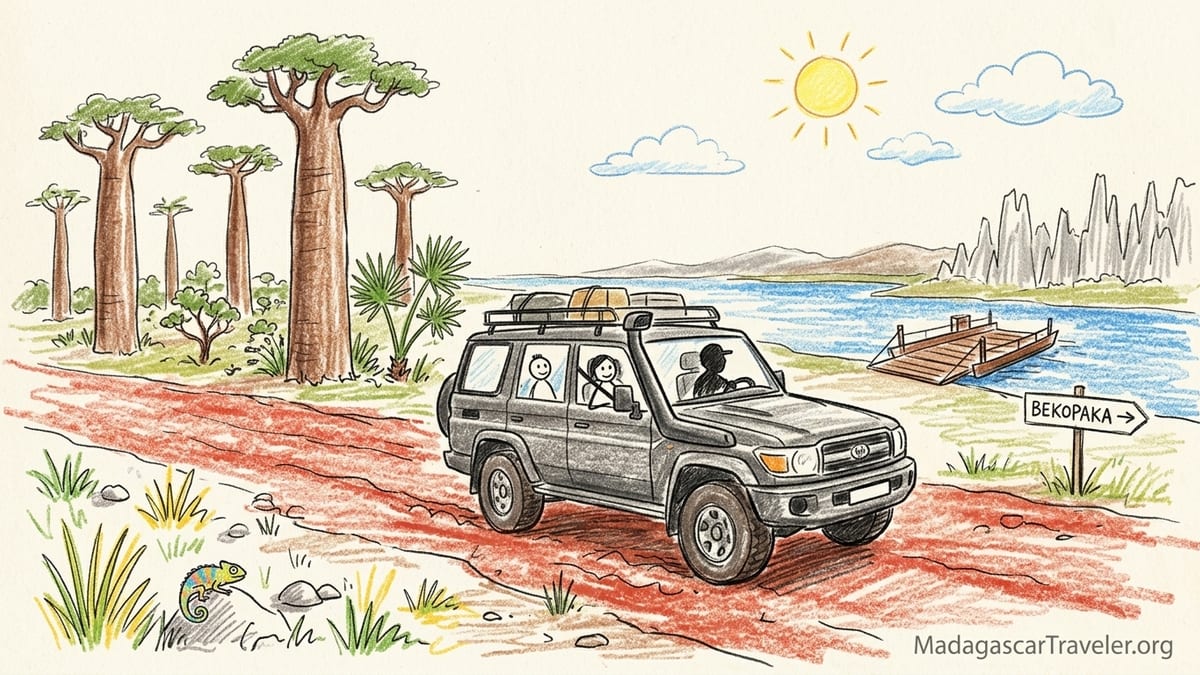
Western Madagascar’s showcase trio of Morondava, Tsingy de Bemaraha and Kirindy Forest sit at the end of one of the country’s roughest access routes. The RN8 from Morondava to Bekopaka, the gateway village for Tsingy, is officially under 200 kilometres, but in practice it is a full day of ruts, sand, dust and river crossings that only high-clearance 4x4 vehicles can handle reliably during the dry season. Local tourism offices in Morondava report that independent self-drive attempts have dropped sharply, with most visitors now hiring a vehicle and driver or buying a packaged 4x4 tour that departs directly from town.
This shift is driven by a mix of safety, comfort and logistics. The track changes every rainy season, small wooden ferries on the Tsiribihina and Manambolo rivers follow variable schedules, and breakdown support outside towns is minimal. A local driver who knows current detours and ferry habits is not a luxury but a form of insurance. For a pair or a small group, the daily rate for a chauffeur-driven 4x4 from Morondava has become the standard way to reach Kirindy and Tsingy while still keeping flexibility around hotels and activities.
Equally important, Madagascar National Parks regulations at Tsingy require visitors to take certified local guides inside the park. Even travellers experienced with remote tracks gain little by driving themselves when they must still hire a local guide on arrival. A Morondava-based driver or driver-guide handles the road and logistics, then hands over to the park guide for the actual Tsingy circuits, creating a practical division of roles.
Finally, domestic flights between Antananarivo and Morondava have stabilised but remain limited in frequency. Many travellers now fly one way to Morondava, meet a pre-booked 4x4 and driver, then loop through Kirindy and Tsingy before continuing overland toward Tulear or back to the capital. For these complex point-to-point itineraries, a local driver is far easier to arrange than a self-drive rental that may not be insurable for RN8 conditions.
Understanding the Main Transport Options From Morondava
From a transport perspective, travellers heading from Morondava toward Kirindy or Tsingy de Bemaraha in 2026 encounter three main options. The first is a basic 4x4 plus driver arrangement. Here you pay a daily rate for the vehicle, a professional driver and usually fuel, then you handle your own hotels, meals and park arrangements. This is the most common set-up used by local Morondava agencies and individual drivers advertising through guesthouses.
The second option is to upgrade to a driver-guide. In practice, this means your driver speaks better English or French, is comfortable interpreting local culture, and can explain what you are seeing along the road and at sites like the Baobab Avenue or Kirindy. On the tracks themselves, the driving is similar, but communication is smoother, and they may help with negotiating room prices, ferry queues and restaurant orders en route. Rates are higher than for straightforward drivers but the difference can be worthwhile if no one in your group speaks French or Malagasy.
The third option is a fully packaged 4x4 tour that starts and ends in Morondava. These are usually sold by Morondava-based operators, some attached to established beach hotels, and bundle the 4x4 with driver, fuel, ferry fees, park entrance tickets, obligatory local guides at Tsingy, and accommodation in Bekopaka and en route. Prices are quoted per person for fixed itineraries of three to five days, and the experience feels more like a small-group safari than a transport hire.
All three options use the same fundamental piece of infrastructure: a robust 4x4 and driver trained for the RN8 and the sandy side roads through Kirindy and Baobab country. The biggest differences are what is included in the daily rate, who holds the risk for price fluctuations in fuel and ferries, and how much flexibility you keep to change your route or choose your own guesthouses at short notice.
Typical 2026 Daily Rates, Fuel and Ferry Fees
By mid 2026, Morondava-based companies specialising in Tsingy runs are quoting around 450,000 to 500,000 Malagasy ariary per day for a 4x4 with driver on the Tsingy itinerary when fuel is included, but ferry fees are extra. One prominent local agency describes a “location Tsingy” price of 450,000 ariary per day for four or more days round trip from Morondava, covering the vehicle, driver and fuel, specifically stating that river “bac” charges are not included. In euro terms, that base rate sits roughly in the 90 to 100 euro per day range, depending on exchange rates.
Private drivers sourced through guesthouses or informal contacts sometimes quote lower daily figures, closer to 250,000 to 350,000 ariary, then add fuel on top. A recent independent traveller report from August 2026 mentioned paying 250,000 ariary per day for a 4x4 and driver elsewhere in Madagascar, plus fuel, which reflects the lower end of the general market. For the Tsingy route from Morondava, where distances and conditions are tougher and demand is concentrated in a short season, most travellers find real-world negotiations land higher than that baseline.
Ferry costs are an important detail. On the Morondava to Bekopaka stretch, 4x4s must cross at least two rivers on small barges. Operators commonly ask clients to cover these ferry fees in cash on the day of travel, quoting approximate totals rather than exact figures because prices can shift seasonally or between operators. As a rough guide, you can expect ferry charges for a 4x4 and passengers to add the equivalent of several tens of euros to a return Morondava–Bekopaka trip. On some higher-end packaged tours, ferries are folded into the total price so clients do not handle payments directly.
Fuel itself is typically included in newer “Tsingy special” tariffs because calculating exact consumption on RN8 is difficult. Soft sand, detours and air conditioning usage can all raise consumption. Operators that prefer a fuel-excluded rate will usually agree an approximate daily kilometre allowance and then ask you to pay for refuels at local stations along the way, which can be inconvenient given the scarcity of fuel in the interior and the need for jerrycans. For most travellers, a fuel-inclusive daily rate agreed up front is simpler and less stressful.
Driver, Driver-Guide and Full Package: How They Compare
Choosing between a basic driver, a driver-guide and a fully packaged 4x4 tour depends on budget, language needs and how much you enjoy planning. A simple 4x4 plus driver, with fuel included but ferries and accommodation excluded, is often the best-value solution for small groups of three or four who are comfortable booking hotels themselves and handling park payments in Bekopaka. If your driver charges 480,000 ariary per day including fuel and you share it between four people, your transport cost for a four-day Tsingy loop from Morondava can sit around 120,000 ariary per person per day, before ferries and park fees.
Opting for a driver-guide typically adds a premium of 15 to 30 percent. In return, you gain a companion who can translate, brief you on local customs and wildlife, and help weave in stops at the Baobab Avenue at sunset or Kirindy for a night walk. Some Morondava-based outfits explicitly market their English-speaking driver-guides at higher daily rates, while others provide standard drivers who speak Malagasy and basic French. For solo travellers and couples without French, the easier communication with a driver-guide can be worth more than the cost difference.
Fully packaged 4x4 tours from Morondava offer a third level of service. For example, a three-day Morondava–Tsingy–Morondava package might include return 4x4 with driver, ferries, two or three nights in Bekopaka, park fees and local guiding, with prices advertised in the range of roughly 150 to 450 euros per person depending on group size and hotel category. Over four or five days, those figures rise accordingly. Per-person transport costs are higher than a simple driver hire when you compare line by line, but you gain the comfort of a single quote that covers almost all moving parts.
The trade-off with packages is flexibility. Simple 4x4 hire allows you to extend a stay in Kirindy or add a night in Belo-sur-Tsiribihina if you enjoy the slow pace. Packaged tours tend to follow fixed itineraries to manage ferry timings and hotel reservations. If your priority is to see Tsingy efficiently in a short window and you prefer not to negotiate locally, a full package can be attractive. If you want the freedom to linger under the baobabs or switch guesthouses at the last minute, a more basic 4x4 plus driver is the better fit.
How Many Days You Really Need: Sample 4x4 Itineraries
One of the most common surprises for visitors is how long the Morondava to Tsingy journey actually takes in a 4x4. Allowance should be made not just for distance, but for ferry queues, occasional stuck vehicles and stops in small towns. In practice, most reputable Morondava operators now insist on at least three full days for a Baobab and Tsingy run, and four days if you also want daylight time in Kirindy Forest.
A tight three-day schedule from Morondava might look like this: Day 1, early departure from Morondava with sunrise or morning light at the Baobab Avenue, then continue via Belo-sur-Tsiribihina and the ferries to Bekopaka, arriving late afternoon. Day 2, a full day inside Tsingy de Bemaraha National Park with a local park guide, visiting Petit Tsingy in the morning and Grand Tsingy or a Manambolo pirogue trip later if time and energy permit. Day 3, return to Morondava the same way, sometimes including a second stop at the baobabs for sunset if delays allow. This is an intense schedule with two very long driving days.
A more balanced four-day 4x4 itinerary is increasingly popular. Day 1, Morondava to Kirindy with an afternoon or night walk for nocturnal wildlife and an overnight near the reserve. Day 2, Kirindy to Bekopaka via the ferries. Day 3, full Tsingy exploration. Day 4, Bekopaka back to Morondava with the Baobab Avenue at golden hour before returning to town. For those with extra time, a five-day loop that adds an overnight in Belo-sur-Tsiribihina or an extra Tsingy day gives more margin for bad roads or weather while keeping costs within reach.
Because 4x4 pricing is almost always quoted per calendar day, adding an extra day does increase the budget. Yet on a route where a single tyre problem or a slow ferry can easily add several hours, having a spare day built into your 4x4 hire from Morondava often feels less like an indulgence and more like sensible risk management. Discuss realistic timings with your chosen driver or operator before confirming how many days you need.
Vehicle Condition, Comfort and Driver Accommodation
The condition of 4x4 vehicles working the Morondava to Tsingy route in 2026 varies from older but serviceable Toyota Land Cruisers to more recent double-cab pickups adapted for passengers. Established Morondava agencies tend to maintain fleets with high ground clearance, snorkels for river approaches and heavy-duty suspension. Independent drivers may operate vehicles that look rough on the outside but are mechanically sound. In all cases, travellers should expect a utilitarian interior rather than luxury, dust leakage during the dry season and intermittent air conditioning.
Road stories from recent travellers underline that a functioning air conditioning system is not guaranteed. On the RN8, many drivers prefer windows down to avoid overloading engines on long stretches of ruts and sand, leaving passengers dusty by the end of the day. Asking specifically about air conditioning, seat belts and spare tyre arrangements before you confirm your booking is wise, especially if you are travelling with older relatives or children. Photos of the actual vehicle your group will use are increasingly common in online correspondence with Morondava operators.
Driver accommodation is another cost that travellers sometimes overlook. On most Morondava-based 4x4 hires, clients are expected to cover the driver’s food and lodging on the road. In practice, this is handled in two main ways. Some agencies build a flat daily “per diem” into the overall tariff and tell you that the driver’s meals and simple room are already included. Others ask you to pay for a modest room and meals in the same hotel compound where you are staying, often at a significantly reduced staff rate. Either arrangement is normal, but you should clarify which applies before departure so there are no awkward conversations at check-in in Bekopaka.
At the budget end of the spectrum, a few operators propose that drivers sleep in the vehicle or on basic mats in staff quarters, which reduces costs but may not be ideal on a multi-day route that demands concentration and long hours. For safety, sufficiently rested drivers are essential, so most travellers accept the small extra cost of a proper room. As a rule of thumb, adding the equivalent of 10 to 20 euros per night to your calculations for the driver’s accommodation and food will give you a realistic picture of your overall transport budget.
Language, Local Guides and One-Way versus Round Trip
Language ability in Western Madagascar’s transport sector follows a consistent pattern. Most drivers from Morondava speak Malagasy and varying levels of French, while fluent English remains relatively rare. Local tourism forums are full of comments that English-speaking drivers are harder to find in Morondava than in Antananarivo and that those few who are confident in English are in high demand from June to October. As a result, agencies that can reliably assign English-speaking driver-guides for Tsingy runs often charge a premium.
Inside Tsingy de Bemaraha National Park, separate local guides from Bekopaka are obligatory, and several of them speak functional English. Your Morondava driver normally stays with the vehicle at the park office or nearby, while you pay park entrance and guide fees directly at official desks. In 2026, recently updated tariffs for standard circuits at Tsingy list fixed prices for one to four foreign visitors and slightly higher amounts for larger groups, making it easy to split costs. These park fees are distinct from your Morondava 4x4 hire and are usually not included unless you buy a fully packaged tour.
Another growing consideration is one-way versus round-trip 4x4 arrangements. Traditionally, Morondava-based drivers expected to bring clients from Morondava to Tsingy and back again. Increasingly, however, travellers are designing routes that use Morondava as a starting or ending point only. For instance, you might fly Antananarivo to Morondava, then hire a 4x4 with driver for a Tsingy loop and continue south along the coastal track toward Tulear and the RN7, finishing in another city. In these cases, the driver’s “dead leg” back to their base must be factored into the quote.
Some Morondava agencies handle this by charging a one-way supplement or counting an extra day in the daily tally to cover the return without passengers. Others prefer to sell only round-trip packages that begin and end in Morondava. When you first contact a driver or agency, be clear whether you need a loop or a point-to-point route. For one-way plans, you may find it more economical to work with an Antananarivo-based operator that runs circuits via Morondava, though at the cost of slightly higher overall vehicle days.
Booking Channels, Seasonality and Practical Tips
By 2026, the most reliable way to arrange a 4x4 with driver from Morondava is still through local tourism offices, reputable guesthouses and established agencies linked to well-known hotels. Names change as businesses open and close, but a consistent trait is that these operators have vehicles permanently based in Morondava, relationships with the Bekopaka hotels and daily news of RN8 conditions. International tour companies often subcontract to the same local drivers and agencies, adding coordination fees on top.
High season for Western Madagascar runs from roughly June to October, when the tracks to Tsingy de Bemaraha are dry enough for 4x4 traffic and the park is fully open. Shoulder months at the start and end of this window can still see mud patches and higher chances of delays. In the rainy season, from around December to March, the RN8 can become impassable and Tsingy itself usually closes to visitors for safety reasons. During the open season, English-speaking drivers and solid vehicles book up quickly, so advance communication is strongly recommended if your travel dates are fixed.
When comparing quotes, look for clear statements on what is included: daily rate, fuel, ferry fees, driver’s food and lodging, and whether any park fees or local guiding are built in. Ask how many passengers the quoted price covers. In Western Madagascar, a single 4x4 typically carries up to four adult passengers plus the driver comfortably; adding a fifth may be possible but will feel cramped on 12-hour driving days. Confirm payment terms and whether deposits are refundable if heavy rains or park closures force a change of plan.
Finally, remember that Tsingy and Kirindy are frontier destinations in travel terms. Even with a robust 4x4 and experienced driver from Morondava, you should be prepared for long days, dust, heat and occasional changes to the schedule. A transport arrangement that looks slightly conservative on paper, with an extra day or a slightly higher-end vehicle, often provides a smoother experience once you are out on the RN8 among the baobabs and ferries.
The Takeaway
For travellers focused on Western Madagascar, the key decision is no longer whether to rent a 4x4 at all, but which form of chauffeur-driven 4x4 best matches their expectations. In 2026, the market around Morondava has matured toward fuel-inclusive daily rates for solid vehicles and experienced drivers, while leaving ferry fees and park charges mostly separate. Basic 4x4 plus driver arrangements remain the most flexible and economical for small groups ready to organise their own hotels and park visits. Driver-guides add communication ease and interpretation but at a premium, and fully packaged 4x4 tours offer a simpler, more predictable experience for those who prefer not to negotiate each step.
Whichever tier you choose, the fundamentals are constant. The RN8 and the sand tracks around Kirindy and Baobab Avenue demand proper 4x4s, patient drivers and realistic timing. Taking time before your trip to clarify what is included in the quote, how many days you truly need, where your driver will sleep and how language and local park guiding will be handled will reward you with a journey that feels like an adventure for the right reasons rather than for the wrong ones. From Morondava’s beaches to the jagged limestone pinnacles of Tsingy, a well-chosen driver and 4x4 are the backbone of a memorable Western Madagascar itinerary.
FAQ
Q1. How much does a 4x4 with driver from Morondava to Tsingy cost in 2026?
Typical 2026 rates for a Morondava-based 4x4 with driver and fuel for the Tsingy route start around 450,000 to 500,000 ariary per day, with ferry fees and park costs usually excluded. Independent drivers may quote lower daily rates but then ask you to pay fuel separately.
Q2. Are ferry fees usually included in Morondava 4x4 prices?
Most Morondava operators now include fuel but keep the river ferry charges separate, asking clients to pay those in cash on the day. Some higher-end packaged tours fold ferries into their total price, but for simple 4x4 hire it is safer to assume ferries are extra.
Q3. How many days do I need for a Morondava–Tsingy round trip by 4x4?
A very tight visit needs three full days, with two long driving days and one day inside Tsingy. Many travellers now choose four days to add Kirindy or to build in a margin for delays, while five days offers the most relaxed schedule.
Q4. What is the difference between a driver and a driver-guide?
A standard driver focuses on safe driving and basic logistics and usually speaks Malagasy and some French. A driver-guide adds stronger language skills, explanations about what you see along the way and more help with practical issues like hotel check-ins and restaurant orders.
Q5. Can I arrange a one-way 4x4 trip that does not return to Morondava?
Yes, but expect to pay a supplement or for extra vehicle days so the driver can return to base without you. Some agencies prefer loop itineraries that start and end in Morondava, so mention your one-way plans clearly when you first request a quote.
Q6. Do I still need a local guide inside Tsingy if I have a driver-guide from Morondava?
Yes. Tsingy de Bemaraha requires visitors to hire certified local guides based in Bekopaka for the park circuits. Your Morondava driver or driver-guide normally waits with the vehicle while you explore the park with the local guide.
Q7. What condition are the 4x4 vehicles in on the Tsingy route?
Most vehicles are rugged Toyota Land Cruisers or similar pickups, mechanically prepared for RN8 conditions but basic inside. They are built for function rather than comfort, and air conditioning may not always work or may be used sparingly on difficult sections.
Q8. Do I have to pay for the driver’s accommodation and meals?
Often you do. Some 4x4 rates include a daily allowance for the driver’s food and lodging, while others expect you to cover a simple room and meals along the route. Always clarify the arrangement before confirming your booking.
Q9. Is it realistic to self-drive from Morondava to Tsingy instead of hiring a driver?
While technically possible for very experienced off-road drivers, self-drive on RN8 is challenging and not recommended for most visitors. Road conditions, limited backup and unpredictable ferry logistics mean that hiring a local driver is safer and, once costs are shared across a small group, not much more expensive.
Q10. When is the best season to book a 4x4 with driver from Morondava for Tsingy?
The main season runs roughly from June to October, when tracks are dry and Tsingy is open. During this period demand for good drivers and vehicles is high, so it is sensible to reserve your 4x4 and driver several months in advance if you have fixed travel dates.