


Planning my time around Toliara, on Madagascar’s southwest coast, I assumed the city would work as an easy base for day trips: one hotel, light daypacks, and simple forays to the beaches and reserves that ring the bay. The reality on the ground was more nuanced. Distances looked short on the map, but rough surfaces, tides, heat and early boat departures turned some “quick excursions” into full travel days. After testing Toliara as a hub for Antsokay Arboretum, Ifaty and Mangily, the Anakao boat crossing, nearby fishing villages and the inland RN7, I learned where basing in town genuinely saves time and packing, and where it simply means backtracking through the same checkpoints and sand tracks again and again.
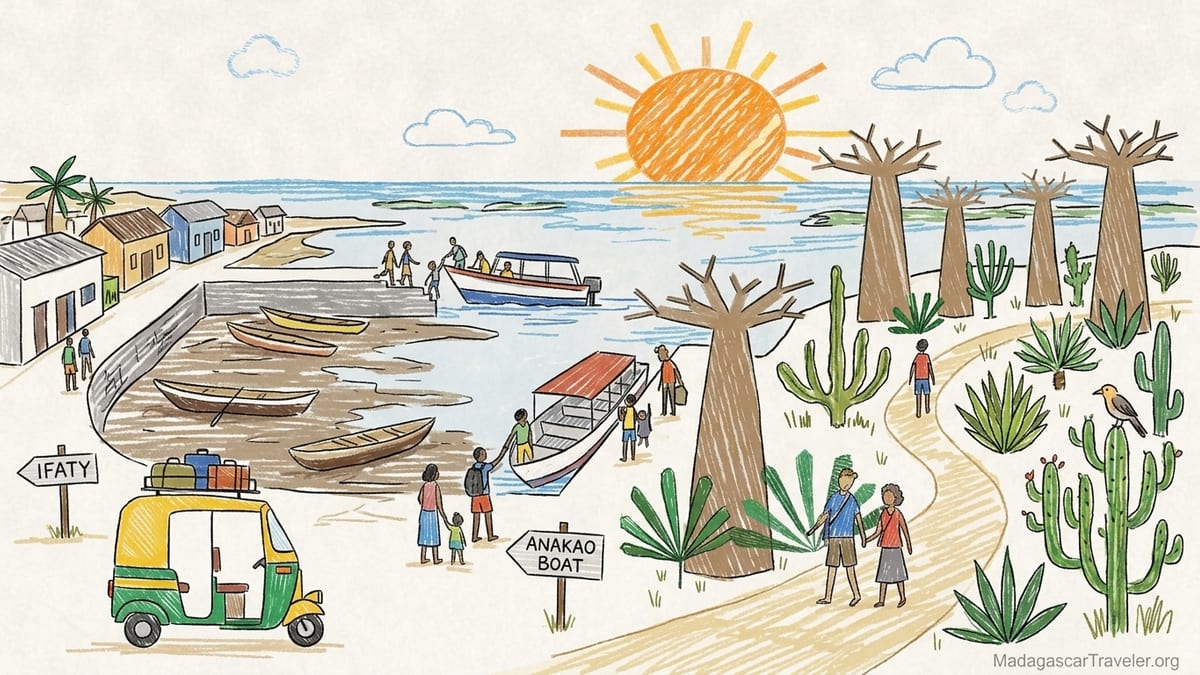
Toliara Today: A Practical Hub, Not Just a Transit Stop
Toliara (also written Tuléar) is the main gateway to Madagascar’s dry southwest, a low-rise city spread along the Mozambique Channel. It anchors the southern end of the RN7 highway and the coastal RN9, and its small airport handles flights from Antananarivo and occasionally other regional cities. On paper it is the place domestic airlines, boat companies and road transfers converge, which is why many itineraries label it “base for the southwest.” In practice, it feels more like a logistics hub than a classic city-break destination, but staying here for a few nights can make sense if you plan your excursions carefully.
The seafront around Boulevard Lyautey has simple hotels, small restaurants serving grilled fish and zebu brochettes, and a modest evening promenade. The city’s own beach is working waterfront rather than resort strand, with pirogues pulled up on the mudflats at low tide and salt-laden breezes rather than photogenic turquoise in front of your room. Most travelers come for the access: the barrier reef offshore shelters better beaches to the north at Ifaty and Mangily and to the south at Anakao, while inland the RN7 leads to Isalo and other highland stops.
Because boats to Anakao and most domestic flights operate in the morning, Toliara’s strongest practical role is as an arrival and buffer point. Many visitors overnight here after a long RN7 drive, then organize their onward moves the following day. The question is whether it also functions well as a base for day trips, or whether you should lean into the region’s beach and nature lodges and minimize time in town. To answer that, it helps to look at each of the main excursions and what they felt like from door to door.
Over several weeks linking the RN7 with southwest beaches, I tried using a single Toliara hotel as my “home” for outings in all directions. Sometimes this reduced stress and kept packing simple. Sometimes it meant trudging back and forth over the same 25 or 30 kilometers of road every day, in heavy heat, and wishing I had just checked into a bungalow by the sand.
Antsokay Arboretum: The One Excursion That Really Works as a Day Trip
The excursion that most clearly rewards a Toliara base is the Antsokay Arboretum. The botanical garden sits roughly 10 to 12 kilometers southeast of central Toliara, just off the RN7 and about 6 kilometers from the airport. It protects dry spiny forest and around 900 plant species, most of them endemic to Madagascar, arranged along sandy paths with interpretive signs, a small museum and a restaurant. With its compact size and close proximity to town, it fits neatly into a morning or afternoon even if you are tired from wider travels.
From a midrange hotel near the seafront, I left around 8:30 in the morning in a hired car with driver. Many local agencies and hotels can arrange this; I paid the equivalent of about 130,000 to 150,000 ariary for a half-day arrangement, which aligns with current local estimates for a car and driver in Toliara, plus fuel on top. The drive out took about 20 minutes in light traffic, including a short section of RN7 where trucks, tuk-tuks and zebu carts mix. By 9:00 I had paid the entrance fee, met an English-speaking guide and was on the trail while the air was still relatively cool.
I spent around two hours walking slowly, stopping often as my guide pointed out medicinal plants, adapted succulents and baobabs, and birds flitting through the euphorbia. By late morning the sun became punishing, even in the spiny forest’s partial shade. This is where using Toliara as a base made the most sense: by 11:30 I was in the on-site restaurant under a thatched roof with a cold drink, and by around 13:00 I was back in my room in town, showered and resting under a fan.
The day never felt especially tiring, and there was no need to change hotels or over-plan logistics. You could combine Antsokay with an airport transfer either on arrival or departure, since the reserve lies on the same stretch of road. It is the clearest example in the region of a genuine, low-stress day trip where a Toliara base is ideal rather than a compromise.
Ifaty and Mangily: Close on the Map, Draining as a Day Trip
North of Toliara, the twin beach villages of Ifaty and Mangily line the lagoon of Ranobe behind the Grand Récif de Toliara. They sit roughly 25 to 30 kilometers from town along the RN9. Large parts of this section of RN9 have been upgraded and paved between Toliara and Analamisampy, which has shortened travel times compared with a decade ago. In dry season, a private car can often cover the run in around an hour from central Toliara to the beachfront guesthouses, sometimes a little less if you set out early and traffic is light.
On my first attempt, I tried to “do” Ifaty as a day trip from Toliara, treating it as a beach taster rather than a stay. I left Toliara around 8:00 in a hired car, again paying in the region of 130,000 ariary for the day plus fuel, which ended up adding another 60,000 ariary or so for the return journey. The road left town quickly, then passed dusty villages and baobabs as the air grew hotter. We reached Mangily about 9:00, and I had a few hours to walk the beach, talk to pirogue owners on the sand and swim in the shallow lagoon.
By noon the sun on the open beach was fierce, and most shade came from simple restaurants and the verandas of lodges. Diving centers and snorkeling pirogues typically prefer early morning departures to use calmer seas over the reef, which meant as a day-tripper arriving after 9:00 I had already missed the best marine window. Around 13:30 I met my driver again, and we rattled back along the same 25 kilometers to reach Toliara in mid-afternoon traffic, arriving hot and tired by 15:00. In theory I had enjoyed “a day at the beach.” In practice, half of the relatively short day was spent in the car, and the heat of mid-afternoon made both the return and the beach time more exhausting.
By contrast, spending a few nights in Ifaty or Mangily changed the equation completely. On a later visit, I moved hotels and checked into a simple bungalow right behind the sand. The car transfer from Toliara was the same one hour or so, but this time it was a single one-way trip at the start of a three-night stay. From the bungalow I could join a 6:00 departure into the nearby spiny forest with a village guide, stand under baobabs as the sun rose, then be back at the lodge by 8:30 for breakfast. Another morning I joined a pirogue for snorkeling over the reef, again leaving shore early to avoid midday winds and returning for lunch. None of this rhythm was feasible when I treated Ifaty as a there-and-back outing from Toliara.
Using Toliara as a base for Ifaty technically works if you are extremely tight on time and only want a visual glimpse of the lagoon. Transport is straightforward: taxis from town quote around the equivalent of 15 to 25 euros one way, and cheaper but slower taxi-brousse minibuses shuttle the route when full, at the cost of extra stops and less comfort. However, what looked like an easy day trip on the map ended up feeling like a long, hot commute that cut the heart out of what makes Ifaty restful. My conclusion was clear: If your aim is to enjoy beach time, diving or spiny forest walks, move your base to a lodge in Ifaty or Mangily for at least two nights and reduce backtracking to a single round-trip transfer via Toliara.
Anakao by Boat: Why a “Quick Crossing” Rarely Feels Like a Day Trip
South of Toliara, the fishing village and beach strip of Anakao faces open water beyond the protection of the inner reef. There is no simple coastal road linking Toliara and Anakao in a reasonable driving time; the land route can take 10 hours or more on rough tracks and is rarely used by short-stay visitors. Instead, almost everyone crosses the bay by boat. From Toliara’s small port area, shared speedboats and lodge transfers run in the morning, usually between around 7:00 and 9:00, to match calmer seas and prevailing winds.
When I planned my trip, I optimistically labeled Anakao as a possible day out from Toliara: leave early, cross in about an hour, spend a few hours on the beach or visiting nearby Nosy Ve, then come back. The numbers at first seemed to support it. Current local guidance suggests the fast motor launches, including companies such as Anakao Express and other lodge-operated boats, tend to take around one hour in calm conditions, perhaps a little more if seas are choppy. One-way fares in 2026 usually fall somewhere in the range of 20 to 35 US dollars per person for a shared transfer, booked through your lodge or a local agent.
On the ground, several factors quickly turned my day-trip idea into a theoretical exercise. Check-in for the boat was requested at 6:30 at a specific pontoon on Toliara’s waterfront. My guesthouse arranged a tuk-tuk, costing about 10,000 to 15,000 ariary, to pick me up at 6:00 in the barely cool dawn. Luggage was loaded into large plastic tubs, passengers waded a few steps through the shallows and clambered aboard. The crossing itself took a little over an hour with spray and rising chop as the sun strengthened. By the time we beached at Anakao around 8:30, I had already been up and in transit for nearly three hours.
Once you arrive, Anakao is the opposite of a quick-hit excursion. The whole appeal of the place is to slow down: long sand bars, basic but atmospheric lodges, kite-surf flags thrumming in the breeze and pirogues lining the shore. Side trips to Nosy Ve for birdwatching or snorkeling also require boats, and these usually leave mid-morning and return in early afternoon. Crucially, returning to Toliara the same day relies on there being an afternoon boat back, and many of the established services are structured around morning crossings in both directions. Sea conditions in the afternoon can deteriorate quickly, and several local operators and guides I spoke with strongly advised against planning out-and-back day use of the passage.
In the end, I stayed three nights and was grateful I had not tried to shoehorn Anakao into a single day. The boat crossing itself, with early start, salt spray and sun exposure, was tiring enough that all I wanted that first afternoon was a nap and a slow swim. On the return, the operator had to adjust departure by an hour due to wind. Travelers I met who had tried to squeeze Anakao plus a Nosy Ve excursion into one day described it as stressful, constantly clock-watching in case the return boat’s timing shifted. For most visitors, the more sensible pattern is to use Toliara as a one-night staging post before and after Anakao, not as a base. You sleep in Toliara to be close to the port, cross early, then settle into an Anakao lodge for several days rather than commuting across the bay.
Closer Coastal Villages: Sarodrano, Baie de Saint-Augustin and Time Traps
Looking at a regional map, the villages scattered along the coast south of Toliara seem temptingly close. Names such as Sarodrano at the mouth of the Onilahy River or Baie de Saint-Augustin appear only a short distance as the crow flies. In theory, these could be classic Toliara day trips, with pirogue departures or 4x4 tracks hugging the bay. In practice, they tend to absorb far more of the day than you might expect, and this is where I felt the limits of using Toliara as a catch-all base most acutely.
I joined a small pirogue excursion from near Toliara towards the sandbars and fishing hamlets on the far side of the bay. We left around 8:00, after meeting the captain on the beach and negotiating a price in the region of 180,000 ariary for the boat for four people, including fuel and guiding. Even in relatively calm conditions, poling and sailing across the shallow channels took more than two hours one way. By 10:30 the sun was already high, and while the scenery of mangroves, sand spits and Vezo fishing canoes was memorable, the open exposure on the wooden benches was draining.
We beached near a village, walked inland for half an hour to see an inland lagoon, then shared a simple lunch of grilled fish under a palm-thatched shelter. All the while, I was conscious that we had the same long crossing to repeat in the heat of the afternoon. We pushed off around 14:00 and did not reach Toliara’s shore until after 16:00, sunburned and tired. It had been a rewarding day in terms of encounters and landscape, but it consumed almost all daylight for a relatively short linear distance from the city.
Friends who attempted to reach Baie de Saint-Augustin by road in a single day from Toliara in a 4x4 had a similar impression. The bay lies around 35 to 40 kilometers from town, but the track is sandy and slow. They left around 7:30, arrived close to 10:00, swam and explored for a few hours, then had to turn back by mid-afternoon to avoid driving in the dark. Adding a pirogue crossing to the headland or any extended walking would have been impossible without an overnight. Their verdict echoed mine: what looks close south of Toliara often hides low average speeds and harsh sun, turning even “short hops” into full days of effort. These are wonderful extensions if you enjoy rougher travel and homestays, but they sit awkwardly within the comfortable day-trip radius of a Toliara hotel.
If you are considering such villages, a more relaxed strategy is to build them into a coastal itinerary that uses basic accommodation outside Toliara. That might mean staying in a simple lodge overlooking Baie de Saint-Augustin or arranging an overnight with a community project in a Vezo village. Using Toliara as a base here tends to deliver either rushed visits or long, hot returns.
RN7 and Inland Extensions: Why “Just Popping Up to Isalo” Does Not Work
Toliara is also the southern terminus of the RN7, the classic overland route through Madagascar’s highlands and southern national parks. From here, most travelers continue inland to Isalo, Ranomafana and beyond, or arrive at the coast after many days of road travel. On the map, popular inland stops such as Isalo National Park do not look impossibly far. Ranohira, the park gateway town, lies roughly 240 kilometers from Toliara. However, anyone who has traveled Madagascar’s national roads knows that distance here is not the defining metric.
Even in decent conditions, the drive from Toliara to Ranohira tends to take about four to five hours in a private vehicle, more in a taxi-brousse with stops. This is a full half day each way. I met more than one traveler who had fantasized about waking up in Toliara, “popping up” to Isalo for a hike and returning in the evening. Once they saw the actual journey, with checkpoints, slow trucks, village speed limits and roadworks, the idea evaporated. The heat on the lower stretches of RN7 also makes afternoon hiking in the canyons inadvisable. Park guides and lodges usually encourage dawn or early-morning departures for longer circuits.
On my own RN7 journey, I used Toliara as a terminus rather than a base for inland day trips. I arrived from Isalo in the early afternoon after a four-hour drive and was content to spend the rest of the day in town, sorting laundry and resting. Two days later, I departed north again at sunrise. At no point did a there-and-back from Toliara feel sensible. If your goal is to experience the sandstone canyons and ring-tailed lemurs of Isalo, you should base in Ranohira for several nights and commit to the one-way transfer to or from Toliara before or after your stay.
The same logic applies even more strongly to farther inland destinations such as Zombitse-Vohibasia National Park, which you pass between Isalo and Toliara. While Zombitse can technically be visited as a long day from Toliara, many tours break the drive from Ranohira to Toliara with a stop there instead. Using Toliara as a base to shuttle all the way out and back in a single day would involve seven to nine hours of driving, during which the heat, dust and traffic would overshadow much of the forest experience. Here again, Toliara is a staging post rather than a true hub.
Heat, Fatigue and the Reality of “Easy” Transfers
Across all of these excursions, the factor that shaped my perception of what worked as a day trip was not only distance and transfer time, but also heat and how early departures felt in my body. Toliara’s climate is hot and dry for much of the year. Midday sun in the austral spring and summer can be intense, and even the shoulder seasons feel warm for travelers used to temperate climates. This amplifies how tiring short journeys feel and makes the timing of activities critical.
Boat transfers to Anakao and Nosy Ve, as well as snorkeling and diving outings from Ifaty, cluster in the morning to use calmer seas. Walking in Antsokay or the spiny forests around Ifaty is best done very early, from sunrise to mid-morning, before the day heats up. What this means in practice for a traveler based in Toliara is a string of early starts, often between 5:30 and 7:00, followed by journeys in bright sun and a return in the afternoon when your energy is lowest.
I found that the days where I commuted from Toliara and back, such as the attempt at an Ifaty day trip or the pirogue journey across the bay, left me far more drained than days that were technically longer but involved waking up already at the beach or in the forest. When I slept in a bungalow in Ifaty, for example, I could walk to the dive center in five minutes with a coffee in hand rather than climbing into a car for an hour first. In Anakao, stepping out of my room barefoot onto the sand at dawn to meet a Nosy Ve boat felt infinitely more humane than imagining a pre-dawn tuk-tuk run from Toliara to catch the same tide.
The financial side is also worth factoring in. Using Toliara as a base for repeated day trips racks up cumulative transfer costs: a car and driver at around 130,000 ariary per day plus fuel to Ifaty several times, tuk-tuks to and from the port for early Anakao boats, and the boats themselves if you were attempting there-and-back visits. In contrast, moving once to a beach lodge folds the transport cost into a single transfer and may even be bundled with your accommodation. When I tallied my receipts at the end of the month, the days I had tried to “save money” by not changing hotels had in some cases cost more in local transport than a straightforward move would have.
In short, map distance and quoted transfer times do not tell the full story in southwest Madagascar. Heat, early starts, sea conditions and the cumulative fatigue of repeated backtracking are at least as important. Recognizing this transformed how I structured the second half of my trip.
The Takeaway
By the end of my stay in Madagascar’s southwest, I no longer thought of Toliara as a classic base for exploring the region in all directions. Instead, I saw it as a flexible hinge in an itinerary that connects beaches, forests and inland parks. It excelled in a few specific roles and fell short in others. Understanding those patterns can help you decide when to keep your bags in one Toliara hotel and when to shift your base to the beach or bush.
In my experience, Toliara makes sense as a base in three scenarios. First, for short stays focused on the Antsokay Arboretum and city logistics. A two- or three-night stay in town allows a calm half-day at Antsokay, time to buffer around domestic flights that may shift schedules, and a chance to arrange onward road or boat transfers without rushing. Second, as a necessary staging post around Anakao and Ifaty transfers. Sleeping in town the night before or after a long drive or early boat keeps you close to the port or airport and avoids relying on same-day connections. Third, as an administrative pause at the end of an RN7 journey when you need to rest, do laundry and regroup before continuing elsewhere in Madagascar.
For most other purposes, moving to a dedicated beach or nature property works better than commuting from Toliara. If your priority is lagoon swimming, diving or spiny forest walks, shift your base to Ifaty or Mangily for at least two or three nights and treat the transfer from Toliara as a one-time move, not a daily shuttle. If you are drawn to open-ocean beaches, fishing village life and side trips to Nosy Ve, plan three or more nights in Anakao and embrace the early one-way boat crossing. For exploratory trips to southern bays and villages such as Sarodrano or Baie de Saint-Augustin, consider building in overnights in community-run stays or small lodges, rather than attempting to rush out and back from town.
The one major “looks close but ate the day” lesson I took away was that almost anything involving a pirogue crossing or a long sandy track south of Toliara demands a more generous time budget than the map suggests. Anakao is emphatically not a practical day trip, and Ifaty only barely qualifies if your goal is to tick a box rather than rest by the lagoon. If you embrace Toliara’s true strengths as a connector and keep your number of back-and-forth transfers low, the whole southwest region knits together more smoothly. Your suitcase may move a little more often, but your days themselves will feel longer, cooler and more rewarding.
FAQ
Q1. Is Toliara a good place to spend several full days, or mainly a transit city?
Toliara is primarily a logistics hub and staging point. It works well for one to three nights to visit Antsokay Arboretum, buffer around flights and organize onward transfers, but most travelers find the best beaches and nature experiences in nearby areas such as Ifaty, Mangily and Anakao.
Q2. Can I visit Ifaty or Mangily as a simple day trip from Toliara?
It is possible to visit Ifaty or Mangily as a day trip by hiring a car and driver for around an hour each way, but the heat and limited beach time make the day feel rushed. For diving, snorkeling or spiny forest walks, at least two nights based in Ifaty or Mangily is a far better use of your time.
Q3. Is Anakao realistic as a day trip from Toliara?
In practice Anakao is not a comfortable day trip. Boat transfers take about an hour each way, require early morning check-in and depend on sea conditions, with many services geared towards multi-night lodge guests. Most visitors use Toliara as a staging point, then stay several nights in Anakao instead of commuting.
Q4. How much does it cost to hire a car and driver in Toliara for day trips?
Recent on-the-ground rates in Toliara for a car with driver are commonly around 130,000 ariary per day plus fuel, with additional fuel costs varying by distance. Hotels and local agencies can usually arrange this and may quote in euros or dollars for convenience.
Q5. What is the best excursion to do from Toliara without changing hotels?
The Antsokay Arboretum is the most rewarding true day trip from Toliara. Located about 10 to 12 kilometers from the city, it offers guided walks in spiny forest, a small museum and a restaurant, and fits comfortably into a half-day without exhausting travel time.
Q6. How early do I need to leave my Toliara hotel for the Anakao boat?
Most shared fast boats to Anakao ask passengers to check in at the Toliara waterfront between about 6:30 and 8:00 in the morning. Allow at least 20 to 30 minutes to travel from your hotel to the harbor, plus time for loading luggage, so expect a pre-dawn or early-morning start.
Q7. Does staying in Toliara save money compared with moving to beach lodges?
While some city hotels are cheaper per night than beachfront lodges, repeated transfers for day trips can add up quickly in car hire, fuel, tuk-tuks and boat fares. For multi-day beach or nature activities, moving once to a dedicated lodge often proves similar in overall cost and much less tiring.
Q8. How hot does it get around Toliara and how does that affect day trips?
Toliara has a hot, dry climate, and midday temperatures in the warm season can feel intense, especially under direct sun on beaches or boats. This makes early starts essential for comfort and turns even moderate journeys into tiring undertakings if you are commuting in and out of town each day.
Q9. Is it safe to arrange day trips and transfers locally in Toliara?
Most travelers arrange cars, guides and boat tickets through reputable hotels or established local agencies in Toliara, which is generally considered the safer option. As with anywhere, you should keep valuables discreet, confirm prices clearly in advance and avoid traveling isolated tracks after dark.
Q10. When does it make the most sense to base yourself in Toliara rather than at the beach?
Toliara works best as a base when you need to connect flights, organize onward logistics or visit Antsokay. For extended beach time, marine activities or forest walks, you will usually have a better experience moving your base to Ifaty, Mangily or Anakao and using Toliara mainly as a gateway.