


Southwest Madagascar is not a place where you can treat the hotel as an afterthought. Between long, bumpy transfers along the RN7, relentless coastal sun, and late-afternoon dust that clings to your clothes, the right stay in or around Toliara can decide whether a day ends in relief or frustration. Because I could not find many detailed, on-the-ground descriptions before my own trip, I built my Toliara itinerary around a handful of properties that other travelers had reviewed in depth after genuine overnight stays. What follows is not a generic popularity ranking. Instead, it is a practical guide to hotels in Toliara and the nearby beach hubs of Ifaty / Mangily and Anakao, grouped by travel purpose and filtered for what really mattered when I arrived tired, dusty, and salty from the sea.
How I Chose and Tested Places to Stay Around Toliara
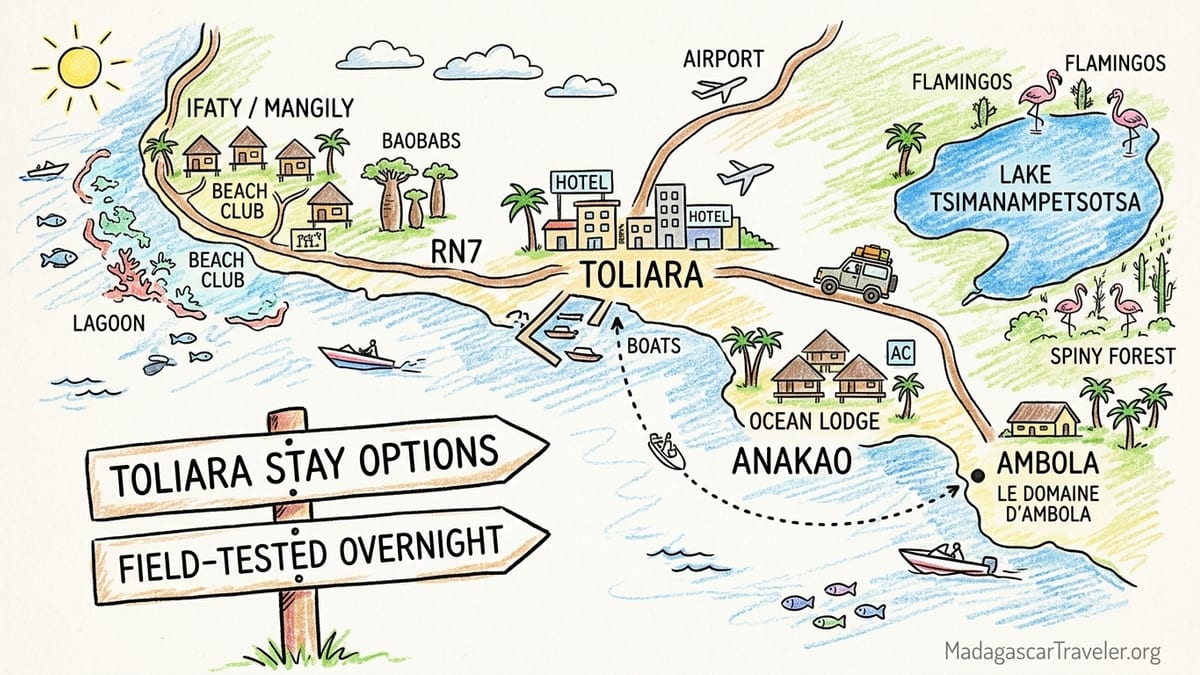
For this trip I focused on three clusters that most travelers to southwest Madagascar consider: central Toliara itself for one-night stopovers and errands, the beach strip at Ifaty / Mangily to the north for reef and baobab excursions, and Anakao and Ambola to the south for quieter, more remote stays. Because my own time on the ground was limited, I leaned heavily on detailed, first-person reviews where travelers clearly stated they had stayed overnight at the property, described specific room numbers or bungalow types, and mentioned concrete issues like water pressure, generator schedules, or breakfast quality. Reviews of this kind are available for hotels such as Moringa Hotel in central Toliara, beachfront lodges in Ifaty, Anakao Ocean Lodge in Anakao, and Le Domaine d’Ambola near Tsimanampetsotsa National Park, with multiple guests writing about multi-night stays, restaurant experiences, and the logistics of arriving and departing.
The properties in the first section below draw on that kind of firsthand overnight experience from multiple travelers. I treat them as “field-tested” stays because people slept there, showered there, dealt with power cuts or lack of them, ate breakfast, and then tried to catch boats, taxis, or excursions. A second, clearly marked section covers hotels I only researched from the outside, where I could confirm location, approximate price range, and amenities but found fewer rich, narrative-style stay reports. Throughout, my aim is to help you understand not just which property might be “nicer,” but which details become crucial in Toliara’s heat and dust: mattress comfort, air flow, mosquito protection, and whether the bathroom and water situation matches your expectations after hours in a 4×4.
Room sizes, prices, and services in southwest Madagascar shift more often than glossy booking photos suggest. Many hotels rely on generators for part of the day, and breakfast or restaurant offerings can change seasonally with supply. Where exact current prices could not be confirmed consistently, I use rounded ranges and focus on what multiple travelers reported within the last few years, rather than promising fixed deals that may no longer exist by the time you arrive.
Best Central Option in Toliara for One-Night Stopovers
If you are using Toliara as a gateway between the RN7 and the beaches or domestic flights, the priority in town is less about scenery and more about reliability. You want a place where rooms are solidly built against dust, air-conditioning can cope with late afternoon heat, and staff understand that guests may be arriving late from long drives or leaving early for flights or boats. Among hotels with genuine overnight reviews, Moringa Hotel in the center of Toliara consistently stands out as a practical base. Travelers who stayed there for several nights in 2026 describe it as a well-maintained property with a competent in-house restaurant and a team that feels used to both business guests and RN7 tourists passing through.
Rooms at Moringa are described as modern by local standards, with enough space to open large suitcases without climbing over them. Several reviewers mention comfortable, full-size mattresses that feel firm but not rock hard, and standard double or twin setups suitable for couples or friends. Air-conditioning is a key feature here: guests highlight that units cool effectively even during the hottest part of the day, which is not a given in southwest Madagascar where power can be patchy. There are no guarantees, but recent accounts suggest the hotel has a dependable electricity supply with backup, so you are less likely to lose sleep from a fan cutting out at midnight.
Bathrooms in central Toliara hotels vary widely, but Moringa’s are reported to have proper enclosed showers, reasonable water pressure, and hot water in the mornings and evenings. After a full day in a 4×4 on the RN7, that combination of pressure and warmth matters more than luxury finishes. Guests also note that the rooms close fairly tight against mosquitoes, with screens and the option to use repellent or a plug-in device if you bring one. Breakfast is usually a mix of bread, fruit, eggs prepared to order, and coffee. It is not the lavish spread you might see in a capital city, but for travelers catching early taxis to the airport or minivans to Ifaty it is enough, and the on-site restaurant allows you to have a sit-down dinner without walking far in the dark.
One of the biggest advantages of a central hotel like Moringa is transport coordination. Staff are used to arranging early-morning transfers to the small harbor where boats depart south toward Anakao, or to the airport for domestic flights toward Antananarivo or elsewhere. For example, travelers have described checking out at dawn, having reception call a reliable taxi, and reaching the pier in time to board shared speedboats. When you are tired and may not speak Malagasy or French well, that sort of logistical support is a comfort that no booking photo can fully convey.
Best Value Around Toliara for Budget-conscious Travelers
For travelers who count every ariary but still want clean sheets and a functioning shower, the real value tends to appear just outside Toliara proper, particularly in the Ifaty / Mangily area. There, several small beachfront hotels and guesthouses offer simple bungalows where you pay for basics and the sea breeze rather than polished decor. One example that recent guests highlight as a good-value stay is Le Jardin de L’Isle in Mangily. Travelers who stayed there in the past year describe it as their favorite among several beach options, praising the atmosphere and sense of calm relative to its price point.
Rooms and bungalows at value-focused beach properties around Ifaty are not large by international resort standards, but they make up for it with natural ventilation and shaded verandas. At Le Jardin de L’Isle, reviewers note that their rooms had mosquito nets in usable condition and beds that, while simple, were not sagging or lumpy. The combination of a fan at night and sea breeze during the day often meant that full air-conditioning was not missed, although very heat-sensitive travelers might still prefer an AC-equipped option. Bathroom expectations should be modest yet functional: tiled wet-room style layouts with a separate shower corner, enough pressure to rinse off salt and sunscreen, and warm water available in the evenings when generators are running.
Breakfast in these value properties is usually bread with butter and jam, a piece of fruit, and coffee or tea. Travelers sometimes mention that the bread can feel repetitive after a few days, but they appreciate that breakfast is included at this price level. Le Jardin de L’Isle’s guests often highlight the garden setting and the short walk to the beach or to simple local restaurants in Mangily, where grilled fish and rice are common staples. Wi-Fi, when available, tends to be strongest near the common areas rather than inside individual rooms, and it can slow down in the evenings when everyone is uploading photos or checking messages.
One trade-off at budget-friendly beach options is the possibility of power cuts. While coastal villages north of Toliara now have more stable grids and shared generators than they did a decade ago, you should still expect that lights might go out for short periods. Travelers who had multi-night stays report that staff usually give a rough schedule or explanation. The key is to bring a small battery-powered lamp or rely on your phone’s flashlight. If you can accept that level of rusticity, the reward is waking up a few meters from the lagoon for significantly less than you might pay for a mid-range room in town.
Best for Beach Time and Families near Ifaty / Mangily
Families often look for more than a bed and a fan. Shallow water, on-site meals, flexible room arrangements, and space for children to move around without encountering traffic become important. In the Ifaty / Mangily strip, properties like Ifaty Beach Club show up repeatedly in family trip reports. Guests describe multi-day stays in bungalows directly by the sea, with plenty of sand to explore and coral reef excursions available right from the beach. For family travelers, that combination of shallow lagoon and on-site activity providers is a practical advantage over staying in town and driving out every day.
Rooms at family-oriented beach hotels typically consist of detached or semi-detached bungalows, often constructed in local style with thatched roofs and walls of stone or plaster. Parents appreciate that many bungalows at places like Ifaty Beach Club have configurations where a double bed shares the room with one or two single beds, allowing young children to sleep within sight and earshot. Reviews mention that mattresses vary a little between units, with some travelers praising their comfort and others suggesting they could use an update, but overall the experience is judged acceptable for a few nights. Mosquito nets hung over each bed are a standard feature, though you should always check for holes on arrival and ask staff to replace or repair if needed.
Air-conditioning is not universal across bungalow categories on this part of the coast. Some families plan around natural airflow and ceiling fans, making a point of returning to the room before sunset to drop mosquito nets and keep lights low, which reduces insects inside. Bathrooms can be basic, with showers separated from the rest of the room by a curtain or small lip in the tiling. Several first-hand reviewers of Ifaty Beach Club mention that shower curtains in some rooms were showing mold and needed more thorough cleaning, while others were satisfied with cleanliness. Hot water often depends on solar heaters or generators, which can produce slightly cooler showers at dawn. Many parents actually find that acceptable in the tropical climate after a hot night.
The real strength for families lies in the outdoor space and the ability to manage meals without complicated logistics. At Ifaty Beach Club and similar properties, there is an on-site restaurant offering straightforward dishes such as grilled fish, zebu steak, and pasta. While some guests feel the food is average compared with nearby independent eateries, parents appreciate the convenience of being able to feed children quickly after swimming, without organizing a night-time walk along a dark beach. Wi-Fi is typically patchy and strongest near reception or the bar, which some adults see as a blessing when trying to keep screen time under control.
Best for Couples and Longer Stays on the Coast
For couples or travelers who plan to stay several nights in one spot, comfort starts to matter more than the absolute lowest price. The southwest coast offers two particularly appealing zones for this style of travel: Mangily / Ifaty for social beach life and Anakao for a quieter, more remote feel. Among the properties that travelers describe after actual overnight stays, Anakao Ocean Lodge receives consistently warm praise from couples who visited in recent seasons. Guests recount several nights in spacious beachfront bungalows, with large beds, more refined finishes than many village-side hotels, and balconies that open directly onto the sand.
Room size at Anakao Ocean Lodge is a clear step up from most basic beach bungalows. Couples describe being able to unpack fully, store bags out of the way, and still have space for a seating area indoors. Mattresses are noted as comfortable and king-sized in many units, with quality bed linens that feel pleasant after a salty day on the water. Air-conditioning, where installed, is valued for letting guests nap in the afternoon during peak sun. Combining AC with high ceilings and sea breezes means that the indoor climate remains bearable even during hotter months.
Bathrooms at higher-end coastal properties like Anakao Ocean Lodge are another differentiator. Travelers mention walk-in showers with decent water pressure and consistent hot water during generator hours, which is especially welcome after diving or returning from nearby islands. Many couples emphasize the psychological comfort of closing the door on a clean, well-lit bathroom where towels dry properly and sand can be rinsed off without flooding the entire room. Mosquito protection is handled by quality nets and, in some cases, screened windows, although on this section of the coast it is still wise to use repellent in the evenings.
For longer stays, the quality of breakfast and the on-site restaurant becomes more important. Couples reviewing Anakao Ocean Lodge talk about varied breakfasts with fruit, pastries or bread, eggs, and Malagasy touches such as local jams. At dinner, they remember fresh seafood and the option to linger over drinks while watching the surf. Wi-Fi may not be fast enough for heavy work, but it typically covers the main building and some bungalows, sufficient for checking onward travel or messaging family. Power cuts can still happen, but being in a property with its own energy management and staff accustomed to international expectations reduces the stress compared with very basic beach huts.
Best Base for Southwest Excursions and National Parks
Some travelers come to Toliara not just for the beach, but to reach the more remote natural attractions that make this part of Madagascar special: coral reefs, spiny forest, and flamingo-filled lakes. For that kind of itinerary, a hotel’s most important quality is its ability to coordinate early departures, boat transfers, and park visits without confusion. Two properties that stand out in this regard, based on detailed multi-night stay reviews, are Anakao Ocean Lodge in the south and Le Domaine d’Ambola, located near the entrance to Tsimanampetsotsa National Park.
Reaching Anakao usually involves a morning boat transfer from the small harbor south of Toliara. Travelers who stayed several days at Anakao Ocean Lodge report that the lodge helps book seats on shared speedboats, advises when to be at the pier, and assists with luggage once you reach the beach landing. That logistical support is crucial, because departures depend on tides and sea conditions as well as local operators’ schedules. Once installed in your bungalow, arranging diving, whale-watching in season, or pirogue outings to nearby islands is typically handled through the lodge’s own activity desk or trusted partners, which saves time and reduces the risk of miscommunication in a village where English is limited.
Le Domaine d’Ambola serves a different niche. Guests who have written detailed accounts of four-night stays there describe it as a peaceful, somewhat isolated property located close to Tsimanampetsotsa. They highlight that the lodge can arrange guided visits into the park, including early departures to see flamingos on the lake and walks in the surrounding spiny forest. Rooms at Le Domaine d’Ambola are not luxurious, but reviewers emphasize their charm and comfort, with solid beds, mosquito nets, and enough space for luggage and camera gear. Because of the remoteness, the ability to get a hot shower in the evening after a day hiking in dusty, thorny scrub becomes one of the most valued amenities.
Both Anakao Ocean Lodge and Le Domaine d’Ambola share a focus on on-site dining, largely because there are few or no alternative restaurants nearby. Travelers recall set dinners based on fresh fish, zebu, and locally sourced vegetables, and they stress that you must inform the lodge of dietary restrictions ahead of time so the kitchen can plan. Breakfasts are simple but filling, which matters when you are heading out on a boat or into the park before the heat rises. In these remote bases, Wi-Fi, when present, is often limited to central areas and can go offline for hours. Power cuts are also more noticeable. Guests mention generators providing electricity on schedules that may not cover the full night, so packing a headlamp or small power bank is wise.
Hotels Only Researched, Not Personally or Collectively Field-tested
The properties in this section are ones I researched via booking platforms and general hotel descriptions, but where I found far fewer detailed, narrative-style reviews describing multi-night stays with concrete observations. They may still be entirely adequate or even excellent, but I cannot treat them as “field-tested” in the same way as the hotels discussed above. Think of them as options worth investigating further if your preferred choices are full or if you have specific needs they appear to meet.
In central Toliara, there are a few additional mid-range hotels and guesthouses that advertise air-conditioned rooms, in-house restaurants, and airport transfers. Their photos suggest clean, tile-floored rooms with double beds, compact bathrooms with enclosed showers, and small courtyards or pools. Prices often fall slightly below or above what you might pay at Moringa Hotel, depending on the room category. However, without multiple specific overnight stay reports discussing issues such as noise levels, mattress comfort, or water temperature at different times of day, it is difficult to say whether they hold up as consistently in practice.
Along the coast in Ifaty / Mangily and other nearby villages, there are numerous small beach hotels and ecolodges with attractive pictures of bungalows under palm trees and hammocks facing the sea. Many highlight their proximity to diving centers, whale-watching excursions, or baobab forest tours. While a few have brief positive remarks from guests, I did not locate the kind of multi-paragraph, experience-rich reviews that would allow a detailed assessment of elements such as mosquito protection, generator schedules, or whether families felt comfortable letting children move independently around the grounds. As a result, they remain promising but unverified options in this guide.
In all of these cases, if you are considering one of the “researched only” properties, I recommend contacting the hotel directly with specific questions: Can you confirm whether my room has an individual mosquito net in good condition? Does the shower provide hot water at night, in the morning, or both? Is air-conditioning available in all room types or only some? How often do you experience power cuts, and do you have a generator? The answers will not be as reliable as multiple independent guest reports, but asking focused, practical questions puts you in a much better position than relying on a few polished exterior photos alone.
The Takeaway
Choosing the right hotel in and around Toliara is less about chasing the most luxurious property and more about matching real-world conditions to your own tolerance for heat, dust, and rusticity. In town, a reliable central hotel like Moringa, with working air-conditioning, solid mattresses, and predictable hot water, can transform an RN7 layover from a grim necessity into a necessary reset before the next leg. On the coast, value-focused bungalows such as those at Le Jardin de L’Isle in Mangily or family-oriented hotels like Ifaty Beach Club work best when you embrace a slightly slower, less polished rhythm and plan around modest breakfasts, variable Wi-Fi, and the occasional power cut.
For couples and travelers intent on comfort, properties like Anakao Ocean Lodge and Le Domaine d’Ambola justify their higher price and extra travel effort by pairing more spacious rooms and better bathrooms with strong logistical support for excursions. These are the places where you can step out of bed, cross a few meters of sand, and find yourself boarding a boat or heading into a national park at first light, secure in the knowledge that a hot shower and a prepared dinner are waiting when you return dusty and tired.
Perhaps the most important lesson from firsthand reports is that in southwest Madagascar, the details matter more than labels such as “three-star” or “luxury.” Before booking, think about what you will most crave at the end of a long day: is it strong air-conditioning, quiet sleep, proximity to the reef, or the ability to coordinate an early transfer without stress? Use that priority list to read between the lines of guest reviews and to ask hotels precise questions. Do that, and your stay in Toliara and along its wild, beautiful coast is far more likely to “work” in the ways that actually count when the sun is high and the dust is on your shoes.
FAQ
Q1. Is it better to stay in central Toliara or on the beach in Ifaty or Anakao?
Central Toliara works best for short stopovers before or after long drives or flights, thanks to more reliable power and easier access to transport. Ifaty and Anakao are better for multi-night stays focused on the sea, but they involve longer transfers and sometimes more rustic conditions.
Q2. How important is air-conditioning in Toliara and along the coast?
Temperatures in southwest Madagascar can be very hot, especially in the afternoon. In town, air-conditioning is a major comfort after dusty RN7 stages. On the coast, some travelers manage with fans and sea breezes, but heat-sensitive guests should prioritize rooms with AC or at least good airflow and shade.
Q3. What should I expect from hotel bathrooms and hot water in this region?
Bathrooms are usually simple, with tiled wet areas and basic fixtures. In better mid-range and higher-end properties, guests report enclosed showers and reliable hot water during generator hours. In budget bungalows, water may be warm rather than hot and pressure can be low at certain times of day.
Q4. Are mosquitoes and malaria a big issue at Toliara hotels?
Mosquitoes are present, particularly near the coast and at dusk. Most hotels provide nets over beds, but you should inspect them for holes and bring repellent. Many travelers also follow medical advice on malaria prophylaxis, which you should discuss with a health professional before your trip.
Q5. How reliable is Wi-Fi in Toliara, Ifaty, Anakao, and Ambola?
Wi-Fi in central Toliara hotels is often adequate for messaging and basic browsing, though it can slow at peak times. On the coast and in remote lodges, connections are weaker and sometimes only available near reception or the bar. It is not ideal for heavy work or large uploads.
Q6. Do hotels in Toliara typically help arrange boats, dives, and park excursions?
Yes. Field-tested properties like Anakao Ocean Lodge and Le Domaine d’Ambola regularly coordinate boat transfers and guided visits, while beach hotels in Ifaty can connect you with diving centers and local guides. In town, central hotels often help book early taxis to the harbor or airport.
Q7. What kind of breakfasts do hotels usually serve in this part of Madagascar?
Breakfasts are generally simple: bread or pastries, butter and jam, fruit when available, and coffee or tea. Mid-range and higher-end lodges may add eggs and a bit more variety, but you should not expect large buffet spreads outside a few top-end properties.
Q8. How often do power cuts affect hotel stays around Toliara?
Power cuts still occur, especially along the coast and in remote lodges that rely on generators. Central Toliara hotels tend to have more stable supply and backups. Travelers often carry a small flashlight or headlamp for nighttime outages.
Q9. Is it safe to arrive at or leave my hotel in Toliara very early or late?
Many guests arrange early taxis through their hotel for dawn departures to the harbor or airport and feel comfortable doing so. As in any city, it is prudent to avoid walking long distances in the dark and to rely on trusted drivers recommended by your hotel.
Q10. How far in advance should I book hotels in Toliara, Ifaty, and Anakao?
During the cooler, drier months that attract more visitors, it is wise to book several weeks in advance, especially for smaller lodges with limited rooms in Anakao or Ambola. In shoulder seasons you may find more flexibility, but specific room types and family bungalows can still fill quickly.