


On paper, getting to Toliara on Madagascar’s southwest coast looks simple. You can fly there in under two hours or follow the legendary RN7 highway across almost the whole length of the island. In reality, the choice between flying and finishing the RN7 overland defines the shape, pace and mood of your entire trip. After doing one route in the air and the other by road, I came to think of Toliara not just as a destination, but as a decision point. Do you want to arrive quickly and clean, or dusty, exhausted and full of stories?
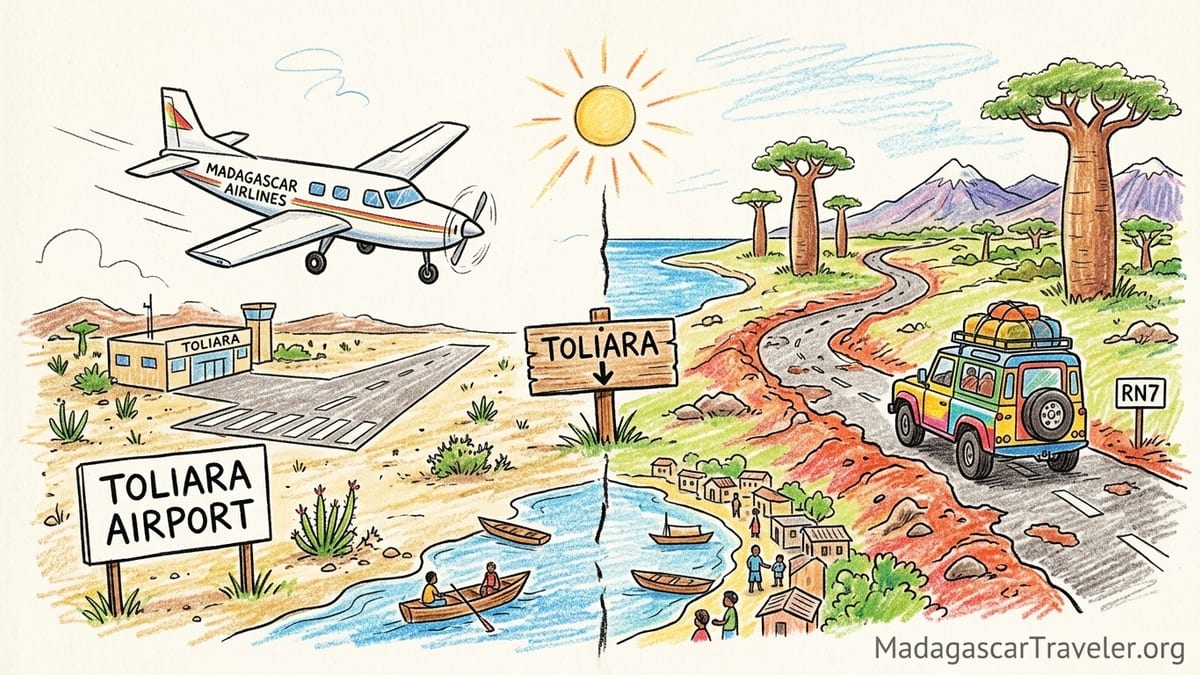
The Two Faces of Toliara: Gateway vs Grand Finale
For most visitors, Toliara is either a quick domestic hop from Antananarivo or the natural full stop at the end of the RN7, the 900-plus kilometre ribbon of asphalt that runs from the capital to the southwest coast. On my first visit, I chose convenience and flew Antananarivo to Toliara, using the city as a springboard for the beaches at Ifaty and Anakao. On the second, I reversed the logic and made Toliara the finale of a long, slow overland journey down the RN7, stopping in Antsirabe, Ranomafana, Isalo and several smaller towns along the way.
Seeing Toliara arrive from above and then later from the road completely changed how I thought about the place. Landing at Toliara Airport, with its single-story terminal and dust-hazed runway, felt like slipping quietly into a regional town. Rolling into the city after days on the RN7, past baobab silhouettes and long stretches of patched tarmac, felt triumphant, as if I had actually crossed a continent.
The practical question for most travelers is not whether Toliara is worth it. It is. The coral-rich Mozambique Channel, the spiny forests and the easy onward routes to Ifaty, Anakao and Salary Bay make it one of Madagascar’s most appealing bases in the southwest. The real decision is how you choose to arrive. That choice will dictate not only your level of comfort, but also what percentage of Madagascar you actually see in between your international landing and your first sunset over the lagoon.
What follows is what it was really like to fly Antananarivo to Toliara, followed by a day-by-day look at completing the RN7 overland, and how those experiences translate into a clear decision for future trips.
Flying Antananarivo to Toliara: Airport to Hotel in One Afternoon
My flight route was the straightforward one most people still take: Antananarivo Ivato International Airport to Toliara Airport on Madagascar Airlines, the national carrier that now bundles its domestic services under the same brand. At the time of my trip, the schedule resembled the pattern still visible in recent timetables: a midday departure from Antananarivo, around 12:35 to 12:50, and an arrival in Toliara at about 14:20 to 14:35, for a block time in the region of 1 hour 45 minutes.
Checking in at Ivato for a domestic flight feels noticeably lower key than for international departures, but you still need to give yourself time. I arrived a little under two hours before departure and did not regret it. The domestic counters opened roughly 90 minutes ahead, with a short queue of locals and a handful of tourists heading toward Toliara, Fort Dauphin and Nosy Be. Hand luggage limits were enforced more firmly than I expected, especially on busy days when smaller regional aircraft were in use, so I ended up checking a soft duffel I had hoped to carry on.
The baggage formalities were simple but old-fashioned. There was a manual tag check at the entrance to the security area and a quick scale weigh-in at the counter. Excess baggage charges on my flight were calculated by kilogram in ariary at rates that had clearly edged up since pre-pandemic times. One traveler in front of me, with surfboard in tow, negotiated whether the board would travel as sports equipment or general oversized luggage, which made a meaningful difference to his final bill.
Security itself was brisk, with a single scanner line operating and shoes left on. The domestic departure lounge at Ivato is modest: a few plastic chairs, one kiosk selling bottled water and biscuits, and the usual safari posters curling slightly at the corners. On my flight day, the departure screen initially showed an on-time 12:50 take-off. About 45 minutes before boarding, the status flicked to a short delay attributed to “operational reasons,” the same broad category the airline referenced in its public warnings about possible schedule adjustments due to fleet maintenance constraints in late 2026. In practice, we boarded about 25 minutes late, with no change to the arrival time posted at the other end.
In the Air: A Short Flight That Still Eats a Half Day
Once we boarded, the aircraft itself was a familiar regional workhorse, configured with two seats on either side of the aisle. Cabin baggage filled quickly, and several roller bags had to be gate-checked. The safety demonstration was performed in Malagasy and French, with a brief summary in English. The seat pitch was tight but manageable, similar to a European low-cost carrier on a short hop.
The actual flying time between Ivato and Toliara tends to hover around one and a half hours. On my trip, wheels-up to wheels-down clocked in at about 1 hour 40 minutes, tracking closely with the official block time. Service on board was minimal: a small cup of juice and a packet of biscuits, handed out about halfway through the flight. What I appreciated most was the view. Leaving Antananarivo’s highlands, the patchwork rice fields and terracotta villages slid away beneath us, opening out into more arid plateaus and, finally, the shimmering blue of the Mozambique Channel.
It is important, when planning your wider itinerary, to remember that a 1 hour 45 minute flight still consumes most of a day once you add the margins. From a hotel in central Antananarivo, I allowed just over an hour to get to Ivato by taxi, plus time for check-in and the mild delay on departure. By the time I walked out of Toliara Airport with my luggage, it was already late afternoon. For travelers hoping to make a same-day connection from an international arrival into a Toliara flight, this has serious implications. Domestic services on this route have a reputation for rescheduling and occasional cancellations, and several recent travel advisories from tour operators still suggest a one-night buffer in the capital before or after domestic legs.
Nonetheless, in terms of sheer physical comfort, nothing beats that gentle descent over the coast, the wheels brushing the runway, and the sense of arriving in the southwest without a single pothole in your spine.
Arriving at Toliara Airport: From Tarmac to Hotel
Toliara Airport sits a short drive southeast of town, a compact airfield serving only domestic traffic. Stepping off the plane, the first thing that hits you is the dry heat and the smell of dust. The second is how small everything is. The walk from the aircraft to the terminal is on foot, across the tarmac, with a visible line painted to guide passengers. Inside, there is a single baggage carousel, a simple arrivals hall and a small desk area used by taxi drivers and local agencies meeting clients.
On my flight, luggage appeared within about 15 minutes of arrival. A staff member checked baggage tags informally at the door, more for crowd control than strict security, but it was enough to prevent mix-ups. There were no jet bridges, no multiple conveyor belts just a quick handoff from a tractor pulling the baggage cart to the lone carousel. Compared with Ivato, where baggage delays can stretch out, this was refreshingly efficient.
For transfers into town, you have three realistic options. You can pre-arrange a pick-up with your hotel or tour operator, which is what I did on my first trip. In that case, a driver will usually stand at the exit with a printed sign, often bearing the name of the lodge rather than your own. You can also take a local taxi waiting outside the small parking area. Prices are negotiable on the spot, but on my visit drivers clustered around a ballpark figure that worked out to the equivalent of a few US dollars for the 10 to 15 minute ride to central Toliara, slightly more for hotels scattered toward the Ifaty road. Finally, some travelers traveling on tight budgets walk out to the main road and flag down a shared taxi or minibus, although this felt less appealing in the afternoon heat with baggage in tow.
From touchdown to hotel check-in, the process took under an hour. My driver threaded through town past small shops, pousse-pousse carts and the low, sun-bleached facades that make Toliara feel more like a frontier port than a polished resort city. That same evening, I was already having dinner at a seaside restaurant on the Boulevard de la Liberte. It was hard to argue with the efficiency. Within a single day, I had gone from the cool air of Antananarivo’s hills to the salty breeze of the southwest coast, without once touching the RN7.
The RN7 Overland: A 9-Day Descent to the Sea
My second journey to Toliara could not have been more different. Instead of flying, I decided to make Toliara the natural endpoint of a full RN7 road trip, starting in Antananarivo and taking nine days to reach the coast. This pace is in line with what experienced local drivers and recent travelers now recommend for the route: roughly a week and a half to move south while still having time to hike Isalo, visit Ranomafana and stop in small highland towns without collapsing from fatigue.
We left Antananarivo early on day one, just after dawn, with a private car and driver. The first day pushed as far as Antsirabe, a four to five hour drive broken up with coffee stops and roadside markets. Day two took us from Antsirabe to Ambositra and then on toward the Fianarantsoa area, where we stayed outside town to be closer to the tea estates and the detour toward Ranomafana National Park. We spent two nights in this region, giving ourselves one full day to explore Ranomafana’s rainforest trails and hot springs.
From there, the road bent steadily toward the drier interior. Day five carried us from the green hills around Fianarantsoa through Ambalavao, with a stop at the Anja Community Reserve, and on across the Horombe Plateau to reach the Isalo area. Two nights near Isalo felt essential. The park’s sandstone canyons, natural pools and longer circuits demand at least one full hiking day; attempting to squeeze them into a rushed one-night stop would have cheapened the experience. Only after that, on day seven, did we turn our attention to the long haul west toward Sakaraha and finally, on day nine, Toliara.
This was not a taxi-brousse itinerary, although many of the stages mirror those of the national minibus network. With a private driver and a sturdy 4x4, our daily driving times averaged five to seven hours, with frequent stops to stretch legs and buy fruit from roadside vendors. Friends who have taken the same route strictly by taxi-brousse describe longer days and more cramped conditions, but surprisingly similar overall timings, with many reaching Toliara from Antananarivo in two to three days of continuous travel if they skip most sightseeing.
Road Conditions, Driver Fatigue and the Reality of the RN7
The RN7 has long been promoted in tourist brochures as one of the better-maintained paved highways in Madagascar. On paper, this is still technically true: it is surfaced for its full length, and it carries a steady mix of private cars, buses and freight. In practice, the last few years have been rough on the road. Seasonal rains, increased heavy truck traffic and periodic underfunding of maintenance have combined to produce long stretches of degraded tarmac, especially in the southern sections closer to Toliara.
On my overland trip, we encountered frequent potholes large enough to force near-complete stops, segments where only one lane remained comfortably drivable, and occasional construction zones where rehabilitation work was underway. Local media in 2025 and 2026 echoed what we saw firsthand, with drivers complaining of “lamentable” stretches that required them to break the journey in two to avoid nighttime driving. Between Sakaraha and Toliara, our progress slowed considerably, with average speeds dipping far below what maps might suggest.
Fatigue builds quickly on this road, not only for the driver but also for passengers. The constant need to brake, swerve or slow for road damage and livestock means you cannot settle into a steady highway rhythm. Even in a comfortable vehicle, the combination of heat, dust and vibration leaves you feeling rung out by late afternoon. In hindsight, I was grateful we kept daily driving stages moderate. Travelers who try to compress the RN7 into a handful of long days regularly report arriving in Toliara too tired to enjoy the coast for the first 24 hours.
Despite the physical strain, the road never felt dull. We drove past zebu carts silhouetted against the sky, children waving from red-earth villages, and sudden vistas of rocky outcrops and baobabs. The price of admission for these scenes was a certain amount of discomfort and unpredictability. A short downpour could flood a low-lying section. A broken-down truck might block half the traffic. Fuel stations were more sporadic in the south, and our driver made a point of topping up whenever we passed a functioning pump.
Does Toliara Feel Like the Natural End of the RN7?
After nine days on the RN7, the final approach to Toliara felt symbolic. The landscape flattened, the air grew saltier, and the traffic shifted from long-distance trucks to local tuk-tuks and bicycle taxis. By the time we passed the sign marking the city limits and hit the dusty avenues of town, it genuinely felt as if we had crossed an entire country. Toliara became, in my mind, not just a city on the coast but the full stop at the end of a long, narrative sentence.
Emotionally, the arrival carried a sense of completion that my earlier flight simply could not match. Because we had watched the scenery change gradually from highland rice paddies to dry savannah to coastal scrub, reaching the sea seemed earned. The first glimpse of the Mozambique Channel at the northern edge of town was almost cinematic, the water appearing beyond low buildings after days of only inland horizons.
Pragmatically, Toliara also functions as a logical endpoint for logistics. From here, it is straightforward to continue on by boat to Anakao or Ifaty, or to simply rest in town before looping back by plane to Antananarivo. Many itineraries now use the RN7 as a one-way route and then rely on the Antananarivo–Toliara flight to close the loop. This pattern makes sense. After driving one direction, few people feel eager to retrace every pothole in reverse.
Seen this way, Toliara is both an ending and a beginning. It can mark the end of your overland immersion and the start of a more relaxed coastal chapter. Or, if you choose to fly in first and drive north later, it becomes your launching pad into the RN7, reversing the emotional arc but preserving the sense of a journey with a clear spine.
Costs, Time and Risk: Flying vs RN7 in Real Terms
When deciding between flying directly to Toliara or making it the endpoint of an RN7 journey, three factors matter most: time, budget and your tolerance for risk and rough travel. On time alone, the plane wins by a large margin. Even allowing for check-in, transfers and moderate delays, you can reasonably get from a central Antananarivo hotel to a Toliara guesthouse in half a day. By road, covering the same distance at a humane pace requires around nine to ten days if you want to actually see the national parks and towns along the way, or at least two long, tiring days if you try to rush in a hired car or taxi-brousse.
Costs are more nuanced. Domestic flight prices between Antananarivo and Toliara have fluctuated sharply in recent years with fuel costs and airline restructuring. For most foreign visitors, a one-way ticket now falls in a mid-range international price bracket, certainly not a token add-on. However, once you factor in the days of vehicle hire, driver fees, fuel, accommodation and park entrance charges that accompany an RN7 trip, overland travel can easily exceed the cost of one or even two domestic flights. For backpackers using taxi-brousse services and staying in simple guesthouses, the RN7 can be considerably cheaper, but they pay the difference with their backs and their time.
Risk and reliability weigh heavily in favor of the road if you focus on predictability day by day, but in favor of the plane if your priority is making specific long-haul connections. On the highway, the main risks are road quality, weather and occasional security concerns after dark, which is why most drivers and taxi-brousse operators avoid nighttime travel altogether. Schedules are flexible because you control your departure times or simply wait for the next minibus to fill. In contrast, airline timetables can look clear on paper and then shift at short notice due to maintenance or operational constraints, as reflected in public advisories about possible schedule adjustments in late 2026. If you need to be back in Antananarivo by a fixed date for an international flight, many experienced travelers now plan an overnight buffer in the capital to hedge against such changes.
Another subtle cost is energy. The flight leaves you refreshed enough to explore Toliara or transfer onward the same day, while the RN7 even at a relaxed pace leaves you grateful for rest upon arrival. If your overall time in Madagascar is short, those first and last days of real energy may be worth preserving by spending money on flights and saving the slower segments for one or two specific regions rather than the entire southbound axis.
The Takeaway
Looking back at both routes, my conclusion is that flying directly to Toliara and making it the endpoint of an RN7 journey are not interchangeable choices. They create two entirely different trips. The flight is a practical, comfortable bridge between the highlands and the southwest coast, ideal for travelers with limited time or those building complex itineraries involving other domestic flights, islands and international departures. It gets you from Antananarivo to a beachside sundowner in a single afternoon, with the minimum of friction.
The RN7 overland journey, by contrast, is a commitment to see Madagascar in slow motion. It costs days of your schedule, demands more money overall if you hire a car and driver, and tests your tolerance for bad roads, dust and unpredictability. Yet it repays that investment with some of the country’s most memorable landscapes and encounters. Arriving in Toliara at the end of a nine-day descent from the capital feels far more significant than stepping off a plane, because you have traced the island’s spine and watched it change.
If you have ten to twelve days total in Madagascar and your priority is the southwest coast, fly Antananarivo to Toliara. Use the time you save to explore the reefs at Ifaty, the dunes near Anakao or even to add a short side trip to another region by air. If you have three weeks or more and want a trip that feels like a journey rather than a series of hops, build the RN7 into your plan and let Toliara be either the big finish or the starting point, with a flight in the opposite direction to close the loop.
In the end, the decision comes down to what story you want to tell yourself about Madagascar. If that story is about squeezing the most coastline and lemur sightings into a tight vacation window, book the plane. If it is about the long roads, the highland markets, the smell of eucalyptus and the steady unfolding of the landscape from city to sea, take the RN7 and let the sight of Toliara at the end feel like it truly belongs to you.
FAQ
Q1. Is it safe to travel the RN7 from Antananarivo to Toliara?
It is generally considered one of Madagascar’s main tourist routes, but safety depends on daytime driving, using a reputable driver or company, and avoiding night travel. Road conditions can be poor in places, so choosing a sturdy vehicle and pacing the journey sensibly are important.
Q2. How many days should I plan for an RN7 trip ending in Toliara?
A comfortable overland journey that includes key stops such as Antsirabe, Ranomafana and Isalo usually takes about nine to ten days one way. This allows for two-night stops in at least one or two parks so you are not spending every day entirely in the car.
Q3. Can I do the RN7 by taxi-brousse instead of a private car?
Yes, many locals and budget travelers use taxi-brousse minibuses along the RN7. It is cheaper than hiring a car and driver but also slower and less comfortable, with departures often tied to vehicles filling up and overnight stops dictated by timing rather than sightseeing preferences.
Q4. How reliable are flights between Antananarivo and Toliara?
Flights usually operate close to their published times, but the national airline has warned that fleet-maintenance issues may cause schedule adjustments. Delays of an hour or two are not uncommon, and occasional cancellations do occur, so it is wise to build a buffer before any onward international flights.
Q5. What is the best way to get from Toliara Airport to my hotel?
The simplest option is to arrange a transfer through your hotel or tour operator so a driver meets you at arrivals. Alternatively, you can take a local taxi from the airport parking area into central Toliara, agreeing a fare before departure for the short ten to fifteen minute ride.
Q6. Does arriving by road make it easier to reach places like Ifaty or Anakao?
In practical terms, access is similar whether you arrive by road or air, since boat and road transfers to Ifaty or Anakao almost always start in or near Toliara itself. The main difference is how tired you feel on arrival and whether you prefer to spend an extra night in town recovering before moving on to the coast.
Q7. Should I start the RN7 in Toliara and drive north, or start in Antananarivo and drive south?
Both directions work, but many travelers prefer to start in Antananarivo and end in Toliara so the journey feels like a descent from the highlands to the sea. Starting in Toliara and driving north can be practical if your international flight leaves from the capital and you want to finish near the airport.
Q8. How much does it cost to hire a car and driver for the RN7?
Prices vary by vehicle type, fuel costs and negotiation, but hiring a 4x4 with a driver for a multi-day RN7 trip typically adds up to a significant portion of a mid-range travel budget. When you include fuel, the driver’s daily fee and accommodation, the total often exceeds the cost of a one-way domestic flight, though it also covers your sightseeing transport along the way.
Q9. Is it worth doing both the RN7 and the flight in one trip?
If you have enough time and budget, combining both can be ideal: travel one way overland to experience the changing landscapes, then fly the other way to save days on the road. Many itineraries now use this pattern, treating Toliara as the hinge between the flying and driving parts of the journey.
Q10. If I only have ten days in Madagascar, should I fly or drive to Toliara?
With ten days or less, most travelers are better off flying to Toliara to avoid spending much of their trip in transit. You can then focus on the southwest coast and perhaps add a short side trip, rather than rushing the RN7 and arriving too exhausted to enjoy the places you came to see.