


Tsingy de Bemaraha is one of Madagascar’s most dramatic landscapes, a labyrinth of razor-sharp limestone pinnacles, hanging bridges and deep canyons that rise above the Manambolo River. Reaching it from Morondava is a serious undertaking, which is why most travelers book a packaged 2, 3 or 4 day tour that bundles a 4x4, driver-guide, ferries, permits and accommodation in Bekopaka. With current private packages typically running from about €630 to more than €820 per person depending on duration and inclusions, it is a purchase you want to get right.
Understanding the Route from Morondava to Tsingy
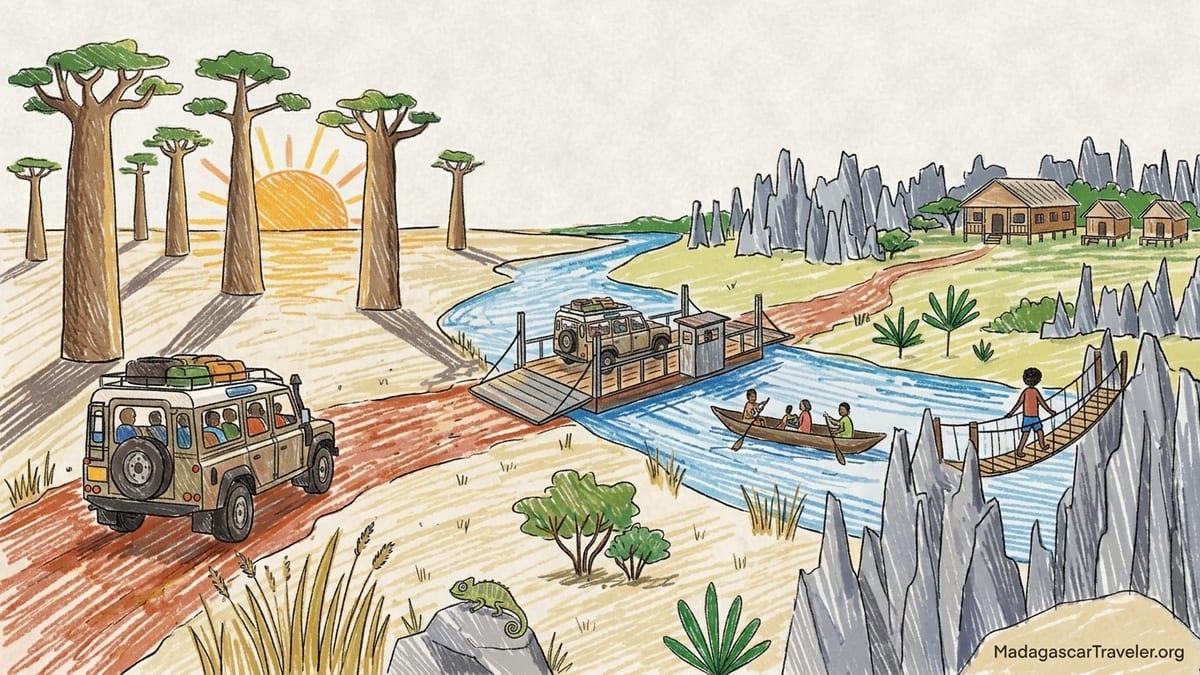
All Tsingy de Bemaraha tours from Morondava follow the same backbone: the rough, unpaved National Road 8 that runs north from Morondava through the Avenue of the Baobabs, on to Belo-sur-Tsiribihina and finally Bekopaka, the gateway village for the park. The road covers roughly 190 to 200 kilometers but, because it is unsealed and intersected by rivers, the drive typically takes 9 to 12 hours each way in the dry season and can be longer if there has been recent rain. Many recent travelers report leaving Morondava around 7:00 in the morning and arriving in Bekopaka close to sunset.
On the way you will cross at least two major rivers on basic ferry barges powered by outboard engines. These crossings are included in serious tour quotes, but they add uncertainty to timing because there may be queues of local trucks and 4x4s waiting on either side. The same is true of the road surface itself. In a dry August, travelers have found the piste dusty but passable, while others visiting in May or after early rains have encountered wheel-deep mud, stuck vehicles and delays. This is why a robust 4x4 and an experienced local driver-guide are non-negotiable elements of any tour.
Morondava-based operators often package the Tsingy with nearby highlights such as Kirindy Forest and the Avenue of the Baobabs. Some, such as local outfits headquartered near Morondava’s seafront hotels, advertise “Tsingy Expedition” trips with 4 days including Grand and Petit Tsingy, a Manambolo River excursion, Kirindy by night and a sunset stop at the baobabs on the return. These on-the-ground examples underline that the Tsingy trip is not just a simple there-and-back transfer but a short expedition through western Madagascar’s countryside.
2, 3 and 4 Day Tours: What You Actually Get
At the lower end, a 2 day Tsingy trip from Morondava is usually a compressed private itinerary, sometimes built around a charter flight or for travelers already partway up the route. In practice, overland 2 day tours tend to mean one very long drive to Bekopaka with only a short visit to Petit Tsingy or a viewpoint, then a long drive back the next day. Because the road alone easily consumes a full day each way, there is little slack for weather delays or ferry queues, and these whistle-stop packages are best suited to travelers with very limited time who accept that they will see just a slice of the stone forest.
Three day tours are a more realistic minimum and are increasingly marketed as core products by both local agencies in Morondava and larger Madagascar specialists. A typical 3 day outline from Morondava might be: Day 1 drive to Bekopaka with baobab photo stops; Day 2 hike Petit Tsingy combined with a short Manambolo pirogue circuit; Day 3 drive back to Morondava, often arriving in time for a sunset at the Avenue of the Baobabs. At current rates, private 3 day packages for two to four people often fall in the region of €650 to €750 per person if staying in midrange lodges and including park fees and local guides.
Four day tours from Morondava provide the breathing space that most travelers secretly want but do not always realize they need. In a typical 4 day program, operators extend the stay in Bekopaka to two full days, allowing for both Petit Tsingy and Grand Tsingy circuits, plus a longer Manambolo pirogue trip and a less pressured pace on the drive days. Many 4 day itineraries also add Kirindy Forest as a stop on either the outward or return leg, turning the trip into a compact west Madagascar highlights tour. Prices today often start around €700 to €820 per person for a private 4 day itinerary based on two passengers, with costs dropping per head if three or four people share the vehicle.
Grand Tsingy vs Petit Tsingy: How They Compare
Grand Tsingy and Petit Tsingy are two main access sectors of Tsingy de Bemaraha, each with distinct character and logistics. Petit Tsingy is closer to Bekopaka, usually within an hour’s 4x4 drive, and its circuits combine narrow canyons, small viewpoints and limestone pinnacles with relatively modest ladders and via ferrata sections. Many visitors describe it as a “taster” of the Tsingy, ideal for a half day outing that still leaves time for the Manambolo River on the same day.
Grand Tsingy lies roughly 17 to 18 kilometers north of Bekopaka and requires a longer 4x4 approach on an even rougher track. Recent accounts mention that the drive alone can take around two hours each way when the trail is muddy. The reward is access to the most extensive stone forest, with hanging bridges suspended above knife-like ridges, airy viewpoints over a sea of grey limestone and more sustained climbing. The classic Grand Tsingy circuits often involve fixed cables, harnesses and vertical ladders, making them more physically demanding. During the main dry season, operators and park guides report that the rock can still be slippery if light rain has fallen, so sturdy footwear and a good head for heights are important.
From a trip-planning perspective, Petit Tsingy comfortably fits into a fast 2 or 3 day itinerary, while Grand Tsingy is realistically reserved for 3 and especially 4 day packages. Many 3 day tours will offer a choice between focusing on Grand Tsingy or Petit Tsingy plus the gorge, whereas 4 day trips are more likely to promise both sectors. Travelers who opt for the longer itineraries often reflect that the actual time spent walking on the limestone is only a few hours compared with long road days, which makes the opportunity to explore both areas feel like far better value for the time and effort involved in getting there.
Manambolo Gorge by Pirogue: What to Expect
The Manambolo River carves a deep gorge along the southern edge of Tsingy de Bemaraha, and exploring it by dugout pirogue is a signature element in many tours. From Bekopaka, visitors descend to the river banks where local boatmen operate simple wooden canoes, sometimes stabilized with outriggers. A standard tourist excursion usually lasts two to three hours, gliding between overhanging cliffs, small caves and sandy beaches, with occasional stops to walk into shallow grottos or view local tombs from a respectful distance.
Longer pirogue trips are possible, particularly in combined expeditions that use the Manambolo as a travel corridor into or out of the Tsingy, but for most Morondava-based itineraries the gorge visit is a half-day highlight that pairs well with Petit Tsingy. Because the excursion is operated by local boatmen, reputable agencies typically include the fare and a local river guide in their package price, though tips remain customary. Life jackets are increasingly provided, but standards can vary, so travelers who are cautious around water sometimes bring their own compact flotation vests.
In commercial terms, the Manambolo pirogue segment is usually a modest portion of the overall tour cost, but it adds considerable experiential value. Floating beneath vertical limestone walls, watching for birdlife and perhaps a crocodile on sunlit banks, is a striking contrast to scrambling over the jagged stone forest above. When comparing 2, 3 and 4 day offers, note whether the gorge trip is explicitly mentioned. Some bare-bones 2 day itineraries omit it entirely, while mainstream 3 and 4 day packages normally include it as standard.
Bekopaka Accommodation and What Midrange Really Looks Like
Bekopaka is a small, dusty gateway village whose lodges and guesthouses serve the entire flow of visitors to Tsingy de Bemaraha. Accommodation ranges from very simple bungalows with cold water and intermittent electricity to more polished midrange lodges with landscaped gardens, swimming pools and proper dining rooms. In current midrange packages around €630 to €820 per person, travelers can expect comfortable en suite rooms with mosquito nets, fans, hot showers when the generator is running and set-menu dinners featuring local rice, zebu and fish.
Higher-end options, often used in international tour itineraries, include lodges perched on bluffs above the Manambolo valley or set back in quiet bushland. These might offer larger chalets, better soundproofing, more consistent hot water and extras like a small spa or air conditioning in some rooms. At the other end of the spectrum, budget-oriented travelers who arrange their own 4x4 sometimes walk into simple guesthouses in Bekopaka that offer a bed, shared bathrooms and basic local meals for far less, though these are less commonly bundled into the short, private tour packages marketed from Morondava.
When comparing quotes from different operators, look closely at how they describe the standard of accommodation. Descriptors such as “midrange lodge” or “comfortable bungalow” can mask a wide spread in quality. If you see a price that is significantly cheaper than others for a similar-length tour, it may be using a simpler property in Bekopaka, omitting certain meals or placing two travelers in twin rooms rather than doubles. Conversely, if a 3 or 4 day package breaks through the €900 per person threshold without including internal flights, it is reasonable to ask if the Bekopaka property is markedly more upscale or if other premium services are rolled in.
4x4 Vehicles, Drivers and Park Logistics
The 4x4 and driver-guide are the backbone of any Tsingy trip from Morondava. Most reputable operators use Toyota Land Cruisers or similar high-clearance vehicles, often with snorkels for river fords and reinforced suspension. On the current market, private 4x4 rental with a licensed driver and fuel for several days of piste driving represents a large slice of the package price, which is why even basic tours rarely dip below several hundred euros per person. Some travelers on a budget try to share a 4x4 with other visitors, coordinating through guesthouses in Morondava or online forums, in order to split the cost.
A good driver-guide does more than simply steer the vehicle up National Road 8. Local specialists based in Morondava and Bekopaka know recent road conditions, the ferry operators, unofficial detours and realistic timings. They will also handle paperwork at ferry crossings and the park office, book local park guides for the Tsingy circuits and suggest how to structure each day around heat and crowds. Licensed guides working within the park accompany all hikes and are normally paid through the tour operator or as an extra fee, depending on your agreement. Park entry fees and guide charges have risen in recent years, and are commonly bundled into mainstream 3 and 4 day package prices rather than paid ad hoc by clients.
Ferries across the Tsiribihina and Manambolo rivers are simple metal barges or wooden platforms that load a handful of vehicles at a time. Queues can build quickly, and schedules are flexible rather than fixed. Because of the long hours on unsealed roads and the potential for mud or water, itinerary descriptions that promise highly precise driving times should be treated with caution. Many tour operators now underpromise and overdeliver, describing the drive as “about 10 to 12 hours” to leave room for delays and reducing guest frustration if something changes on the day.
Baobabs and Kirindy: Are They Included in Short Tsingy Tours?
For most travelers, the other essential sights around Morondava are the Avenue of the Baobabs and Kirindy Forest Reserve. The avenue lies directly on the route of National Road 8 north out of Morondava, so nearly all Tsingy tours include at least a brief stop there. The difference between itineraries is whether this is simply a daytime pause for photos, or a planned sunrise or sunset session when the silhouettes of the giant baobabs are at their most photogenic. Some Morondava-based operators build this into day one or day four of a Tsingy trip, advertising “sunset at Baobab Avenue” as a highlight on the return leg.
Kirindy, by contrast, is a detour. The dry forest lies north of Morondava along the same general route but requires a bit of additional time, especially if you want to take a night walk to look for fossa and nocturnal lemurs. In practice, Kirindy is often included in 4 day itineraries that have an extra half-day to spare. For example, a sample 4 day circuit might run Morondava to Kirindy for an afternoon and night walk, continue to Bekopaka on day two, dedicate day three to Grand Tsingy and Petit Tsingy, then return to Morondava on day four with a sunset stop at the baobabs.
Short 2 day tours almost never include Kirindy and may offer only a quick, non-golden-hour stop at the Avenue of the Baobabs in order to keep driving times manageable. Three day tours fall in the middle. Some will prioritize the Tsingy and Manambolo, relegating baobab visits to opportunistic road stops. Others, especially those marketed to photographers, will position at least one sunrise or sunset at the avenue as a selling point. When comparing quotes, check carefully whether Kirindy entry fees, night walks and baobab golden-hour stops are explicitly listed or simply assumed.
Pricing and How to Compare 2, 3 and 4 Day Packages
Current private small-party packages from Morondava to Tsingy de Bemaraha typically cluster in the range of roughly €630 to €820 per person for 3 and 4 day itineraries, based on two or three travelers sharing a 4x4. Two day overland tours, while rare and intense, may come in slightly lower, but they provide less time on the ground in the park and sometimes cut out key experiences such as Grand Tsingy or the Manambolo pirogue trip. Prices can rise significantly for solo travelers, for charter flight-based packages or for itineraries that combine Tsingy with longer cross-country routes.
To make a meaningful comparison, look beyond the headline euro figure and consider the contents. A 3 day tour at €680 per person that includes midrange Bekopaka lodging, all breakfasts and dinners, park entry, local guides, the Manambolo outing and a sunset at the Avenue of the Baobabs may offer better value than a 4 day tour quoted at €720 that excludes most meals and charges park fees separately. Likewise, be cautious of quotes that seem markedly cheaper than the local norm. Some low-cost offers may use older vehicles, skip important inclusions such as the Manambolo gorge or rely on unlicensed operators in order to keep prices down.
If your budget allows it, choosing a 3 or 4 day option is usually the most rational decision. Considering that you will spend at least two full days in transit on National Road 8, squeezing the entire experience into a 2 day trip can feel rushed and unforgiving if anything goes wrong with weather or ferries. In contrast, an extra day spreads the fixed costs of reaching Bekopaka over more time spent actually enjoying the park, which many travelers feel justifies the modest increase in overall price.
The Takeaway
Planning a Tsingy de Bemaraha tour from Morondava is less about ticking a single attraction and more about committing to a short expedition across western Madagascar. The rough but scenic road, the river ferries and the villages along National Road 8 are all part of the journey. Because access is demanding, the decision between a 2, 3 or 4 day itinerary has outsized impact on how satisfying the experience will feel when you finally stand atop the stone forest.
In most cases, 3 and especially 4 day tours hit the sweet spot between cost, time and depth. They give you enough slack for road delays, the chance to explore both Petit and Grand Tsingy, an unhurried pirogue trip through the Manambolo Gorge and better odds of catching the Avenue of the Baobabs in good light. Four day itineraries are also the most realistic way to weave in a Kirindy Forest night walk without rushing every day. Two day options exist for travelers with tight calendars, but they should be approached with clear expectations that they are compromises built around the long drive more than the park itself.
Whichever length you choose, prioritize reputable Morondava-based operators using solid 4x4s, licensed driver-guides and transparent pricing that indicates what is and is not included. Ask specifically about accommodation standards in Bekopaka, whether both Tsingy sectors are visited, the exact format of the Manambolo trip and how much time is allocated to the baobabs and Kirindy. With realistic expectations and the right partner, a Tsingy de Bemaraha tour from Morondava can be one of the defining adventures of a Madagascar journey.
FAQ
Q1. Is a 2 day Tsingy tour from Morondava really worth it?
A 2 day tour is only worth considering if your time is extremely limited and you understand that most of the experience will be driving, with just a short visit to either Petit Tsingy or a limited viewpoint. You will have little margin for delays, and it is unlikely that both Grand Tsingy and a proper Manambolo Gorge trip can be included.
Q2. What is the best choice between a 3 day and 4 day Tsingy trip?
For most travelers, a 3 day trip is the minimum that feels balanced, while a 4 day itinerary is ideal. Three days allow a Petit Tsingy hike and a short Manambolo pirogue outing, plus baobab stops. Four days provide enough time for both Grand and Petit Tsingy, a longer river excursion and the flexibility to include Kirindy Forest without rushing.
Q3. How difficult are the Grand Tsingy hikes compared to Petit Tsingy?
Grand Tsingy circuits are more physically demanding, with taller ladders, harnesses and exposed bridges high above the pinnacles. Petite Tsingy routes involve some scrambling and narrow passages but are generally shorter and less exposed. Travelers with moderate fitness and no serious fear of heights usually manage both, but those who are nervous may prefer to start with Petit Tsingy.
Q4. Are Manambolo Gorge pirogue trips safe?
Manambolo pirogue excursions are widely offered and generally considered safe, though standards vary. Most operators now provide life jackets, but it is sensible to check before departure and to wear one during the trip. The boats are basic wooden canoes, and conditions depend on water levels, so travelers who are very cautious around water sometimes bring their own compact flotation vest for extra peace of mind.
Q5. What kind of accommodation can I expect in Bekopaka?
In Bekopaka you can expect simple to midrange lodges with private bathrooms, mosquito nets and often a fan, with electricity typically supplied by generator for part of the day. Some properties have swimming pools and landscaped grounds, while budget guesthouses offer more basic rooms and shared facilities. In most mainstream 3 and 4 day tour packages, operators book midrange lodges that balance comfort with cost.
Q6. How important is the quality of the 4x4 and driver-guide?
The quality of the 4x4 and the experience of the driver-guide are critical on the rough, often muddy National Road 8. A well-maintained, high-clearance vehicle with a competent local driver reduces the risk of breakdowns and delays, and a seasoned guide will know how to handle ferries, paperwork and park logistics. This is one area where paying a little more for a reputable operator is usually worthwhile.
Q7. Are park fees and local guides usually included in tour prices?
Many reputable operators now bundle Tsingy de Bemaraha park entry fees and mandatory local park guides into their advertised tour price, especially for 3 and 4 day packages. However, some budget-oriented offers list these as extras payable on the spot. When requesting quotes, ask for a clear written breakdown so you know whether park fees, river trips and local guides are included or must be budgeted separately.
Q8. Do most Tsingy tours include the Avenue of the Baobabs at sunrise or sunset?
Almost all tours pass through the Avenue of the Baobabs, but not all time their visits for sunrise or sunset. Many 3 and 4 day itineraries plan at least one golden-hour stop, usually at sunset on the return to Morondava. Shorter or cheaper trips may include only a brief daytime visit. If baobab photography is important to you, confirm the timing of your stop when booking.
Q9. How likely is it that Kirindy Forest is included in a Tsingy package?
Kirindy Forest is most commonly included in 4 day west Madagascar itineraries that have the extra time needed for a night walk and wildlife viewing. Some 3 day tours may include a daytime stop, but many focus on the Tsingy and baobabs instead. Because adding Kirindy requires additional driving and park fees, it may increase the overall price slightly, so check your quote carefully.
Q10. When is the best time of year to visit Tsingy de Bemaraha from Morondava?
The park generally opens during the dry season, when river levels and road conditions are suitable, typically from around April or May to November. The heart of the dry season offers the most reliable access, but the piste can still be muddy at the beginning and end of this window. When planning, ask your operator about current road conditions and the exact opening dates for the park in the year you intend to travel.