


Western Madagascar is one of those regions where the map looks deceptively simple. Morondava seems close to the Avenue of the Baobabs, Kirindy Forest, the Tsingy de Bemaraha, the Manambolo Gorge, the Tsiribihina River and even the quiet beaches of Belo-sur-Mer. In reality, distances are short but travel is slow, roads are rough and every add-on has a cost in time, budget and comfort. This guide compares the west’s main destinations so you can build an itinerary that matches your priorities, whether that is photography, wildlife, hiking, river adventure or low-key coastal time.
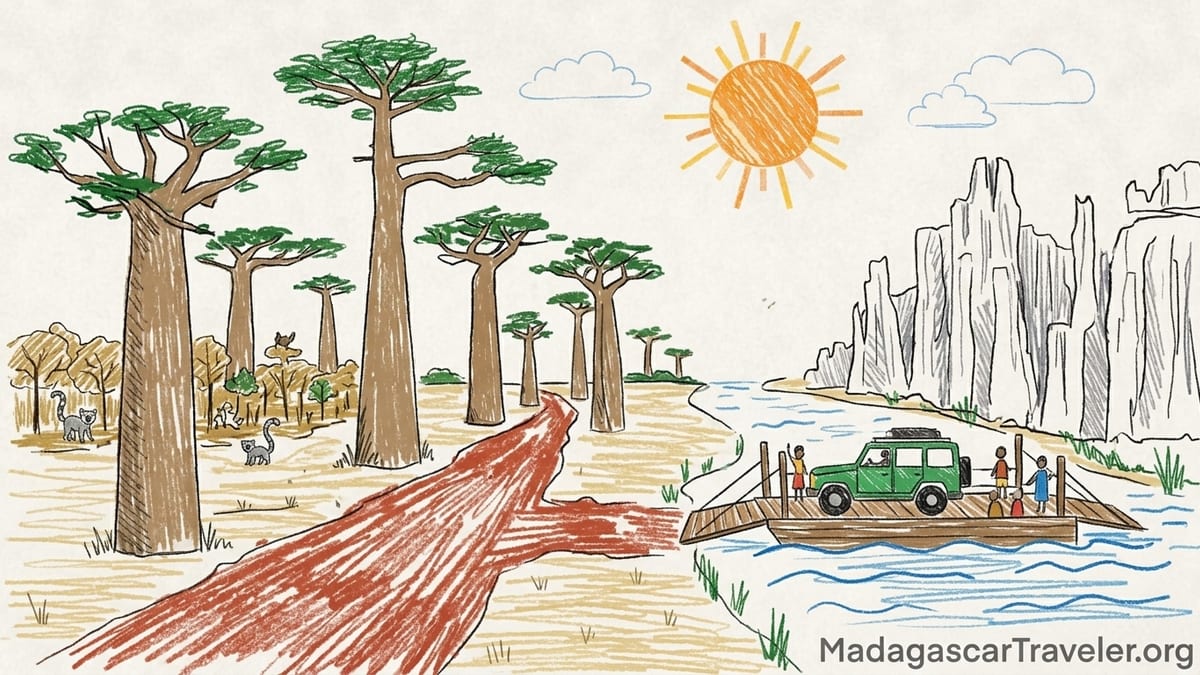
Understanding Western Madagascar’s Geography and Travel Reality
Morondava is the natural hub for exploring western Madagascar. It is a laid-back town on the Mozambique Channel and the starting point of Route Nationale 8, the rough laterite track that runs north through the Avenue of the Baobabs, Kirindy Forest, Belo-sur-Tsiribihina and on to Bekopaka, the gateway village for Tsingy de Bemaraha National Park. A separate, much less developed route heads south from Morondava along the coast toward Belo-sur-Mer. On a large-scale map everything appears clustered, but once you factor in road conditions and river crossings, it becomes clear that some places are quick excursions while others are full-scale expeditions.
The key planning constraint is time in a 4x4. Reaching the Avenue of the Baobabs from Morondava is usually a 40 to 60 minute drive each way on a bumpy track. Kirindy Forest is around two hours from town in dry-season conditions. By contrast, getting from Morondava to Bekopaka for the Tsingy de Bemaraha can take a very long day or even two days of driving, including ferries across the Tsiribihina and Manambolo rivers. For most travelers this is not a casual side trip but one of the central commitments of their itinerary.
Seasonality also shapes what is realistically possible. The dry season from roughly May to November is when the laterite roads are passable and Tsingy de Bemaraha National Park is open. In the rainy months, sections of RN8 can turn into deep mud that challenges even experienced drivers, and river levels may make ferry timings unpredictable. If your visit falls in the shoulder seasons, it is wise to allow at least one buffer day in case road or weather conditions slow you down.
Finally, budget interacts directly with the landscapes you can reach. A private 4x4 with driver for a multi-day circuit to the Tsingy typically costs several hundred euros when shared over four or five days, sometimes in the range discussed by travelers who report quotes around 700 euros for a Morondava–Kirindy–Tsingy loop. Independent public transport, while cheaper, moves slowly and rarely aligns well with park opening times, so most visitors aiming for specific landscapes or photographic light choose to pay for a dedicated vehicle.
Morondava and the Avenue of the Baobabs: Iconic Landscapes and Easy Access
If you are primarily chasing the classic Madagascar images, Morondava combined with the Avenue of the Baobabs delivers a lot of impact for relatively little travel time. The avenue itself lies about 20 kilometers northeast of town along RN8, and most local operators run half-day trips that leave Morondava mid afternoon to arrive at least an hour before sunset. This is when the red dust road, tall Grandidier’s baobabs and low sun combine into the photographs you have probably seen in magazines and airline ads.
From a landscape and photography perspective, the baobabs are hard to beat on a short schedule. A practical example: travelers commonly fly from Antananarivo to Morondava in the late morning, check into a midrange guesthouse such as a beachfront bungalow, then head straight out to the avenue for sunset. The next morning, they may return at sunrise for entirely different light and far fewer people. This two-visit pattern, sunset and sunrise, costs little extra in money but gives a significant boost in photographic variety, from silhouettes against a crimson sky to soft pastel tones with morning mist in the nearby rice paddies.
Time commitment is modest. Many visitors slot the baobabs into a three-day window: arrival day sunset, a full day for Kirindy Forest or the beach, and a final morning or evening at the avenue before flying out. A private 4x4 just for the baobabs might run roughly the equivalent of a few dozen euros for the afternoon, especially if you negotiate directly in Morondava or share costs with other travelers met at your hotel. Even budget-conscious visitors using local taxis or shared pickups can usually arrange to get to the baobabs and back in a single afternoon.
In terms of experience, Morondava and the Avenue of the Baobabs work best if your priority is iconic scenery, soft adventure and relaxed coastal evenings rather than deep wilderness. You can spend mornings on the beach, wander the fishing quarter where pirogues come and go with the tide, and still catch world-class sunsets among baobabs without committing to multi-day, bone-rattling drives.
Kirindy Forest: Wildlife Focus with Manageable Travel Time
Kirindy Forest Reserve, roughly 60 kilometers north of Morondava along RN8, is where western Madagascar’s landscapes shift from open baobab countryside to dense dry deciduous forest. From a wildlife perspective, this is one of the top sites in the west and one of the best chances to see the elusive fossa, Madagascar’s largest predator. Visitors also commonly encounter several lemur species, including Verreaux’s sifaka, red-fronted brown lemurs and a suite of nocturnal species on guided night walks.
Logistically, Kirindy is still within “excursion territory” rather than full expedition. Most 4x4s take around two hours to reach the reserve from Morondava in the dry season, so it works well either as a day trip or as an overnight visit. Many tour operators structure a four-day circuit that looks like this in practice: Day 1, sunset at the Avenue of the Baobabs; night in simple accommodation near Kirindy; Day 2, morning wildlife viewing in the forest and return to Morondava; and optionally continue north the following day for the Tsingy. This pattern keeps daily driving hours reasonable while still maximizing dawn and dusk in the best wildlife habitats.
From a budget angle, visiting Kirindy as part of a larger package often adds only the marginal cost of an extra night’s accommodation and park entry fees, since you are already covering vehicle and driver expenses to get to the baobabs or onward to Bekopaka. For independent travelers, basic bungalows near the reserve tend to be simple but adequate, with electricity sometimes running only in the evenings and limited menu options. Those seeking more comfort often prefer to stay in Morondava and accept a longer driving day to and from the forest instead of overnighting on site.
Kirindy is particularly worth prioritizing if your main goal is wildlife and you do not have the time or budget to traverse the entire west. A traveler with a week in Madagascar might fly into Morondava, allocate one day and night to Kirindy and the baobabs, then return to Antananarivo for a separate circuit in the rainforest interior. In that scenario, Kirindy functions as an efficient wildlife highlight with manageable travel time, without requiring the full Tsingy and river journey commitment.
Tsingy de Bemaraha and Manambolo Gorge: Serious Adventure and World-Class Hiking
Tsingy de Bemaraha National Park is the west’s big expedition objective. Recognized as a UNESCO World Heritage site, the park protects a spectacular landscape of eroded limestone pinnacles, canyons and caves, with narrow suspension bridges, iron ladders and via ferrata-style routes connecting viewpoints over a literal forest of stone. If you are looking for serious physical adventure, unique hiking and one of the most dramatic landforms in Madagascar, this is where you spend your time and budget.
Getting there is what shifts Tsingy from “excursion” to “expedition.” From Morondava, a typical dry-season journey involves driving RN8 north through the baobabs and Kirindy, crossing the Tsiribihina River on a barge-style ferry near Belo-sur-Tsiribihina, then continuing on rough laterite tracks to cross the Manambolo River toward Bekopaka. Depending on conditions and vehicle, travelers report anything from eight to ten hours of continuous 4x4 travel in one day to a more comfortable two-day approach with a night in Belo-sur-Tsiribihina. Either way, you will spend significant daylight hours in a vehicle to reach the park.
Once in Bekopaka, the park splits into Petit Tsingy and Grand Tsingy sectors, each with marked circuits of varying difficulty. A common pattern is to spend one day tackling a half-day or full-day route in Petit Tsingy, often combined with a morning or afternoon pirogue excursion on the Manambolo River Gorge, and a second day on a longer Grand Tsingy loop featuring vertical ladders, narrow rock chimneys and exposed lookouts. These hikes require a basic level of fitness and comfort with heights; harnesses and safety gear are usually provided. Visitors with mobility issues or a low tolerance for exposure might instead choose only the shorter, less vertical routes.
Costs reflect both remoteness and the specialized guiding needed. Private 4x4 packages from Morondava for about four days, including stops at the Avenue of the Baobabs, Kirindy, the ferries and two days of guiding in Tsingy, often fall in the mid hundreds of euros once you factor in fuel, driver, park fees and basic lodging in Bekopaka. For photographers and hikers, this works out as good value because you gain sunrise and sunset access to the stone “forest,” and the light slicing through the pinnacles during early morning can produce striking images. For casual sightseers wary of long drives, the same costs and time may feel disproportionate.
The Manambolo Gorge is the softer counterpart to the vertical drama of the Tsingy. Short pirogue trips from Bekopaka glide beneath high limestone cliffs with caves and burial sites set into ledges. Water levels and currents vary by season, so most pirogue outings are scheduled in the morning when conditions are calmer. If your interest in the Tsingy region is as much about river scenery and cultural context as technical hiking, combining a half-day gorge paddle with a shorter Tsingy walk creates a more balanced, less strenuous experience.
Tsiribihina River Journeys: Slow Travel Through West Madagascar’s Heartland
While road travel dominates most western itineraries, the Tsiribihina River descent offers a very different approach: days spent drifting downstream in a wooden pirogue or simple barge, camping on sandbanks, spotting crocodiles and birdlife, and visiting small riverside villages. Many multi-day itineraries start inland at Miandrivazo, reach the river by road, then spend two to three days heading downstream to finish near Belo-sur-Tsiribihina or the lower Tsiribihina, where travelers transfer back to 4x4s bound for Bekopaka and the Tsingy or south to Morondava.
In terms of pure “adventure feel,” the Tsiribihina descent rates highly. There is no road noise, nights are under the stars, and amenities are basic. Showers may mean buckets or the river itself, and toilets are improvised. Meals are often prepared by boat crews over campfires, featuring rice with simple stews and grilled fish when available. This is not an experience for travelers who are uncomfortable with limited privacy or who need reliable electricity and hot water every day. However, for those who value slow, immersive travel, the river becomes a highlight equal to the baobabs or the Tsingy.
Time and logistics are the trade-off. Adding a two to three day Tsiribihina descent to a Morondava-based itinerary will extend your trip by at least three nights, plus connecting road time to reach Miandrivazo at the start and to rejoin the Morondava or Tsingy routes at the end. For example, a traveler might spend two days getting from Antananarivo to Miandrivazo, three days on the river, then a day by 4x4 to Bekopaka before the Tsingy hikes. That is already a full week before even returning toward Morondava and the coast. If you have under ten or eleven days in Madagascar, fitting both a river descent and Tsingy hikes becomes challenging without cutting elsewhere.
From a landscape and wildlife standpoint, the Tsiribihina is more about broad, low river scenery, canyon walls, waterfalls and riparian wildlife than about iconic single views. Photography tends to focus on river life, golden light on sandbanks at sunrise and sunset, and candid village scenes rather than postcard landmarks. In the west, Rough Guides and many specialist operators increasingly highlight the Tsiribihina and Manambolo rivers as key elements of a comprehensive circuit, but they are best suited to travelers who enjoy the journey itself as much as the destination.
Belo-sur-Mer and the Quieter Coastal South
South of Morondava, the character of western Madagascar changes again. Instead of baobab avenues and stone forests, the draw becomes quiet beaches, mangroves, and the traditional shipbuilding culture of Belo-sur-Mer. Reaching Belo-sur-Mer typically requires either a half day of rough coastal driving from Morondava in a 4x4 or a boat transfer when conditions allow, and services are limited compared with more developed beach towns in other parts of Madagascar.
For travelers who have already done the baobabs and perhaps Kirindy, Belo-sur-Mer offers a relaxed counterpoint to the long driving days of the Tsingy route. Days here are often spent walking along empty beaches, watching carpenters building wooden sailing dhows on the sand, and snorkeling over nearby reefs when water clarity is good. Accommodation tends toward small ecolodges and simple guesthouses, some of which offer full-board packages because there are few independent restaurants. Electricity may be generator-based and not always 24 hours.
In a destination-selection sense, Belo-sur-Mer is an alternative to, not an extension of, the Tsingy for travelers with limited time. Both require days of 4x4 travel from Morondava, but in different directions. Trying to do the Tsingy loop to the north and then add Belo-sur-Mer to the south in a ten-day itinerary generally means trading away most of your downtime to road travel. Many travelers instead choose one major west-coast objective beyond the baobabs and Kirindy: either the Tsingy and river gorges to the north, or Belo-sur-Mer and the quieter coast to the south.
Belo-sur-Mer becomes especially attractive if your top priorities are rest, low-key village life and the sense of visiting a working coastal community rather than ticking off major sights. For example, some visitors schedule three or four nights here after a demanding Tsingy and Kirindy loop, using Belo-sur-Mer as a place to decompress before flying back to Antananarivo. Others skip the northern expedition entirely and design a shorter, gentler holiday built around Morondava, the Avenue of the Baobabs and a beach stay in Belo-sur-Mer.
Matching Destinations to Your Travel Style and Time
With so many compelling options in western Madagascar, the most useful way to choose is to work backward from your priorities and time budget. If landscapes and classic photography are paramount and you have only three or four days on the west coast, Morondava plus multiple visits to the Avenue of the Baobabs and a day in Kirindy Forest offer the best return on investment. You can capture baobab silhouettes at sunrise and sunset, photograph sifaka leaping through dry forest, and still enjoy Morondava’s seafood restaurants in the evenings, all without spending entire days in a vehicle.
If adventure and hiking are at the top of your list and you can allocate at least five or six full days around Morondava, then Tsingy de Bemaraha should rise to the top. In that case, plan at minimum a four-day 4x4 circuit: Morondava to Bekopaka via the baobabs and Kirindy, one full day in Grand Tsingy, one day in Petit Tsingy and the Manambolo Gorge, and a long day driving back to Morondava with a final sunset at the baobabs. Adding a buffer day for delays is wise, particularly early or late in the dry season.
If you are drawn to river journeys and slow travel, and you have ten days or more to devote to the west, then integrating the Tsiribihina descent with the Tsingy or Morondava circuit makes sense. For example, you might travel from Antananarivo to Miandrivazo, spend three days on the river, connect by 4x4 to Bekopaka for Tsingy hikes, then exit south through Kirindy and the Avenue of the Baobabs to finish in Morondava. This gives you three distinct landscape experiences in one loop: river gorges, stone pinnacles and baobab plains.
For travelers seeking a quieter coastal stay and gentler days, Belo-sur-Mer is the natural choice beyond Morondava itself. It works particularly well for those who are willing to accept basic infrastructure in exchange for solitude and who do not feel obliged to reach every UNESCO site on a first visit. A practical example might be a honeymoon couple who spend one night close to the baobabs for dramatic sunset photography, then transfer south to Belo-sur-Mer for four nights in a beach bungalow, alternating between snorkeling, dhow-watching and long walks along the shore.
The Takeaway
The west of Madagascar offers an unusual concentration of headline landscapes in a relatively compact region, but reaching them involves real trade-offs in time, comfort and budget. Morondava and the Avenue of the Baobabs deliver the iconic images with limited travel time, Kirindy adds high-value wildlife viewing within a manageable radius, and Tsingy de Bemaraha plus the Manambolo Gorge provide serious adventure at the cost of several days of demanding 4x4 travel. The Tsiribihina River descent layers in slow, immersive river life for those with extra days, while Belo-sur-Mer gives a quieter coastal alternative to the more high-intensity Tsingy route.
Rather than trying to do everything, most travelers will have a richer experience by selecting one or two anchor destinations beyond Morondava that best match their style. Think in terms of themes: baobab landscapes and dry forest wildlife for short visits; limestone pinnacles and river gorges for active expeditions; or working fishing villages and low-key beaches for a more contemplative stay. By aligning your route choices with your priorities, western Madagascar can deliver a journey that feels both adventurous and well-paced instead of rushed and exhausting.
FAQ
Q1. How many days do I need in western Madagascar if I only want to see the baobabs and Kirindy?
Most travelers can comfortably visit the Avenue of the Baobabs at sunset and sunrise and spend a full day in Kirindy Forest with 3 to 4 days based in Morondava, including flight days. This allows time for at least two baobab visits and one night walk in Kirindy without rushing.
Q2. Is Tsingy de Bemaraha worth the long 4x4 journey from Morondava?
For travelers who enjoy hiking, do not mind basic accommodation and are comfortable with long, rough drives, the Tsingy is often described as a highlight of Madagascar. If you dislike extended time in vehicles or have back problems, you may prefer to focus on the baobabs, Kirindy and coastal areas instead.
Q3. When is the best time of year to visit western Madagascar?
The dry season from roughly May to November is generally best. Roads are more passable, Tsingy de Bemaraha is open, and conditions are favorable for baobab sunsets, Kirindy wildlife viewing and river trips. In the rainy months, Tsingy may close and sections of RN8 can become very difficult.
Q4. Can I visit the Tsingy, Tsiribihina River and Belo-sur-Mer in a two-week trip?
It is possible but usually very rushed. Combining the Tsiribihina descent and Tsingy already uses about a week, not counting travel from and back to Antananarivo. Adding Belo-sur-Mer on top often means spending a large share of your holiday in 4x4s. Most visitors choose either the river plus Tsingy circuit or a quieter coastal extension, not both.
Q5. Do I need a guided tour or can I travel independently in western Madagascar?
It is technically possible to travel independently using public transport and arranging local guides at each site, but services are infrequent and delays are common. Many travelers choose a private 4x4 with driver for at least the Tsingy and river segments to save time and manage river crossings and park logistics more safely.
Q6. How physically demanding are the hikes in Tsingy de Bemaraha?
The Grand Tsingy circuits involve ladders, narrow rock chimneys and exposed viewpoints, requiring a good basic fitness level and comfort with heights. Petit Tsingy offers shorter, less strenuous routes. Harnesses and fixed cables are provided, and your guide can suggest itineraries suited to your ability.
Q7. Is western Madagascar suitable for families with children?
Morondava, the Avenue of the Baobabs, Kirindy and Belo-sur-Mer can all work well for families, especially with school-age children interested in wildlife and beaches. The Tsingy’s more demanding routes and long 4x4 transfers are better suited to older children or teenagers who enjoy hiking and adventure.
Q8. What kind of budget should I expect for a multi-day Tsingy circuit from Morondava?
Costs vary, but a four or five day private 4x4 circuit including a driver, fuel, basic accommodation, park fees and guiding for the baobabs, Kirindy and Tsingy often falls into the mid hundreds of euros for two people. Sharing a vehicle with other travelers can lower the per person cost.
Q9. How basic are the conditions on a Tsiribihina River descent?
Expect simple wooden boats, camping on sandbanks, bucket-style washing, and limited or no electricity. Meals are basic but usually hearty, and toilets are improvised. It is an immersive experience best suited to travelers comfortable with rustic conditions and a degree of unpredictability.
Q10. Is Belo-sur-Mer a good alternative if I decide to skip the Tsingy?
Yes. If your priorities lean toward quiet beaches, village life and gentler days, Belo-sur-Mer works well as a main objective beyond Morondava. You will still experience western Madagascar’s coastal landscapes and culture without committing to the long 4x4 journey and steep hikes of the Tsingy.