


Tsimanampetsotsa National Park is one of southwestern Madagascar’s most otherworldly landscapes: a milky-white salt lake filled with flamingos, surrounded by baobabs, spiny desert scrub and limestone caves hiding blind fish. Remote but increasingly accessible from the coastal hubs of Toliara and Anakao, it rewards those who plan carefully with surreal scenery, reliable birdwatching and a real sense of the wild south. This guide explains how to visit from Anakao or Toliara, what you will see on the main circuits, and how to prepare for the park’s harsh, beautiful conditions.
Where Tsimanampetsotsa Is and Why It Matters
Tsimanampetsotsa National Park lies in Madagascar’s Atsimo Andrefana region on the southwest coast, about 85 kilometers south of Toliara as the crow flies. The park protects a slice of the Mahafaly Plateau and coastal plain, covering just over 200,000 hectares after a major expansion in 2015. It is one of Madagascar’s oldest protected areas, first designated in 1927 and later upgraded to national park status, and is also a Ramsar-listed wetland because of its importance for waterbirds and unique hydrology.
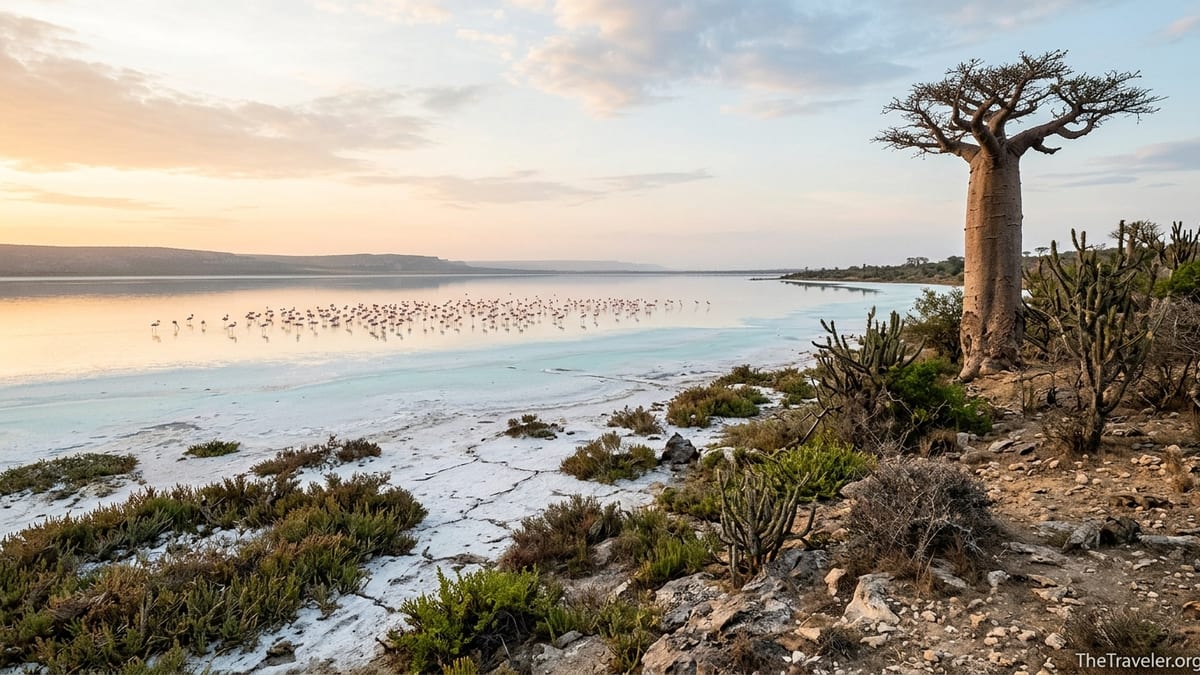
The centerpiece is Lake Tsimanampetsotsa, a shallow, hypersaline soda lake so mineral-rich that it supports no fish. Its milky, turquoise water contrasts sharply with the dazzling white salt flats and rust-toned shoreline. This harsh chemistry suits flamingos, which sift microscopic organisms from the brine, and draws travelers who want to see one of Madagascar’s most unusual lakes alongside classic spiny forest, baobabs and limestone caves.
Most visitors approach from Toliara, a major gateway city with an airport, or from the beach village of Anakao, which sits roughly 60 kilometers north of the park on the coast. Because the wider region is dry, hot and sparsely populated, services thin out quickly once you leave these hubs. Understanding the logistics between town, coast and plateau is essential to making the most of a short visit.
The park is managed by Madagascar National Parks with local communities, and access regulations can change in response to weather and conservation needs. Fees are broadly comparable to other Malagasy national parks, but exact amounts are subject to periodic revision, so it is wise to confirm current rates with the Madagascar National Parks office in Toliara or through a local operator before you travel.
Reaching the Park from Toliara and Anakao
Travelers usually combine Tsimanampetsotsa with time on the southwest coast, and your starting point shapes the experience. From Toliara, many visitors first take the morning boat to Anakao, spend a night or two on the beach, and then continue inland by vehicle to the park. The regular passenger boat from Toliara’s small harbor to Anakao typically departs once a day in the morning, taking around one hour across the Mozambique Channel, though weather can disrupt schedules, especially during the cyclone season from December to March.
From Anakao, the park entrance is reached by a rough inland track that swings east across sandy coastal plains and low limestone rises. Specialist operators and coastal lodges generally quote around two to three hours each way, depending on recent rains and vehicle type. Several Madagascar-focused tour companies structure this as a long day trip, leaving Anakao around 6:30 to 7:00 in the morning, doing two or three walking circuits in the park, and returning around sunset.
It is also possible to approach from inland via National Road 10 south of Toliara, then along signposted tracks toward Beheloke and the park. This route is longer, slower and more isolated, and is normally used by organized expeditions, birding groups or overlanders rather than independent first-time visitors. Because fuel and mechanical support are scarce once you leave the main roads, self-drivers should plan fuel stops in Toliara or Betioky and travel with ample supplies, spare tires and recovery equipment.
A practical example: a small group staying at a midrange lodge in Anakao might book a 4x4 excursion with the lodge for the following day. The package often includes park entry, guide fees and packed lunch. The driver collects guests at 7:00, reaches the park around 9:30, completes the Andaka lakeshore walk and the Tsiamaso cave and baobab circuit, then departs by mid-afternoon to get back to the coast before dark.
Road Conditions and Whether You Need a 4x4
Despite the relatively modest distance from Anakao, Tsimanampetsotsa still feels remote because of road conditions. The inland track from Anakao is unpaved, sandy and stony, with patches of corrugations and occasional dry riverbeds or ruts. In the long dry season, roughly April to November, this route is usually passable but rough, and local operators strongly prefer high-clearance 4x4 vehicles. In or after heavy rains, parts of the track can become muddy or deeply rutted, making four-wheel drive and experienced drivers essential.
From the RN10 inland approach, you are driving on a mix of laterite, rock and sand. This is more committing for independent travelers, as the route runs through sparsely populated areas with very limited roadside assistance. For most visitors arriving by air to Toliara, it is rarely cost-effective or relaxing to self-drive all the way; hiring a vehicle with driver through a Madagascar-based agency in Toliara or using the 4x4 services offered by Anakao lodges tends to be safer and often works out similarly in price once fuel and potential repairs are considered.
In practice, you should treat Tsimanampetsotsa as a 4x4-only destination for tourism planning, especially if you value your schedule and peace of mind. A low-clearance sedan or small city car might manage the dry-season track with luck and very slow driving, but getting stuck in deep sand or damaging the undercarriage would rapidly turn an adventure into an expensive delay. Shared 4x4 day trips from Anakao, which you can often organize through lodges such as beach bungalows or ocean lodges, remove this risk and include drivers who know recent conditions.
If you are overlanding in your own or a rental 4x4, it is worth asking lodge staff or the Madagascar National Parks office in Toliara about current track conditions when you arrive in the city. Early in the dry season the track can still hold muddy patches from late rains, while by October and November deep dust and heat can make the journey tiring, especially without air conditioning.
The Salt Lake, Flamingos and Birdlife
Lake Tsimanampetsotsa is the park’s visual and ecological anchor. The lake is shallow and alkaline, with a pale, opaque appearance that shifts between chalky white, turquoise and soft blue-green depending on light and season. Because its mineral content is so high, it does not support fish, but it is rich in microscopic organisms that feed flocks of flamingos and other waterbirds. The stark contrast of delicate pink birds and pure white salt flats is one of southern Madagascar’s classic scenes.
Two flamingo species visit the lake. Greater flamingos are the more obvious, with pale plumage and bright pink highlights, while lesser flamingos tend to show deeper pink coloration and are somewhat smaller. Their presence can vary, but birding itineraries and nature tour operators regularly report sizable groups between roughly September and March, when water levels and food availability are favorable. Outside this window, you may see scattered birds rather than big concentrations, so it is wise to manage expectations if visiting in the heart of the dry season.
Beyond flamingos, the park records around 70 bird species, with a mix of spiny forest specialists and wetland birds. On a typical visit you might scan the lake for glossy ibis, teal and other wild ducks, while in the scrub you can look for vangas, couas and the localized red-shouldered vanga. Many visitors who are not dedicated birders still enjoy carrying compact binoculars, as even a simple pair makes a real difference when flamingos and plovers are feeding far from shore.
The most accessible way to experience the lake is the Andaka circuit, an easy one-hour walking route from a nearby parking area. This circuit leads you through salt-tolerant succulents and salicornia along the lakeshore to several scenic viewpoints. Local guides often time this walk for early morning or late afternoon, when the light is softer, the heat is less intense and flamingos are more active close to shore. Photographers who want still water reflections should bring a polarizing filter to control glare from the bright, salty surface.
Baobabs, Spiny Forest and Limestone Caves
The land that surrounds the lake is classic southern Malagasy “spiny forest.” This unique ecosystem features drought-adapted shrubs and trees armed with elaborate spines, along with succulents and pachypodiums, all growing in sandy, stony soils under a relentlessly dry climate. Average annual rainfall is low and highly irregular, and the region experiences a long dry season of seven to nine months. Many plants have bizarre, sculptural forms that make even short walks feel like moving through a botanical gallery.
Baobabs are a highlight, especially on the Tsiamaso circuit, where guides point out individual trees with local nicknames such as the “smiling baobab,” “grandmother baobab” and “foreigner baobab.” These trees develop twisted trunks and hollowed cavities, sometimes used in local stories and rituals. Visitors used to the crowded Avenue of the Baobabs near Morondava often appreciate that here, baobabs rise quietly from spiny scrub with no other tourists in sight, particularly outside peak travel months.
Beneath the surface, the Mahafaly Plateau is riddled with limestone caves and sinkholes. On the Tsiamaso circuit you visit Mitoho Cave, a sacred site with still, clear water and blind cave fish, and another bat cave where fruit bats roost in the gloom. There is also a dramatic sinkhole known as Aven Vintany, whose vertical walls are draped in the aerial roots of banyan trees reaching down toward the water. These underground features are fragile environments, so guides typically enforce quiet voices, no swimming and limited torch use to reduce disturbance.
The caves are cool and shady compared to the baking plateau above, but the approach walks can be exposed. Most visitors wear closed footwear with good grip, as you will be walking over uneven limestone, roots and loose stones. A small headlamp is handy inside the caves, even though local guides often carry basic torches. Those prone to claustrophobia should mention this in advance so the guide can adjust which cave segments you visit and how far you venture inside.
Lemurs, Tortoises and Other Wildlife
Although Tsimanampetsotsa is best known for its lake and birdlife, the park also shelters dry-forest wildlife, some of which is difficult to see elsewhere. The Tsiamaso circuit is again the main focus, with a reasonable chance of encountering ring-tailed lemurs as they rest in daytime sleeping trees or move through the scrub. Because this species is relatively tolerant of dry, open scrub, sightings here are quite reliable for groups walking quietly with an attentive guide.
The park is also an important refuge for the critically endangered radiated tortoise, an iconic southern Madagascar species with a beautifully patterned shell. With luck and an observant guide, you may see individuals among the low vegetation, especially in quieter sections away from the main paths. Responsible guides will keep a respectful distance and discourage visitors from handling or crowding around tortoises, both for the animals’ welfare and to respect conservation rules.
Reptile diversity is high, particularly among geckos and small lizards, though many visitors notice them only incidentally. With patience, you might spot a ground gecko along the path, or see a day gecko basking on a sunlit branch. After sundown, herpetologists and keen naturalists sometimes arrange special night walks just outside the strict park interior to look for active reptiles, but these must be organized in advance and are not part of the standard day-trip experience.
In the caves, the star is the blind cave fish of the genus Typhleotris, which live in inland karst lakes cut off from surface light. Guides may shine a torch across the water to reveal ghostly pale fish moving slowly just below the surface. Fruit bats are also common in some chambers; you are likely to hear their calls and the rustle of wings even before your eyes adjust to the dim light.
Walking Circuits and How to Choose Between Them
Madagascar National Parks has established several marked circuits at Tsimanampetsotsa, each with a different focus and length. Official descriptions list durations between about one and three hours, though actual times vary with your pace, how often you stop for photos, and heat. The two circuits most visitors experience on a day trip from Anakao are Andaka and Tsiamaso.
The Andaka circuit is an easy lakeshore walk of roughly one hour. It starts near a parking area and leads over flat terrain alongside the lake, crossing low, salty vegetation and patches of salicornia. This is the circuit to prioritize if your main goal is flamingos and wide-angle landscape views of the salt lake. Families, older travelers and those who are less heat-tolerant often find this the most comfortable route, especially if done in the morning.
The Tsiamaso circuit is slightly longer, commonly described as around two hours on foot, and brings together many of the park’s headline features. You visit the sacred Mitoho Cave to look for blind fish, pause at lemur roost trees and bat caves, view several distinctive baobabs and end at Aven Vintany with its banyan-draped sinkhole. The path is still considered “easy” in official descriptions but involves more uneven ground and short rocky sections than Andaka.
Some itineraries mention additional circuits or extended variants that focus more on forest birds, dunes or longer cross-country walks. These are usually arranged on a private basis with the park office or through a specialist tour operator, such as birding or trekking companies. If you have a strong interest in a particular group like birds or plants, it is worth mentioning this when booking your visit so the park assigns a guide experienced in that area and recommends the best route for your priorities and fitness level.
Guides, Safety, Water and Sun Protection
Visiting Tsimanampetsotsa with a local guide is mandatory and also the best way to appreciate the park’s subtle features. Guides are normally organized either through the official Madagascar National Parks office at the entrance or via your lodge or tour operator. In practice, travelers staying at Anakao beach hotels usually bundle guide fees into their day-trip cost, while independent visitors arriving in their own vehicle can pay for a guide directly on arrival before starting a circuit.
The climate is sub-arid with strong sun, low humidity and very little natural shade away from the caves and some baobab groves. This makes water and sun protection crucial. A realistic recommendation is to carry at least 2 to 3 liters of drinking water per person for a half-day visit that includes two circuits, and more if you are visiting in the hottest months around October and November. Most Anakao lodges can pack large refillable bottles or individual 1.5 liter bottles for guests, and some visitors also bring electrolyte tablets to add to their water.
Clothing should prioritize coverage and breathability over fashion. Lightweight, long-sleeved shirts, long trousers, a wide-brimmed hat and high-SPF sunscreen help protect against the intense ultraviolet radiation reflected off the bright salt flats. Sunglasses with good UV protection are useful both at the lake and during the drive, when dust can irritate eyes. Sturdy walking shoes or light hiking boots are recommended; open sandals leave feet exposed to spines, sharp rocks and hot sand.
Because medical facilities are limited in the immediate area, it is sensible to carry a small personal kit with basics: plasters, antiseptic wipes, pain relief tablets, antihistamines and any prescription medicine you need. Phone coverage can be patchy once you leave Anakao and the main roads, so do not rely on mobile data for navigation or translation. Instead, have your arrangements written down in French or Malagasy, along with contact details for your lodge and a Toliara-based agency or hotel that can assist if plans need to change.
Day Trip from Anakao vs Staying Near the Park
For most travelers, Tsimanampetsotsa works well as a long day trip from Anakao. The standard pattern is to spend several nights at a lodge or guesthouse on the beach, devoting one full day to the park. This avoids the need to move accommodation for just one night, and lets you return to the comfort of coastal facilities such as reliable meals, cool drinks and, at midrange places, hot showers and electricity for charging cameras.
A typical example: a couple staying three nights at a midrange Anakao lodge might pay a per-person supplement for a full-day Tsimanampetsotsa excursion that includes 4x4 transport, park entry and guide. They depart just after sunrise, reach the park mid-morning, walk Andaka and Tsiamaso with a break for a packed picnic in a shaded area, then return to the coast by early evening. For such visitors, the extra expense of arranging accommodation closer to the park often outweighs the benefit, especially if they have limited time in Madagascar.
However, there are scenarios where staying nearer to Tsimanampetsotsa makes sense. Birders and wildlife photographers who want dawn and dusk light on the lake, or multiple attempts at flamingo flocks, may choose to overnight at simple accommodation in or near the village of Efoetse or at basic campsites associated with the park. Conditions here are typically rustic compared to Anakao’s beach lodges, with more limited electricity, simpler food and less language support in English, but the trade-off is more time in the park and shorter daily drives.
Travelers approaching overland on RN10 from the south or east, or those combining Tsimanampetsotsa with other remote dry-forest sites, also tend to stay closer to the park because detouring to the coast would add significant travel time. If your itinerary focuses on the southwest’s inland landscapes rather than the beach, a night near the park, followed by continued overland travel, may be more efficient than shuttling back to Anakao by the same track.
The Takeaway
Tsimanampetsotsa National Park rewards travelers who value atmosphere and unusual landscapes over long wildlife checklists. The salt lake, with its pastel flamingos and blinding white shores, is the immediate draw, but it is the combination of baobabs, spiny forest, caves with blind fish and the feeling of true remoteness that leaves a lasting impression. Reaching the park from Anakao or Toliara may involve bumpy tracks and early starts, yet access is straightforward enough with a 4x4, a good driver and realistic expectations about comfort.
For most visitors, a full-day excursion from Anakao is the most practical way to experience two of the main walking circuits, see the lake and explore at least one cave. Those with specialist interests in birding, photography or geology can consider staying closer to the park or linking it into a longer overland journey through Madagascar’s southwest. Whichever option you choose, advance planning for water, sun protection and guiding will make the difference between enduring the dry heat and truly enjoying one of Madagascar’s most distinctive protected areas.
FAQ
Q1. Can I visit Tsimanampetsotsa National Park as a day trip from Anakao?
Yes. Many visitors do a long day trip from Anakao, leaving early in a 4x4, walking two main circuits and returning by evening, though it is a full and tiring day.
Q2. Do I really need a 4x4 vehicle to reach the park?
In practice, yes. The tracks from Anakao and the inland RN10 are rough, sandy and rocky, and a high-clearance 4x4 with an experienced driver is strongly recommended.
Q3. When is the best time of year to see flamingos on the lake?
Flamingos can be present at various times, but tour reports often highlight roughly September to March as favorable months for larger groups, depending on water levels and food.
Q4. How much drinking water should I carry for a visit?
Plan on at least 2 to 3 liters of water per person for a half-day with two walking circuits, and more during the hottest months or if you are sensitive to heat.
Q5. Are guides mandatory inside Tsimanampetsotsa National Park?
Yes. Local guiding is required for park entry and is the best way to access circuits such as Andaka and Tsiamaso while learning about wildlife and cultural sites.
Q6. Is there accommodation inside or very close to the park?
Accommodation very close to the park is limited and basic. Most travelers stay in Anakao’s beach lodges, while birders or overlanders sometimes use simple local guesthouses or campsites near the park.
Q7. What kind of footwear and clothing are suitable for the circuits?
Closed shoes or light hiking boots, breathable long sleeves and trousers, a wide-brimmed hat and sunglasses are recommended to cope with heat, spiny plants and bright reflected light.
Q8. Can children or less fit travelers manage the walks?
Yes, if they can handle heat and uneven ground. The Andaka circuit is short and flat, while Tsiamaso is slightly longer but still considered easy, with plenty of stops.
Q9. Is swimming allowed in the lake or caves?
No. The lake’s water is too saline for bathing, and cave pools like Mitoho are considered sacred and ecologically sensitive, so entry is on foot only with no swimming.
Q10. How can I arrange a visit if I am not on a group tour?
You can contact an Anakao lodge or a Toliara-based operator to book a 4x4 day trip that includes park entry and a guide, or organize overland access with a driver if you are already touring RN10.