


Southwest Madagascar is one of the country’s most rewarding regions, but it is also one of the trickiest to plan. Distances look short on the map, yet journeys can involve a patchwork of speedboat transfers, broken tarmac, deep sand tracks and tides that dictate when you can drive at all. This guide focuses on building a practical regional route around Toliara (Tuléar), combining Ifaty, Anakao, Tsimanampetsotsa National Park and, for those with enough time and a true 4x4, remote bays such as Salary. The aim is not another island-wide loop, but a realistic southwest itinerary that avoids unnecessary backtracking and explains clearly when you must return through Toliara, when you travel by boat, and when conditions demand serious off-road driving.
Understanding Toliara as Your Southwest Hub
Toliara is the natural gateway for exploring southwest Madagascar. Most travelers arrive by domestic flight from Antananarivo, making Toliara the place where you pick up a 4x4 with driver, stock up on cash and supplies, and organize boat transfers. The city itself has a low-rise, sandy feel, with the main tourist services concentrated around Boulevard Lyautey near the waterfront. This is where you will find transfer offices for the fast boats to Anakao and local agencies offering excursions north toward Ifaty or, for more adventurous visitors, toward Andavadoaka and Salary Bay.
The key logistical point is that almost every combination of Ifaty, Anakao and Tsimanampetsotsa involves passing through Toliara at least once. If you are coming down the RN7 from Isalo or Antsirabe by road, you effectively enter the region at Toliara before deciding whether to fan north to the lagoon at Ifaty via the RN9 or head south by boat to Anakao. Even travelers who connect two beach areas often have to double back through the city because there is no easy direct route between the northern and southern coasts without serious off-road driving or private boats.
For example, a traveler flying from Antananarivo and heading directly to Anakao would typically land in Toliara in the morning, transfer by taxi to the Mahavatse embarkation point and board a scheduled speedboat mid-morning. On the return, they are likely to overnight in Toliara again before continuing overland on the RN7. Thinking of Toliara as a practical hub for one or two short stopovers, rather than simply a transit point, makes it easier to construct workable routes.
North of Toliara: Ifaty and the Easy RN9 Section
The simplest extension from Toliara is north to Ifaty and neighboring coastal villages such as Mangily. This stretch runs along the RN9, which has been upgraded and partly paved between Toliara and Analamisampy. In practice, this means that the first section of the road out of Toliara is comparatively smooth, and even in a regular taxi or a basic taxi-brousse you can usually reach Ifaty in under two hours in dry season. Many local agencies arrange private transfers for visitors staying at mid-range beachfront lodges, which is often worth paying for if you are carrying dive gear or traveling with children.
Once in Ifaty, most travelers settle into a slower rhythm: snorkeling or diving on the coral reef, visiting the nearby spiny forest at dawn with a local guide, and relaxing in small beach hotels that line the sandy shore. In practical routing terms, Ifaty functions best as either a first or final stop around Toliara. For instance, a traveler coming down the RN7 might spend two or three nights in Ifaty to decompress after long driving days, then return to Toliara for an onward flight or boat transfer to Anakao. Attempting to continue north by road from Ifaty eventually leads onto much poorer coastal tracks, which quickly turn a relaxed beach stay into a demanding overland expedition.
Crucially, if your southwest plan includes both Ifaty and Anakao but does not involve a full 4x4 coastal expedition, you will need to backtrack through Toliara. There is no regular public boat linking Ifaty with Anakao, and the inland road network forces you to drop back down the RN9 to the city to change modes of transport. In realistic terms, even an efficient itinerary that combines both coasts will look like a triangle with Toliara at its base, rather than a neat loop along the shore.
South of Toliara: Boats to Anakao and Nosy Ve
South of Toliara, the transport character changes from asphalt to ocean. There is no coastal road directly linking the city to Anakao, so travelers rely on speedboats run by local operators such as Anakao Express. These boats typically depart from Toliara around mid-morning and reach Anakao in roughly an hour, skimming along the lagoon behind the barrier reef. Seats are sold per person, with rates often quoted in ariary or euros; budget around the equivalent of a modest hotel night per person for a one-way ticket, acknowledging that prices can shift with fuel costs and season.
The boarding process itself is part of the adventure and worth understanding when planning. The embarkation point near Mahavatse is a simple sandy beach without a deep-water pier, so passengers are usually ferried from shore to the waiting speedboat on a tractor-drawn trailer or local zebu carts, depending on the tide. Bags can get splashed, and there is limited shade on the sandbar, which makes packing valuables in dry bags and wearing sandals rather than closed shoes a practical choice. On arrival in Anakao, luggage is again carried ashore from the anchoring point just off the beach.
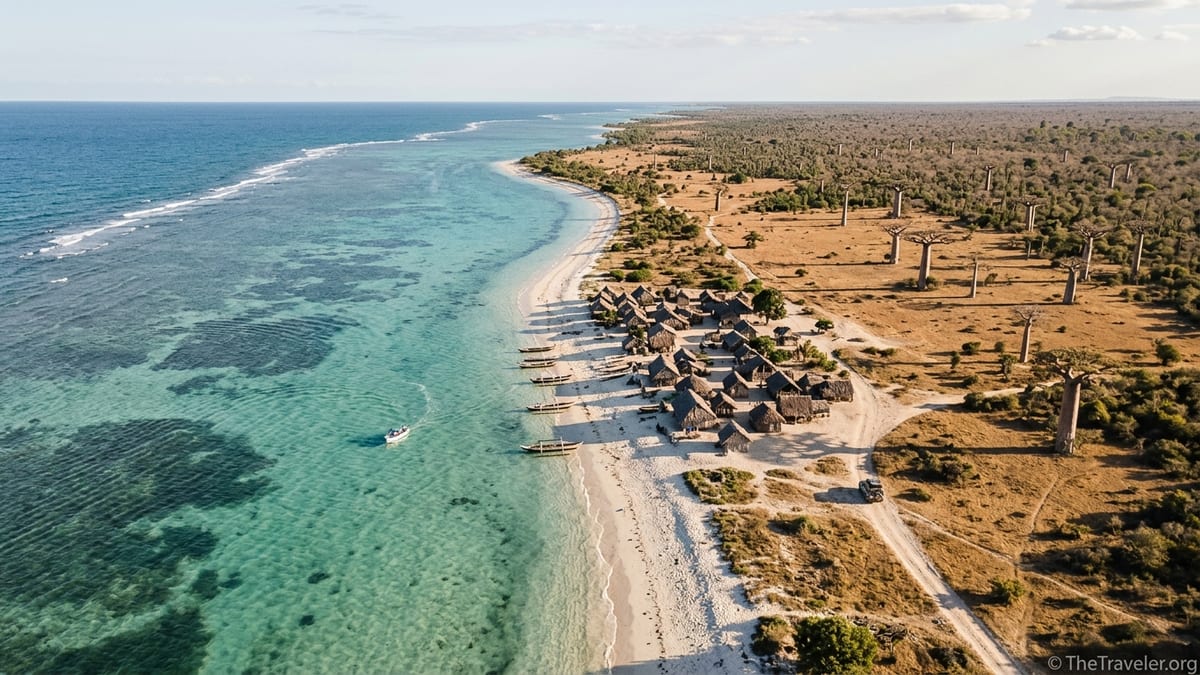
Anakao’s appeal lies in its remote-beach feel, with simple guesthouses as well as a few more comfortable lodges scattered along a long strip of pale sand. From here, local pirogues and small motorboats run day trips to the offshore islet of Nosy Ve, where visitors can snorkel and walk on dazzling white sand while seeing nesting seabirds. For routing, it makes sense to group Anakao and Nosy Ve together as one southern coastal segment anchored by the Toliara boat transfer. Travelers typically stay at least three nights, partly because boat schedules are concentrated in the morning and you lose most of a day to the transfers in each direction.
Linking Anakao With Tsimanampetsotsa and Ambola
Tsimanampetsotsa National Park lies further south and inland from Anakao, known for its salt lake, baobabs and caves, as well as flocks of flamingos when water levels are suitable. The challenge is that there is no straightforward paved approach; the most practical access for most visitors is from Anakao or from the small coastal village of Ambola on sandy tracks. This is where the distinction between a simple beach holiday and an off-road adventure becomes clear.
A common pattern is for lodges in Anakao to help arrange a 4x4 day trip or overnight excursion to Tsimanampetsotsa, often combining the lake with nearby caves and lookouts over the spiny forest. Such excursions typically require a full day, starting early to avoid the fiercest heat, and involve bumping along rough trails where progress can be slow. Prices are usually quoted per vehicle rather than per person, which can make them relatively good value for small groups but more of a splurge for solo travelers.
For those willing to go a little further, some boat operators in Toliara can extend transfers beyond Anakao to Ambola when sea conditions and demand allow. In that case, Ambola becomes a more direct base for visiting the park. However, these boat services are usually on request rather than scheduled, and weather can disrupt plans, so you should avoid building an itinerary that requires an exact Ambola boat on a specific day. In most realistic scenarios, travelers visit Tsimanampetsotsa as a side trip from Anakao and then return by vehicle to the coast to reconnect with the regular speedboats back to Toliara.
Heading North by 4x4: Salary Bay and the Remote Coast
North of Ifaty, the character of the coast changes again. The tarmac and the more regular taxi-brousse services fade away, replaced by sandy tracks that thread through fishing villages, mangroves and low dunes. Reaching Andavadoaka and Salary Bay involves sections of deep sand, tidal flats and occasional river crossings, which is why local agencies emphasize that a true 4x4 with high clearance and an experienced driver is essential. Self-drivers who are new to Madagascar’s tracks often choose to hire not just a vehicle but also a local guide who knows which detours to take around flooded areas or collapsed bridges.
Salary Bay in particular has developed a quiet reputation among divers and kitesurfers for its turquoise lagoon and sense of isolation. Getting there from Toliara usually involves a full half-day of driving, often quoted at around three and a half hours in dry-season conditions in a well-prepared 4x4. Some high-end properties in the bay even mention light aircraft strips for private charter flights, but for most travelers the practical option is still the rough coastal track. This route is best attempted between May and October when the terrain is drier and river levels lower.
From a routing perspective, once you commit to Salary or the villages beyond, your journey becomes an expedition rather than a simple transfer. The same track that brings you north continues through remote settlements toward Andavadoaka and ultimately links, in a patchwork of local routes, with the coast further up toward Morondava. However, this is not a place to rely on mapping apps. Travelers heading north from Toliara along this coast typically do so as part of a pre-arranged 4x4 itinerary with a driver who knows the sequence of ferries and sand tracks, rather than trying to piece it together ad hoc.
Designing Practical Regional Routes With Minimal Backtracking
When you put these pieces together, the key to a workable southwest Madagascar itinerary is to recognize where backtracking is unavoidable and where it can be minimized. Any route that includes both Ifaty and Anakao without a full coastal 4x4 journey will require you to pass through Toliara at least once in each direction. For example, a ten- to twelve-day trip might reasonably look like: arrival via RN7 or flight into Toliara, two or three nights in Ifaty, back to Toliara for one night, then boat to Anakao for three or four nights with a day trip to Nosy Ve and an optional excursion to Tsimanampetsotsa, before returning by boat to Toliara for departure.
Travelers with more time and an appetite for rough tracks can extend this framework without turning it into a maze of repeated legs. One practical pattern is to start with the easier segment: Toliara to Ifaty and back, then boat from Toliara to Anakao. From Anakao, arrange a 4x4 link south to Tsimanampetsotsa and onward along the remote coast, looping gradually back north toward Salary and eventually rejoining the improved section of RN9 closer to Toliara. This type of through-route reduces the number of times you must return all the way to the city, but it only makes sense if you are traveling with a well-supported 4x4 and have enough days in hand to absorb weather or mechanical delays.
What usually does not work well is trying to add every possible coastal stop without increasing your timeframe. For instance, squeezing in both Salary and Andavadoaka in addition to multiple nights in Ifaty and Anakao in under ten days typically leads to constant packing and long transfer days, with several returns via Toliara or repeated stretches on the same track. A more satisfying strategy is to choose either a “north plus hub” plan focused on Ifaty and, if you like, Salary, or a “south plus hub” plan anchored by Anakao and Tsimanampetsotsa, using Toliara as the pivot point between them.
Transport Choices, Seasons and On-the-Ground Costs
Choosing the right mix of transport is what makes or breaks a southwest itinerary. Between Toliara and Ifaty, budget travelers can get by with local taxis or shared vehicles along the RN9, provided they accept slower, less predictable timetables. Many independent travelers end up negotiating directly with hotel drivers in Toliara or Ifaty for a one-way transfer, which can be cost-effective when split between two or three people. Between Toliara and Anakao, the scheduled speedboats are the central spine of movement, and seats are usually booked either through your Anakao lodge or at the operator’s office in Toliara at least a day in advance.
Once you step off the paved or semi-paved roads, however, a proper 4x4 with a driver quickly becomes less a luxury and more a safety net. Agencies in Antananarivo and Toliara often quote multi-day packages that bundle vehicle, driver, fuel and accommodation stops along the remote coast, with sample itineraries of around eight days from Morondava to Toliara or similar durations from Toliara up to Salary and beyond. For context, travelers on recent trips have reported daily vehicle-and-driver costs that, when shared among a small group, ended up comparable to the nightly rate of a mid-range hotel per person, though fuel price fluctuations and seasonal demand can push this up.
Season also plays a decisive role. The dry months roughly from May to October are usually recommended for tackling remote routes north of Ifaty and around Tsimanampetsotsa. In the wetter months, some sections of the coastal track can become boggy or cut by swollen rivers, and boat departures around Toliara are more frequently adjusted for rough seas or wind. Building a buffer of at least a day on either side of key boat connections and avoiding tightly stacked same-day domestic flight and speedboat combinations is a sensible precaution.
The Takeaway
Southwest Madagascar rewards those who plan with the region’s real-world constraints in mind. Toliara functions as the practical hinge that lets you pivot between the gentler beach break of Ifaty on the partially paved RN9 and the wilder, boat-accessed shores of Anakao and Ambola. From there, Tsimanampetsotsa and the remote coastal tracks toward Salary Bay open up only for those willing to invest in a capable 4x4, time and a degree of flexibility.
Rather than chasing a perfect loop that touches every bay, the most satisfying itineraries are those that choose a focus and accept some limited backtracking where the geography and infrastructure demand it. Linking a couple of carefully chosen beach bases with realistic travel days, and respecting the seasonal rhythms of sea and sand, turns the southwest into an achievable highlight rather than a stressful detour. With that mindset, the lagoons, baobabs and fishing villages between Ifaty and Salary or between Anakao and Tsimanampetsotsa can slot naturally into a broader Madagascar journey without dominating it.
FAQ
Q1. Can I visit both Ifaty and Anakao without flying more than once?
You can. Most travelers fly into or out of Toliara only once and link both coasts by returning through the city: Toliara to Ifaty and back by road on the RN9, then Toliara to Anakao by scheduled speedboat. Doing it this way keeps transfers manageable and avoids needing private boats or difficult overland shortcuts.
Q2. Do I really need a 4x4 to reach Salary Bay?
Yes, for practical purposes you do. The coastal tracks north of Ifaty toward Andavadoaka and Salary involve deep sand, tidal sections and occasional river crossings. Agencies that run trips there emphasize using a high-clearance 4x4 with an experienced driver familiar with local conditions, especially outside the driest months.
Q3. How long is the boat ride from Toliara to Anakao?
Expect roughly an hour on the water in calm conditions. Scheduled speedboats usually depart Toliara in the morning and cross the lagoon behind the reef, but boarding and disembarkation at the sandbar can add extra time. It is best to treat the transfer as a half-day movement door to door.
Q4. Is there a direct boat from Ifaty to Anakao?
No regular public service links Ifaty and Anakao. Private charters might be possible in theory, but they would be costly and dependent on sea conditions. In realistic trip planning, you should assume you will travel via Toliara, returning by road from Ifaty and then switching to a scheduled speedboat south.
Q5. How many days do I need to include Tsimanampetsotsa National Park?
If you base yourself in Anakao, you can see key parts of the park on a long day trip in a 4x4. However, many visitors prefer to stay at least one night either in or near the park or back in Anakao afterward to avoid back-to-back long driving and boat days. Building in two full days around Tsimanampetsotsa gives you more flexibility for weather and road delays.
Q6. When is the best season to explore the remote southwest coast?
The dry season, broadly from May to October, is usually the safest bet. Coastal tracks north of Ifaty and around Tsimanampetsotsa are generally firmer, river levels lower, and there are fewer heavy rainstorms to disrupt boat schedules. Shoulder months can still work, but more patience and backup plans are advisable.
Q7. Can independent travelers use taxi-brousse for this region?
Between Toliara and Ifaty, yes, shared vehicles and local minibuses are common, though they can be slow and crowded. Between Toliara and Anakao or onward to Ambola, regular taxi-brousse services are not an option, so you need to rely on scheduled boats. For the remote track up to Salary and beyond, independent travel without a 4x4 and driver is not realistic.
Q8. How should I plan my cash and supplies for this itinerary?
Toliara is the main place in the region with ATMs, larger markets and pharmacies. Once you are in Ifaty, Anakao or Salary, card payments are accepted at some lodges but not all, and cash is needed for local guides, community fees and small purchases. Many travelers withdraw the bulk of their trip budget in Toliara and carry a reserve for remote days.
Q9. Is it safe to self-drive the southwest routes?
Experienced overlanders sometimes self-drive, but they often still hire a local guide for the trickier coastal sections. For most visitors, the combination of poorly signposted tracks, variable sand and river conditions, and limited roadside assistance makes hiring a vehicle with driver from a reputable agency the safer and less stressful option.
Q10. How far in advance should I book boats and 4x4s?
During the dry high season and around local holidays, it is wise to reserve speedboat seats to Anakao and 4x4 services several weeks ahead, especially if you have fixed domestic flight dates. Outside peak times, booking a few days in advance in Toliara is often sufficient, but leaving arrangements until the last minute can limit your options or force you to adjust your route.