


I based myself in Toliara for several days and then moved out along the coast, staying first in Ifaty / Mangily and later in Anakao. On this trip I was not interested in marketing promises about “turquoise lagoons” or “world‑class reefs.” I wanted to know what the sea actually felt like under my feet: how clear the water really was, whether waves or currents made swimming stressful, what the coral looked like, and how busy the beaches felt with boats and fishing activity. This article is written as a decision tool, not a love letter. It is about where I would sleep if I came back to the southwest coast, and why.
How I Actually Traveled the Southwest Coast
My base was Toliara, where I spent three nights in town before and between beach stays. From there I stayed two nights in Ifaty / Mangily, about 30 kilometers north by the RN7, and three nights in Anakao, reached by the standard morning speedboat from Toliara’s small port. This matters, because I am only going to strongly recommend beaches where I actually got into the water, walked the sand at different times of day, and watched how conditions changed with tides and wind. General destination descriptions are useful as background, but they often gloss over discomfort and variability.
In Ifaty I slept in a simple bungalow directly on Mangily beach, facing the lagoon, with the surf on the offshore reef clearly visible from my veranda. In Anakao I stayed in a beachfront bungalow just south of the main village, where Vezo pirogues are pulled up along the sand and the same barrier reef continues offshore. In both places I swam every day, usually once at high tide and once when the tide was lower, and I went out by boat to snorkel on the reef itself. I am a confident swimmer and comfortable in open water, but not a thrill‑seeking surfer. My bias is toward clear, calm water where you can float, snorkel and relax rather than fight waves.
The other piece of context is season. I traveled in the dry season, between late June and early July, when the southwest coast is usually at its most settled. Locals in both Ifaty and Anakao were quick to point out that winds can be stronger earlier in the year and that rough days still occur. Anything I say about comfort or safety is a snapshot from that period, not a permanent guarantee. Sea conditions anywhere on the Mozambique Channel can change quickly with weather, tides and storms far offshore.
Because this is a decision article, I will keep the focus tight: what the water, beach and atmosphere felt like in Toliara town, Ifaty and Anakao, and whether it makes more sense to stay in town and day‑trip or to commit to several nights on the coast itself.
Toliara Town Beaches: Practical But Not Why You Came
My first swims were technically in Toliara, though “swim” might be an overstatement. The coastline immediately around town is more of a functional working waterfront than a classic Indian Ocean beach. The water here is shallow and strongly affected by tides. At low tide the sea retreats far over mudflats and seagrass. At high tide you get swimmable depth, but the water near the port is often brownish or cloudy with sediment. There are Vezo pirogues and larger boats constantly coming and going, and in places rubbish collects along the shoreline. I chose to keep my swimming very short and close to my accommodation, mainly to cool off rather than to enjoy the sea.
Water clarity off central Toliara was the poorest I experienced along this stretch of coast. On my clearest morning I could see my feet at about chest depth, but the water had a green‑brown cast and the bottom was soft rather than sandy, so each step kicked up more cloud. There are small stretches of sand where local children play, but this is not the translucent turquoise you might expect from Madagascar postcards. There are no reefs close enough to snorkel from shore here, and given the boat traffic and water quality, I did not look for any.
Waves and currents in town were not a problem on my visit because the entire area sits behind the same grand barrier reef that shelters the coast further north and south. Swell from the Mozambique Channel breaks on that reef a long way offshore, so what reaches the town is essentially chop rather than surf. The issue in Toliara is not rough water. It is clarity, pollution risk and the constant presence of working boats. I was always aware of diesel fumes when the wind was wrong, and I avoided putting my head underwater near the main port area.
Facilities are of course best in Toliara. You have a full range of guesthouses, mid‑range hotels, ATMs, pharmacies and basic supermarkets. If your time is very short or you only have one transfer window to the coast, staying in town for a night can be logistically necessary. But for anyone whose main reason to be here is the sea, the beaches right in Toliara are the weakest option. They are a place to transit through, not the place to finally lay down your towel.
Ifaty / Mangily: Living in a Protected Lagoon
Ifaty and Mangily are the names most travelers hear first when they picture beaches near Toliara. Driving north from town along the RN7, the landscape quickly dries into spiny forest and sandy tracks before the road drops you onto a strip of guesthouses facing a sheltered lagoon. The structural fact here is the barrier reef off Toliara, which lies a few hundred metres to a couple of kilometres offshore and breaks the energy of the ocean swells before they reach the beach. From my bungalow I could clearly see a continuous line of white water where the surf exploded on the reef, while inside that line the lagoon stayed glassy or just lightly rippled.
Inside the lagoon at Ifaty the water depth near shore ranged from ankle deep at low tide to shoulder deep at high tide during my stay. That shallow gradient made the beach feel forgiving underfoot. I could walk out a long way over pale sand before losing my footing, and there was no sudden drop‑off. On two mornings the water was almost perfectly flat and very clear. I could see small fish and ripples in the sand at waist depth, and my legs and hands looked sharp under the surface. By afternoon, when the daily thermal winds picked up, the lagoon turned slightly choppy and visibility dropped a little because waves stirred up fine sand, but it never became rough or intimidating.
Snorkeling directly from the beach in Mangily was limited. There are patches of seagrass and isolated coral heads inside the lagoon, but the more complex coral and fish life sit closer to the main reef. To see that you need to hire a motor pirogue or small dive boat. I joined a half‑day snorkel trip with a local operator based just behind the beach. The ride out took about 20 minutes across the lagoon, passing Vezo fishermen sailing or paddling their painted canoes toward and away from the reef. Once we tied to a basic mooring near a site known colloquially as a “rose” coral patch, the water changed character. It was cooler, around chest‑tingling rather than bath‑warm, and significantly clearer than inside the shallowest part of the lagoon. I could see several metres down to hard coral fields and schooling fish.
It is important to temper this picture with reality. The coral I saw off Ifaty was a mix of living and dead. There were healthy sections of branching and boulder corals populated by parrotfish, sergeant majors and the occasional anemonefish, but also large grey patches that looked bleached or broken. Local guides candidly mentioned past cyclone damage and fishing pressure. On my visit, plankton suspended in the water reduced the sort of crystalline visibility you might associate with the Maldives or Red Sea. When clouds covered the sun, everything took on a murkier blue‑green tone and fine details faded quickly with depth. It was still enjoyable, but it was not a pristine wall of color.
Ifaty on Foot: Sand, Shade, Vendors and the Human Atmosphere
The sand along Mangily beach is a soft, pale beige with a slightly coarse texture where crushed shell fragments mix in. Walking barefoot was comfortable except for occasional bands of small shells and the odd piece of coral. At high tide the water comes close to the line of simple restaurants and bungalows. At low tide wide sandflats appear and local children play football, while pirogues sit on their sides waiting for water. Shade is available mostly under the thatched umbrellas and palm trees of the small hotels. Natural tall palms are present, but much of the immediate shade is planted and maintained by the accommodations. I never struggled to find a place out of the sun as long as I stayed near my lodge’s loungers.
Vendors are a visible part of the beach life in Ifaty. In front of the more established hotels, women walk slowly along the sand selling shell jewellery and sarongs, and men sometimes offer carved wooden ornaments. On my first afternoon, I was approached by half a dozen different sellers within an hour of lying down with a book. The interactions were polite and a gentle “non, merci” was accepted, but the frequency is something to be aware of if you dream of complete solitude. Away from the denser stretch of bungalows the beach empties quickly, and you can walk for several minutes seeing only fishermen repairing nets under the shade of their sails.
Fishing activity inside the lagoon is constant but usually low impact for swimmers. Vezo pirogues criss‑cross the lagoon under their angled lateen sails, heading for the reef or returning with small catches of fish and octopus. Near the main village there is a busier cluster of boats landing and gutting fish, which can make the water feel oily or attract scavenging birds. I avoided swimming right in front of that zone and preferred the slightly quieter sections in front of low‑key guesthouses just north of the village. Motorboat traffic was modest on my visit. Most snorkel and dive trips left early, so by mid‑morning the lagoon was relatively quiet.
Facilities in Ifaty are enough for a relaxed beach stay but not much more. My bungalow had running water, a fan and intermittent Wi‑Fi. Restaurants along the sand served grilled fish, zebu skewers and simple vegetarian plates at prices that felt fair for a remote coastal strip. Cash remains king, and it was easier to pay in ariary withdrawn in Toliara than to rely on card machines. In practical terms, Ifaty worked best as a place to do very little: swim at high tide, snorkel from a boat once or twice, read in the shade and walk the sand at sunset while the reef threw up a distant, continuous roar of breaking waves.
Anakao: Clearer Water, More Exposure, Stronger Character
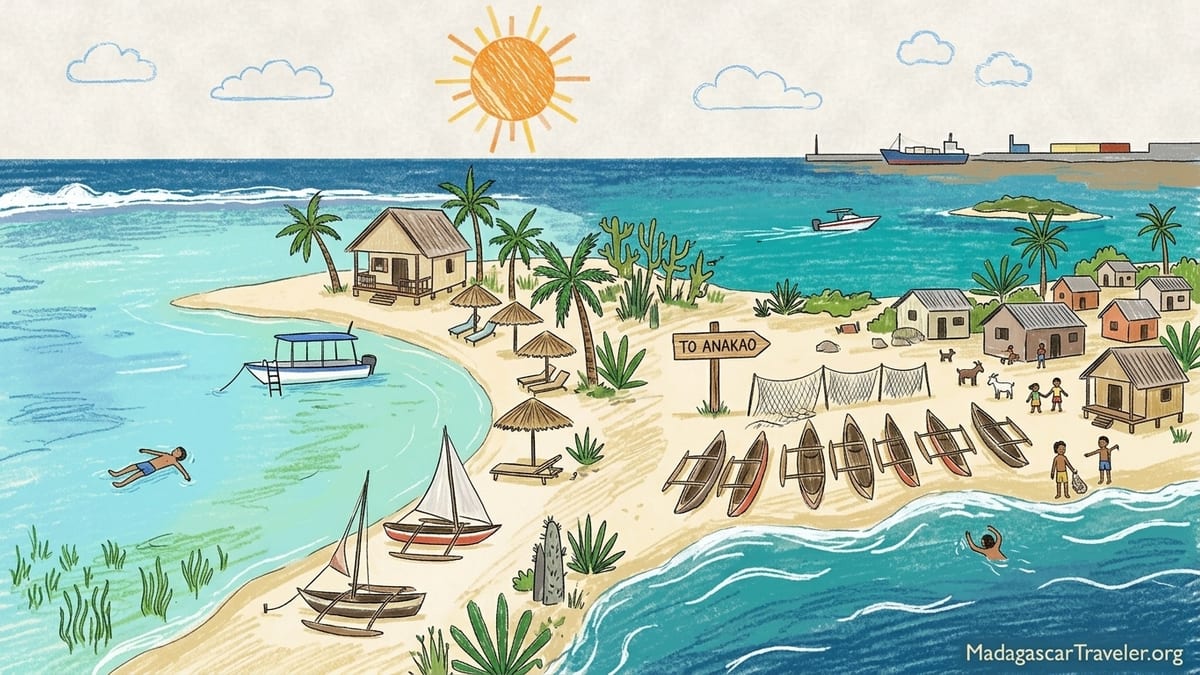
Arriving in Anakao by speedboat from Toliara felt like stepping into a more elemental version of the same coastal system. The barrier reef still sits offshore, taking the brunt of the Mozambique Channel swell, but in Anakao the lagoon between reef and beach is a little wider and the village is more tightly woven into the sand. Vezo pirogues line the beach in long rows, net racks dry in the sun, and goats and children wander among beached hulls. My bungalow opened directly onto this scene, with the reef line visible on the horizon and the constant sound of waves breaking far out to sea.
In the water, Anakao felt slightly cooler and clearer than Ifaty during my stay. On a still early morning I could see the stripes on small reef fish in chest‑deep water right off the beach, and the sandy bottom looked almost white under a strong sun. The lagoon floor drops off a little faster than in Ifaty, so within a dozen metres of shore I was already floating rather than standing easily. That depth gave the water a more intense turquoise color but also meant that weaker swimmers might feel less secure. There were gentle waves lapping at the beach, especially when afternoon winds funneled between buildings and the open lagoon. These waves were nothing like open‑ocean surf. They rolled rather than crashed, and I never once had to duck through breaking sets near shore.
Snorkeling from Anakao took two forms on my visit. On calm mornings, I swam out over the inner lagoon toward isolated coral heads, where I found scattered patches of hard coral and small fish in relatively shallow water. On less settled afternoons, visibility dropped in the inner lagoon as sand and fine silt were stirred up, and the experience was more about floating in cool water than spotting marine life. For more consistent snorkeling I joined a boat excursion to sites nearer the reef edge and around nearby islets. Out there, the water clarity improved noticeably. Sunlight cut deep columns into clear blue, and the coral gardens showed more variety than what I had seen off Ifaty, though again with obvious damaged areas.
The feeling of exposure in Anakao comes less from the size of waves near shore and more from the sense of being on the frontier of the ocean. The beach is open, there are fewer planted palms than in Mangily, and the afternoon wind can blow quite strongly through gaps between buildings. Sitting on the sand with salt drying on my skin, I felt the constant presence of the sea as work rather than just leisure, because everywhere around me people were launching and landing pirogues, dragging nets and moving buckets of fish. It is attractive in a raw, uncurated way, but it does not try to wrap the seafront in the soft edges of a resort strip.
Facilities in Anakao are slightly more scattered and, at the budget end, more basic than in Ifaty. My bungalow had solar power for lights, an outdoor cold‑water shower and intermittent electricity for charging devices. Some mid‑range lodges further from the main village offer more comfort, including hot water and better food menus, but are separated from the everyday life of the village by a short walk. Food prices for grilled fish and rice were roughly comparable to Ifaty, while boat excursions, especially to offshore islets, tended to be a bit more expensive because of the fuel needed for longer runs.
Reef‑Protected Lagoons vs More Exposed Stretches
Both Ifaty and Anakao sit behind the same grand barrier reef that protects this entire section of Madagascar’s southwest coast. Official tourism materials often describe Ifaty as a lagoon destination, focusing on snorkeling and diving behind the reef, and Anakao as a Vezo fishing village with clear turquoise water, snorkeling, diving and even surfing further offshore. This general framing is accurate enough, but it blurs important distinctions that matter when you are choosing where to sleep, especially if you are not completely comfortable in the ocean.
In a reef‑protected lagoon like the one immediately off Mangily, the reef acts as a physical breakwater. The big energy of the Mozambique Channel swells is spent crashing on the reef crest, which you see as that distant line of white. Inside the lagoon the water is shallow and usually calmer. Waves, when they appear, are more like wind‑ripples than surf, and the bottom tends to be sandy and gently sloping. On my visit, I never saw or felt a strong lateral current in the inner lagoon at Ifaty. I could stand in chest‑deep water and simply drift in place, watching small fish flicker over patches of seagrass. This made the lagoon feel friendlier for less confident swimmers and for children, provided adults kept an eye on tides and boat movements.
In more exposed stretches, which you begin to feel around parts of Anakao and more so on transfers toward surf breaks outside the main lagoon, the protection of the reef is less absolute. The lagoon can be deeper close to shore, which means even modest wind waves carry more punch when they reach you, and any gaps or passes in the reef can channel water in and out, creating currents that are not obvious from the beach. On the boat rides toward reef breaks used by surfers south of Anakao, the swell built into long, rolling humps that rocked the pirogue enough that standing securely required holding a rail. I did not surf there, but simply traveling through that water made the difference from the gentler inner lagoons very clear.
Reef protection does not guarantee permanent safety. Even in Ifaty’s shallow lagoon, strong winds, spring tides or distant storms can transform calm water into something confused and uncomfortable, especially for people unused to the sea. Water clarity is also highly variable. On my clearest morning in Ifaty I had six to eight metres of visibility over the reef. Two afternoons later, after a period of stronger wind, suspended sand and plankton cut that down to perhaps three metres. In Anakao I had one snorkel session where the water on the reef edge felt as clear as a swimming pool and another, less than 24 hours later, where incoming swell and clouds made the same site feel hazier and less inviting.
The practical takeaway on reef‑protected versus more exposed water is to match the destination to your own comfort and to pay attention to local advice daily. If you are drawn to gently lapping water with firm sand underfoot and no interest in surfing, the inner lagoon beaches like Mangily are likely to feel better under your skin. If you are comfortable with deeper water, longer boat rides and the possibility of more movement in the sea, Anakao opens up clearer snorkeling and a stronger sense of being on the outer edge of the Indian Ocean. In both cases, you should never assume that sea conditions tomorrow will match your best swim today.
Should You Stay in Toliara, Ifaty or Anakao?
After using Toliara as a transit base and then living by the sea in both Ifaty and Anakao, my conclusion is clear. If the coast is the reason you came to this part of Madagascar, you should move out of town and sleep by the beach for at least a few nights. The difference between hearing trucks in Toliara and hearing the reef at night in Ifaty or Anakao is the difference between passing through a region and actually being in its landscape. Day‑trips from town are technically possible but come with trade‑offs that most travelers underestimate when they plan on a map.
From Toliara to Ifaty by car or taxi‑brousse you are looking at a transfer of around one hour each way in dry season conditions, sometimes a bit more if the sandy final stretch is rutted or busy. That means a return day‑trip cuts at least two hours into your beach time, and you will still need to negotiate boat trips or find a place to change and shower. For Anakao, the standard speedboat departures cluster in the morning from Toliara and return late afternoon, essentially forcing you into the shape of a full‑day excursion if you stay based in town. You arrive after the first soft light on the lagoon and must leave before the most peaceful part of the evening.
By contrast, when I slept in Ifaty and Anakao, I had the freedom to choose my swim and snorkel windows. I woke before sunrise, walked a few steps onto the sand to watch the sky go pink over the reef, and slipped into the water when it felt right. If afternoon winds rose and the lagoon became choppier, I could simply read in the shade instead of feeling pressured to “get value” from a day‑trip. In practical terms, staying on the coast also made it easier to arrange boat outings at short notice. In Anakao, I was able to join a small group heading to a nearby reef after a quick conversation over breakfast, something much harder if you are commuting from town.
There are reasons someone might still choose to sleep in Toliara. Prices for accommodation and food can be lower in town, and you have much wider choice for services such as pharmacies, money exchange and onward transport. Travelers with very tight itineraries might land late in the day from Antananarivo and not want to tackle sandy coastal roads or boat crossings in the dark. In that case, using Toliara for a night on arrival and a night before departure makes sense. But if your schedule allows even three or four nights at the coast, I would strongly recommend dividing them between Ifaty and Anakao rather than bouncing back to town after day‑trips.
Between the two main beach options, Ifaty is the easier and more forgiving base, especially if you are tired after an RN7 road trip and want the simplest possible transition from land to sea. It is closer to Toliara, has a more obvious strip of beachside restaurants and bars, and its inner lagoon feels immediately familiar and safe to many visitors. Anakao feels wilder and a bit more work, both in terms of the boat transfer and the more exposed feel of the coast, but rewards that extra effort with clearer water on its better days and a stronger sense of place. On a future trip I would still split my time, but if forced to choose one, I would personally base in Anakao for the greater intensity of the seascape and then spend at least a full day in Ifaty to experience its softer lagoon.
The Takeaway
On this stretch of Madagascar’s southwest coast, the sea is always filtered through the presence of the barrier reef. From town in Toliara you see its influence in the absence of big surf yet you do not feel the magic of the lagoon because of mudflats, pollution risk and heavy boat traffic. In Ifaty you finally live with the reef as a distant white line on the horizon, protecting a shallow lagoon where you can walk far out over sand, float without effort and learn the rhythm of Vezo pirogues slipping to and from the reef. In Anakao you push closer to the outer edge of the ocean, with deeper turquoise water, clearer snorkeling on its better days and a fishing village that is fully alive to the sea as work, not just play.
The practical distinction between these places is less about marketing labels and more about how you personally relate to the water. If you are here to swim gently, to get used to the sea and to have facilities within easy reach, Ifaty’s protected lagoon is likely to fit. If you are comfortable with slightly more exposed conditions, longer boat rides and fewer soft edges in the human environment, Anakao can feel like a rare, raw corner of the Indian Ocean that has not yet been fully converted into an international resort strip. Neither beach is permanently safe or permanently perfect. Wind, tide and distant weather can turn clear water hazy, calm lagoons choppy and easy snorkels into something more strenuous overnight.
What I learned from staying in Toliara, Ifaty and Anakao is that your best experience of this coast comes from sleeping where you want to swim. The reef, the light and the daily life of the Vezo people reveal themselves most clearly early in the morning and late in the day, when day‑trippers are on the road or already back in town. If your budget and itinerary can stretch to at least three nights split between Ifaty and Anakao, you will gain a far richer sense of the southwest coast than if you watch it like a film from the seat of a transfer vehicle. Toliara town is a necessary hub, but the beaches that most travelers dream about are out along the sand and the lagoon, where the roar of the distant reef replaces the hum of engines after dark.
FAQ
Q1. Is it realistic to stay in Toliara and day‑trip to Ifaty or Anakao for the beach?
It is possible but not ideal. Reaching Ifaty from Toliara usually takes around an hour each way by road, and Anakao requires a scheduled speedboat that typically runs mornings and late afternoons. Those transfers eat into the calmest beach hours at sunrise and sunset. After doing both, I found that actually sleeping in Ifaty or Anakao gave me more relaxed swimming windows, easier access to boat trips and a much stronger feel for the coast.
Q2. Which beach felt safer for nervous swimmers, Ifaty or Anakao?
On my visit, Ifaty’s inner lagoon felt gentler and more predictable. The water was shallower for longer as you walked out, with soft sand underfoot and very small waves thanks to the strong protection of the offshore reef. In Anakao, the lagoon deepened more quickly near shore and there were slightly larger wind‑driven waves in the afternoons, which might unsettle beginners. In both places I would still advise checking daily conditions and staying close to shore if you are not confident in open water.
Q3. Where did you find clearer water for snorkeling, and was coral in good condition?
Overall, I found clearer water and more varied coral on boat trips from Anakao, especially closer to the reef edge and around nearby islets. Off Ifaty, the inner lagoon was pleasant for a dip but not rich in coral. By boat near the reef I saw pockets of healthy hard coral mixed with large damaged or bleached areas. In both areas visibility changed a lot with wind and tide. Some sessions felt almost pool‑clear, while others a day later were noticeably murkier.
Q4. How busy were the beaches with vendors and fishing boats?
In Ifaty, the main Mangily strip had a steady flow of beach vendors offering sarongs, shell jewellery and carvings, especially in front of mid‑range lodges. It was never aggressive, but I was approached several times each afternoon. Fishing pirogues moved across the lagoon throughout the day, with a busier cluster near the main village fish landing. Anakao felt more like a working fishing village, with many more boats pulled up on the sand and constant net activity, but fewer roaming vendors walking directly between sun loungers.
Q5. Did you feel comfortable swimming directly off the beach in both places?
Yes, with some caveats. In Ifaty I swam multiple times a day directly off the beach and felt comfortable as long as I paid attention to boats and avoided the immediate vicinity of the fish landing area. In Anakao I also swam straight from the sand, particularly early in the mornings when the lagoon was calm and clear. On windier afternoons in Anakao the chop and depth close to shore made me more selective, choosing shorter swims and keeping closer to my bungalow.
Q6. Are there shaded spots on the sand, or do you need to bring sun protection?
Both Ifaty and Anakao have sections of natural and planted shade, mainly from palms and from thatched umbrellas provided by beachside accommodations. In Ifaty’s Mangily area, I rarely struggled to find a lounger under a palm or shelter. In Anakao, shade depended more on how each lodge had arranged its beachfront, and the open village sections of beach felt quite exposed in the middle of the day. In all cases, strong sun and reflection off the water mean high‑factor sunscreen, a hat and long sleeves remain essential.
Q7. How easy is it to arrange snorkeling or diving from each base?
In Ifaty, small dive centres and lodges along Mangily beach routinely arrange morning snorkel or dive trips to the reef, often in simple motor pirogues. I could sign up the afternoon before and join a group the next morning. In Anakao, most beachfront lodges work with boatmen to offer trips to nearby reefs and small islands. The choice is slightly more dispersed, but once I was staying at the coast it was easy to organize outings over breakfast conversations. Trying to arrange the same trips from Toliara town would add extra steps and uncertainty.
Q8. What about non‑water comforts like food, electricity and connectivity?
Toliara town has by far the best range of restaurants, shops and internet options. Ifaty offers a string of simple beach restaurants serving grilled seafood and local dishes, with patchy but usable Wi‑Fi in some lodges. Power cuts happened, but most places had basic backup. Anakao was more variable: my bungalow relied partly on solar power, with limited charging hours and weaker connectivity. Some higher‑end lodges in Anakao offer more reliable electricity and better food, but you should still expect a simpler setup than in town.
Q9. If I only have three nights on the southwest coast, how would you split them?
Based on my own experience, I would spend the first night in Toliara if arrival times make coastal transfers awkward, then two nights in either Ifaty or Anakao depending on your comfort with water. If you are cautious in the sea and value easy lagoon swimming, put those two nights in Ifaty. If you prioritise clearer snorkeling and a stronger sense of a working fishing coast and are comfortable with slightly deeper water, give those two nights to Anakao instead. If boats and schedules allow, shifting one night from town to the coast will nearly always improve your experience.
Q10. Is it worth visiting both Ifaty and Anakao on the same trip?
I found value in experiencing both. Ifaty gave me a gentle reintroduction to the southwest coast after long inland travel, with soft lagoon swims and simple sunset walks. Anakao then deepened the experience with clearer offshore water and a stronger feeling of being on the edge of the Indian Ocean. If you have at least five or six nights to allocate to the region, staying two or three nights in each, with only the minimum necessary nights in Toliara itself, is an excellent way to understand how the same reef shapes quite different beach experiences.