


When most people talk about Toliara, they picture the Mozambique Channel, coral reefs and long, pale beaches stretching north toward Ifaty. I went for those too, but what stayed with me were the hours I spent away from the sea, among thorny silhouettes, baobab trunks and mud-brown mangrove roots. Using Toliara as a base, I stitched together a series of half-day trips into the surrounding spiny forest and wetlands, and the landscapes I found there felt like a completely different country from the greener Madagascar I had seen along the RN7.
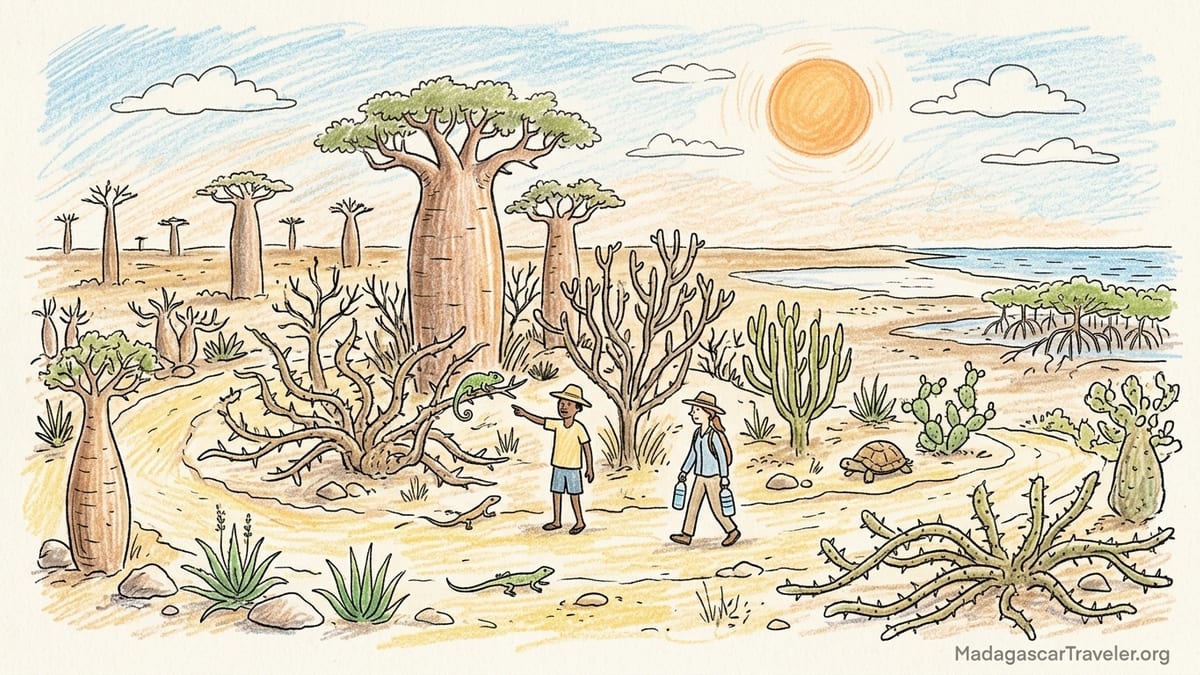
Leaving the Coast Behind: First Impressions of Toliara’s Dry Country
My introduction to Toliara’s hinterland began before I ever set foot on a forest trail. On the drive into town from the airport, the scenery shifted from the last rice paddies of the highlands to an increasingly dusty, flat plain. By the time we reached the outskirts of Toliara, the trees were no longer familiar broadleaf shapes but spindly forms with swollen trunks and branches held out like claws. The air felt hotter and drier than anything I had experienced in Andasibe or Ranomafana, and even the light seemed whiter, bouncing off pale sand instead of red soil.
Staying in Toliara itself made logistics easy. I based myself in a modest hotel a few blocks from the waterfront, where staff were used to arranging excursions for people either heading north to Ifaty or south toward Anakao. When I mentioned that I wanted to see the spiny forest and mangroves rather than only the beaches, reception pulled out a dog-eared folder of local guides’ numbers and laminated day-trip price sheets. Cars and guides could usually be confirmed the afternoon before, which suited the changeable internal flight schedule.
Compared with Madagascar’s rainforest towns, Toliara felt like a frontier port. Dust coated the windshields and window ledges, and beyond the palm-lined seafront the land looked almost bare at first glance. It was only when I began venturing out that I understood how much life was tucked into this dry mosaic of thorns, succulents and salt flats. The contrast with the lush eastern escarpment was so stark that it felt like watching a nature documentary flip to a new biome with a hard cut.
Those first days convinced me that if you only see Toliara as a beach stop at the end of the RN7, you miss the real story of this region. The natural highlights are spread in a semicircle around town: the Arboretum d’Antsokay in the south, the spiny forests around Mangily and La Table to the north and northeast, and mangrove reserves tucked into the coast between.
Arboretum d’Antsokay: A Guided Walk Through the Spiny Forest’s Logic
The Arboretum d’Antsokay was my first deliberate step into the spiny forest. Madagascar Tourism is right: it lies roughly 12 kilometres south of Toliara, just off the RN7. I arranged a visit through my hotel, which booked a local driver with a basic sedan. We left around 7:30 in the morning to beat the worst of the heat and the short drive took about 25 minutes along a paved road, with a final dusty track leading to the entrance and its low stone buildings.
At the reception desk I paid a modest entry fee in ariary and was introduced to my guide, a soft-spoken man in his thirties who had been working there for several years. Guided walks are not optional here, and after twenty minutes on the trail I was grateful for that rule. Without him, the vegetation would have been an impenetrable wall of unfamiliar thorns. With him, each stop became a story about survival in sand. He pointed out bottle-shaped trunks storing water for the dry season, leaves reduced to tiny scales to limit evaporation, and an entire group of plants that rely on spines rather than foliage to photosynthesize.
We followed a sandy loop trail that took about an hour and a half at a slow pace. Underfoot, the path was mostly flat but soft, the kind of sand that makes your calves work, and there were occasional low rock steps. I wore closed shoes and was glad I had. The sun exposure was nearly total; small shrubs and the wiry crowns of octopus trees cast more patterns than genuine shade. By 9:00 the light was already fierce, so I kept my hat on and drained most of a one-litre water bottle. Anyone sensitive to heat would be wise to start earlier if possible.
The animals I saw here were that subtle kind you only notice once you stand still. On a sunlit branch beside the trail, my guide spotted a small chameleon, its body patterned in soft browns that matched the dust. A little further on, we paused near a thicket and listened to a bird calling with a low, repetitive note while another flitted between branches in brief arcs of movement. Lizards skittered away from our steps, and near a cluster of succulents we came across a tortoise resting in the patchwork of light and shade. None of these were spectacle moments on the level of seeing lemurs leap through rainforest canopy, but they were a reminder that this dry, prickly landscape is just as alive.
How the Arboretum Compares With Greener Madagascar
What struck me most about the Arboretum d’Antsokay was how compressed and legible everything felt compared with the tangle of a rain forest. In places like Ranomafana, I remember craning my neck to follow guides’ laser pointers into a dark ceiling of foliage while leeches worked their way toward my socks. Here, the tallest trees were still small enough to read as individuals. Trunks and branches were exposed like skeletons, and the space between plants was filled with light instead of deep shade.
The guide used that clarity to show cause and effect. He would place my hand carefully on a trunk to feel how cool and waterlogged it was beneath its thick bark, then step back so I could see how its fat base supported a modest spray of branches. He pointed to an area where the soil had been disturbed in the past and explained how long it took for the slow-growing shrubs of the spiny forest to reclaim space once cleared. Because the arboretum sits inside natural spiny forest, the line between curated collection and wild landscape felt blurred; cultivated beds of labelled plants faded gradually into denser natural thicket.
In practical terms, the arboretum is an easy half-day experience for travellers staying in Toliara. I spent roughly two hours walking with my guide, then retreated to the small on-site restaurant for a cold drink in the shade, watching the shimmering heat beyond the veranda. By late morning, the temperature on the open paths was already intense. I was grateful we had not tried to start any later. Compared with the effort of hiking in hilly rainforest parks, this outing was physically easier but more punishing in terms of sun and dehydration.
If you only have one spare morning in Toliara and want to understand what makes the southwest different from the rest of Madagascar, this is where I would send you first. You will not tick off many headline animals, but you will come away with a mental map for the rest of the region’s dry habitats, from the spiny forest north of town to the scrubby plateaus on the way to the airport.
Into the Spiny Forest Near Mangily: Walking Among Baobabs and Thorns
My next foray left the city in the opposite direction. North of Toliara, the coastal road runs toward Ifaty and Mangily, where patches of relatively intact spiny forest survive between villages and fields. I joined a small-group excursion arranged through a local operator that bundled road transport from Toliara, a local forest guide at Mangily and a simple lunch near the beach. We left town just after dawn in a battered minivan, sharing the road with zebu carts and motorbikes piled high with sacks of charcoal.
The drive up the coast took about an hour and a half with a few slow sections where the asphalt had broken up. As we drew closer to Mangily, the silhouettes of baobabs began to punctuate the horizon more regularly. These were not the long rows you see near Morondava but individual giants and small clusters, some so wide at the base that several of us could barely link hands around them. Between them grew dense walls of thorny shrubs, octopus trees and cactus-like euphorbias, all adapted to survive on minimal water and regular cutting for firewood.
On the ground, the spiny forest proved surprisingly textured. Our local guide, a man from a nearby village who split his time between farming and guiding, led us into a network of sandy paths threading between the densest sections of vegetation. We walked for about two hours in total, with frequent stops in any scrap of shade we could find. The terrain was mostly flat, but the loose sand made it feel like walking on a beach with ankle-deep give. My light hiking shoes filled with fine dust, and I repeatedly snagged my trousers on unseen spines when I strayed too close to the edges of the path.
Wildlife sightings mirrored the Arboretum in their subtlety. Lizards darted away as we approached, leaving only quick traces in the sand. At one point our guide gestured for silence and pointed high into a baobab crown where a bird perched briefly before flying off with a flash of movement. We saw no lemurs on this particular walk, though our guide mentioned they are sometimes spotted in the early morning when the forest is quieter. The most engaging moments came when we simply stopped to take in the shapes around us: a baobab trunk twisted as if it had been braided, a tangle of branches ending in dagger-sharp thorns, a cactus-like shrub growing directly out of a rock slab.
Surviving the Heat: Timing, Exposure and Trail Conditions
Compared with hiking in Madagascar’s greener parks, the biggest difference in the spiny forest around Toliara is not distance or elevation but exposure. There is almost no canopy to provide relief. Even short walks can exhaust you if you start too late or underestimate the sun. On my Mangily outing, despite beginning just after sunrise, the temperature was already climbing by the time we turned back toward the village. Hats, sunscreen and at least two litres of water per person were not optional extras but basic survival gear.
Trail difficulty here is deceptive. On paper, a mostly flat, two-hour walk sounds suitable for anyone with average fitness. Underfoot, however, the combination of soft sand, occasional roots and persistent heat makes it feel more like a half-day trek. I noticed our group’s energy dip sharply whenever we stepped into a particularly open section without even the lightest shade. Wearing long, breathable sleeves and thin trousers offered both sun protection and a barrier against thorns, which sometimes arched into the path at chest height.
From a safety standpoint, I was struck by how essential a guide was in this environment. It would be very easy to wander off one of the informal paths and become disoriented among the repeating patterns of shrubs and baobabs. Our guide also knew which plants were safe to touch or lean against when we stopped and which harboured spines that could go straight through a shoe sole. In one section he steered us deliberately away from a small hollow where he said snakes sometimes bask on cool mornings, even though we did not see any that day.
For visitors using Toliara as a base, all of this means that early starts are worth the inconvenience. Both at the Arboretum d’Antsokay and in the spiny forest near Mangily, I found that beginning between 6:30 and 8:00 in the morning made the difference between an enjoyable nature walk and a trudge through hot air. Afternoon visits might suit sunset photography, but they come with harsher heat and, near the coast, more biting insects.
Honko Mangrove Reserve: Life Between River and Sea
After time among thorns, the mangroves north of Toliara felt almost soft. I visited the Honko Community-Based Mangrove Reserve, which lies along the coast on the way to Ifaty. To get there, I hired the same driver I had used for the Arboretum and combined the outing with a simple lunch stop at the beach. The drive from Toliara to the reserve took roughly 45 minutes, with the final stretch on a sandy track leading to a small visitor centre and shaded seating area.
At Honko, all visits are guided, and I joined a short interpretive walk led by a local guide connected with the community project. We started on a raised wooden boardwalk that snakes across the mudflats into denser stands of mangrove trees. Underfoot, the boards were firm but occasionally warped or slightly loose, so I watched my step. The trail itself was easy, with minimal elevation change, and the shade from mangrove canopies and cloud cover made it feel significantly cooler than the open spiny forest.
Here, the wildlife felt more immediately visible. Crabs worked around their burrows in the mud, retreating as we approached and then resuming their sideways foraging once we passed. Small fish flickered in the tidal channels below the boardwalk. In the middle distance, birds stood on exposed sandbanks, and we paused to watch one wading slowly through shallow water. The guide pointed out different mangrove species growing at slightly different distances from the water line, explaining how each one tolerates salt in its own way. The air smelled faintly of mud and salt, with a sweetness I had not noticed in the dry forest.
After the boardwalk circuit, I joined a short canoe outing with another visitor, paying a separate fee at the reception hut. We sat low in the water as a boatman poled us through narrow channels between mangrove roots. From that angle, the forest looked like an upside-down world: roots reaching down instead of branches up, trunks mirrored in the still water. The paddling itself was gentle and required no effort from us; the only physical challenge was sitting still in the humidity and occasional whiff of mosquitoes. Compared to the constant sun in the spiny forest, this felt like the most forgiving ecosystem around Toliara to explore on a hot day.
What Guides Added to Each Experience
Across all three habitats I visited from Toliara, the presence of a guide shifted my experience from sightseeing to understanding. At the Arboretum d’Antsokay, my guide’s knowledge of plant adaptations transformed what could have been a botanical checklist into a narrative about water, soil and time. He did not simply recite Latin names; he told me which shrubs were used locally for medicine, which trees burned too quickly to be good firewood, and which species had become rarer in the wild as fields expanded.
In the spiny forest near Mangily, the guide’s role felt more like that of a pathfinder and interpreter of subtle signs. He read the sand for animal tracks I would have missed, pointed out freshly cut stumps where people had harvested wood and explained how local communities balance those needs with the growing interest in tourism. When we stopped under a baobab, he described how people in the village talk about these trees almost as elders, which changed the way I looked at the gnarled trunk above me.
At Honko Mangrove Reserve, the guiding was explicitly linked to community conservation. My guide spoke candidly about how mangroves had been cut in the past for firewood and how replanting efforts, supported by visitor fees and outside partners, were slowly changing that pattern. He showed me a plot where younger mangrove saplings had been planted in orderly lines, standing beside older, natural stands that grew in a more chaotic patchwork. Seeing both together made it easier to grasp what the project was trying to restore.
From a practical perspective, guides also handled logistics that would have been tedious or risky on my own: negotiating canoe prices at Honko, knowing how far into the spiny forest we could walk before the heat became unsafe, and carrying basic first-aid supplies. On each outing, I tipped in cash at the end of the visit, grateful that their local knowledge had maximised what I could see in just a few hours.
Is a Half-Day From Toliara Enough for Nature Lovers?
Using Toliara as a base inevitably means trading depth for convenience. None of my nature outings lasted more than half a day, partly because of heat and partly because I was fitting them around work and flight schedules. Yet, looking back, those short windows were still enough to build a coherent picture of the region’s dry ecosystems, especially when combined with earlier experiences in Madagascar’s greener parks.
A morning at the Arboretum d’Antsokay gave me a structured introduction to the flora of the southwest, with clear explanations and a manageable walking time. A separate early walk in the spiny forest near Mangily added a more rugged, less curated feel and the emotional impact of standing under wild baobabs. The visit to Honko Mangrove Reserve layered on an understanding of coastal wetlands and community-led conservation. Taken together, these three half-days formed a kind of triangle around Toliara, each corner offering a different angle on how life copes with dryness, salt and human pressure.
Could you devote longer to any of these places? Absolutely. Birders and photographers might want repeat dawn visits to the spiny forest, and those with a strong interest in botany could easily spend more time following additional trails at the Arboretum or joining a night walk to look for nocturnal animals. Similarly, kayakers or conservation volunteers could turn Honko into a full-day or multi-day experience. But for a general traveller with limited time, a sequence of focused half-day trips is both realistic and rewarding.
If anything, the constraint of the heat makes half-days a natural fit. By late morning, the open trails south and north of Toliara become an oven. Returning to town for lunch and a siesta, then perhaps strolling the seafront in the cooler late afternoon, matches the rhythm of local life too. You can still end your days with sunset over the Mozambique Channel, but the stories you tell later may be about thorns, roots and trunks rather than waves.
The Takeaway
Before I went, I thought of Toliara mainly as the dusty endpoint of the RN7 and a staging ground for beaches and reefs. After a handful of mornings in the Arboretum d’Antsokay, the spiny forest near Mangily and the mangroves at Honko, the city now sits in my memory as a hub for some of Madagascar’s most quietly remarkable landscapes. None of these places shout for attention in the way a rainforest full of lemurs does. Instead, they reward slowness, early starts and a willingness to look closely at forms that, at first, seem hostile or barren.
Standing in the spiny forest, with thorns at shoulder height and a baobab trunk rising beside me, I realised how narrow my original picture of Madagascar had been. The country is not only about emerald canopies and cascading waterfalls. It is also about dry winds threading through branches that photosynthesize through their bark, roots that tolerate salt where rivers meet the sea and communities learning to make space for both charcoal kilns and conservation projects.
If you find yourself in Toliara with even a couple of spare mornings, it is worth trading a few hours of beach time for a closer look inland and along the tidal flats. Go early, bring more water than you think you need, hire local guides and let them show you how much life hides behind the first impression of dust. What I actually saw beyond the beaches was not a harsh desert but a set of finely tuned systems that have been adapting to scarcity for far longer than visitors like me have been arriving at the coast.
FAQ
Q1. Can I visit the Arboretum d’Antsokay from Toliara without joining a big tour?
Yes. I arranged a private driver through my hotel and paid the arboretum’s entry and guide fee on arrival. The site lies about 12 kilometres south of Toliara along the RN7, and the drive took roughly 25 minutes each way.
Q2. How physically demanding are the spiny forest walks near Mangily?
In my experience the trails were mostly flat, but the sandy ground and strong sun made a two-hour walk feel more tiring than the distance suggests. Closed shoes, long sleeves and an early start made the outing manageable.
Q3. Is it realistic to see both the Arboretum d’Antsokay and a mangrove reserve in one day from Toliara?
I preferred to visit them on separate mornings to avoid the worst heat, but with a private car you could do the arboretum early, return to town for lunch and then continue to a mangrove reserve in the mid-afternoon if you tolerate higher temperatures.
Q4. Do I really need a guide, or can I walk these areas on my own?
At the Arboretum d’Antsokay and Honko Mangrove Reserve, guided visits were part of the experience. In the spiny forest near Mangily, a local guide was essential for navigation, safety and understanding how people use and manage the land.
Q5. What wildlife did you actually see around Toliara’s spiny forest and mangroves?
On my visits I saw lizards, a tortoise, a few chameleons, several small birds and numerous crabs and fish in the mangroves. Larger or rarer species exist but are not guaranteed on short, daytime walks.
Q6. When is the best time of day to visit these nature sites from Toliara?
Early morning worked best for me. Starting between 6:30 and 8:00 kept walks in the spiny forest and at the arboretum relatively cool. Mangroves were more forgiving and could be enjoyable later, especially with some cloud cover.
Q7. What should I wear and bring for a half-day nature outing from Toliara?
I wore light long sleeves, thin trousers, a wide-brimmed hat and closed shoes. I carried at least one to two litres of water, sunscreen, insect repellent, and some cash for guide fees and tips.
Q8. Is Toliara a good base for serious birdwatchers or photographers?
It can be. While my own sightings were modest, I met travellers who used Toliara to access spiny forest and mangrove habitats over several mornings, working with specialist guides to focus on birds and particular plant species.
Q9. Are these excursions suitable for children or older travellers?
Yes, with adjustments. The arboretum and mangrove boardwalks are relatively gentle, but heat is a concern. Shorter walks, plenty of water and shaded breaks are essential, especially for young children and older visitors.
Q10. If I only have one free morning in Toliara, which nature site should I prioritise?
Based on my experience, I would choose the Arboretum d’Antsokay. It offers a concentrated, guided introduction to the spiny forest’s unique plants and sets the scene for understanding the wider landscapes around Toliara.