


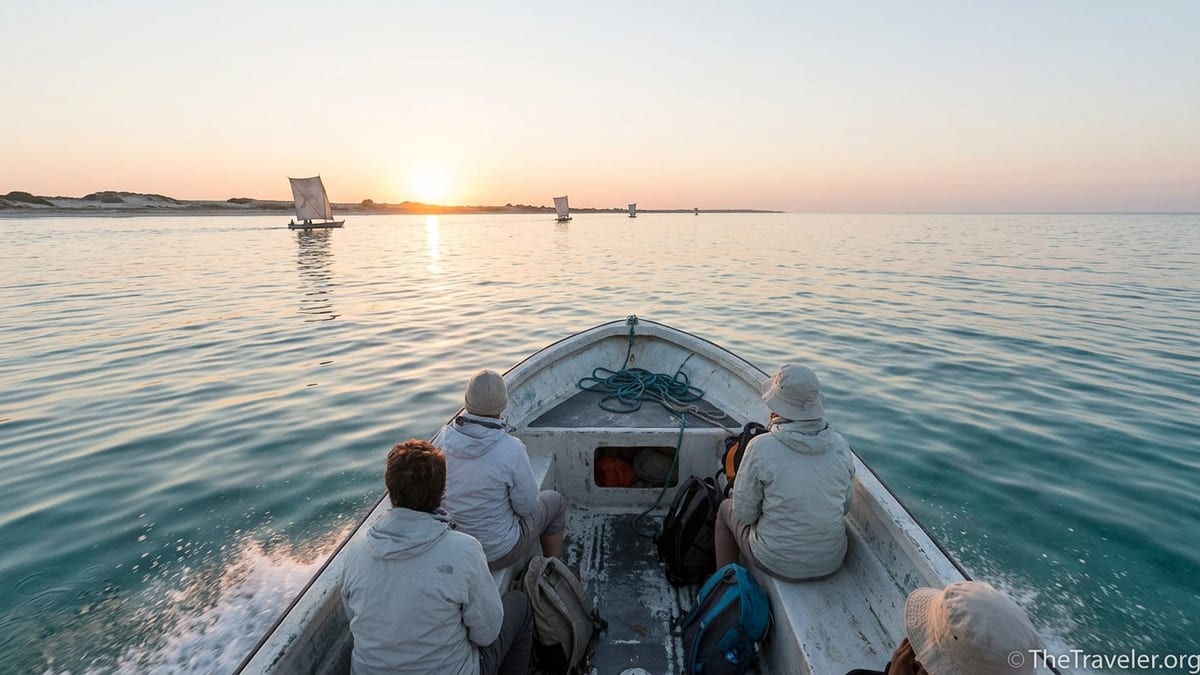
For most travelers, reaching Anakao begins with a short but memorable sea crossing from Toliara. The low, sandy coastline, Vezo fishing pirogues and the broad sweep of Saint-Augustin Bay turn a simple transfer into a mini sea journey, and for practical reasons, the fast boat has become the standard way in and out. Understanding how these transfers work, where to board and how to link them with flights into Toliara will make the difference between a smooth arrival and a stressful scramble.
Why the Boat Is the Practical Route to Anakao
Anakao lies roughly 35 kilometres south of Toliara across the mouth of the Onilahy River and the wide Saint-Augustin Bay. In straight-line distance it is close, but the combination of tidal estuaries, soft sand tracks and seasonal flooding makes overland travel slow and unpredictable. In contrast, dedicated speedboat companies such as Anakao Express and Anakao Transfert run near-daily services that take around one hour in normal sea conditions, turning what could be a grueling day on rough tracks into a straightforward morning crossing.
Several coastal lodges, including well-known beach hotels in Anakao and nearby Andovoke Bay, explicitly quote their prices assuming guests will arrive by boat. A typical example is a lodge that sells a shared fast-boat transfer from Toliara port to Anakao for about the cost of a mid-range dinner in a European capital, per person, and schedules check-in times around the morning boat. Local tour operators along the RN7 itineraries from Antananarivo also routinely include the Toliara to Anakao boat as the final link in classic Isalo–Toliara–Anakao circuits, which reinforces how standard this route has become.
Travelers occasionally ask whether it is possible to drive all the way. While 4x4 drivers with time and experience do sometimes make the run via inland bridges and sandy tracks, they typically quote travel times of 8 to 10 hours or more for what is, as the crow flies, a very short hop. In the rainy season, parts of the route can become impassable for days at a time. By comparison, the fast boat operates on a clear, simple timetable and is widely considered the default option by hotels, surf operators and local agents.
There is also a safety and comfort dimension. The fast boats are purpose-built for coastal waters and usually operated by crews who have been running the same route for many years. Vehicles attempting the overland shortcut may need to negotiate makeshift ferries, deep sand and waterlogged ruts far from mechanical assistance. For visitors on tight itineraries, the relative reliability of the established maritime transfers is an important advantage.
Departure Points in Toliara and How Boarding Works
Most regular transfers to Anakao leave from the Mahavatse embarkation point on the Toliara waterfront, a short drive south of the town centre. Companies such as Anakao Express maintain their own pontoon and small office there, where passengers check in, settle payment if they have not prepaid through a hotel, and wait with a coffee or soft drink before boarding. The atmosphere is relaxed but busy on peak days, with a mix of tourists, locals commuting to Anakao and staff buying supplies for coastal lodges.
If your hotel or guesthouse in Toliara has arranged your ticket, they will usually organise a tuk-tuk or car to bring you directly to the correct pontoon at an agreed time in the morning. For example, a traveler staying in a mid-range Toliara hotel might have a 08:30 pick-up, reach the Mahavatse jetty by 08:45, check in and then board a 09:00 or 09:30 departure. Independent travellers who did not book through a hotel can normally turn up at the Anakao Express or Anakao Transfert office in town the afternoon before, pay in cash (euros or ariary are widely accepted), and receive a paper ticket or reservation note for the next morning.
Boarding itself is straightforward. Once the boat is ready, staff will call the departure and invite passengers onto the pontoon. On some days with lower tides or slightly choppy conditions, you may need to step from the pontoon into a small tender or directly into the bow of the speedboat; wearing sandals or shoes you do not mind getting wet is wise. Crew members usually help by passing bags and giving a steadying hand. Life jackets are provided and, on reputable operators, are either laid out on seats or handed to each passenger as they board.
Expect the scene around the embarkation point to feel informal compared with big ferry ports. There is often a line of motorised pirogues and smaller fishing boats, children selling snacks, and porters ready to help with luggage. This is all normal; valuables are best kept on your person while larger bags are handled by staff. If you are uncertain which boat is yours, simply show your ticket or mention the name of your Anakao hotel; staff are used to directing visitors to the correct vessel.
Schedules, Crossing Time and Morning Departure Patterns
Fast boats from Toliara to Anakao almost always depart in the morning, typically between 08:30 and 09:30. One widely referenced schedule has departures from Anakao around 07:00 to 07:30 heading north, and the return leg from Toliara to Anakao leaving about 09:00 to 09:30. This pattern allows boats to make the round trip in favourable sea and wind conditions, returning to Toliara early enough for crew to prepare for the next day.
The crossing itself usually takes just under an hour in calm seas. Travelers who have timed their watches report journey times of 45 to 60 minutes in standard conditions on modern twin-engine speedboats. On days with stronger swell or headwinds the captain may slow down for comfort and safety, and the ride can extend to around 75 minutes. Operators aim to hug the coast part of the way, which provides scenic views of the low dunes and fishing villages, before cutting across the bay toward Anakao.
Schedules are regular but not rigid in the way of large commercial ferries. In high season, typically the dry months from June to September and again around Christmas and New Year, companies sometimes add an extra departure if there is demand, or charter a second boat to run minutes behind the first. In shoulder seasons with fewer visitors, a single morning departure may be the only option. Pre-booking a day or two beforehand through your lodging is strongly advised, both to secure a seat and to avoid waking early only to find that a specific departure was cancelled due to lack of passengers.
Afternoon crossings from Toliara to Anakao are rare and generally treated as special charters rather than scheduled services. If you land in Toliara by road in the early afternoon and hope to continue directly, you will likely need to pay for a private boat or stay overnight instead. For planning purposes, most travelers assume that if they are not at the port ready to board by late morning, same-day travel to Anakao will be difficult.
Luggage Handling, Onboard Comfort and What to Expect on Arrival
Luggage is normally stacked in a designated area at the stern or bow before passengers settle into their seats. Crew will often ask you to place large backpacks and hard suitcases together so they can be secured with straps or covered with a waterproof tarp. For a couple traveling with two 60-litre backpacks and a small dive bag, all three are typically loaded together, with only a daypack kept at hand under the seat. Cameras, passports and medication should always be kept in a small bag with you, in case spray reaches the luggage pile.
Seating arrangements vary by boat but are usually bench-style or padded individual seats facing forward. On a clear morning the ride can be silky smooth, but in choppier conditions you may feel the hull slap against the swell; sitting toward the back can reduce the impact slightly. Many travelers appreciate a light jacket or windbreaker, as the apparent wind at speed can be cool even under the tropical sun. Boats are generally open-sided or semi-open, so sunblock and sunglasses are essential. Sea spray is common, particularly when crossing the mouth of the bay; electronics should be in a dry bag or at least a sealed plastic pouch.
Arriving in Anakao, the boat usually stops just off the beach in front of the main village or individual lodges, depending on arrangement. In many cases, you will transfer to a small motorised pirogue or wade the last few metres through shallow water. Hotel staff from properties such as Anakao Ocean Lodge, Lalandaka or smaller family-run bungalows often wait on the sand at agreed times, ready with handcarts or wheelbarrows to help move luggage up the beach. It is not unusual to step straight onto soft white sand, with your hotel dining hut or bar visible within a minute’s walk.
Formal infrastructure at the Anakao end is minimal, which is part of its charm but also means there are no jetways, trolleys or paved jetties in most places. Travelers with reduced mobility should inform their hotel beforehand so that extra assistance can be arranged. For everyone else, being ready to remove shoes, roll up trousers and hop out into ankle-deep turquoise water is part welcome ritual, part practical necessity.
Hotel-Arranged vs Independent Transfers
Most visitors experience the crossing as part of a hotel-arranged package. Coastal lodges in Anakao routinely offer to book your boat transfer from Toliara when you confirm your room. For instance, a guest reserving a four-night stay might be sent a proforma including accommodation, breakfast and a shared boat transfer priced per person, with an option to add a Toliara airport pick-up by private car. In this scenario, the hotel liaises directly with the boat operator, reserves seats on the appropriate departure and ensures that someone meets you either at the airport or your Toliara overnight stop.
Booking through your lodge simplifies communication, especially if you do not speak French or Malagasy. If a flight is rescheduled, sea conditions deteriorate or there is a last-minute change such as a medical evacuation, hotels usually receive updates from the boat companies by phone and can proactively adjust plans. Some even arrange for the captain to drop guests closer to their particular stretch of beach, reducing the need for a further pirogue ride along the shore.
Independent travelers, however, can also book directly with the boat companies. This is common for backpackers who decide late in their itinerary to head to Anakao, or for those moving between budget guesthouses that do not handle bookings. In practice, this means visiting the company office in Toliara a day before departure, paying in cash and noting the check-in time. A solo traveler might, for example, arrive by overnight taxi-brousse from Antananarivo, check into a simple Toliara guesthouse for a few hours of rest, then walk or take a tuk-tuk to confirm their seat for the next morning’s crossing.
The key trade-off is support versus flexibility. Hotel-arranged transfers can be slightly more expensive but come with an extra layer of coordination and responsibility if something changes. Independent bookings may save a few euros and allow last-minute decisions, but you shoulder more risk if your bus or internal flight is delayed. Whichever option you choose, keeping a WhatsApp number or local phone contact for your boat operator is sensible, as mobile coverage around Toliara and Anakao is generally adequate near the coast.
Weather, Sea Conditions and Seasonal Considerations
Sea conditions across Saint-Augustin Bay are closely tied to seasonal trade winds and local weather patterns. The dry season from roughly May to September often brings fresher southeasterly winds that pick up as the day progresses, which is one reason departures are concentrated in the morning when the sea is typically calmer. In these months, expect slightly cooler air on the boat and a greater chance of choppy sections, though the crossing remains well within the capabilities of modern speedboats.
The rainy season, usually from December through March, introduces different challenges. Tropical downpours can reduce visibility and create short-lived squalls, and cyclones forming in the wider southwest Indian Ocean occasionally bring very rough seas. When forecasts indicate unsafe conditions, reputable operators will delay or cancel crossings rather than take risks. This might mean waiting a few hours for a storm to pass, or in more serious weather, postponing travel by a day or two. Travelers should build modest flexibility into their itineraries between Toliara, Anakao and onward flights during this period.
Even in fair weather, localized wind effects can roughen the water around the river mouth and open sections of the bay. Those prone to seasickness may want to take motion-sickness medication 30 to 60 minutes before departure and choose seats toward the rear, where movement is often slightly less pronounced. Having a small snack rather than a heavy breakfast can also help, as can keeping your gaze on the horizon rather than focusing on your phone.
On the positive side, many travelers rate the crossing as one of the highlights of their southwest Madagascar trip. In the early morning light you are likely to see Vezo fishermen setting out in narrow outrigger pirogues, sometimes under square sails patched from rice sacks. During the austral winter months, between June and October, humpback whales migrate along this coast, and some operators advertise seasonal whale-watching outings that build on the same boats and crews used for the Anakao transfers.
Why Overland Routes Are Rarely Practical
Looking at a map, it is tempting to imagine a simple coastal road from Toliara to Anakao. The reality is a mosaic of sand tracks, tidal flats and river crossings. One inland route heads east from Toliara, crosses the Onilahy River at Tongobory on a bridge, then loops back toward the coast. Travelers who have attempted this journey by 4x4 report journey times of 10 to 12 hours depending on the season, with long stretches of corrugated dirt and riverine mud. In the wet season, sections can become swampy or wash out entirely, forcing detours or overnight stops in villages with minimal facilities.
A more direct coastal approach involves driving south of Toliara along rough sand tracks, then fording or negotiating makeshift ferries across the river mouth and bays. This option is even more sensitive to tides and weather. Sediment and shifting channels mean that unofficial ferry points come and go, and breakdowns are not uncommon among vehicles repeatedly tackling saltwater and deep sand. While local transport such as taxi-brousse and supply trucks do run variants of these routes, they are slow, crowded and far from predictable.
For visitors on a two- or three-week itinerary, the time cost of experimenting with these overland options is usually prohibitive. Instead of a one-hour morning boat followed by lunch on the Anakao beach, you may face an all-day slog in intense heat, with no guarantee of arrival before dark. This is why local tourism businesses, from surf camps to dive operators, overwhelmingly treat the boat as the practical link and rarely recommend driving except to dedicated overlanders who specifically seek out difficult tracks.
There is also a subtle environmental argument. The narrow dunes and coastal scrub south of Toliara are vulnerable to erosion, and repeated vehicle tracks can further destabilise them. Concentrating tourist transport on existing maritime services reduces the footprint of ad hoc 4x4 routes across fragile terrain. While the boats themselves burn fuel, they follow a fixed corridor over open water, and the small number of daily crossings contrasts with the potential wear of multiple vehicles churning through the same stretches of sand.
Connecting from Toliara Airport to Anakao on the Same Day
Toliara’s small airport sits a short drive northeast of town, typically 15 to 20 minutes by taxi or hotel transfer vehicle. In theory, a morning domestic flight arriving before 08:00 could connect with a 09:00 boat departure, but in practice internal flights in Madagascar are prone to schedule changes and delays. Airlines have been known to retime routes within a few weeks of departure and, on the day, aircraft can land one or two hours behind schedule, particularly in the rainy season or when aircraft are rotated to cover other sectors.
As a result, most experienced tour operators and coastal lodges recommend planning at least one night in Toliara before continuing to Anakao, especially if you are arriving on a same-day connection from an international flight into Antananarivo. A typical conservative itinerary might see you land in the capital in the afternoon, overnight near the airport, take a morning flight to Toliara the next day, check into a Toliara hotel and then board the boat to Anakao the following morning. This adds a night to the schedule but significantly reduces the risk of missed connections and expensive last-minute private charters.
There are, however, scenarios where a same-day connection can work. For example, if you are already in Madagascar and booked on an early Toliara-bound flight scheduled to land around 07:00, you might arrange with your Anakao lodge and the boat company to hold places on a slightly later-than-usual departure, or to reserve a private boat that can wait if the aircraft is mildly delayed. In such cases, hotels often send a driver to meet you at the airport with instructions to phone the boat captain as soon as you are in the car. This kind of tight choreography is best reserved for travelers comfortable accepting the risk and cost if things go awry.
If your flight lands in Toliara after mid-morning, assume you will stay in town that night. Use the time to walk along the seafront, visit the market or simply rest after a long journey, then head to the port fresh the following day. Booking your boat seat as soon as you arrive, either through your Toliara hotel reception or directly at the operator’s office, ensures you are on the manifest and clarifies the exact check-in time. For peace of mind, many travelers build their itinerary so that the Anakao portion sits between more flexible segments, rather than being squeezed between inflexible international flights.
Practical Tips for a Smooth Toliara–Anakao Crossing
A few simple steps can make the boat transfer almost effortless. First, carry small-denomination cash in euros or Malagasy ariary. While many lodges can add boat tickets to your room bill if they made the booking, independent operators at the port may only accept cash, and having the right amount speeds things up on busy mornings. Second, pack a small waterproof bag for passports, phones and a change of clothes for the upper body; even on sunny days, a stray wave or gust of spray can leave you damp for the rest of the morning.
Clothing choices matter more than you might expect. Footwear that can handle water, like sandals with a heel strap or reef shoes, works better than heavy trainers, which stay wet for hours. Quick-drying shorts or trousers you can roll up are ideal for stepping in and out of the boat. A wide-brimmed hat and high-SPF sunblock are strongly recommended; the open layout of the boats and reflection off the water can produce sunburn in less than an hour, even in hazy conditions.
Keep essential documents and any medicines in your daypack, not in checked luggage. While mishandling is rare, bags are sometimes stacked in a way that makes them awkward to access mid-journey or on arrival if disembarkation happens through a smaller pirogue first. In an illustrative scenario, a diver arriving with two heavy gear bags found them briefly diverted to a neighbour lodge’s wheelbarrow on a busy morning; because passports and electronics were on hand, this was an inconvenience rather than a crisis, and resort staff quickly retrieved the bags from a few hundred metres down the beach.
Finally, treat the crossing as the start of your Anakao experience rather than simply a transfer. Sit where you can look out to sea, watch for flying fish or dolphins, and soak in the coastal scenery. For many visitors who have just spent days on the RN7 through Isalo and the highlands, the moment the boat rounds into the bay and Anakao’s pale sand slides into view is when the trip shifts from inland adventure to ocean escape.
FAQ
Q1. How long does the boat from Toliara to Anakao take?
The fast boat crossing usually takes about 45 to 60 minutes in normal conditions, and up to around 75 minutes if the sea is choppy or the captain slows for comfort.
Q2. Where exactly do boats to Anakao depart in Toliara?
Most regular transfers leave from the Mahavatse embarkation area on the Toliara seafront, where companies such as Anakao Express and Anakao Transfert maintain their pontoons and offices.
Q3. Do I need to book the Toliara–Anakao boat in advance?
Advance booking is strongly recommended, especially in the dry high season. Many travelers reserve through their Anakao hotel, while independent travelers usually confirm seats a day or two ahead in Toliara.
Q4. Can I travel from Toliara to Anakao overland by road instead of by boat?
It is technically possible for experienced 4x4 drivers, but the routes are long, rough and sometimes impassable, often taking most of a day. For normal visitors, the fast boat is widely regarded as the practical option.
Q5. Is it realistic to connect from a morning flight into Toliara straight to the boat?
Only with generous buffers and some risk tolerance. Domestic flights can be delayed, so most operators advise overnighting in Toliara and taking the boat the following morning rather than relying on tight same-day connections.
Q6. What happens with my luggage on the boat transfer?
Large bags are stacked together and often covered with a tarp, while you keep a small daypack with valuables and essentials at your seat. On arrival, hotel staff or porters usually help move luggage up the beach.
Q7. Are there afternoon boats from Toliara to Anakao?
Scheduled departures are almost always in the morning to take advantage of calmer seas. Afternoon trips, if they happen at all, are usually private charters arranged on request at higher cost.
Q8. What should I wear for the crossing?
Wear sun-protective, quick-drying clothing and footwear that can get wet, such as sandals. Expect some spray and possibly a short wade through shallow water when boarding or disembarking.
Q9. Are the boats safe and do they provide life jackets?
Reputable operators use modern speedboats and provide life jackets for all passengers, with crews experienced on this specific route. It is reasonable to check that jackets are available and in good condition as you board.
Q10. Can my hotel in Anakao organise my boat and airport transfers?
Yes. Most Anakao lodges routinely arrange combined packages that include Toliara airport pick-up, a night in town if needed and confirmed seats on the shared morning boat to Anakao.