


Southwest Madagascar does not give up its secrets easily. The coastal region around Toliara opens onto the Mozambique Channel with luminous lagoons, coral reefs and remote Vezo fishing villages, but reaching its best beaches and wildlife often means rough tracks, boat rides and slow travel. For first-time visitors willing to make the effort, this is one of Madagascar’s most rewarding corners, with world-class diving and snorkeling, seasonal whale watching, spiny forest and baobab landscapes, and a feeling of being at the far edge of the Indian Ocean.
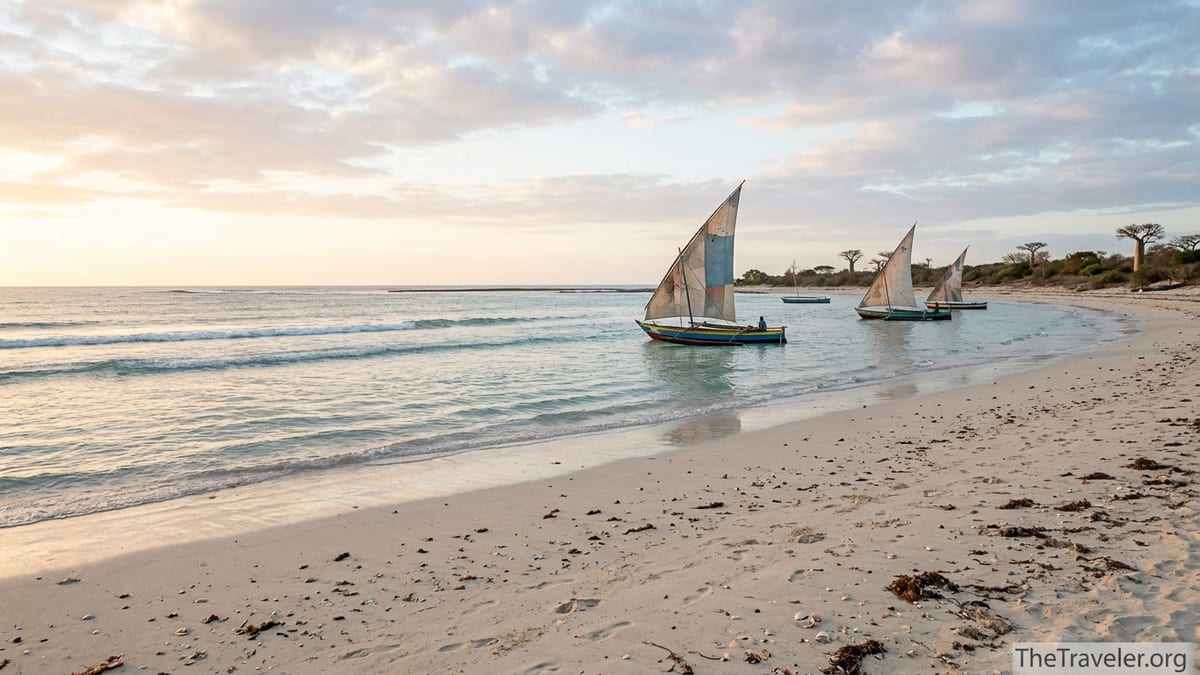
Understanding Southwest Madagascar and the Toliara Coast
Toliara, often written Tuléar or Tulear, is the dusty, wind-battered port city that anchors southwest Madagascar and serves as the practical gateway to the Mozambique Channel coast. Most travelers arrive here by domestic flight from Antananarivo, then fan out along the shore to quieter beach bases such as Ifaty, Mangily, Anakao and Salary Bay. The long offshore barrier reef, sometimes called the Grand Récif de Toliara, creates sheltered lagoons that give this region its turquoise water and calm, shallow swimming conditions.
The coastline naturally divides into two distinct zones: north of Toliara around Ifaty, Mangily and Salary Bay, and south of Toliara around Anakao, Nosy Ve and the remote track toward Itampolo. North of the city you find easier access, more developed accommodation and classic lagoon beaches. South of Toliara feels wilder and more remote, with villages that still depend primarily on fishing and long stretches of empty sand where you may see more zebu carts than vehicles.
What unites the region are its defining features: the Vezo fishing culture, whose people move across the water in painted pirogues; the spiny forest and baobabs that begin just behind the dunes; and marine life that includes reef fish, turtles, and migratory humpback whales between roughly June and September. Diving and snorkeling are possible in several hubs, while birdlife and rare plants draw naturalists to places like Tsimanampetsotsa National Park and the Reniala spiny forest reserve.
Travel here remains logistically challenging. Roads beyond Toliara quickly deteriorate into sandy tracks, public transport is sparse and slow, and many lodges are only reachable by 4x4 or boat. As a result, most first-time visitors choose one or two bases and explore from there, rather than trying to “do it all.” This guide focuses on those realistic bases and the experiences around them so you can match the coast’s different areas to your interests in beaches, wildlife, diving or remote adventure.
North of Toliara: Ifaty, Mangily and Salary Bay
The northward strip from Toliara to Ifaty and Mangily, about 30 km by rough coastal road, is the most accessible section of the southwest coast. This is where many tours along National Route 7 end with a few days by the sea, using simple beach hotels as a base. The villages of Ifaty and Mangily blend together along the lagoon, with sandy lanes, thatched bungalows, and an easy-going atmosphere that invites long afternoons in a hammock between swims.
This area is an excellent choice for a first beach stay, particularly if you want a balance of comfort and local life. Beachfront guesthouses can start around 25 to 40 US dollars per night for simple bungalows, with midrange lodges rising into the 70 to 150 dollar bracket, depending on season and facilities. You typically walk directly from your room onto the sand, with fishermen launching their pirogues at dawn and returning in the late afternoon with octopus, small tuna or parrotfish, much of which ends up grilled in the local restaurants that evening.
Salary Bay, several hours farther north along much rougher tracks, offers a more isolated version of the same lagoon scenery. Reaching it usually requires a chartered 4x4 transfer from Toliara or Ifaty that can cost in the region of 150 to 250 US dollars one way, shared between passengers, reflecting the time and fuel required. In return you get wide, near-empty beaches, shallow turquoise waters and an off-the-grid feel. A stay here suits travelers who want to disconnect, are comfortable with intermittent electricity and limited menus, and value space and silence over nightlife or shopping.
Throughout the northern coast, Vezo pirogues are a constant presence. You can often arrange outings directly with local fishermen for simple sailing trips along the lagoon or for a morning of line fishing. Prices are usually negotiated on the beach, often starting around the equivalent of 15 to 30 US dollars for a couple of hours for two people, and rising for longer or more structured excursions. Using a local guide or your guesthouse to help with negotiation ensures fair pay and clear expectations.
South of Toliara: Anakao, Nosy Ve and the Road to Itampolo
South of Toliara the coast feels wilder. The main beach hub here is Anakao, a Vezo village that has grown into a low-key resort strip. It is reached primarily by speedboat from Toliara’s small port area or from the village of Saint-Augustin near the Onilahy River mouth. Boat transfers usually take about one hour in calm conditions and are often bundled into accommodation packages, with prices that can hover around 25 to 40 US dollars per person one way, depending on the operator and sea state.
Anakao suits travelers looking for a more remote, traditional feel than Ifaty, without venturing to the extreme isolation of Salary or Itampolo. The beach is wider, the lagoon a little more open, and the village still revolves around fishing and the rhythms of the tide. Basic bungalows and midrange lodges line the sand, many running on solar power or generators. You can spend days here swimming, walking the strand, watching sail pirogues crisscross the bay and organizing boat trips for snorkeling, surfing in season, or whale watching when humpbacks come close to shore.
Just offshore, the small island of Nosy Ve is one of the southwest’s signature excursions. Reached by motorized pirogue or speedboat in roughly 30 to 45 minutes, the island is part of a protected marine area. It is known for its clear water, birdlife and intact coral gardens. A typical day trip from Anakao includes boat transport, time for snorkeling or swimming, a simple grilled fish lunch on the beach and a walk to observe nesting seabirds, with prices often around 30 to 60 US dollars per person depending on group size and inclusions.
Farther south still, the coastline becomes increasingly remote on the route toward Itampolo and beyond. Tracks may be impassable after heavy rain, fuel and drinking water must be planned carefully, and services are minimal. Travelers who undertake this journey usually do so with an experienced local operator, traveling in convoy with well-equipped 4x4 vehicles. In return, they gain access to long, untouched beaches, isolated fishing hamlets and a strong sense of Madagascar’s raw, unfiltered southwest.
Spiny Forests, Baobabs and the Reniala & Tsimanampetsotsa Reserves
One of the surprises of the Toliara region is how quickly the coastal scenery shifts from sand and lagoon to an arid, almost otherworldly spiny forest. This ecosystem, found mainly in southwest Madagascar, is dominated by thorny shrubs, octopus trees, euphorbias and towering baobabs. It is home to endemic birds, reptiles and plants found nowhere else on earth, making it a highlight for nature lovers as important as the beaches.
Near Mangily and Ifaty, the Reniala Reserve provides the easiest introduction to the spiny forest. Located a short drive or even a walk inland from many beach hotels, it protects a pocket of baobab forest with twisting, bottle-shaped trees and a network of sandy trails. Local guides lead early-morning walks when birds are most active, pointing out species such as long-tailed ground rollers, green-capped couas and various kingfishers, along with chameleons clinging to spiny branches. Entrance fees and guiding together are generally modest by international standards, often around 10 to 20 US dollars per person for a couple of hours.
Farther south, Tsimanampetsotsa National Park lies inland from the coast between Anakao and the road toward Itampolo. Access typically requires a 4x4 from Anakao or Toliara, organized through a tour operator or lodge, and the journey is part of the adventure as you cross dry plateaus and pass herds of zebu cattle. The park’s centerpiece is a shallow, saline lake that can appear milky blue or pale turquoise depending on light and wind, and is frequented by flamingos in certain seasons. Around the lake and in the surrounding limestone plateau, you find caves, sinkholes and pockets of spiny forest with rare plants and reptiles.
A visit to Tsimanampetsotsa rewards those interested in landscapes and solitude as much as in wildlife. Facilities inside the park are basic, with simple picnic spots and few formal trails. Many visitors join a day trip from Anakao that includes a picnic lunch, several short walks to viewpoints and caves, and time to watch flamingos feeding or resting on the lake. As with other excursions, precise pricing varies by operator, but a full-day 4x4 and guide from Anakao can easily run into the low hundreds of US dollars for a small group when fuel and park fees are included.
Coral Lagoons, Diving, Snorkeling and Whale Watching
The Mozambique Channel off Toliara is lined with reefs, seagrass beds and sandbars that create sheltered lagoons. For many travelers, the main draw of the region is time in the water rather than on land. Conditions vary by season and location, but visibility can be very good in the dry months, and the long barrier reef near Ifaty and Anakao helps keep swells down inside the lagoon, making entry and exit relatively easy for beginners.
Ifaty and Mangily host several well-established dive centers that offer PADI courses and fun dives to nearby reefs. A typical two-tank boat dive might cost roughly 80 to 120 US dollars per person, including gear rental, with discounts for multi-day packages. Sites range from shallow coral gardens suitable for novice divers to deeper outer reefs where currents are stronger and larger pelagic species occasionally pass. Night dives are also available in calm conditions, revealing crustaceans, octopus and sleeping parrotfish.
Snorkeling is widely accessible, both from shore and by boat. Simple mask-and-snorkel hire can be as low as a few dollars per day from beach hotels, while organized snorkeling excursions to the outer reef or islands such as Nosy Ve cost more but deliver clearer water and more diverse marine life. Many first-time visitors choose a half-day boat trip that combines snorkeling over coral heads with a picnic on a sandbank or small island.
Whale watching is a seasonal highlight. Humpback whales migrate along Madagascar’s west and south coasts, with the southwest seeing regular sightings between roughly June and September, and sometimes into early October depending on the year. Local operators in Ifaty, Mangily, Anakao and occasionally Toliara run half-day trips in small boats, often scheduling departures in the calm early morning. Prices can hover around 40 to 80 US dollars per person. Ethical operators keep a respectful distance, cut engines when whales are near and do not allow guests to enter the water with the animals, both for safety and to avoid disturbance.
Vezo Fishing Culture and Everyday Coastal Life
The cultural heart of the southwest coast belongs to the Vezo, a semi-nomadic fishing people whose identity is closely tied to the sea. Along the shore from Ifaty to Anakao and beyond, you see their slender wooden pirogues everywhere, usually equipped with colorful lateen sails patched from different fabrics. Children help bale water or untangle nets, while elders mend lines under the shade of palm fronds. Many families still move seasonally along the coast to follow fish and octopus, setting up temporary camps on promising stretches of beach.
For visitors, interacting respectfully with Vezo communities is one of the most memorable parts of a trip. Simple moments, such as buying still-warm fried fish from a beach stall or watching a dugout canoe being carved from a single log, bring the region’s culture to life. Some lodges can arrange visits to nearby villages with a local guide who translates and explains customs, making clear what is appropriate to photograph and how to offer small contributions in a way that does not encourage dependency.
Seafood naturally dominates local menus. In both Ifaty and Anakao, it is common to find dishes like grilled langoustines with rice, octopus in coconut sauce, or a whole fish cooked over charcoal and served with tomato salad. Prices depend heavily on proximity to the fishing grounds and the type of establishment. In a simple beachfront eatery, a plate of grilled fish with sides might cost the equivalent of 5 to 10 US dollars, while a multi-course seafood dinner in a lodge restaurant could run closer to 20 to 30 dollars per person. Vegetarians can often find rice, beans, salads and vegetable curries, but choice may be limited outside larger hotels.
As in much of Madagascar, cash is essential once you leave larger towns. In Toliara, you can expect to find ATMs that accept international cards, but they are less reliable or absent in Ifaty, Anakao and more remote villages. Many smaller businesses do not accept cards at all. First-time visitors should withdraw enough local currency in Toliara to cover anticipated expenses such as meals, boat trips, guides and tips while on the coast, and should keep notes in different places for security.
Getting Around, Seasonality and Choosing Your Base
Reaching Toliara usually involves a domestic flight from Antananarivo, with schedules and prices that can fluctuate significantly by season and airline. Once in Toliara, most visitors rely on a mix of private transfers, hotel-arranged transport and boats. The coastal road north to Ifaty and Mangily is unpaved and can be bumpy, but 4x4 vehicles and local taxis can make the roughly one-hour journey in dry conditions. For Anakao and the southern coast, sea transfer is often quicker and more comfortable than road travel.
Public transport options exist in the form of bush taxis and shared trucks, but they are slow, crowded and operate on flexible timetables. For example, a shared taxi-brousse from Toliara toward Ifaty might leave when full rather than at a fixed hour, and travel times can double when sand is deep or if a vehicle breaks down. Travelers on tight schedules or carrying dive gear often find that paying for a pre-arranged transfer from their hotel or tour operator provides more certainty, even if it costs more than local transport.
Season matters. The dry season from roughly April to November generally brings cooler temperatures, less rain and better visibility for snorkeling and diving. July to September adds the bonus of humpback whale sightings. The hotter, wetter months around December to March can still offer rewarding travel but may bring heavier seas, reduced underwater visibility and occasional disruption to boat schedules. Cyclones, although less common this far south and west than on Madagascar’s east coast, remain a regional possibility during the peak of the rainy season, and travel plans should remain flexible.
Choosing where to base yourself comes down to priorities. Ifaty and Mangily work best for travelers who want relatively straightforward access from Toliara, a choice of accommodations, easy visits to Reniala Reserve and simple snorkeling or diving on the nearby reef. Anakao is better for those seeking a slightly wilder beach with day trips to Nosy Ve and Tsimanampetsotsa, and who do not mind relying on boat transport. Salary Bay and the coast toward Itampolo appeal to experienced travelers who value remoteness, can commit to multi-day 4x4 journeys and are comfortable with very limited services.
The Takeaway
Southwest Madagascar is not a plug-and-play beach destination. Infrastructure is light, journeys take time and things do not always go according to plan. Yet for first-time visitors who approach the region with realistic expectations and some flexibility, the rewards are exceptional: lagoons protected by one of the world’s great barrier reefs, encounters with humpback whales and reef fish, evenings under baobabs in the spiny forest, and the daily choreography of Vezo pirogues gliding across the Mozambique Channel.
Planning your trip around Toliara means choosing the slice of this coast that matches your interests and tolerance for remoteness. Ifaty, Mangily and Salary Bay offer accessible beaches and lagoon life to the north. Anakao, Nosy Ve, Tsimanampetsotsa and the far coast toward Itampolo unlock a more rugged, wild southwest to the south. Start with one or two well-chosen bases, build in rest days and leave space for spontaneous boat trips or village walks. That combination of structure and openness is often what turns a journey here into the kind of trip people talk about for years.
FAQ
Q1. Is southwest Madagascar safe for first-time visitors?
Safety conditions can change, but most visitors who stick to established routes around Toliara, Ifaty and Anakao, use reputable guides and follow local advice report positive experiences. Normal precautions apply, such as avoiding walking alone at night in towns, keeping valuables out of sight and using hotel safes where available.
Q2. How many days should I plan for the Toliara coast?
For a first visit, plan at least four to six days on the coast, not counting travel to and from Antananarivo. This allows time for two or three full days at a beach base, a day for an excursion such as Reniala or Nosy Ve, and a buffer day in Toliara for flight connections or weather-related delays.
Q3. Do I need a 4x4 vehicle to explore the region?
You do not need your own 4x4 if you are only visiting Ifaty or Anakao and rely on hotel transfers and boats. A 4x4 becomes essential for more remote destinations such as Salary Bay, Tsimanampetsotsa National Park or the coast toward Itampolo, where tracks can be sandy, rough and sometimes impassable after rain.
Q4. When is the best time for whale watching near Toliara?
The main humpback whale season in southwest Madagascar typically runs from about June to September, occasionally extending into early October. During this period local operators in Ifaty, Mangily and Anakao often offer dedicated whale watching trips, with the most reliable conditions usually found in the calmer morning hours.
Q5. Can beginners dive in Ifaty or Anakao?
Yes, several dive centers around Ifaty, Mangily and Anakao welcome beginners and offer entry-level courses along with guided dives on sheltered sites. Good communication with instructors about your comfort level, plus choosing days with calm seas, helps ensure a safe and enjoyable first diving experience.
Q6. How expensive is food and accommodation along the coast?
Costs vary widely, but simple beach bungalows can often be found from around 25 to 40 US dollars per night, with midrange lodges charging more. In local eateries, basic seafood dishes might cost the equivalent of 5 to 10 dollars, while lodge restaurants charge higher prices that reflect their more remote supply chains and broader menus.
Q7. Is it possible to visit both Ifaty and Anakao on one trip?
It is feasible to visit both, especially if you have a week or more on the coast. Many travelers spend a few nights in Ifaty or Mangily for easier logistics and spiny forest access, then transfer back through Toliara to reach Anakao by boat for a more remote experience and excursions to Nosy Ve.
Q8. What should I pack for a trip to southwest Madagascar?
Pack light, breathable clothing, a wide-brimmed hat, strong sun protection, reef-safe sunscreen, insect repellent, sturdy sandals or water shoes, and any prescription medicines you may need. A lightweight fleece or jacket is useful for cool evenings in the dry season, and a dry bag helps protect electronics on boat rides.
Q9. Are there medical facilities near Ifaty and Anakao?
Basic clinics and pharmacies exist in Toliara, but facilities are limited in smaller coastal villages. For anything more serious than minor illnesses or injuries, you would likely need to return to Toliara or, in some cases, to Antananarivo. Travel insurance that covers medical evacuation is highly recommended for this region.
Q10. Can I pay with cards, or should I bring cash?
In Toliara a few larger hotels and businesses may accept cards, but in Ifaty, Anakao and smaller villages most transactions are in cash. It is wise to withdraw enough local currency in Toliara to cover planned expenses on the coast, as ATMs are scarce or nonexistent in beach settlements and power cuts can affect their reliability.