


On the northeast tip of Madagascar, the Three Bays of Diego Suarez form one of the country’s most rewarding coastal walks. Sakalava Bay, Pigeon Bay and Dune Bay are linked by sandy tracks and a wild clifftop path that give you constant views of turquoise water, empty beaches and the open Indian Ocean. With a bit of planning, you can walk all three bays in a single day or visit by 4x4 and still be back in Diego Suarez or Ramena in time for sunset.
Understanding the Three Bays and How They Differ
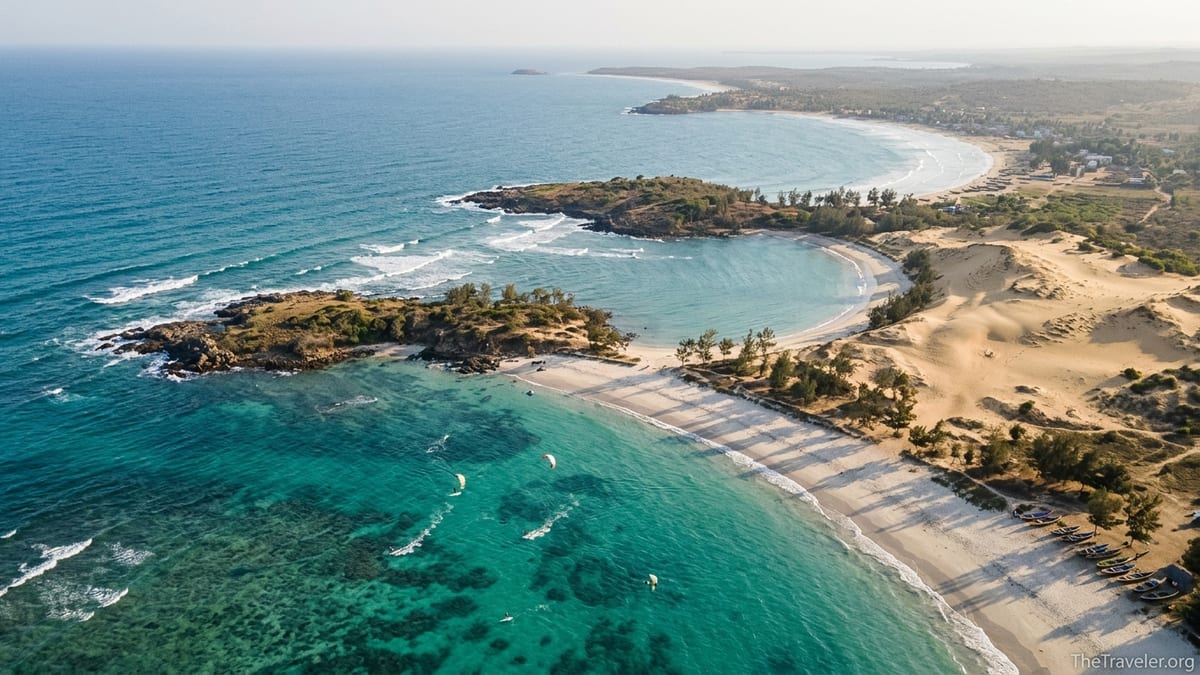
The Three Bays sit just east of Diego Suarez (also called Antsiranana) and north of the village of Ramena. Although they are often sold as a single excursion, each bay has a distinct character. Sakalava Bay is the most developed and the most windswept. It is a long, curved lagoon backed by low dunes and casuarina trees, with a couple of small hotels and kitesurf schools dotted along the shore. The constant trade wind and shallow, protected water make it a magnet for kitesurfers and windsurfers between roughly April and November, and you will often see colorful kites scattered across the horizon.
Pigeon Bay, by contrast, feels almost completely wild. Sheltered by low headlands and sand spits, it is usually calmer than Sakalava. The beach here is narrower, with high dunes behind it and clear, glassy water at high tide. It is the best of the three for a relaxed swim on a typical day, which is why some tour operators plan longer picnic stops here. Outside of local school holidays you may share the bay with only a few fishermen and the odd 4x4 group.
Dune Bay, sometimes listed first in tour descriptions, is the most exposed to the open ocean. Here the beach is wide and windswept, framed by tall dunes and scrub. The surf can be powerful, and currents are stronger, so it is more of a scenic and photographic stop than a swimming beach for most visitors. Many guided itineraries start or end at Dune Bay for its sense of space, then link back to the gentler waters of Pigeon and Sakalava.
The three bays are joined by a mix of sandy 4x4 track and a coastal footpath. Most guided 4x4 tours follow the track in and then let guests walk short sections, while independent hikers often walk the entire line of the coast from Sakalava to Ramena or vice versa. The total walking distance between Sakalava Bay and Ramena via Pigeon Bay and Dune Bay is roughly 10 to 12 kilometers, enough for a satisfying but achievable day hike for reasonably fit travelers.
Coastal Walking Route: Sakalava Bay to Ramena
For independent travelers, the most straightforward coastal walk runs from Sakalava Bay to Ramena, with the wind at your back for much of the way. Several hotels at Sakalava Bay can call a taxi or arrange a transfer from Diego Suarez, which is about 18 to 20 kilometers away on a mostly paved road. From central Diego, expect around 40 to 50 minutes by car to reach Sakalava. Many travelers ask a driver to drop them at Sakalava around 9:00 a.m., then meet them later in Ramena.
Starting on the beach at Sakalava, head east along the sand with the lagoon to your right and low dunes to your left. After about 30 to 40 minutes of beach walking, a sandy track and faint path lead over low dunes and scrub, sometimes passing small fishing camps. This section is easy to follow in clear weather, but having an offline GPS map is helpful because there are few signs. You will reach a small, unnamed cove, then continue on toward higher dunes that mark the approach to Pigeon Bay.
From Sakalava to Pigeon Bay on foot usually takes 1.5 to 2 hours at a relaxed pace, including photo stops. The path undulates slightly and can be hot in midday sun, but there are frequent sea views and chances to get back down to the water. Once you drop onto the sand of Pigeon Bay, you can walk its full length in about 20 minutes. At the far end, steeper dunes rise, with a footpath climbing to a viewpoint that looks back over both Pigeon and Dune bays and out to the Indian Ocean. This is one of the best vantage points on the route and worth a break for snacks or a simple picnic.
From the dune viewpoint, the path continues along the back of Dune Bay then gradually bends toward Cap Miné and the old French military installations above the headland. Here the terrain becomes a mix of sandy track and rocky ground. After exploring the lighthouse and gun emplacements, the track drops back down via the Orangea military zone before finally reaching Ramena and its broad, calm beach. The full walk from Sakalava to Ramena, including time for swimming and photos, typically takes 3.5 to 5 hours. Most travelers finish in Ramena by mid-afternoon, in time for a late seafood lunch and a taxi back to Diego Suarez.
Alternative Route: Ramena to Dune Bay, Pigeon Bay and Sakalava
If you prefer to start and end in a village with more services, the reverse route from Ramena toward Dune Bay can also work well. From the center of Ramena, a sandy road leads past the Orangea military post and Cap Miné toward Dune Bay. Independent walkers should be aware that this road crosses a controlled zone. In practice, many visitors are simply waved through, sometimes after a small entry payment in Ariary is requested. To avoid any awkwardness, carry cash in small denominations, keep a low profile, and consider joining an organized excursion if you are uncomfortable with informal payments.
Once past the military area, the road becomes more remote and passes ruined French fortifications and lighthouse structures on the headland. From here you can either continue to Dune Bay by 4x4, or, if walking, drop down first to Dune Bay for a look at its wide beach and surf. Walking onward along the sand and over the small rocky point brings you to Pigeon Bay. Because this bay is more sheltered, walkers often pause here for a swim, especially around high tide when the water is deepest and clearest.
From Pigeon Bay, a sandy path climbs the dunes at the southern end of the bay before skirting scrub and low forest toward Sakalava Bay. The path is sometimes faint, and in several places multiple side tracks split off toward the coast. A good rule of thumb is to keep the sea within sight or sound to your right when walking from Ramena to Sakalava. After 1 to 1.5 hours you descend to the long beach of Sakalava Bay, where you can end your walk at one of the small hotels or kitesurf centers, many of which serve simple lunches of grilled fish, rice and fresh fruit juice.
If you start this direction from Ramena around 8:00 a.m., you can comfortably reach Sakalava by early afternoon, allowing plenty of stops. Some travelers arrange for a 4x4 to collect them at Sakalava and return them either to Ramena for sunset drinks or directly to their hotel in Diego Suarez. In total, the walk from Ramena to Sakalava via Dune Bay and Pigeon Bay is similar in length to the reverse route, around 10 to 12 kilometers, but can feel a little more tiring because the soft sand is often tackled in the hotter part of the day.
4x4, Quad and Taxi Access: Choosing Your Transport
The access road from Diego Suarez to Ramena is mostly paved and regularly used by taxis and shared cars. From Ramena onward to the bays, however, the roads are sandy tracks best tackled by 4x4, quad bike or on foot. Local tour operators and hotels consistently recommend a true 4x4 for the Three Bays, particularly in or after the rainy season when sections can be rutted. Small city taxis from Diego, which are often older compact cars, are generally not suitable beyond Ramena and may refuse to continue.
As a rough guide, a private 4x4 day trip from Diego Suarez to the Three Bays, including driver and fuel, typically starts around 250 000 to 350 000 Malagasy Ariary for a small group, depending on negotiation, season and current fuel prices. That is often in the range of 50 to 70 US dollars for a vehicle, and some operators quote per person rates between the equivalent of about 50 and 150 euros when they include guiding, lunch and possibly additional stops like the Emerald Sea. Cruise-focused agencies sometimes charge higher, closer to 130 to 160 US dollars per person, in exchange for fixed schedules and port pickup.
Quad tours are another option if you want a more adventurous route along the tracks that link the bays. Local companies based in Diego Suarez advertise half-day Three Bays quad outings that usually include helmet, guide, fuel and sometimes soft drinks. Prices vary, but a benchmark is around 90 to 100 euros per quad for a half-day, with two people sometimes sharing a vehicle to reduce the cost. These tours normally follow the sandy tracks rather than the full coastal footpath, but they often stop at Dune Bay and Pigeon Bay for short walks and photos.
For budget travelers staying in Ramena, the simplest solution is often to negotiate with a local driver on the beach or in the village. For example, you might arrange a morning drop-off at Sakalava Bay and an afternoon pick-up from Ramena after you have walked the coastline. Expect to pay more for waiting time or a flexible pick-up, and clarify before departure whether the driver’s car is capable of the sandy section. Whatever your transport choice, confirm the total price, approximate timetable and what is included in Ariary before setting off.
Beaches, Swimming and Safety Along the Route
Each of the Three Bays offers slightly different conditions for swimming and beach time. Sakalava Bay, being long and shallow with a reef-protected lagoon, often has moderate chop and steady wind. It is pleasant for wading and cooling off, but kitesurfers and windsurfers move quickly along certain sections, so giving them plenty of space is courteous and safer. Many visitors keep their swimming here to waist or chest depth, especially if they are not strong swimmers or if the tide is low and the bottom is uneven.
At Pigeon Bay the water is usually clearer and more sheltered, particularly around mid to high tide. This is where many independent walkers choose to swim, as the bay forms a natural curve with gentle entry. Simple snorkeling close to shore is sometimes possible, though this is not a classic coral reef site and visibility depends on recent swell. It is wise to wear reef-safe sunscreen and, ideally, thin water shoes to protect against shells and rocks. There are no lifeguards anywhere along the route, so swimmers must judge conditions for themselves.
Dune Bay looks spectacular but can be deceptive. Waves break with more power, and hidden currents may run parallel to the shore. Unless you are a strong ocean swimmer used to surf conditions, treat Dune Bay as a viewing and walking beach rather than a swimming spot. Many guided tours explicitly describe Dune Bay as a photo stop with time to climb the high dunes or walk along the waterline, but not as their main swimming location. Children in particular should be kept well back from breaking waves.
Beyond the water, there are a few general safety points for the Three Bays walk. Petty theft can occur in remote areas, especially if bags are left unattended on the beach. Carry cash and valuables close to your body, preferably in a small daypack you can keep in sight. Do not leave cameras or phones lying in the sand while you swim. Occasional reports in the past mentioned non-violent robberies on parts of the route, so modern local advice sometimes suggests walking in small groups rather than entirely alone, particularly outside of weekends when there are fewer local visitors around. In practical terms, walking with two to four people during daylight hours and staying on the main track significantly reduces hassle.
Starting Points, Time Planning and What to Bring
Most visitors base themselves in Diego Suarez or Ramena. Diego Suarez has a wider choice of hotels and restaurants, while Ramena offers a quieter, beach village feel and easier access to the bays. From Diego Suarez, you can either book a full Three Bays excursion through a hotel or agency, or hire a 4x4 and driver for the day and build your own schedule. Leaving Diego between 7:30 and 8:30 a.m. works well if you want to combine walking with plenty of beach time and still be back in town by early evening.
From Ramena, the logistics are simpler. Many travelers choose to sleep in Ramena, have breakfast on the beach, then start their walk or 4x4 trip toward Dune Bay and the other bays by mid-morning. Because Ramena is at one end of the route, you can begin or end there without worrying about complicated returns. A common pattern is to take a 4x4 from Ramena to Sakalava, walk back along the bays to Ramena over 3.5 to 5 hours, then reward yourself with a late lunch at one of the beachside restaurants serving grilled fish, zebu skewers and cold drinks.
For the coastal walk, bring sun protection first. The path is very exposed, with little natural shade, and the tropical sun can be intense even on days that feel breezy. A wide-brimmed hat, high-factor sunscreen, sunglasses and light, long-sleeved clothing are all useful. At least 1.5 to 2 liters of water per person is sensible for the full walk, more if starting late or walking at a leisurely pace with many stops. There are often no formal shops between Sakalava and Ramena along the coast, so do not rely on finding drinks en route.
Footwear is a matter of preference, but many experienced visitors recommend lightweight trail shoes or sturdy sandals that can handle both sand and rocky sections. Flip-flops alone can become tiring over 10 kilometers. A small dry bag for phones and cameras, insect repellent for occasional mosquitoes or sandflies, and a basic first-aid kit with plasters and painkillers round out a simple but effective packing list. If you plan to swim, a travel towel or sarong and swimwear worn underneath walking clothes make changing easier on exposed beaches.
Guide or No Guide, and Combining the Three Bays with Ramena
One of the main decisions for the Three Bays is whether to hire a guide. Confident hikers with decent navigation skills often choose to walk independently, using offline maps on their phones to follow the coastline. The path is not formally signposted, but the combination of sea on one side and dunes on the other makes it hard to become seriously lost in clear weather. Independent walkers appreciate the flexibility to stop wherever they like and to adjust their pace without worrying about a group.
Hiring a guide, however, offers several advantages. Local guides know the informal shortcuts, the safest entries to the water on a given tide and swell, and up-to-date information about any issues along the route, such as sections of soft sand that are difficult for vehicles or any areas best avoided in the current season. Guides can often be arranged through hotels in Diego Suarez or Ramena, or via established local agencies. Their daily fee is usually modest in international terms and directly supports the local economy. For travelers new to Madagascar, or those with limited French or Malagasy, a guide can also smooth interactions at checkpoints and with local residents.
Combining the Three Bays with Ramena is straightforward and does not require turning the day into a whirlwind of unrelated stops. In fact, Ramena complements the bays perfectly. The village’s wide, sheltered beach offers calmer water than the exposed Dune Bay, and its beachfront restaurants and simple bars make a natural end point for a day of walking or 4x4 touring. Many organized itineraries use Ramena for lunch, returning there from Dune or Pigeon Bay for a meal of grilled fish, coconut rice and fresh fruit before looping back to Diego Suarez in the late afternoon.
If you are staying in Diego Suarez, one of the most rewarding day plans is to drive out to Sakalava in the morning, walk the coast past Pigeon and Dune bays to Ramena, swim and eat there, then drive back to town as the light softens over Diego Bay. Another option is to transfer by vehicle from Diego to Ramena first, enjoy a short beach break, then explore one or two of the bays by 4x4 as half-day excursions on separate days. This approach spreads out the walking and allows more time simply to enjoy each beach rather than racing through all three in one day.
The Takeaway
The Three Bays of Diego Suarez offer a rare combination of accessible adventure and genuine wildness. In a single day you can stride along empty beaches, watch the Indian Ocean crash against dunes, swim in sheltered coves and finish with a plate of fresh seafood in a laid-back fishing village. Whether you tackle the route on foot, join a 4x4 or quad excursion, or mix both options, the core experience remains the same: wide horizons, constant sea views and a feeling of space that is increasingly hard to find.
Planning ahead is key to making the most of it. Decide whether you prefer walking from Sakalava to Ramena or the reverse, book a suitable vehicle if you need transfers, and carry enough water and sun protection for several exposed hours. Think about your swimming comfort level and choose your stops accordingly, using Dune Bay for drama and Pigeon Bay for calmer water. Above all, allow enough time. Rushing the bays in two hours between other sightseeing stops will not do them justice.
For many visitors to northern Madagascar, the day they spend at Sakalava Bay, Pigeon Bay and Dune Bay becomes a lasting highlight, mentioned in the same breath as the region’s better-known national parks and the Emerald Sea. With thoughtful logistics and realistic expectations, you can turn this simple string of beaches into one of the most memorable coastal walks of your travels.
FAQ
Q1. How long does the full Three Bays walk take?
The coastal walk between Sakalava Bay and Ramena via Pigeon Bay and Dune Bay typically takes 3.5 to 5 hours, depending on pace, swimming stops and photo breaks.
Q2. Is it better to start from Diego Suarez or Ramena?
For most visitors, basing in Ramena is logistically simpler, but starting from Diego Suarez with a 4x4 drop at Sakalava then walking back to Ramena works very well for a full-day outing.
Q3. Do I need a 4x4 for the Three Bays?
You need a 4x4 or quad for the sandy tracks beyond Ramena if you are not walking the full route. Regular city taxis generally do not go past Ramena because of the soft sand and ruts.
Q4. Is swimming safe in all three bays?
Swimming is usually most comfortable in Pigeon Bay and parts of Sakalava Bay. Dune Bay is more exposed with stronger waves and currents, so many visitors treat it as a scenic stop rather than a swimming spot.
Q5. Can I visit the Three Bays without a guide?
Yes, confident walkers can follow the coastline independently, especially with an offline map. However, a local guide adds safety, local knowledge and help with checkpoints or informal fees.
Q6. How much should I budget for a Three Bays excursion?
A private 4x4 day trip from Diego Suarez usually costs the equivalent of about 50 to 70 US dollars for the vehicle, while organized per-person tours with extras can range roughly from 50 to 150 euros.
Q7. What should I bring for the walk?
Bring strong sun protection, at least 1.5 to 2 liters of water per person, comfortable footwear for sand and rocky sections, swimwear, a light towel, insect repellent and a small first-aid kit.
Q8. Is the route suitable for children?
Active children used to walking can enjoy parts of the route, especially near Pigeon Bay and Ramena, but the full 10 to 12 kilometers in strong sun may be too demanding for younger kids.
Q9. Are there places to buy food and drinks along the bays?
Between Sakalava and Ramena there are usually no formal shops on the coastal path, so treat it as self-sufficient. Plan to buy meals and drinks in Sakalava, Ramena or back in Diego Suarez.
Q10. When is the best time of year to visit the Three Bays?
The drier, cooler months, roughly from May to October, generally offer the best combination of firm tracks, clearer skies and comfortable temperatures for walking and beach time.