


Northern Madagascar has quietly become one of the most reliable high-wind destinations on the Indian Ocean. Around Diego Suarez, the twin lagoons of Sakalava Bay and the Emerald Sea at Babaomby now anchor dedicated kitesurf holidays, with trade winds that blow for months on end, shallow turquoise flats and reef breaks for advanced riders. This guide focuses on how to build a practical kitesurf trip around these spots, from when to travel and which bay suits your level, to choosing schools, accommodation and combining your sessions with time in Diego Suarez and nearby national parks.
Wind Seasons and Conditions in Northern Madagascar
The kitesurf season in northern Madagascar is driven by the Varatraza trade wind, which funnels into the Diego Suarez region from roughly April to November. Around Sakalava Bay, local schools report usable wind almost every day in this period, with the most consistent months typically June to September, when the trades are strongest and most regular. Outside this window, from December to March, the area shifts into a wetter, stormier pattern with lighter, less predictable breezes, so most dedicated kite lodges reduce or pause operations.
During the shoulder months of April, May, October and early November, the wind at Sakalava and Babaomby is usually in a comfortable medium-strong range. Centers commonly describe averages around the mid-20s knots on many days, which for most riders means packing kites in the 7 to 10 square metre range for adults, with perhaps a 12 metre as a light-wind backup. This period works well for mixed groups and families because conditions are strong enough for experienced kiters yet manageable for learners with appropriately sized equipment.
In the core winter months of June, July, August and September, the Varatraza can become extremely powerful, and it is not unusual for local schools to recommend very small kites. Reports from Sakalava often mention 30 knot days as routine in July and August, with stronger gusts during wind peaks. Advanced freestylers and big air riders thrive in this season, while beginners still learn safely by using small kites, staying in shallow sections of the lagoon and following instructor guidance. The key is to size down and let the consistent wind do the work.
Air and water temperatures remain warm throughout the kiting season. Sea temperatures commonly sit in the mid to high 20s Celsius, so many riders use only a Lycra top for sun protection outside the peak winter months. From June to September, the wind chill on the water can make a shorty 2/2 mm wetsuit comfortable for long sessions, but full winter suits are rarely necessary. On land, expect dry, sunny days and cooler evenings, especially if you stay in more exposed lodges on the Babaomby peninsula.
Sakalava Bay: Flat-Water Playground Near Diego Suarez
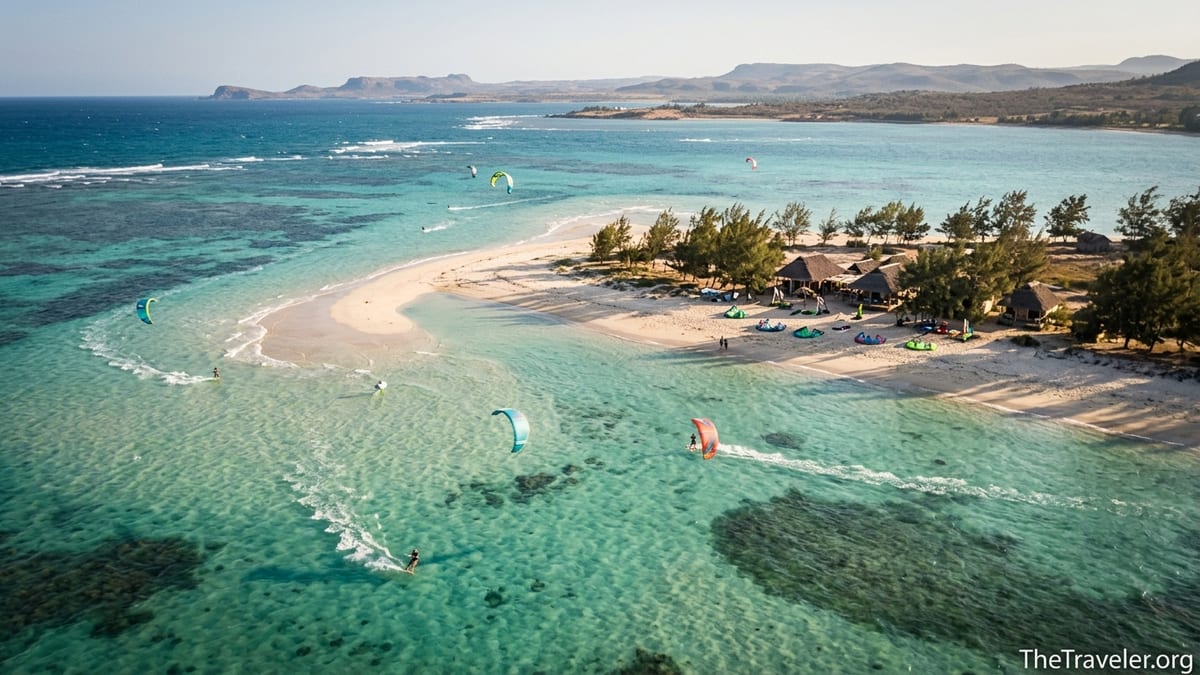
Sakalava Bay is the closest main kitesurf spot to Diego Suarez and has become the best-known base for riders who want easy access to town. The bay is a wide, shallow lagoon partly protected by a reef, with sandy bottom and large standing-depth areas at mid-tide. The wind blows side-shore or side-onshore from the left for most of the season, which keeps kiters inside the bay and provides a generous safety margin for learners. On busy days you may see dozens of kites on the water, yet the lagoon is still spacious by global standards.
The shoreline is lined with a small cluster of kite-focused lodges and schools. Operations such as Sakalava Lodge, KiteParadise, Ocean Lodge, Michel Kite Mada, Karibo Kite and Sergio Kite School typically offer a mix of accommodation, courses and gear rental directly on the sand. You can wake up in a bungalow, have breakfast facing the lagoon and be on the water within minutes. Several of these schools are affiliated with the International Kiteboarding Organization, provide radio-assisted teaching and maintain fleets of modern kites and boards sized specifically for the strong local wind.
For intermediate and advanced riders, Sakalava offers both flat and choppy water depending on the tide and wind strength. Inside the lagoon, the water can be comfortably flat near the upwind section in front of some lodges, ideal for practicing transitions, unhooked tricks and foiling. Further downwind and toward the reef the surface becomes more textured, which freestylers use to load and pop. On strong-wind days in July and August, riders often swap down to 6 or 7 metre kites and enjoy long powered sessions across the turquoise water with consistent pull and little risk of wind holes.
Beginners at Sakalava usually train in the shallow central section of the bay, where the sandy bottom allows most people to stand and walk back upwind. Instructors position students far enough away from the reef not to be affected by any waves and usually choose times of day when the tide height and crowding are optimal for lessons. A typical first-course schedule might involve one or two three-hour sessions per day over three to four days, including body dragging, water starts and first riding in both directions.
Babaomby and the Emerald Sea: Remote Lagon for All Levels
Roughly 20 kilometres across the bay system from Sakalava lies the Emerald Sea, a luminous turquoise lagoon bordering the Babaomby peninsula. This area is less connected to Diego Suarez but has a reputation among European and South African riders as a remote, high-quality freeride playground with consistent wind and postcard scenery. From Diego Suarez, reaching Babaomby typically involves a drive to a small fishing village followed by a boat transfer of around 45 minutes to one hour across the lagoon, timed to tide and sea conditions.
At Babaomby, the main accommodation is Babaomby Island Lodge, which functions as both lodge and watersport center. The lodge sits directly on the lagoon and operates a dedicated kite, wingfoil and windsurf school with IKO-certified instructors. One distinguishing feature here is the use of a safety jet ski during sessions, which allows the team to supervise riders spread across the lagoon and rapidly assist anyone who drifts too close to the reef or encounters equipment issues.
The Emerald Sea lagoon itself is expansive, with different zones suitable for various levels. In front of Babaomby Island Lodge, beginners can practice in a waist-deep area with sandy bottom, generally free from significant shorebreak. More confident riders take downwinders to well-known sub-spots such as the Piscine and Paradise, where the water can be mirror-flat between sandbanks at certain tides. Along the outer reef there are wave spots like Toreky and Suarez, where experienced wave kiters and windsurfers ride clean lines breaking in turquoise water with strong side-shore wind.
Because Babaomby is more isolated than Sakalava, most guests book packages that include full board, gear storage and often lesson or rental bundles. On non-windy mornings, riders might take a pirogue trip to nearby islets for snorkeling, or simply rest in hammocks facing the lagoon. The atmosphere is communal: guests typically eat together at a shared table, discuss the previous day’s conditions and plan excursions to other parts of the Emerald Sea once the wind fills in.
Choosing Between Sakalava, Babaomby and a Combined Trip
For many travelers, the first question is whether to base themselves at Sakalava Bay or commit to Babaomby and the Emerald Sea. Sakalava is the practical choice if you value proximity to Diego Suarez, a variety of lodges and the possibility to dine out or explore town in the evenings. It works especially well for shorter trips of one to two weeks, or for mixed groups where not everyone is kiting all day. Taxi transfers from Diego Suarez to Sakalava typically take 30 to 45 minutes along a laterite track, and some lodges include these in their packages.
Babaomby suits riders seeking a more immersive, off-grid experience with less day-to-day logistics. Once you reach the lodge by boat, you are essentially in a self-contained kite village surrounded by lagoon on three sides. The payoff is exceptional water colour, fewer crowds and the sense of riding in a vast natural amphitheatre with very little development on the horizon. Because access requires coordination of boat schedules and tides, many guests stay for a minimum of five to seven nights to make the transfer worthwhile.
A popular approach is to split a two- or three-week trip between both areas. For example, you might start with four or five days at Sakalava to shake off the rust, rent equipment and enjoy a mix of riding and evenings in Diego Suarez. Once you feel tuned in to the wind and have adapted to the conditions, you can transfer to Babaomby for a week of intensive sessions on the Emerald Sea, riding the Piscine or wave spots when the forecast looks best. Some Sakalava schools even organize guided day or overnight excursions across to the Emerald Sea, combining the two spots within a single package.
Budget can also influence your decision. Simple kite lodges in Sakalava sometimes offer more economical room-only or half-board options, leaving you free to eat in town or self-cater part of your stay. Babaomby and similar Emerald Sea lodges tend to operate as full-board packages including meals, given their remote location, which can make nightly rates higher but simplifies planning. As pricing and inclusions change frequently, it is worth checking current package details directly with the lodges before you book flights.
Kitesurf Schools, Rentals and Lesson Options
For learners or those travelling without equipment, the Diego Suarez area offers several professional kitesurf schools. In Sakalava Bay, Sakalava Lodge runs one of the longest-established centers in Madagascar, with a large quiver of modern kites in a broad size range, boards for different weights and styles, and an IKO-based teaching program. Other operations such as KiteParadise, Ocean Lodge, Karibo Kite, Sergio Kite School and Michel Kite Mada also provide beginner and intermediate instruction, private or semi-private lessons and supervised rental for independent riders.
A typical beginner package at Sakalava might include around 9 to 12 hours of instruction spread over three to four days, with all equipment supplied. Lessons usually begin with kite control on the beach, followed by body dragging in the shallow lagoon and then water starts and first riding once you are comfortable. In strong-wind months, instructors often use small kites between 4 and 7 square metres for first sessions, which keeps the power manageable while still allowing quick progression. More advanced coaching such as transitions, jumps or unhooked tricks can be booked as add-ons.
At Babaomby, Babaomby Island Lodge’s school covers kitesurfing, wingfoil and windsurf using a dedicated quiver of recent equipment. The lagoon’s standing-depth area in front of the lodge is well suited to learners, and the presence of a safety boat or jet ski adds peace of mind for both beginners and experienced riders exploring downwind sections. Rental packages typically include unlimited use of gear within opening hours, with staff on hand to help launch, land and tune kites to the day’s wind strength.
If you bring your own gear, most centers offer storage and use-of-facilities options. For instance, a Sakalava lodge might charge a daily or weekly fee that covers secure storage, compressor use, beach assistance and rescue coverage in case of equipment failure. Riders often bring a quiver biased toward small sizes, for example a 6, 8 and 10 metre set for an 80-kilogram rider, plus a directional or foil board if they want to take advantage of reef waves or lighter early-season days. Always check baggage rules with your airline and consider using a tough boardbag, as internal flights within Madagascar can involve manual handling at smaller airports.
Accommodation and Life Around the Spots
Accommodation near Sakalava Bay ranges from simple eco-bungalows to more comfortable lodges with en-suite bathrooms and on-site restaurants. Many kite camps are built from local materials such as wood and thatch, set among casuarina trees or dunes just behind the beach. Power often comes from a mix of solar and generator sources, and Wi-Fi may be available but not as fast or stable as in major cities. Several lodges offer full-board packages that include three meals a day, snacks and filtered drinking water, which simplifies logistics in a relatively remote coastal area.
If you prefer to stay in Diego Suarez itself, you will find a broader range of guesthouses and small hotels in town, some with air conditioning and better access to shops, pharmacies and restaurants. In this setup, you would typically arrange daily transfers to Sakalava Bay with your chosen kite school or via taxi, leaving town after breakfast and returning in the late afternoon or evening. This pattern suits non-kiting partners who enjoy having more things to do in town during the day, as they can stroll the colonial-era streets, visit markets or book excursions while you are on the water.
In Babaomby and on the Emerald Sea, lodging is more secluded. Babaomby Island Lodge, for instance, offers bungalows perched close to the water, with open-air dining areas overlooking the lagoon. Electricity might be limited to certain hours, and there is usually no nightlife beyond the bar at the lodge itself. Evenings tend to revolve around sunset sessions, communal dinners and early nights in preparation for long days on the water. This rhythm appeals to travelers who see the trip as a chance to disconnect, focus on wind sports and appreciate the natural environment.
Wherever you stay, it is important to factor in the remote nature of the region. You will want to carry any essential medications with you, including seasickness tablets if you are sensitive, as boat transfers to Babaomby can occasionally be choppy. Mosquito protection is also important in northern Madagascar; most lodges provide nets above the beds, but bringing long-sleeve clothing for evenings and a reliable repellent is sensible. Travel insurance that covers kitesurfing and medical evacuation is highly recommended.
Getting There, Transport and Combining with Diego Suarez & Parks
The main gateway to northern Madagascar for kitesurfers is the airport at Antsiranana, also known by its former name Diego Suarez. Depending on the season and airline schedules, you may connect through Antananarivo or other regional hubs before reaching Diego Suarez. Flight timetables change frequently in Madagascar, so it is wise to reconfirm close to departure and allow generous connection times, especially if carrying large kite bags that may be checked as special baggage.
From Diego Suarez airport to Sakalava Bay, most lodges arrange private transfers in 4x4 vehicles or minibuses. The drive typically takes under an hour and passes through dry savannah and cashew plantations before reaching a sandy track down to the bay. For Babaomby, the journey continues beyond town to a small coastal village where you board a boat for the lagoon crossing. Some kitesurf travel operators in Madagascar sell combined packages that include all transfers from the airport to Sakalava, onward to Babaomby, and eventually back to Diego Suarez for your departure flight.
Many riders choose to extend their stay to explore the surrounding region beyond the water. Diego Suarez town itself has a sheltered bay, historic architecture, a busy local market and viewpoints such as French Mountain, which some kite schools incorporate into day trips alongside sessions. Roughly an hour or two’s drive from town, Amber Mountain National Park offers hiking through montane rainforest, waterfalls and encounters with lemurs and chameleons. A little further afield, Ankarana National Park is known for its limestone tsingy formations, caves and suspension bridges.
A classic combined itinerary might look like this: arrive in Diego Suarez, spend a night in town to rest and organize cash, then transfer to Sakalava for six or seven days of kitesurfing. After that, take two or three days for a road trip to Amber Mountain and Ankarana, staying in simple lodges near the park entrances, before finishing the holiday with a week at Babaomby on the Emerald Sea. This structure balances intensive time on the water with the opportunity to see Madagascar’s unique wildlife and landscapes, making the long-haul journey more rewarding.
Practical Tips for a Successful Kitesurf Trip
Planning ahead is essential in northern Madagascar, particularly in the peak wind months when kite lodges can fill with returning guests. Booking accommodation and school slots several months in advance is sensible if you are targeting July or August. When comparing offers, look carefully at what is included: airport transfers, boat transport to Babaomby, meals, rescue services and equipment rental can significantly change the final cost and convenience of your stay.
On the equipment side, think in terms of strong prevailing wind. Most average-weight kiters will spend a lot of time on kites between 6 and 9 metres during the core season, with slightly larger sizes useful in April, May and October. Bringing a reliable helmet, impact vest and booties is recommended due to the presence of occasional rocks or sea urchins, especially near the reef. A spare bar, extra lines and a basic repair kit can save sessions in remote areas where replacement parts are not always immediately available.
Cash management also deserves attention. ATMs in Diego Suarez can sometimes run out of cash or impose low withdrawal limits, and card payments at remote lodges are not always guaranteed. Many operators suggest travelers arrive with a mix of local currency and euros or dollars, and settle final bills in cash. Check with your chosen lodge or school in advance about accepted payment methods, and keep some smaller notes for tipping boatmen, drivers and local guides.
Finally, remember that northern Madagascar remains a relatively wild and developing region. Its charm lies in the empty lagoons, unspoiled reef lines and low-density tourism, but this also means occasional power cuts, simple infrastructure and slower service than in more established resort destinations. Approaching the trip with flexibility and a sense of adventure, while leaning on the experience of local instructors and lodge staff, will help you make the most of one of the most wind-reliable corners of the Indian Ocean.
FAQ
Q1. When is the best time of year to kitesurf in Sakalava Bay and Babaomby?
The main kitesurf season runs from about April to November, with June to September offering the strongest and most reliable Varatraza trade winds.
Q2. What kite sizes should I pack for a trip to northern Madagascar?
Most average-weight riders use small kites for much of the season, typically a quiver around 6, 8 and 10 metres, with a slightly larger kite useful in shoulder months.
Q3. Is Sakalava Bay suitable for complete beginners?
Yes. The bay has large shallow sections with sandy bottom and side-shore wind, and several professional schools offer structured beginner courses with modern equipment.
Q4. How does Babaomby’s Emerald Sea compare to Sakalava for beginners?
In front of Babaomby Island Lodge the Emerald Sea offers a wide waist-deep area ideal for learners, supported by an on-site school and safety boat for extra reassurance.
Q5. Do I need to rent a car to reach the kite spots from Diego Suarez?
No. Most kite lodges arrange 4x4 transfers from Diego Suarez airport to Sakalava, and boat transfers to Babaomby, so many visitors do not hire a vehicle.
Q6. Can I combine kitesurfing with visits to national parks nearby?
Yes. Many travelers add two to four days to visit Amber Mountain and Ankarana National Parks for hiking and wildlife between or after their kite sessions.
Q7. Are there equipment rental options if I prefer not to fly with my gear?
Several schools at Sakalava and Babaomby rent complete kitesurf, wingfoil or windsurf setups, often as daily or weekly packages that include beach assistance and rescue.
Q8. What kind of accommodation is available near the kite spots?
Around Sakalava you will find kite lodges with beach bungalows and some town hotels in Diego Suarez, while Babaomby offers more remote full-board lagoon-side bungalows.
Q9. Is travel insurance that covers kitesurfing really necessary?
It is strongly recommended, as the region is remote and serious injuries may require medical evacuation, which standard policies or basic coverage may not fully cover.
Q10. Can non-kiting partners enjoy a holiday based in Sakalava or Babaomby?
Yes, though experiences differ: Sakalava allows easy access to Diego Suarez and excursions, while Babaomby is quieter and better suited to nature lovers and readers.