


High above the warm, windy bay of Diego Suarez, Amber Mountain National Park offers a cool green world of waterfalls, crater lakes and dripping rainforest alive with lemurs and chameleons. Known locally as Montagne d’Ambre, this extinct volcanic massif is one of northern Madagascar’s easiest parks to visit, yet it still feels wild and remote once you step under the canopy. This guide explains exactly how to get there from Diego Suarez and Joffreville, what to expect on the trails, how much time to allow and how to combine Amber Mountain with Red Tsingy and Ankarana on a wider northern loop.
Getting Your Bearings: Why Amber Mountain Is Special
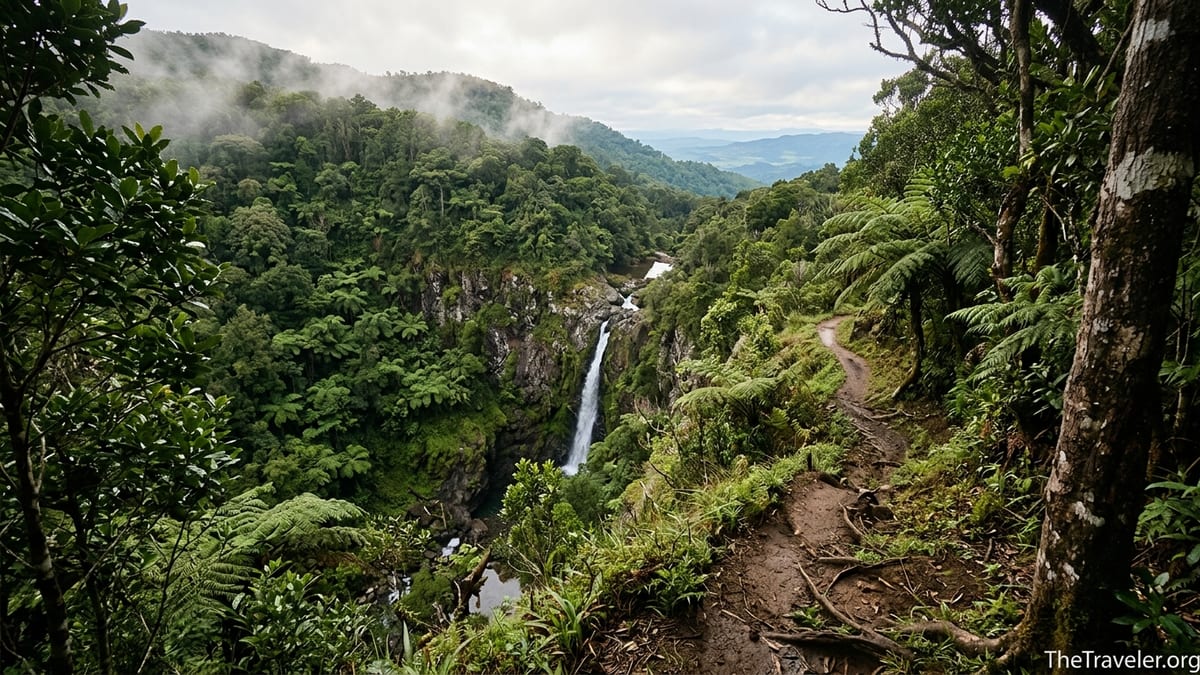
Amber Mountain National Park lies about 35 km southwest of Diego Suarez, above the former colonial hill station of Joffreville. The massif rises to around 1,450 m at its highest points, which means temperatures are significantly cooler than on the coast and clouds often cling to the ridges. The park protects evergreen montane rainforest, mid-altitude forest and pockets of dry forest, all packed into a relatively compact area. For travelers, that means you can see waterfalls, crater lakes and dense primary forest in a single day without extreme hiking.
The park is famous for its biodiversity. Local guides often describe it as one of the most species-rich protected areas in Madagascar, and even a short walk can produce sightings of crowned lemurs moving through the canopy, ring-tailed vontsira darting across the path and tiny leaf-tailed geckos perfectly camouflaged on mossy trunks. Herpetology enthusiasts flock here to look for the minute Brookesia tuberculata chameleons that can sit on a fingernail, while birders come for species such as the Amber Mountain rock thrush and Madagascar crested ibis. Even if you are not a specialist, it is hard not to be impressed by the sheer density of life.
Because the park sits on an extinct volcano, its hydrology is remarkable. Rainfall captured by the forest feeds multiple springs, streams and crater lakes that in turn supply water to the surrounding region, including parts of Diego Suarez. As you walk, you are constantly crossing clear streams on stepping stones or small wooden bridges, and you will notice how the air feels humid and cool even in the middle of the dry season. This combination of easy access, diverse scenery and abundant wildlife is what makes Amber Mountain such a rewarding stop on a northern Madagascar itinerary.
Getting There from Diego Suarez and Staying in Joffreville
Most visitors base themselves either in Diego Suarez (Antsiranana) and come on a day trip, or stay overnight in Joffreville to be closer to the park gate. From Diego Suarez, the paved RN6 runs inland toward Joffreville for roughly 30 to 40 km. In practice, this is usually 45 minutes to 1.5 hours of driving, depending on road works, weather and the type of vehicle. Tour operators in Diego Suarez commonly advertise Amber Mountain day trips that include hotel pickup, park entry, guide and picnic lunch; prices often fall in the range of a full-day excursion in northern Madagascar, and can be shared if you form a small group.
If you prefer to travel more independently, you can hire a private car and driver in Diego Suarez for the day, which is common practice in the region. Travelers frequently report full-day rates that feel reasonable by European standards, especially when divided between two or three people. Another budget option, used by backpackers and locals, is the taxi-brousse (bush taxi) between Diego Suarez and Joffreville. These usually depart from taxi-brousse stations on the edge of town and run when full. They are cheap but slow and often crowded, and you will still need to arrange a transfer from Joffreville to the park entrance, which sits several kilometers uphill.
Joffreville itself, once a French colonial hill retreat, has a scattering of small lodges and guesthouses. Many properties sit on the slopes with views over Diego Suarez Bay and serve as convenient bases for early starts in the park. A typical pattern is to arrive from Diego Suarez in the afternoon, sleep in Joffreville, then spend a full day or two exploring the trails before continuing south toward Red Tsingy or Ankarana. Staying in Joffreville has the added advantage that you can be at the park gate soon after opening, which is when lemurs and birds are most active.
Do You Need a 4x4 and a Guide?
Whether you need a 4x4 to visit Amber Mountain depends on the season and your tolerance for rough roads. The RN6 between Diego Suarez and the Joffreville turnoff is paved, but the final stretch of road up to Joffreville and then to the park entrance can develop potholes and muddy sections, especially in the rainy months from roughly November to March. Many local operators use 4x4s year round, both for comfort and because the same vehicles often continue to more remote spots like Red Tsingy. In the dry season, a high-clearance vehicle rather than a full 4x4 may be sufficient, and taxi-brousse services do make the climb, which shows that it is not an extreme off-road track.
Inside the park you will be walking on foot, not driving, so the type of vehicle matters mainly for reaching the entrance. For travelers who have limited time, the simplest solution is to book a private vehicle with driver from Diego Suarez, which can be arranged through hotels, local agencies and even restaurants that know trustworthy drivers. If you are traveling on a longer trip down the RN6, you might continue with the same 4x4 driver from Antananarivo or Ankify, stopping at Amber Mountain on the way south to Ankarana.
Guides are officially available at the park entrance, and hiring one is strongly recommended even if not strictly mandatory on some circuits. They are relatively affordable by international standards and are a major part of the local economy. A good guide will spot well-camouflaged chameleons, leaf-tailed geckos and rare lemurs that you would almost certainly miss alone, and will explain local fady (taboos), the significance of sacred waterfalls and how villagers use endemic plants. Many visitors arrange guiding through their lodge in Joffreville, while others simply request an English or French-speaking guide at the park gate and join forces with another couple or small group to share the cost.
Waterfalls, Crater Lakes and Classic Trails
Amber Mountain’s trail network is well established and clearly signposted, ranging from short out-and-back walks to full-day loops connecting waterfalls and lakes. A common introductory hike is the circuit that links a sacred waterfall with one of the crater lakes. This route typically starts from the main parking area and leads through thick rainforest where strangler figs, tree ferns and moss-covered trunks create a distinctly prehistoric atmosphere. After 30 to 60 minutes of steady but not difficult walking, you reach a waterfall plunging into a rocky bowl, often draped in mist. Local guides may ask you not to swim here out of respect for its sacred status and because of safety concerns.
Further up, several crater lakes occupy old volcanic vents, their still, green water fringed by dense forest. On clear days you can sometimes see dragonflies skimming the surface and hear the calls of distant lemurs echoing over the water. One of the lakes supplies drinking water to parts of Diego Suarez, so swimming is not allowed, but walking around the shore provides excellent birdwatching and photo opportunities. Many full-day excursions combine at least one waterfall and one crater lake with a forest viewpoint that looks out over the plains toward the Indian Ocean.
For more active hikers, there are longer circuits that climb higher on the massif or link multiple waterfalls. Travel agencies and lodge owners often describe these as four to six hours of walking, depending on your pace and how often you stop to watch wildlife. Trails are generally in good condition but can be muddy, rocky or covered in tree roots, so expect moderate hiking rather than a casual stroll. In practice, most visitors who are reasonably fit and used to walking can manage the main circuits with regular breaks. If you prefer something gentler, ask your guide or the park office for a shorter loop of two to three hours near the entrance.
Wildlife: Lemurs, Chameleons and Endemic Plants
Amber Mountain is particularly rewarding for close wildlife encounters because animals are accustomed to people passing on the trails yet the forest remains relatively intact. Crowned lemurs are often seen in small groups, with their distinctive facial markings and rust-colored backs. You may spot Sanford’s brown lemurs as well, moving more quietly among the mid-level branches. At dusk, and occasionally during daytime in darker gullies, local specialists sometimes manage to find nocturnal species such as the Amber Mountain fork-marked lemur, although these sightings are less guaranteed and usually require an overnight stay and night walk with an experienced guide.
Reptiles and amphibians are another highlight. Guides carry a mental map of where particular chameleons tend to perch and will tap gently on branches to draw your attention to individuals that perfectly match the surrounding leaves. The tiny Brookesia ground chameleons can be found among the leaf litter, where guides use trained eyes to pick out what looks at first like a small brown twig. Tree frogs, geckos and a remarkable variety of insects live along the streams and around the moist ravines near the waterfalls, making macro photography rewarding for those with the patience to stop frequently along the trail.
The plant life is just as distinctive. You will walk beneath giant tree ferns, past pandanus plants with prop roots and through stands of orchids that bloom at different times of year. Many species are endemic to Amber Mountain or the wider northern region of Madagascar, meaning they are found nowhere else on earth. Local guides can point out medicinal plants and explain traditional uses, such as leaves used in herbal teas for stomach complaints or bark employed in local remedies. When you compare the lush green canopy here with the dry thorny scrub around parts of Diego Suarez, the importance of this humid refuge becomes very clear.
How Much Time to Allow and When to Visit
You can visit Amber Mountain as a long day trip from Diego Suarez, but many travelers feel that this barely scratches the surface. A typical day trip involves leaving Diego Suarez around 7:00 in the morning, arriving at the park entrance between 8:00 and 9:00, walking until early afternoon with a picnic break by a waterfall or viewpoint, then returning to Diego Suarez before dark. This works if you are on a cruise stop or have very limited time, but you may feel rushed if you enjoy birdwatching, photography or simply moving slowly through the forest.
If your schedule allows, plan at least one overnight in Joffreville and one full day in the park, preferably two. With two days you can explore an easier trail on the first day, then a longer circuit the next, or mix a daytime hike with an evening walk on the edge of the park to look for nocturnal species. Some organized itineraries include Amber Mountain as one of several north Madagascar highlights, giving it one full day sandwiched between Red Tsingy and Ankarana. If you are particularly keen on rainforest wildlife or cooler temperatures, you can reasonably spend three days here without feeling you have exhausted the options.
In terms of season, the coolest and driest months in the Amber Mountain area generally run from about May to October. During this period, the forest trails are less muddy, and nights in Joffreville can be surprisingly chilly, especially in July and August. From November onward, heavier rains become more common, cloud cover increases and some trails may be slippery or temporarily closed. The flip side is that the forest looks even lusher, waterfalls run fuller and certain amphibians and reptiles are more active. As always in Madagascar, road conditions can change after heavy rain, so build in some flexibility and avoid overly tight connections on travel days.
Practical Tips: Clothing, Gear and Park Logistics
Amber Mountain’s elevation and rainforest microclimate mean you should pack as if you were going on a cool-weather hike rather than a tropical beach outing. During the day, lightweight hiking trousers or leggings and a quick-drying long-sleeve shirt work well, protecting you from insects and brushing against vegetation. Under the canopy it can feel cool and damp, so bring a light fleece or long-sleeve layer, especially from June to August. A compact rain jacket or poncho is essential in any season, as showers can come and go quickly. Many visitors are surprised by how cold it feels in Joffreville after sunset, so pack a warm layer if you are staying overnight.
On your feet, closed shoes with good grip are important. Trail shoes or light hiking boots are ideal, but even sturdy trainers work if you are cautious in muddy sections. Flip-flops and beach sandals are not suitable for most circuits. A small daypack should hold at least 1.5 to 2 liters of water per person, snacks or picnic lunch, insect repellent, sunscreen for more open viewpoints, a hat and a basic first-aid kit. Mobile reception is patchy inside the park, so do not rely on your phone for navigation or emergency contact; instead, stay with your guide and group.
At the park entrance you will pay conservation fees per person and, if you have not arranged one in advance, select a guide and agree on a route and approximate duration. Fees are typically structured per day, and there may be separate charges for guides, local porters and vehicle parking. Payment is usually in Ariary, so bring enough cash, as card facilities are often unreliable or unavailable. Park hours generally favor daytime visits, so plan to arrive early for the best wildlife activity. Lodges in Joffreville will often prepare packed breakfasts for guests who wish to enter the park soon after opening.
Combining Amber Mountain with Red Tsingy and Ankarana
Most northern Madagascar itineraries link Amber Mountain with at least one other major attraction south along the RN6, typically Red Tsingy and Ankarana. The Red Tsingy, or Tsingy Rouge, is a fragile landscape of eroded red sandstone and laterite pinnacles set in a dry valley. Although it lies off the main highway down a dirt road, many tours run a loop from Diego Suarez that visits both Amber Mountain and Red Tsingy over one or two days using a 4x4. For example, you might spend a full day hiking in Amber Mountain, overnight in Joffreville or near the tsingy, then visit Red Tsingy the next morning before continuing to Ankarana.
Ankarana National Park, reached via the RN6 toward Ambilobe, showcases a completely different environment of grey limestone tsingy, caves and dry deciduous forest. Driving time from Diego Suarez to Ankarana’s main entrance near Mahamasina is commonly quoted at around three to four hours one way, depending on road conditions. Many multi-day trips break this into stages, stopping first in Joffreville for Amber Mountain, then heading south to Red Tsingy and Ankarana, and finally continuing toward Ankify and the islands around Nosy Be. This sequence gives a satisfying contrast: cool rainforest and waterfalls at Amber Mountain, sculpted red pinnacles at Tsingy Rouge and jagged grey karst formations at Ankarana.
If you are traveling independently with a hired 4x4 and driver, you can ask them to suggest a realistic schedule based on current road works and seasonal river levels. Travelers often underestimate how slow driving can be on Madagascar’s highways, so it is wise to allow extra time between each destination rather than trying to rush from Amber Mountain to Red Tsingy and Ankarana all in a single very long day. A comfortable plan might allocate one full day to Amber Mountain, a half day to Red Tsingy and at least one full day, ideally two, to Ankarana’s circuits. This pacing leaves space for delays while still feeling like a holiday rather than a race.
The Takeaway
Amber Mountain National Park is one of the easiest places in Madagascar to experience lush rainforest, cool mountain air and abundant wildlife without multi-day treks or rough camping. Its proximity to Diego Suarez and Joffreville, combined with a network of established trails and local guiding services, means you can organize anything from a simple day trip to a multi-day stay focused on lemurs, chameleons and waterfalls. The park also fits naturally into a broader northern route that includes Red Tsingy and Ankarana, offering a striking sequence of landscapes from green crater lakes to red and grey tsingy.
For most travelers, hiring a local guide and, in the wetter months, a 4x4 vehicle represents money well spent, turning a basic hike into a deeper encounter with the region’s ecology and culture. Pack for cool, damp forest rather than beach heat, give yourself at least one full day on the trails and be prepared for travel to run on Malagasy time. Do that, and Amber Mountain is likely to stand out in your memory long after the trip ends, not only for its wildlife but for the sense of walking through a self-contained world above the surrounding dry plains.
FAQ
Q1. How long does it take to reach Amber Mountain from Diego Suarez?
Travel time from Diego Suarez to the park entrance is typically between 45 minutes and 1.5 hours by car, depending on road conditions, traffic and the type of vehicle.
Q2. Is a 4x4 vehicle essential to visit Amber Mountain?
In the dry season, high-clearance vehicles can often manage the road, but in the rainy months a 4x4 is safer and more comfortable, especially if you plan to continue to Red Tsingy.
Q3. Do I need a guide inside Amber Mountain National Park?
Guides are strongly recommended. Trails are marked, but a guide greatly improves wildlife spotting, explains local culture and helps you choose routes suited to your fitness and time.
Q4. Can Amber Mountain be visited as a day trip from Diego Suarez?
Yes. Many visitors do a full day trip from Diego Suarez, leaving early in the morning and returning by late afternoon, but staying in Joffreville allows a more relaxed pace.
Q5. How many days should I plan for Amber Mountain itself?
One full day is the practical minimum. Two days lets you combine an easier circuit with a longer hike and potentially an evening walk for nocturnal species.
Q6. What should I wear for hiking in Amber Mountain?
Wear long trousers, a quick-drying long-sleeve top, a light fleece, a waterproof jacket and closed shoes with good grip. Nights in Joffreville can feel chilly, especially in the dry season.
Q7. When is the best time of year to visit Amber Mountain?
The cooler, drier months from roughly May to October are generally best for hiking, though the forest is beautiful year round and rains make waterfalls fuller from about November onward.
Q8. Can I combine Amber Mountain with Red Tsingy and Ankarana?
Yes. Many itineraries link Amber Mountain with Red Tsingy and Ankarana along the RN6, typically allowing one day for Amber, a half day for Red Tsingy and at least one full day in Ankarana.
Q9. Are there accommodations near the park?
Joffreville has several small lodges and guesthouses within a short drive of the park gate, while Diego Suarez offers a wider range of hotels for those doing only a day trip.
Q10. Is it possible to visit Amber Mountain on a tight budget?
Budget travelers can use taxi-brousse services between Diego Suarez and Joffreville and then hire a guide at the park gate, sharing costs with other visitors where possible.