


Just inland from the beaches of Ifaty and Mangily in southwest Madagascar, Reniala Private Reserve protects a fragment of one of the planet’s strangest ecosystems. Here, swollen baobabs, octopus-like didierea and a tangle of thorny shrubs shelter rare birds, reptiles and nocturnal mammals that exist nowhere else on Earth. For travelers who can tear themselves away from the lagoon for a morning or evening, Reniala offers an accessible, rewarding window into the island’s otherworldly spiny forest.
What and Where Is Reniala Private Reserve?
Reniala Private Reserve is a small, community-managed protected area on the edge of Mangily/Ifaty, around 25 kilometers north of the port city of Toliara in southwest Madagascar. The reserve sits less than a kilometer from the Mozambique Channel but feels a world away from the palm-fringed coastline. Within a compact area, it preserves spiny forest, baobab groves and a network of sandy trails designed for guided walks and birdwatching.
Travelers typically base themselves at beach hotels in Mangily or Ifaty, then arrange a short transfer inland. Many lodges, such as Bamboo Club, Belle Vue or La Mira, can organize a car and guide on request. The drive from the beachfront hotels to the reserve entrance is usually 10 to 15 minutes along a sandy track, often in a 4x4 or local taxi known as a taxi-brousse for shared rides.
From Toliara, most visitors travel up the coast road by private car, hotel transfer or taxi, a journey of roughly 25 kilometers that usually takes 30 to 45 minutes depending on conditions. Recent estimates suggest a standard taxi for the full Toliara–Ifaty run can cost the equivalent of about 7 to 10 US dollars, although travelers should expect to negotiate and confirm fares in advance rather than rely on fixed pricing.
Despite its modest size, Reniala has become a key stop on specialist birding and nature itineraries. International tour operators often schedule early-morning walks here specifically to seek out southwest endemics like the long-tailed ground roller and subdesert mesite before continuing to more remote reserves such as Tsimanampetsotsa National Park farther south.
The Spiny Forest: Baobabs, Octopus Trees and Other Drought Masters
Reniala lies within the Madagascar spiny forest ecoregion, a semi-desert belt that runs along the island’s southwest coast. This habitat is shaped by intense sun, poor sandy soils and rainfall that can be as low as a few hundred millimeters per year. Plants here have evolved to survive long dry seasons through water storage, tiny leaves, protective spines and highly efficient root systems. Walking the Reniala trails feels a bit like stepping into a botanical gallery of drought adaptations.
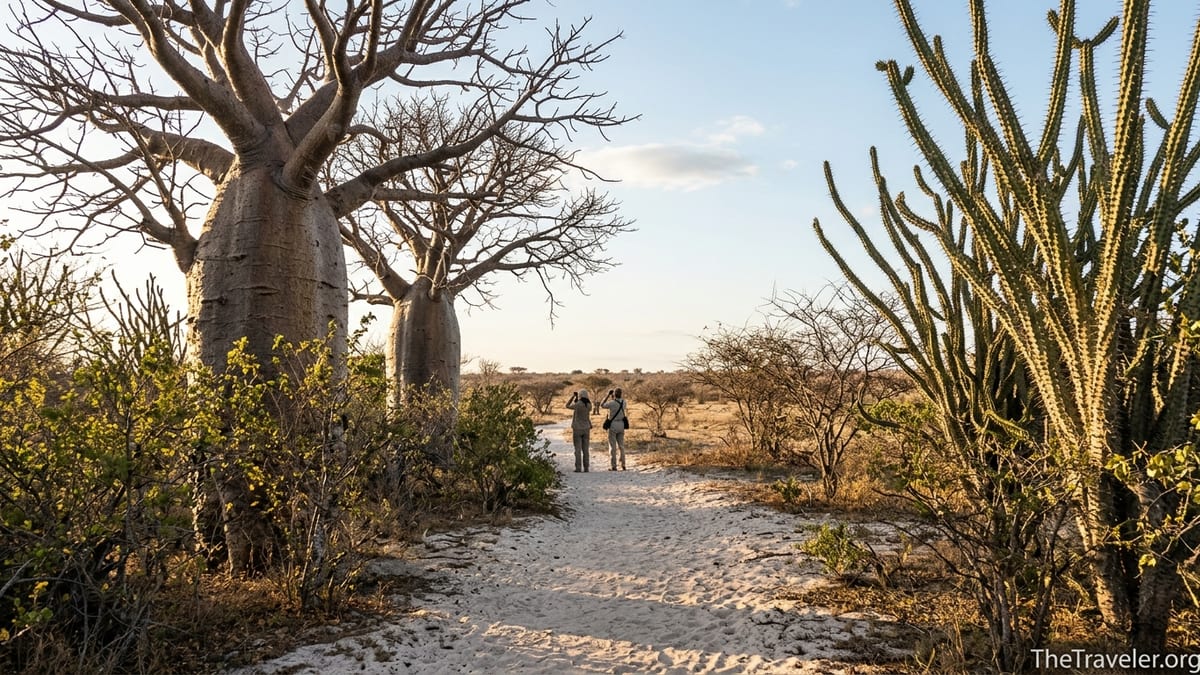
The reserve’s most photogenic residents are its baobabs. Several mature Adansonia trees tower over the scrub, some of them centuries old, with massive trunks that look inflated and smooth. Guides will often stop at a particularly imposing specimen, explaining how baobabs store water in their fiber-rich wood and shed leaves during the dry season to reduce moisture loss. Many travelers visiting in the dry months between May and October will see baobabs bare of foliage, their root-like branches silhouetted against a hard blue sky.
Equally emblematic are the didierea, sometimes called octopus trees or Madagascar ocotillo. Their tall, jointed stems are banded with sharp spines and dotted with tiny leaves clustered close to the stem to minimize evaporation. In the early morning or after light rain, these shrubs can flush with small flowers that draw in sunbirds and other nectar-feeding species. Photographers often use wide-angle lenses to capture octopus trees rising among baobabs, emphasizing the surreal architecture of the forest.
Lower to the ground, Euphorbia succulents, pachypodiums with swollen bases, and various thorny shrubs knit the forest into a near-impenetrable tangle off the main paths. Guides typically encourage visitors to stick to the sandy trails both for safety and to avoid trampling fragile plants that may be slow-growing, with some individuals potentially decades old despite their modest size.
Birdlife Highlights: Long-tailed Ground Roller and Subdesert Mesite
For many visitors, especially birdwatchers, Reniala’s biggest draw is its concentration of southwest Madagascar endemics in a relatively accessible site. Tour reports and trip lists from recent years show that patient groups with skilled local guides routinely find the long-tailed ground roller and subdesert mesite in or around the reserve, often within a single morning session. These species have restricted global ranges and are considered among the “must see” birds of Madagascar’s arid southwest.
The long-tailed ground roller is a plump, terrestrial bird with a striking pattern of blues, tans and blacks and a remarkably long, graduated tail. Unlike the tree-perching rollers familiar from other parts of Africa, this species spends most of its time on the ground, where it runs between patches of cover or freezes motionless when disturbed. At Reniala, local guides know habitual territories and sometimes spend considerable time coaxing a bird into view by using soft whistles or recorded calls, always adjusting their approach depending on local regulations and current best practice on playback.
The subdesert mesite, another target species, is a cryptic ground-dweller that moves quietly through the leaf litter. Small groups may follow specific family parties at a distance for several minutes, giving good views without pushing the birds. Other characteristic species that visiting birders frequently report include running coua, crested coua, Lafresnaye’s vanga, sickle-billed vanga, Archbold’s newtonia and a variety of jerys and brush warblers associated with spiny forest and nearby salt flats.
Because the ground rollers and mesites can be shy, specialist birding tours often dedicate a full, pre-dawn to late-morning block at Reniala rather than dropping in for a quick look from the beach. It is common for such groups to depart hotels around 4:30 or 5:00 a.m., arriving at the reserve shortly before sunrise to be in position as birds become active. Independent travelers who are serious about birding may want to replicate this pattern, arranging a very early departure and requesting a bird-focused guide through their lodge or a local operator in Toliara.
Reptiles, Lemurs and Night Walks
Reniala’s wildlife is not limited to birds and plants. The reserve is an accessible place to look for some of southwest Madagascar’s characteristic reptiles, including radiated tortoises and various day geckos and chameleons. Radiated tortoises, with their star-patterned shells, are often encountered on daytime walks, especially in the cooler hours of the morning. Guides may also point out camouflaged geckos flattened against tree trunks or chameleons hanging motionless among the spines, something many visitors would miss without trained eyes.
One of the reserve’s signature experiences is a guided night walk. After sunset, local guides lead small groups along the trails using headlamps or dim torches held by hand. The focus shifts from birds to nocturnal mammals and reptiles: tiny mouse lemurs darting between branches, sleeping birds perched at eye level and nocturnal geckos with reflective eyeshine. In some seasons, visitors might also glimpse sportive lemurs clinging vertically to tree trunks, their large eyes illuminated in the beam.
Unlike in humid eastern rainforests, where night walks can involve muddy, uneven paths, the trails at Reniala are generally flat and sandy. This makes them relatively accessible for travelers who may not be comfortable with steeper terrain but still want a nocturnal wildlife experience. Sensible footwear such as lightweight hiking shoes or closed sandals is important, however, because of the thorns that can easily pierce thin soles or open shoes.
Guides typically ask visitors to keep noise and sudden movements to a minimum on night walks to avoid stressing shy species. Many travelers choose to combine a morning birding visit with a return after dinner for a shorter night excursion, either on the same day or on consecutive evenings, using the comfort of nearby beach hotels as a base between outings.
Morning vs Evening: When to Visit and How Long to Stay
Reniala can technically be visited at any time of day, but conditions and wildlife viewing opportunities differ markedly between early morning, late afternoon and the middle of the day. The spiny forest heats up quickly, and by late morning temperatures can feel intense, especially from October to December at the start of the wet season when humidity also rises. As a result, many travelers and local operators strongly favor early-morning or late-afternoon visits.
For birdwatchers, early morning is clearly best. Most guides recommend starting on the trails shortly after sunrise, typically between 5:30 and 6:00 a.m., to catch dawn song and peak movement. Ground rollers, mesites and couas are more vocal and active at these hours, and the soft, low-angle light is ideal for photography. A focused birding visit commonly lasts three to four hours, returning to the coast by mid- to late morning for breakfast or an early lunch at the hotel.
Evening visits are better suited to those interested in general nature, photography and the atmosphere of the forest rather than specific bird targets. From about 4:00 p.m. onwards, the light becomes warmer and softer, casting long shadows that highlight the textures of baobab bark and spiny branches. Temperatures start to drop, making walking more comfortable. Visitors who time their outing to end at dusk can then transition straight into a night walk, typically lasting one to two hours, before driving back to the beach for a late dinner.
Midday walks are possible but generally less rewarding, with heat haze affecting long-lens photography and many birds inactive and resting in shade. Travelers who only have a single short window to visit should still go if that is their only option, but expectations should be adjusted. In such cases, focusing on the distinctive vegetation, reptiles like tortoises and the overall feel of the spiny forest may be more satisfying than targeting specific, elusive bird species.
Guided Walks, Local Expertise and Practical Costs
All visits to Reniala are guided, and this is a major part of the experience. Local guides, many of whom have been working in the reserve for years, know individual trees, territories of rare birds, locations of reptile dens and seasonal patterns of flowering and fruiting. International birding groups often comment in trip reports on how quickly these guides can locate a long-tailed ground roller or subdesert mesite in dense undergrowth that appears empty to untrained observers.
The reserve typically offers different themed walks: a general nature circuit, a more specialized ornithological route and dedicated night walks. In practice, guides tend to tailor each outing to the interests of the group. For example, a family staying at a mid-range hotel in Mangily might request a two-hour morning walk focused on “a bit of everything” followed by relaxed photo stops at the largest baobabs. By contrast, a pair of bird photographers may ask for a much slower circuit with time spent quietly waiting near known ground roller territories.
Entry fees and guide charges vary over time and can depend on group size, nationality and whether visitors book directly at the entrance or via a tour operator. Recent online accounts from travelers and small tour companies suggest that a combined entrance and guiding fee for a half-day visit often falls in the range of the equivalent of 10 to 25 US dollars per person, with private birding-focused guiding at the higher end. Some operators note that a one-hour private tour for a single visitor can cost roughly as much as a local worker’s weekly wage, which helps explain why guiding is an important source of income for nearby communities.
Travelers should bring enough cash in Malagasy ariary, as card payments are rarely available on-site. It is also customary to tip guides and, where present, spotters who help locate animals. Modest tips, scaled to the length and complexity of the walk, can make a meaningful difference locally and are often shared among team members.
Transport and Logistics from Ifaty, Mangily and Toliara
Most visitors will reach Reniala either from their accommodation in Mangily/Ifaty or from the regional hub of Toliara. From beachfront hotels, travel is straightforward: many properties maintain relationships with local drivers and guides and can arrange round-trip transfers to the reserve entrance. These are usually in 4x4 vehicles or sturdy vans that can handle sandy tracks and occasional ruts, especially after rain.
Independent travelers based in Toliara have several options. The simplest is to hire a private taxi for the day, negotiating a fare that includes waiting time while at the reserve and possibly short stops at salt flats or fishing villages along the way. Online route planners and recent traveler reports suggest that the 25-kilometer journey typically takes around 30 minutes by private car or taxi in dry conditions. Costs fluctuate with fuel prices and demand, but it is reasonable to budget the equivalent of 20 to 40 US dollars for a return trip with waiting time, then negotiate on the ground.
For those on tighter budgets, shared taxi-brousse services operate between Toliara and the villages along the coast road. These minibuses are cheaper but less predictable, with variable departure times and frequent stops. They can work for flexible travelers comfortable with basic conditions, but for time-sensitive birding visits at dawn, a private vehicle arranged the day before is usually more reliable. Some visitors combine their transfer to or from a beach hotel with a stop at Reniala, asking the driver to schedule a morning in the forest before continuing.
Regardless of how you arrive, it is wise to confirm in advance with your hotel or operator whether they will handle the reserve entrance formalities and guiding arrangements. In high season from June to September, when more organized tours pass through, securing a dedicated bird guide for an early start may require booking a day or two ahead, especially if you want an English- or French-speaking expert.
Photography and Field Tips in the Spiny Forest
Reniala is rewarding for photographers, but conditions require some preparation. The combination of harsh light, deep shade and dense vegetation means that camera settings need to be flexible. Many visiting photographers carry a mid-range zoom such as a 24–70 mm lens for landscapes and baobab portraits, paired with a 300 or 400 mm telephoto for birds and reptiles. A fast aperture, such as f/4 or wider, helps isolate subjects against busy backgrounds and cope with low light at dawn or dusk.
Dust and sand are constant factors, especially in the dry season. Using a weather-sealed DSLR or mirrorless body and changing lenses as little as possible helps protect equipment. Some travelers use a simple rain cover or scarf over the camera body between shots to keep fine dust out of dials and buttons. For handheld photography on narrow trails, a monopod is often more practical than a full tripod, but many photographers dispense with supports entirely to move more quietly and quickly when following guides to a perched coua or basking chameleon.
Clothing choices can make a real difference to comfort. Lightweight, long-sleeved shirts and long trousers protect against sun, spines and insects. Neutral, earth-tone colors such as khaki or olive are less likely to attract insect attention and can help you blend into the environment for closer wildlife encounters. Closed shoes with thick soles are strongly recommended; even a short step off the main path can put you in contact with spiny branches or hidden thorns.
Water and sun protection are essential. Operators that regularly visit Reniala often remind clients to bring at least one to two liters of water per person for a half-day outing, along with a hat and high-factor sunscreen. The flat terrain can be deceptive: because there are no steep climbs, visitors may underestimate both heat and dehydration risk, particularly if they are more accustomed to cooler mountain or rainforest walks elsewhere in Madagascar.
Why Birdwatchers Need a Dedicated Early-Morning Visit
While it can be tempting for beach-focused travelers to treat Reniala as a short add-on excursion, serious birdwatchers will get the most value from a dedicated early-morning visit. Many of the site’s most sought-after species are crepuscular or sensitive to heat, becoming quiet and difficult to detect after mid-morning. Ground rollers, in particular, often vocalize at dawn, and once the sun is high, they may retreat deeper into shade or remain motionless for long periods, effectively invisible.
Specialist tour companies that visit Madagascar regularly almost always allocate specific morning slots for Reniala in their itineraries, sometimes returning for a second early session if key birds are missed on the first attempt. This pattern reflects on-the-ground experience: even with expert local guides, finding a long-tailed ground roller or subdesert mesite in dense, thorny undergrowth can take time. A rushed, one-hour visit squeezed between breakfast and a midday swim is less likely to deliver the same results.
For independent travelers, planning a bird-focused morning can be as simple as agreeing on a 4:30 or 5:00 a.m. pick-up from the hotel, requesting an ornithology-oriented guide and carrying binoculars and a field guide app or book that covers Madagascar’s endemics. Many birders traveling without a dedicated tour join forces with other guests at their lodge to share transport and guiding costs, sometimes arranging these collaborations informally over dinner.
Those whose primary interest lies elsewhere, such as snorkeling or kite-surfing in the lagoon, may still enjoy a more relaxed, late-afternoon stroll among baobabs. However, understanding that the reserve offers very different experiences at different times of day helps set realistic expectations and reduces the risk of leaving disappointed by missed target species that would have been more likely with an early start.
The Takeaway
Reniala Private Reserve is one of the easiest places in Madagascar to access the country’s otherworldly spiny forest without committing to multi-day camping or very long drives. Its proximity to the beach resorts of Ifaty and Mangily makes it possible to combine snorkel-friendly lagoons and sunset cocktails with encounters with baobabs, octopus trees and some of the island’s most localized birds and reptiles.
That convenience should not overshadow the reserve’s conservation importance. The pockets of spiny forest protected here shelter species whose entire global ranges are concentrated in southwest Madagascar. By hiring local guides, paying entrance fees and tipping fairly, visitors help support community livelihoods that depend directly on keeping this fragment of forest standing.
For travelers willing to rise before dawn for a focused morning of birdwatching, or to venture out after dinner with a headlamp for a night walk, Reniala delivers experiences that the beach alone cannot match. Planning transport from Toliara or the coastal hotels, allowing at least half a day and choosing the right time of day for your interests will turn a simple excursion into a highlight of any southwest Madagascar itinerary.
FAQ
Q1. Where is Reniala Private Reserve located?
Reniala Private Reserve sits just inland from the coastal villages of Mangily and Ifaty in southwest Madagascar, around 25 kilometers north of the regional city of Toliara.
Q2. How do I get to Reniala from Toliara?
Most visitors take a private taxi or hotel-arranged car from Toliara, a drive of roughly 30 to 45 minutes along the coastal road, then a short sandy track inland to the reserve entrance.
Q3. How much time should I plan for a visit?
A standard visit lasts two to four hours, but dedicated birdwatchers often plan a full early-morning session of three to four hours, with some returning in the evening for night walks.
Q4. Is Reniala suitable for children and less experienced hikers?
The trails are generally flat and sandy with no steep climbs, so the reserve is accessible for families and those with moderate fitness, though heat and strong sun can be challenging.
Q5. What wildlife am I likely to see?
Visitors commonly see baobabs and spiny-forest plants, a variety of couas and vangas, reptiles like radiated tortoises and day geckos, and, on night walks, mouse lemurs and nocturnal geckos.
Q6. Why is an early-morning visit recommended for birdwatchers?
Bird activity peaks around sunrise, when species such as the long-tailed ground roller and subdesert mesite are more vocal and easier to locate before heat reduces movement.
Q7. Can I visit without a guide?
No, access is with local guides only, both for safety in the dense, thorny vegetation and to increase the chances of seeing wildlife that is difficult to find without expert knowledge.
Q8. What should I wear and bring?
Lightweight long sleeves, long trousers, closed shoes with thick soles, a hat, sunscreen, binoculars, a camera if desired and at least one to two liters of water per person are recommended.
Q9. Are night walks safe?
Night walks follow the same established trails and are led by experienced guides using headlamps or torches; participants should watch their footing and avoid touching vegetation due to spines.
Q10. Can I combine a visit to Reniala with other nearby attractions?
Yes, many travelers stay in Mangily or Ifaty for beach activities and snorkeling and combine this with one or more visits to Reniala; some also continue south to Tsimanampetsotsa National Park for additional birding and wildlife.