

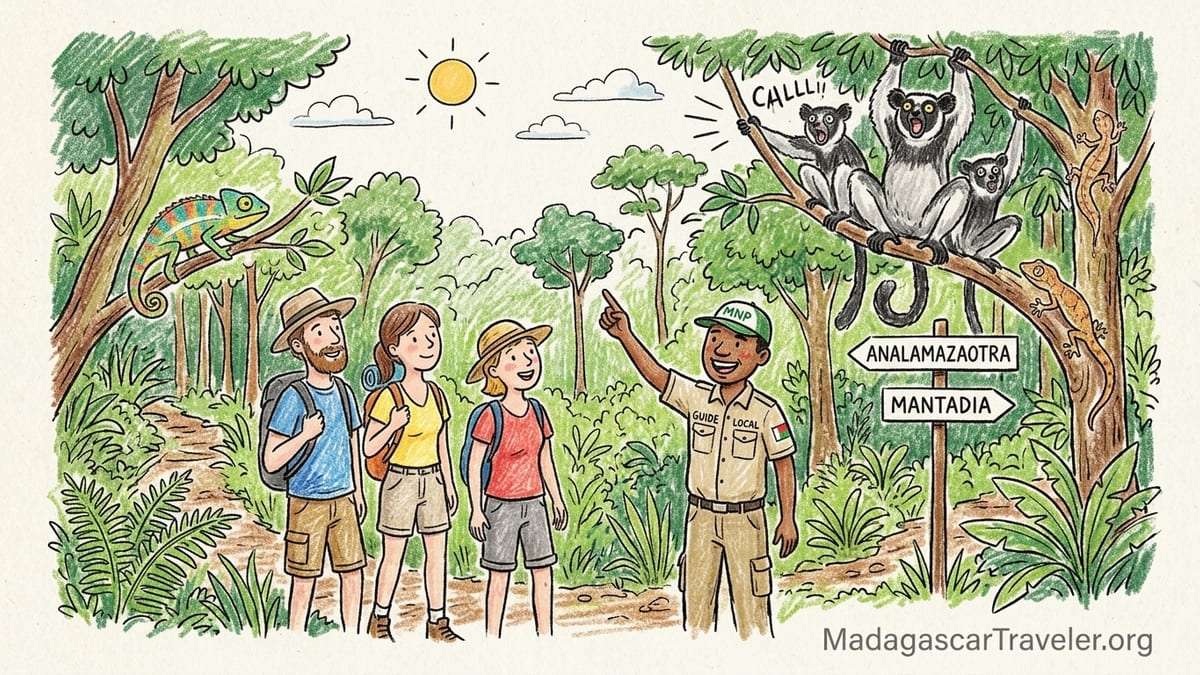
Andasibe and the surrounding Analamazaotra and Mantadia forests are where many travelers get their first real taste of Madagascar’s rainforest. The haunting call of the indri, leaf-tailed geckos flattened against lichen, and chameleons no thicker than a pencil all draw visitors east from Antananarivo. Yet these forests are not places where you simply wander in alone. Madagascar National Parks requires visitors in both Analamazaotra Special Reserve and Mantadia National Park to be accompanied by certified local guides, and recent changes to national park fees confirm that guiding is compulsory here. That leaves a practical question for travelers: beyond what is mandatory, what kind of guide or tour is actually worth paying extra for?
What Guiding Is Mandatory in Andasibe Right Now
As of October 2026, Madagascar National Parks policy confirms that certified local guiding is compulsory at Analamazaotra (often called Andasibe or Perinet) and in Mantadia National Park. This means that whether you arrive with a tour operator, a driver-guide from Antananarivo or completely independently, you cannot enter these core rainforest trails without hiring a local guide at the park entrance. Recent official fee updates list Analamazaotra Mantadia among the parks where entrance fees are separate from guide fees, and where a guide is required for all visitors. In practice, this rule is enforced at the main Analamazaotra gate and at Mantadia’s more remote access point.
Entrance fees themselves are in flux and have changed several times in the past few years, including a new structure introduced in late 2026 that adjusts pricing across major parks such as Andasibe. On the ground, travelers in 2025 and 2026 have commonly reported paying a park entrance fee per person, per day at the gate, then an additional guide fee per group. For Analamazaotra, recent trip reports describe entrance fees in the region of the equivalent of about 10 to 15 euros per person, with local guide fees often falling in the range of 50,000 to 80,000 ariary per half-day for a small group, paid in cash at the office and shared among participants.
At Mantadia, which lies roughly an hour’s drive from the village of Andasibe, costs trend slightly higher. Accessing these trails usually involves arranging a 4x4 vehicle through your lodge or driver, plus a local guide at the park. Visitors in the last year have described full-day Mantadia outings with one local guide and a separate spotter, on top of transport, bringing the total to the equivalent of 50 to 100 euros for a couple, depending on negotiation and exact itinerary. The important point is that neither park will allow you to simply walk in alone, so guide fees are an unavoidable line item that should be built into any Andasibe budget.
Because prices have shifted and are occasionally revised, travelers planning an upcoming visit should treat older blog posts as historical context only. Before departure, confirm current entrance and guide fees directly with your lodge, a trusted tour operator or by contacting Madagascar National Parks information services. On arrival, expect to pay in local currency and to see a clear breakdown of park and guide charges posted at the entrance office.
How Travelers Actually Arrange Guides: Park, Lodge or Tour Operator
On paper, there are three main ways visitors end up with a guide in Andasibe: hiring directly at the park office on arrival, arranging through their lodge, or coming as part of a packaged tour where the operator pre-books local guides. In reality, many trips involve a mix. Independent travelers staying in simple bungalows near the forest, such as the clusters of lodges along the main access road, often walk or drive to the Analamazaotra gate in the morning and hire a guide on the spot. In recent seasons, travelers have reported being paired with an English-speaking guide within 15 to 30 minutes, usually grouped with other visitors unless they explicitly request a private outing and are willing to pay the full guide fee themselves.
Lodges with strong relationships in the community often pre-arrange specific guides for their guests and sometimes line up a favored spotter as well. A number of visitors in 2025 and 2026, staying at mid-range rainforest lodges just outside Andasibe, described simply choosing from a menu of “half-day Analamazaotra walk,” “full-day Mantadia,” or “night walk on community reserve trails.” The lodge then reserved a time slot with particular local guides they trusted. In these cases, guests typically paid entrance and guide fees together through the lodge bill, with costs explained in advance in euros but settled in ariary locally.
Travelers who booked broader Madagascar itineraries through specialized wildlife or photography operators usually met their national guide and driver in Antananarivo, then relied on them to coordinate with Andasibe’s local guides on arrival. Operators running nature-focused trips across several parks routinely state that a national guide, often the same person for the whole trip, accompanies guests throughout, while each park provides a local guide who knows specific territories and animal families. Recent small-group photography tours that spent several days in Andasibe, for example, combined a foreign or Malagasy photographic leader with Malagasy national guides and then added Analamazaotra and Mantadia locals at the trailhead each day for detailed tracking and spotting.
Finally, a growing number of travelers have been contacting Andasibe-area freelance guides directly via word-of-mouth recommendations and social media. These local guides, often based in nearby Moramanga or Andasibe village, arrange transport from Antananarivo, book lodges, and then accompany guests to the community reserves and the national park gates where they still register and sometimes work alongside other certified guides. In these cases, visitors pay a daily guiding fee for the freelance guide, plus the required local guide or spotter fees inside the protected areas, but benefit from having continuity and a single point of contact across multiple days.
What Local Guides Actually Added On The Trail
Accounts from visitors who have used Andasibe guides in the last couple of years are strikingly consistent about what the best local guides contributed. First, their hearing for indri and other lemurs is simply more finely tuned than that of most guests. Several travelers described walking Analamazaotra’s main loop with a local guide who stopped the group long before anyone else sensed anything, then quietly pointed out a faint series of whooping calls carried through the canopy. By triangulating direction and remembering recent territories of particular indri families, the guide then led guests along side paths to a spot where the animals eventually moved overhead, often giving far better views than the first vantage point would have allowed.
Second, local guides proved exceptionally good at spotting cryptic reptiles and amphibians that casual visitors almost always miss. Travelers on both budget day trips and high-end photography tours recounted moments when a guide or park-assigned spotter knelt beside a seemingly blank tangle of branches and revealed a moss-green satanic leaf-tailed gecko flattened against a trunk, or pointed to a stump where a tiny brookesia chameleon clung invisibly to a twig. These finds were not guaranteed on every walk, but repeat visitors noted that on outings without a dedicated guide at the front and a spotter at the back, they saw far fewer of these camouflaged species.
Third, the better guides acted as interpreters of forest ecology rather than simply pathfinders. They explained the difference between secondary forest along the main road and older stands deeper in Mantadia, pointed out parasitic plants and epiphytic orchids, and described how indri family territories shrink or expand with seasonal fruiting of particular trees. Guests on recent guided itineraries also mentioned that local guides often knew individual lemurs by identifying scars or unique facial markings, which helped them predict how animals might behave when other groups approached, and when it was worth waiting quietly rather than moving on.
There are, however, honest reports of more perfunctory guiding as well. A minority of travelers recounted half-day visits in which the assigned guide mainly walked the standard loops, shared only basic information, and relied heavily on other groups’ discoveries, homing in when another guide’s walkie-talkie crackled with news of a roosting chameleon or a newly located indri group. For these visitors, the guide fulfilled the park’s mandatory requirement and ensured they did not get lost, but added less in terms of interpretation or initiative. These mixed experiences are precisely why choosing the right type of guiding and, where possible, a specific person can make a real difference.
Private Versus Shared Guiding: Real Trade-Offs From The Field
The core guide fee that visitors pay at the Andasibe and Mantadia park offices is almost always per guide rather than per person. This means that a solo traveler who wants a private guide might shoulder the full cost of a half-day or full-day outing, while a group of four sharing the same local guide divides that fee between them. Solo and budget-conscious travelers who recently visited Andasibe have used this to their advantage by finding other visitors at their lodge or at the park entrance to share both the cost and the experience. One traveler who had “just wrapped up a fantastic trip around Madagascar” this year reported that they managed to join others at Andasibe, paying only a fraction of the guide’s charge while still seeing key species like indri and various chameleons.
The downside of shared guiding surfaces most clearly for keen photographers and serious wildlife watchers. When a guide is responsible for six or eight people of mixed interests, it becomes harder for them to position everyone well for a backlit indri in the canopy or to linger quietly near a calling bird for the extra ten minutes that might yield a clean shot. Photography groups led by specialist tour operators have responded by either limiting group sizes or offering the option for guests to split off with a private local guide for certain sessions, paying a supplement in exchange for more flexibility and better photographic setups.
Private guiding also seems to make a greater difference on night walks, where smaller group size and silence matter. Independent reports of night outings along the roadside near Analamazaotra and on community-managed trails, using local guides or freelance naturalists, describe how two or three people with a single guide were able to move quietly enough to observe mouse lemurs at close range and watch chameleons sleep on exposed twigs without constant torchlight chatter from multiple beams. In contrast, those who joined larger shared groups of eight to ten people sometimes felt that the noise and competing lights spooked animals or at least reduced the chances of seeing bolder nocturnal behavior.
From a cost perspective, several recent multi-park itineraries that included Andasibe show how private guiding fits into the overall budget. One independent traveler who arranged a largely private 2-week wildlife-focused trip with a national guide and driver reported total guiding and driving costs in the low thousands of US dollars, which covered all transfers between parks and coordination with local guides at each reserve, including Andasibe. By the time this was spread across multiple days and sometimes shared with another traveler, the added daily expense for effectively private guiding within the parks themselves looked less steep and was offset by increased sightings and better use of limited time.
Did Paying More Improve Photography And Sightings?
Photography-focused tours that pass through Andasibe provide some of the clearest evidence about when paying more for guiding delivers better results. Operators running small-group photo expeditions routinely build in both experienced national wildlife guides and local Andasibe specialists, and then emphasize flexible daily schedules. Guests on these trips frequently report that their guides repositioned them repeatedly as indri families moved through the canopy, anticipated the moment when sifakas might cross a more open gap in the trees, and helped locate cleaner backgrounds for portraits of chameleons and day geckos rather than accepting the first cluttered vantage point.
Some tours have also paired photography tuition from a professional photo guide with the field skills of Malagasy trackers. In practice, that means that while the local guide listens for lemurs or scans for reptiles, the photography leader coaches guests on how to make use of the opportunities, from selecting a wider aperture to blur dense foliage to adjusting shutter speed as clouds briefly part and the forest brightens. Travelers who joined these higher-end trips and later shared their experiences often credited the combined guiding team for a step-change in the quality of their images compared to previous independent visits, particularly in low-light rainforest conditions where technical skills and precise positioning matter.
Independent visitors who hired private Andasibe guides for a day or two have described smaller but still meaningful photography benefits. With only one or two guests to consider, guides could adjust pace to match photographic needs, pausing at a vantage point for as long as the light held or doubling back to a known perch when a species of interest called again. One photographer who returned to Analamazaotra after a first visit on a shared tour noted that their second trip, using a dedicated local guide recommended by their lodge and going out alone at first light, produced closer and calmer encounters with indri and allowed time to work through composition rather than rushing.
There are limits to what more guiding can achieve in terms of volume of sightings. Recent first-hand accounts show that even with excellent guides, guests sometimes experienced quieter days when the forest seemed still, lemurs called less, or heavy rain limited movement. Those who paid for private full-day Mantadia outings occasionally returned having seen fewer species than friends who walked Analamazaotra in good weather the day before, simply because animal activity and visibility change from hour to hour. Guides can sharpen your chances and shorten the time to each encounter, but they cannot override seasonality, climatic variation, or the inherent unpredictability that keeps wild encounters authentic.
Weather, Seasons And Other Things Guides Cannot Control
Many disappointed expectations in Andasibe are less about guide quality and more about conditions that no guide can manage. The rainforest on this eastern escarpment is wet for much of the year, and heavy downpours can roll in quickly. Travelers who visited in the wettest months reported that even the most diligent guides struggled to keep guests enthusiastic after several hours of walking in steady rain, and that lemurs often hunkered down under dense cover, remaining almost invisible despite repeated efforts to locate them. In such conditions, photography becomes doubly challenging, with lenses fogging and light levels dropping to the point where hand-held shots of moving animals are difficult.
Season also affects what you will see. Guests who visited Andasibe around the turn of the rainy season spoke of forests that were beautifully green and insect life that was prolific, making it easier for guides to showcase a variety of chameleons, frogs and invertebrates on both day and night walks. Those who came at drier or cooler times sometimes saw fewer reptiles and amphibians but had a slightly easier time with lemur activity during the day and more comfortable hiking. A guide can explain these patterns and tailor which trails you walk on a given day, but they cannot make a species appear if conditions are simply wrong.
Another factor outside a guide’s control is how crowded particular trails become. Andasibe’s popularity with both independent travelers and organized tours means that certain Analamazaotra loops, especially near roadside entrances, can feel busy in peak months. Visitors on shared walks have described scenes where multiple groups converged beneath the same indri family or queuing briefly to photograph a single well-positioned chameleon. Even superb guides can only partially mitigate this by choosing less frequented side trails or going at less popular times of day such as very early morning. Paying for a private guide may allow more flexibility to shift the timing of walks, but it does not guarantee solitude.
Finally, your own energy and mobility set limits on what a guide can offer. Mantadia’s trails, for example, involve more uneven ground and longer walking than the gentler circuits in Analamazaotra. Some guides have softly reported that their guests, after several early starts and long travel days, simply did not feel up to the kind of distance required to reach quieter corners of the forest where shyer species reside. In those moments, guides can adjust the itinerary, but the trade-off is fewer opportunities in less disturbed habitat. Recognizing these human limits is part of deciding when an extended private outing is worth the money and when a shorter shared walk might be more realistic.
Real-World Itineraries: Where Guiding Made Or Broke The Experience
Looking across recent trips that included Andasibe, a pattern emerges in how guiding shapes overall satisfaction. Travelers who slotted Andasibe into a longer, largely self-planned route often treated it as a relatively simple add-on: hire a driver in Antananarivo, spend two or three nights near the park, and pick up local guides at the gate. Many of these visitors came away happy, having heard indri calls, seen at least one or two chameleon species, and joined a single night walk along the roadside or in community reserves. For them, the compulsory guiding in Analamazaotra functioned much like a safety and interpretation service in a national park elsewhere, and they did not feel a need to pay for further customization.
Others, especially those with a sharper wildlife focus, stitched together more guide-heavy itineraries where Andasibe was one link in a chain including Ranomafana, Isalo and other parks. One traveler who combined several reserves over two weeks with a single national guide described how that continuity allowed the guide to learn their specific species interests and adapt Andasibe visits accordingly, prioritizing trails where leaf-tailed geckos had recently been seen or where a particular indri family tolerated quiet observers. In this kind of itinerary, the fee for a national guide and driver is spread across multiple destinations, making the extra outlay for private or semi-private guiding within each park feel proportionate to the value gained.
Travelers on fully inclusive small-group wildlife or photography tours typically paid the highest upfront prices but had the least to worry about once on the ground. These trips, some lasting two to three weeks, bundled accommodation, meals, internal flights, drivers and a suite of guides at each park, with Andasibe often providing the first exposure to Madagascar’s rainforest species. Trip reports from these tours frequently singled out local Andasibe guides by name for their ability to call indri, find rare nocturnal species during sanctioned night walks, and coordinate with photo leaders to manage group positioning. Participants often emphasized that the guiding team was central to making the premium price feel justified.
At the other end of the spectrum, budget-oriented travelers who tried to minimize guide spend sometimes encountered frustrations. A few arrived in Andasibe with only one day to spare, joined the largest and cheapest shared park group available, and left feeling they had done little more than follow a line of visitors along damp trails for a handful of distant lemur glimpses. In retrospect, some of these travelers commented that adding even one extra night and paying slightly more to share a smaller group or choose a recommended guide might have significantly improved their sense of engagement with the forest.
The Takeaway
Guides in Andasibe are not an optional luxury. Within Analamazaotra and Mantadia, they are mandatory, and in the surrounding community reserves and roadside night-walk areas they are, at the very least, a strong safety and conservation recommendation. The question for travelers is not whether to hire a guide at all, but how much to invest beyond the bare minimum. Recent on-the-ground experiences suggest that spending a little extra where it counts can markedly improve both sightings and understanding, especially if you are particularly interested in photography or in seeing more elusive reptiles and amphibians.
Shared guiding arranged at the park entrance or through a lodge works well for visitors whose main goal is to hear indri, walk in the rainforest and gain a general introduction to Madagascar’s wildlife. For those travelers, the per-person cost can be kept moderate by sharing the standard guide fee with others, and a solid local guide will still find key species and explain the basics of forest ecology. Travelers who fall into this category might reserve private guiding only for a single targeted outing, such as a night walk or a dawn session focused on indri calls.
Private guiding, whether through a freelance Andasibe guide, a dedicated national guide accompanying you across Madagascar, or a specialist photography tour, tends to pay off most when you have specific goals or limited time. It can mean shorter delays in organizing groups at the gate, more freedom to choose trails and pace, and better positioning for photography. However, it remains constrained by weather, season, animal behavior and trail crowding. No level of payment guarantees a particular species or a portfolio of perfect images, but good guides consistently tilt the odds in your favor.
As park and guiding fees continue to evolve, the most reliable strategy is to treat older accounts as qualitative guidance on what guides actually add rather than as fixed price lists. Before you travel, confirm current entrance and guide charges with your accommodation or operator, budget realistically for at least one guide-led activity per full day in the area, and be clear with your chosen guide about your interests and fitness. In the forests of Andasibe, the right guide does more than satisfy a regulation. They translate the forest’s sounds and shadows into encounters you might otherwise walk straight past.
FAQ
Q1. Is a local guide really mandatory in Analamazaotra and Mantadia?
Yes. Madagascar National Parks policy currently requires certified local guides for all visitors in Analamazaotra Special Reserve and Mantadia National Park, regardless of whether you arrive independently or with a tour.
Q2. How much should I budget for guide fees in Andasibe?
Recent visitor reports suggest budgeting the rough equivalent of 10 to 15 euros per person per day for park entrance, plus a guide fee per group that can fall in the range of 50,000 to 80,000 ariary for a half-day in Analamazaotra, with somewhat higher costs for Mantadia and full-day outings.
Q3. Is it cheaper to arrange a guide through the park, the lodge or a tour operator?
Hiring directly at the park is usually the simplest and can be cheapest for independent travelers who join a shared group, while arranging via a lodge or operator may cost slightly more but often secures specific trusted guides and bundles in transport and logistics.
Q4. Do I need a private guide to see indri and other lemurs?
No, you do not need a private guide to see indri or the more common lemurs, as shared groups with good local guides regularly encounter them, although private guiding can offer better positioning and more time with particular groups.
Q5. When is paying for a private guide in Andasibe most worthwhile?
Private guiding tends to be most valuable for keen photographers, birders, or travelers with tight schedules, especially for dawn walks, full days in Mantadia and focused night walks with small groups.
Q6. Can guides guarantee sightings of specific species like leaf-tailed geckos?
No guide can guarantee a particular species, but experienced local guides and spotters in Andasibe have far higher success finding cryptic animals such as leaf-tailed geckos and tiny chameleons than unguided visitors would.
Q7. Do guides in Andasibe speak English?
Many certified local guides around Andasibe speak at least basic English, and some are fluent, but language skills vary, so it is worth asking your lodge or operator in advance to book an English-speaking guide if needed.
Q8. Are night walks safe and worth it with a guide?
Guided night walks on designated trails or roadsides around Andasibe are generally safe and often very rewarding, revealing chameleons, frogs and nocturnal lemurs that are rarely seen by day.
Q9. How far in advance should I book a guide in high season?
In busy months it is sensible to ask your lodge or tour operator to reserve guides several weeks ahead, especially if you want a particular person or plan multiple dawn and night outings.
Q10. What should I discuss with my guide before starting a walk?
Before setting out, talk with your guide about your target species, fitness level, interest in photography and how long you want to be out, so they can choose suitable trails and pace the walk to match your priorities.