


Andasibe is the place where Madagascar’s rainforests finally become real. The mist, the vertical walls of greenery, and above all the whale-like cries of the indri at dawn make this one of the island’s most intense wildlife destinations. But as I learned over several visits, not every walk or reserve delivers the same magic. Some short, unassuming outings produced more wildlife than long, muddy hikes. Some much-hyped night walks were strangely quiet, while a simple hour listening to calls from my lodge terrace felt almost overwhelming. This article is organized by experience rather than by park name, and every activity described here is something I personally did, with all the details that matter when you are deciding what to repeat and what to skip next time.
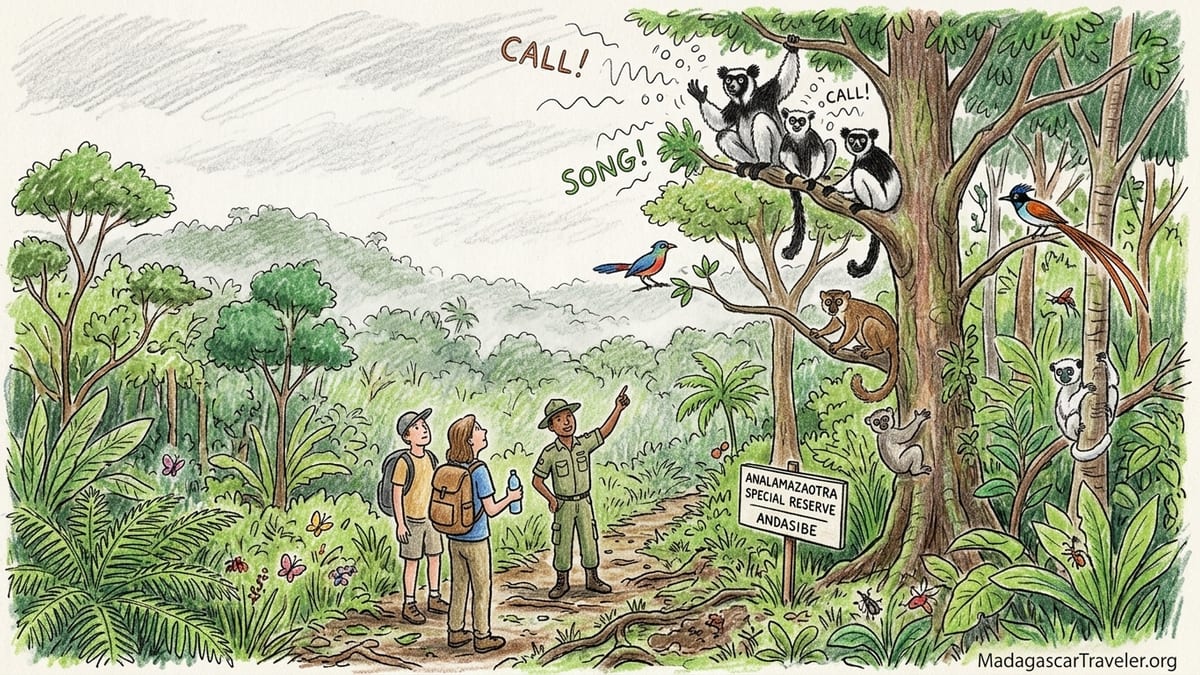
Indri Tracking in Analamazaotra: The Dawn Call That Defines Andasibe
My defining Andasibe experience began in the Analamazaotra Special Reserve, also known as Périnet, just outside the village of Andasibe. I entered the park shortly after it opened at 7:00 a.m., starting from the main entrance near the ticket office. The walk lasted about four hours, finishing close to 11:00 a.m. My guide was a local Analamazaotra guide arranged through my lodge, and our group was just three people, which made it easier to move quietly and adjust pace. The first section followed the wide, compacted main trail that most groups use, then we branched onto the Indri 1 circuit, where the path narrowed, became rooty and occasionally muddy, but never required scrambling. I would rate the physical difficulty as easy to moderate for anyone comfortable walking a few kilometers at a slow, stop-and-start pace.
Conditions that morning were close to ideal. It was the cool, dry season, with overcast skies, temperatures in the high teens Celsius, and a light mist still hanging in the canopy. Within about 20 minutes of leaving the entrance we heard the first indri call drifting through the trees, a rising, almost siren-like song that cut through the forest noise. My guide paused, listened, and then took a side trail, explaining that a habituated group often moved along that ridge in the early morning. Ten minutes later we were standing under our first indri family, three animals including a youngster, about 20 to 25 meters up, calling across to another unseen group deeper in the forest.
On that single morning I saw indri on three separate occasions, each time at slightly different distances and angles. We also observed common brown lemurs, diademed sifaka, red-fronted couas, blue couas and a rainforest endemic Madagascar paradise flycatcher. Several tourists in other groups asked my guide about aye-aye and fossa, which are present in broader eastern Madagascar, but we did not see them here and it would have been misleading to imply that Analamazaotra is a realistic place to tick those particular species on a brief visit. The mammals and birds we genuinely encountered were the ones that defined my sense of the reserve, not a checklist of everything theoretically possible.
From a value perspective, indri tracking in Analamazaotra was absolutely worth it. Park entrance and guide fees change periodically but were in the range of a modest day tour compared with other African wildlife destinations, and the quality of time with the animals was high. We never felt rushed and were often able to wait quietly until other groups moved on, leaving us almost alone with the indri for several minutes at a time. If I had only one morning in Andasibe, I would spend it exactly this way: start on the main trail at 7:00 a.m., use a licensed local guide, and follow the calls rather than a fixed itinerary.
Slow Daytime Rainforest Walks: When a Short Loop Beats a Long Hike
Later that same day, I joined a second daytime walk in Analamazaotra that taught me an important lesson about pacing. This time we started at 14:00, again from the main entrance, with the same guide and a slightly larger group of five. The plan was a gentle two-hour loop along a shorter circuit closer to the entrance. The weather had warmed, the mist burned off, and the light was dappled through the canopy. In theory this should have been a quieter time for lemurs, yet this short afternoon walk produced almost as much wildlife as the longer morning outing, and in some ways offered better viewing.
The trail was mostly flat, with some muddy patches from previous nights’ rain. I would rate the physical difficulty as easy. Because we never strayed far from the main path, we encountered more casual visitors, but that also meant our guide had fresh information from others on where specific groups of animals had been seen an hour earlier. Within 45 minutes we had close views of another indri group, this time lower in the canopy, plus a troupe of common brown lemurs crossing the path at eye level. Bird activity included a Madagascar wagtail near a small stream and several vangas flitting through mid-level branches.
What surprised me most was that the density of sightings on this short loop felt higher than during a far longer hike I did on a previous visit in a more remote section of the park. That long hike had involved several hours of slippery ups and downs, with only brief, distant lemur views to show for the effort. In contrast, this modest afternoon circuit delivered relaxed, extended time with animals and left everyone in the group still energetic enough for an evening activity. It was a reminder that in Andasibe, more distance does not always equal more wildlife, especially if you are moving quickly to “cover ground.”
In terms of value, this shorter daytime walk was unquestionably worth the modest extra guide fee. It required no special fitness, the trail was accessible even to people who are not regular hikers, and the combination of repeated indri encounters and easy photography at lower canopy levels made it an activity I would happily repeat. If you have already done a big morning excursion, a gentle two-hour afternoon loop near the entrance is one of the most efficient ways to add more sightings without exhausting yourself.
Listening to Indri Calls at Dawn from Lodge Grounds
One of the most underrated Andasibe experiences I would repeat without hesitation did not involve entering a reserve at all. On my first morning at a lodge near the forest edge, I woke naturally around 5:15 a.m. to a chorus of distant indri calls. Instead of racing for the park gate, I made coffee and sat on the terrace just outside my bungalow. For the next 45 minutes, from roughly 5:30 to 6:15 a.m., the forest around the valley filled with overlapping indri songs, occasionally joined by the harsher calls of brown lemurs and the first notes of couas and vangas.
The weather that morning was classic highland rainforest: cool, with lingering mist and soft, diffuse light. The lodge gardens were still damp from the night, and low clouds hung just above the treeline. I was not technically “seeing” anything new, yet the sensory impact was enormous. The calls rose, paused, and rose again in waves, echoing off the slopes. I could pick out at least three distinct direction clusters, suggesting several family groups, even though only one animal briefly appeared at the very edge of the forest where the lodge lawn ended.
Because I was alone and stationary, the experience felt very different from hearing indri during a guided walk. There was no need to hurry to another viewpoint or share space with other groups. There were no entrance fees, guide costs, or logistics. It was simply 45 minutes of immersion in sound. For travelers who are not up for multiple hours of hiking, this is perhaps the most accessible “experience” in Andasibe. It requires choosing accommodation genuinely close to intact forest and being willing to wake up before sunrise, but little else.
From a critical perspective, you will not get the close, detailed views of indri that you can find inside Analamazaotra. If your priority is photography or ticking species, you still need to enter the reserve. But in terms of emotional impact, that early morning on the terrace would be in my top three Andasibe moments. I would encourage travelers to plan at least one night where they can simply stay put at dawn and listen, instead of trying to schedule every hour with structured activities.
Nocturnal Forest Walks: When the Night Comes Alive, and When It Does Not
Night walks are now a standard part of almost every Andasibe itinerary, often marketed as essential for seeing mouse lemurs, woolly lemurs, tree frogs and chameleons. I joined two different nocturnal outings on separate visits, both along the public roadside forest strip just outside the main reserves, accompanied by local guides using powerful torches. The most successful night began at about 18:30, shortly after full darkness fell, and lasted around two hours. Our group consisted of four travelers plus the guide, walking slowly along a gently sloping roadside verge and occasionally stepping a few meters into the undergrowth where paths existed. Trail conditions were easy, though footing could be slick after rain.
The weather that night was dry but humid, with a thin layer of cloud that seemed to reflect a little ambient light back into the forest. Within the first half hour, our guide’s torch picked up the eye-shine of a good-sized woolly lemur high in the canopy. A few minutes later we had our first mouse lemur, a tiny, fast-moving animal frozen for an instant in the beam before darting out of sight. Later we saw several tree frogs near roadside puddles, a sleeping chameleon curled on a shrub at waist height, and a large orb-weaving spider whose web spanned the gap between two low branches. Compared with daytime walks, the sense of discovery was sharper, since every new set of eyes seemed to appear suddenly out of the darkness.
On another night, under heavier drizzle and cooler temperatures, the exact same route was almost empty. We set out around 19:00, again for about two hours, but saw only a single distant woolly lemur shape and one chameleon. The rain made it harder to hold torches steady, voices were muffled by hoods, and traffic on the nearby road occasionally broke our concentration. The group was larger, about eight people, which meant more noise and slightly less coordination. It was still atmospheric to be in the forest at night, but in honest terms the wildlife payoff was low compared with the effort and the time that could have been spent resting for an early morning start.
From a value standpoint, I would say a night walk in Andasibe is worth doing once, preferably on your first or second evening, but not worth repeating on every available night unless you are a dedicated herpetology or nocturnal mammal enthusiast. The variability between a productive and a quiet night is significant, and much depends on weather. If conditions are dry, warm and still, with minimal moonlight, your chances improve. If it is raining steadily or unusually cold, I would consider keeping the outing shorter or even saving your energy for dawn in the reserves instead.
Birding and Subtle Wildlife on Longer Mantadia Hikes
For travelers attracted by the idea of deeper primary forest, Mantadia National Park, which is part of the wider Andasibe-Mantadia complex, offers longer, less crowded trails. On my longest Mantadia outing, we left Andasibe village just after 7:30 a.m. by vehicle and reached the park entrance roughly an hour later, traveling along a rougher road that would be slow in heavy rain. The guided hike itself ran from about 8:45 a.m. until 14:30, with a short break for a packed lunch near a small waterfall. Group size was three guests and one guide. Trail conditions varied from wide but rocky paths to narrow, muddy sections with occasional steep, slippery slopes. I would rate the physical difficulty as moderate to challenging for anyone not used to uneven terrain.
The weather during my Mantadia day was mixed: cloudy with a few light showers in the late morning and bursts of brighter light around midday. In terms of large, charismatic mammals, the results were modest compared with Analamazaotra. We saw one group of indri at long distance and glimpsed diademed sifaka moving through the canopy, but never enjoyed the close, relaxed encounters of the previous day. Where Mantadia truly excelled was in bird life and the overall feel of undisturbed forest. With fewer people on the trails, the soundscape was richer in subtle calls. We recorded several rainforest endemics, including ground rollers heard and briefly seen, various vangas, and a Madagascar blue pigeon, as well as leaf-tailed geckos expertly camouflaged on tree trunks.
In hindsight, this long hike delivered a different kind of satisfaction. For a casual wildlife traveler whose main goal is to see lemurs up close, it could feel like a lot of effort for relatively distant views. For those interested in birds, herps and pure forest, the value equation is better. The guide fee for Mantadia was higher than for shorter Analamazaotra circuits and there was the added cost and time of transport from Andasibe village. I do not regret doing it, but if I had only two full days in the area, I would choose one classic Analamazaotra day plus a second flexible mix of shorter walks and a private reserve visit rather than committing to a single long Mantadia trek.
If you are tempted by Mantadia but unsure about fitness, ask specifically which trail your guide plans to use. There are loops of roughly two kilometers that focus on waterfalls and primary forest atmosphere, and others that are longer and steeper. On my visit, the path was slick with mud in several places and required careful foot placement, especially going downhill. Trekking poles and sturdy footwear made a real difference here. Mantadia is where I felt most like I was in an intact, living rainforest system, but it was also the day that left my legs most tired and my wildlife photographs least dramatic.
Chameleons, Reptiles and Lemurs in Private Reserves
Private reserves around Andasibe often draw mixed reactions, but they can play a useful role in a short itinerary. On one visit, I spent a mid-morning at a private forest lodge reserve that included a small “lemur island” accessible by a short canoe ride and a separate area for reptiles such as Nile crocodiles and captive chameleons. The visit began around 10:00 a.m. and lasted about two hours, with a lodge guide and a small group of six guests. Trails inside the forested section were flat and well-maintained, closer to garden paths than wild tracks, and physical difficulty was minimal.
Wildlife here was a mix of semi-habituated and captive animals. On the lemur island we had very close encounters with brown lemurs and bamboo lemurs that were clearly accustomed to human presence. They approached us at close range, sometimes hopping onto nearby branches or handrails. In the reptile area we viewed crocodiles from secure platforms and were shown various chameleons, including colorful panther chameleons, often positioned by the guides for easier photography. None of this replicated the thrill of spotting a truly wild lemur deep in Analamazaotra, but it did provide opportunities to examine details of fur, eyes and hands at distances that would be impossible in a national park.
From a value perspective, I would classify this as a complementary rather than core Andasibe experience. Entrance fees were additional to national park costs but still moderate in absolute terms, especially considering that a visit here can often be combined with a transfer day or used to fill a gap between longer hikes. For families with children or travelers who may not be able to manage long walks, the private reserve provided accessible, low-effort encounters that were still rooted in the region’s natural history. It is important to recognize that many animals in such settings are not fully wild in the same sense as those inside the national parks, however, so they should not be counted as equivalent sightings in a strict wildlife list.
I would repeat a private reserve visit in Andasibe, but I would not substitute it for indri tracking or a guided walk in Analamazaotra. Used strategically, it can round out an itinerary by offering a different style of encounter, especially with reptiles and easily photographed lemurs, but the emotional core of an Andasibe trip still lies in the wilder forest beyond the lodge gardens.
Community and NGO-Managed Forests: A Different Pace and Perspective
Alongside the formal national park, the Andasibe area includes community and NGO-managed forests where local associations oversee conservation and tourism. On one afternoon I visited such a community reserve on the outskirts of the village. We started around 15:00 and walked until just after 17:00, guided by a member of the local association. Our group included four travelers. The trail network was narrower and more rustic than the main Analamazaotra circuits, with some steeper sections and a few small wooden bridges over streams. I would rate physical difficulty as easy to moderate, with occasional short climbs that required attention but no technical skills.
The weather was warm and overcast, with a brief light shower that did not interrupt the walk. Wildlife sightings included common brown lemurs, several chameleons, a leaf-tailed gecko that the guide had clearly learned to locate over many seasons, and a selection of birds similar to those in the adjacent park forests. We did not see indri here, although the guide explained that they were sometimes heard or seen deeper in the reserve. What made this outing distinct was the combination of forest time with conversation about how tourism revenues support local schools and reforestation projects.
In purely wildlife terms, the community forest did not surpass Analamazaotra on this particular day. There were fewer lemur encounters, and viewing distances were often longer. However, the atmosphere was more relaxed, with fewer other groups on the trail, and the chance to see how local guides interpret their home forest added a dimension that felt especially valuable. Entrance and guide fees were modest, and it was clear that a high proportion stayed within the community rather than being absorbed by a larger park administration.
If you have three nights or more in Andasibe, I would recommend including one community or NGO-managed reserve visit in your plan. It may not provide your closest indri sighting, but it can deepen your understanding of how conservation and livelihoods intersect in this part of Madagascar. For me, it was an experience I would repeat, especially if I wanted to balance classic wildlife viewing with a more human-centered perspective on the landscape.
The Takeaway
Looking back across multiple visits, the Andasibe experiences I would most readily repeat are not simply the longest or most physically demanding. A focused morning of indri tracking in Analamazaotra, a short afternoon loop that stays close to the park entrance, a first well-timed night walk under good conditions, a quiet dawn on a forest-side terrace, and a selective visit to a private reserve together create a richer, more nuanced trip than a single marathon hike. Each setting revealed different facets of the ecosystem: national park, community forest, lodge grounds and managed private reserves all contributed something distinct.
Equally important were the trade-offs. My longest Mantadia hike gave me a strong sense of intact primary forest and excellent birding, but delivered fewer close lemur encounters than shorter walks. One night walk was full of life, while another along the same road in drizzle felt almost empty. Private reserves provided easy photography of lemurs and reptiles, yet did not match the emotional impact of meeting indri groups deep in the park. Recognizing these contrasts before you arrive can help you allocate scarce time and energy to the activities most likely to matter to you.
If you are planning your first visit, consider assigning your highest priority to a guided morning in Analamazaotra, ideally starting as soon as the gates open, followed by at least one carefully chosen night walk and one unstructured dawn near the forest. Use private and community reserves to add texture and variety, rather than as substitutes for national park time. And remember that in Andasibe, as in much of Madagascar, patience and flexibility are as important as itineraries. The forest will not deliver the same show every day, but if you give it time from different angles, it rewards you with a layered experience you are likely to remember long after specific species lists fade.
FAQ
Q1. Is indri tracking in Analamazaotra suitable for beginners?
Yes. The main indri circuits use relatively gentle trails with some roots and mud but no technical sections, and guides set a slow pace with frequent stops.
Q2. How many days should I spend in Andasibe to enjoy these experiences?
A minimum of two full days and three nights works well, allowing one main Analamazaotra day, an evening night walk, and time for either Mantadia or a community or private reserve.
Q3. Do I need to book guides in advance for Analamazaotra and Mantadia?
Guides can often be arranged on arrival through your lodge or at the park entrance, but in busy seasons it is wise to have at least your first morning guide reserved.
Q4. Are night walks in Andasibe safe?
Night walks are guided, use established roadside or forest-edge paths, and are generally considered safe, though you should bring a torch, follow instructions and watch your footing.
Q5. What fitness level is required for Mantadia National Park hikes?
Mantadia trails are longer and steeper than Analamazaotra, with mud and uneven ground, so a moderate level of fitness and comfort on rough terrain is recommended.
Q6. Are private reserves in Andasibe worth visiting if I care about wild nature?
Private reserves offer close, often semi-habituated encounters, which are good for photography and accessibility, but they should be seen as additions to, not replacements for, wild park experiences.
Q7. Can I hear indri calls without entering a park?
Yes. Many lodges on the forest edge receive dawn indri choruses, so you can often hear them clearly from terraces, gardens or even your room.
Q8. What is the best season to visit Andasibe for wildlife?
The cooler, drier months tend to offer more comfortable walking and reliable access, while the wetter season brings lusher forest and often more amphibian activity on night walks.
Q9. How much rain should I expect during walks?
Rainfall is frequent but often comes as short showers; carrying a light waterproof layer, protecting electronics and accepting that some mud is inevitable will make walks more enjoyable.
Q10. Is it possible to visit both Analamazaotra and a community reserve in one day?
Yes. Many travelers spend the morning in Analamazaotra and then arrange a shorter community forest visit or village-edge walk in the afternoon to diversify their experience.