


When I first penciled Andasibe into my Madagascar itinerary, every guidebook framed it as a choice between Analamazaotra and Mantadia. On paper they share the same forest block and the same emblematic species, the hauntingly beautiful indri. In reality, they delivered two very different days in the rainforest. I ended up visiting both on the same trip, which means this comparison is based on my own time on the trails, not just a list of species pulled from a brochure. Where I have not personally experienced something, I clearly flag it as researched rather than walked in muddy boots.
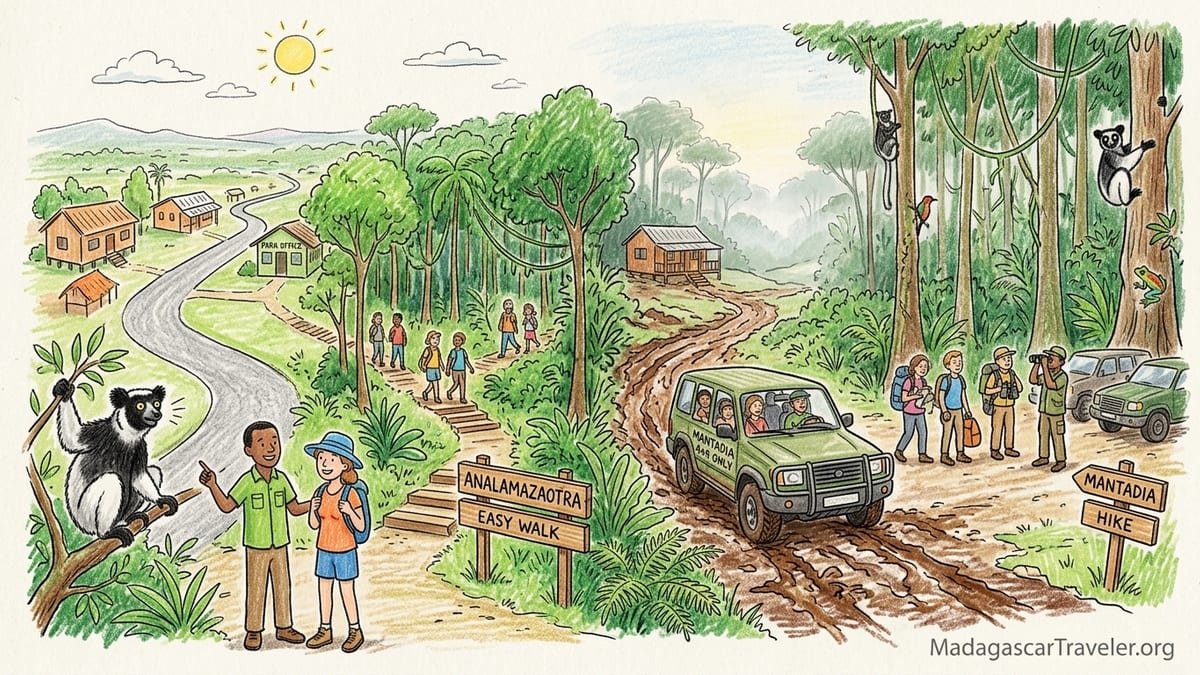
Setting the Scene: Two Forests, One Base in Andasibe
Both Analamazaotra Special Reserve and Mantadia National Park sit under the umbrella of Andasibe–Mantadia, roughly 3 to 4 hours east of Antananarivo by road, depending on traffic and weather. I based myself in a mid-range lodge just outside Andasibe village, as most visitors do, and used that as a jumping-off point for both days. The same entrance ticket covered the complex for the day, but each site required its own logistics and guiding arrangements, which I felt immediately the morning I set out for each forest.
Analamazaotra is essentially Andasibe’s front garden. The reserve presses right up against the RN2 highway and a short side road, with the village, several lodges and simple restaurants scattered within a few minutes’ drive. I walked from my bungalow to the park office in about 20 minutes in the cool early light, passing schoolchildren and market stalls before trading village sounds for indri calls. It felt like a forest you could slip into without a huge production.
Mantadia, by contrast, felt like a small expedition. The park entrance is about 15 kilometers north of Andasibe along a track that most operators describe as off-road, and recent trip reports mention rough conditions with large potholes and mud, especially in the rainy season. Reaching the main trailheads requires a field-capable vehicle, and in my case that meant arranging a 4x4 and driver through my lodge a day in advance, plus an early start to make use of the cooler morning hours in the forest.
From a traveler’s point of view, both forests delivered on their promise of eastern Madagascar rainforest, but the tone of each day was different. Analamazaotra slotted easily into a broader itinerary without changing my sleep schedule or budget much. Mantadia demanded more time, money and energy before I even set foot on the trail, and that shaped how the experience felt from the very first hour.
Getting There: Roads, Start Times and First Impressions
My Analamazaotra day started gently. I met my certified local guide at the Madagascar National Parks office at around 7:30 a.m., after a simple hotel breakfast. The access road from the RN2 was paved and in fair condition, and several independent travelers I met had simply flagged a taxi from the village for the short ride. The trailheads for the main circuits (including the classic Indri 1 and Indri 2 loops) begin a few minutes’ walk from the office, so there was no long transfer after paying fees and organizing a group.
The approach to Mantadia felt more like setting off on safari. I left my lodge at 6:00 a.m. in a 4x4, rattling through Andasibe while the village was still waking up. After we passed the last houses, the paved road gave way to a deeply rutted dirt track that narrowed between rice paddies and patches of secondary forest. Although the distance on the map looked minor, it took close to an hour to reach the park entrance, and in wet weather recent travelers report it can take longer as vehicles navigate mud holes and washouts. This is one of the points where my own visit and researched accounts converge: Mantadia access is slower and more tiring before the hike even begins.
The start times also influenced what I heard and saw. At Analamazaotra, the relatively smooth logistics meant we were on the trail quickly, and within fifteen minutes we stopped to listen to the first calls of indri echoing over the canopy. Other small groups were already fanning out along the same network of paths, so there was a low murmur of voices and radio chatter between guides as they swapped lemur locations. The atmosphere was still very much wild forest, but it carried a sense of shared pilgrimage.
In Mantadia, that pilgrimage felt more solitary. By the time we signed in at the park post and continued by vehicle to the start of one of the main circuits, the day was fully bright and the forest air warmer and heavier. There were two other 4x4s in the parking clearing instead of a small car park full of sedans and minibuses. I sensed immediately that this was a place where you might not see many other hikers once you left the trailhead, especially outside peak holiday periods.
Guides, Fees and On-the-Ground Logistics
In both Analamazaotra and Mantadia, visitors are required in practice to walk with an accredited local guide, and in Analamazaotra this requirement is explicit at the park office. On my Analamazaotra morning, I joined two other travelers to share the guiding cost, which the office staff encouraged to keep things affordable. The official entrance fee for Andasibe–Mantadia has been around 55,000 to 90,000 ariary per person for foreigners in recent years, and the guide fee is structured per group, with shorter circuits costing less than long full-day hikes. Exact amounts are updated periodically by Madagascar National Parks, so they should be confirmed on arrival, but my combined half-day circuit and guide worked out to the equivalent of a simple lunch in the village.
The process was streamlined. We chose a circuit length with the guide at the map board, agreed on the plan in French and basic English, then walked straight out of the office into the forest. Because Analamazaotra receives the bulk of Andasibe’s visitors, the staff were used to handling independent travelers, overland tour groups and day-trippers from Antananarivo all at once, and it never felt chaotic. The mandatory-guide system also meant that even casual visitors who arrived with no prior research ended up with someone who knew how to find indri without trampling vegetation or playing calls from a phone.
Mantadia involved more moving parts. The same park entrance ticket covered both forests for the day, but because Mantadia lies farther from the office, my lodge handled most of the arrangements. We settled on an early departure, a packed lunch, a dedicated guide experienced in both birding and mammals, and a driver happy to spend several idle hours at a trailhead. On top of park and guide fees, I paid separately for the vehicle and fuel, which made this one of the pricier single days of my Madagascar trip. Travelers who join small-group tours often have these costs bundled, but independent visitors should expect Mantadia to require a noticeably higher budget than an Analamazaotra half-day.
That extra cost did buy a slightly different guiding dynamic. In Mantadia, our guide was less focused on quickly locating indri and more inclined to interpret the forest as a whole. We spent time discussing canopy structure and epiphytes, paused at streams to look for frogs, and scanned mid-level branches for more elusive birds. Part of that is personality, and part of it reflects that visitors willing to endure the long, bumpy access are often more serious nature enthusiasts who linger over details rather than ticking species off a list.
Trails, Mud and Physical Effort
Analamazaotra is officially presented as Andasibe’s accessible indri forest, and that description matches my experience. The main circuits I walked followed well-established paths that undulated gently, with the occasional short, steeper section negotiated via earthen steps or simple wooden risers. After overnight rain the ground was noticeably muddy in places, and there were tree roots to step over, but I saw visitors of a wide range of ages, including families with school-age children and older travelers walking carefully with trekking poles.
The most popular loops, like Indri 1 and Indri 2, are a few kilometers long and can be covered in two to four hours at a slow pace with frequent wildlife stops. In practice, that meant I never felt pressed for time, and I could linger when we heard indri calling or found a mixed flock of birds. Footwear did matter: my light hiking shoes were quickly coated in brown mud, and several people in smooth-soled trainers struggled for grip on steeper, damp sections. However, there were enough compacted surfaces and modest gradients that I would still consider Analamazaotra manageable for anyone with average fitness and no major mobility issues.
Mantadia demanded more from my legs and balance. The classic circuits here include easier options of around two hours and more challenging trails of three hours or more with steeper slopes. On the route I walked, our guide warned us at the start that there would be several short but sharp climbs and descents, and that fresh rain could turn certain clay patches into slippery slides. That warning proved accurate. At several points we grabbed roots or trunks for balance while stepping down narrow, leaf-littered paths, and one rocky stream crossing required careful foot placement on wet stones.
In the dry season, Mantadia’s circuits are apparently more forgiving, but even then they involve more elevation change than the main Analamazaotra loops. During or after rain, the effort increases significantly, as mud can cling to boots and make each step heavier. I finished the Mantadia hike pleasantly tired but aware that some travelers would find it taxing, especially in the humid air and with the cumulative time spent standing and scanning trees. If Analamazaotra felt like a focused nature walk, Mantadia felt like a genuine hike layered with wildlife watching.
For those concerned about fitness, it is worth discussing circuit options frankly with your guide before setting out in Mantadia. They can often adjust the route to favor gentler terrain or, for keen hikers, include steeper, longer loops that reach more remote parts of the forest. In Analamazaotra, the flexibility is a bit more limited simply because the area is smaller and the most indri-rich sectors are already along well-trodden paths.
Forest Atmosphere, Density and Crowd Levels
Both forests are biologically connected, but the atmosphere on the ground felt noticeably different. Analamazaotra’s trails pass through lush, mid-altitude rainforest with a dense understory in places, yet there are also clearings, viewpoints and wider paths where light filters down and you can see other groups at a distance. On my morning visit I counted at least half a dozen small parties within the first hour, spaced out but still within earshot when someone located indri or a troupe of common brown lemurs.
This level of visitation had advantages. Guides cooperated closely, using quiet whistles and hand signals to indicate where a certain family group of indri was feeding, or where a rare chameleon had been spotted along a side track. For a first-time visitor, this network meant that the chances of going back to the village without seeing or hearing indri were very low. It also created a subtly social atmosphere, with whispered exchanges between strangers from different countries as we craned our necks together under the same tree. The trade-off was a sense that I was sharing the forest in a managed way rather than discovering it in solitude.
Mantadia, in contrast, felt heavier with vegetation and lighter on people. The canopy seemed taller and the understory more chaotic, with lianas and moss-covered trunks forming a layered wall on either side of narrow paths. The trail we followed quickly left the modest parking area behind, and for most of the morning I did not see another group. Bird calls carried through the forest without being drowned out by footsteps. When we did stop for indri or other lemurs, it was just our small party and the animals, with no queue forming behind us.
This greater sense of isolation was part of Mantadia’s appeal for me. It felt closer to what many travelers imagine when they think of primary rainforest: deep green, slightly intimidating and indifferent to our presence. The silence between wildlife encounters was more profound, and the physical effort of walking the steeper, sometimes muddier path made the occasional open glade or ridge feel like a small reward. For someone who wants to feel immersed and is willing to pay in sweat and logistics, Mantadia provides a distinct forest mood that Analamazaotra, for all its beauty, cannot fully replicate.
However, that same solitude also means fewer eyes searching for animals. Where Analamazaotra benefits from multiple guides constantly scanning and sharing updates, Mantadia offers no such crowd-sourced advantage. When we went twenty or thirty minutes without a sighting, there was no nearby group we could casually intercept to ask what they had seen; our experience depended entirely on our guide’s skill, patience and a measure of luck.
Wildlife Encounters: Indri, Birds, Reptiles and Beyond
If your primary dream is to stand beneath an indri and feel its call reverberate in your chest, Analamazaotra is more than enough. Within the first hour of entering the reserve, my guide led us to a family group that has become habituated to respectful human presence over years of protection. We watched them feed, leap between trunks and groom, often at relatively low heights that made photography with a modest zoom lens perfectly feasible. Their haunting calls, delivered from the upper canopy, were close enough that we could pick out individual voices.
Over the course of that morning in Analamazaotra, we encountered several other lemur species, including groups of diademed sifaka and common brown lemurs, along with a handful of chameleons and frogs along the wetter sections of the trail. Birding was secondary; we paused for bright Malagasy bulbuls and the odd vangas, but the general focus for most groups was on large, charismatic mammals. The density of sightings was such that I never went more than fifteen or twenty minutes without my guide stopping to point out something.
Mantadia offered a different balance. While we did ultimately locate indri there as well, they were higher and more skittish, and the views were less open than in Analamazaotra’s core area. What Mantadia gave me instead was a broader canvas of biodiversity. We spent a long time following diademed sifaka through a stand of tall trees where filtered light created almost theatrical beams around their pale fur. We watched red-bellied and black-and-white ruffed lemurs feeding in distant crowns, needing more patience and binoculars rather than quick snaps.
For birds and reptiles, Mantadia clearly justified the extra effort. Our guide was attuned to calls that I would never have picked out, and we stopped repeatedly for forest ground-rollers, tetrakas and a nervous pair of nuthatch-vangas. Close to streams, we found brilliantly colored mantella frogs and several species of chameleons that blended maddeningly into mossy branches. The number of species seen on paper may not have been dramatically higher than Analamazaotra, but the feeling was of a deeper dive, especially for anyone with a strong interest in birding or herpetology.
It is important to note that wildlife is never guaranteed, and my experience is simply one sample in a forest that changes daily. Some visitors report outstanding indri encounters in Mantadia and quieter days in Analamazaotra, especially at certain times of year or in poor weather. Others see more lemurs around the village and private community forests than inside either core reserve. From my own trip and the accounts I researched while planning, a fair summary is that Analamazaotra stacks the odds in favor of excellent indri viewing with less effort, while Mantadia spreads the reward over a richer but sometimes more subtle diversity of species.
Photography and Overall Visitor Experience
From a photographic point of view, Analamazaotra was kinder. The more open structure near popular indri family territories allowed better angles with fewer branches in the way, and the relatively gentle terrain meant I could focus on framing rather than constantly checking my footing. I shot most of my images with a mid-range zoom, around the equivalent of 70–200 mm, and rarely wished for something longer. Even in cloudy conditions, the filtered light was workable if I raised my ISO and accepted a bit of grain.
The trade-off, unsurprisingly, was the presence of other people in or near the frame. With several groups clustered quietly under the same tree, it took a bit of effort to position myself where I could capture lemurs without a human silhouette in the foreground. That said, most guides managed their groups courteously, and there was a shared understanding that everyone would take turns at the best vantage points. For forest details, macro shots of orchids or close-ups of chameleons, I simply stepped a little off the main knot of observers and worked on the edges.
In Mantadia, the challenge was different. The forest felt darker, the canopy taller and the subjects more distant. A longer lens would have been useful, as many birds and some lemurs kept to mid or upper levels of the vegetation. I frequently found myself shooting at slower shutter speeds or higher ISO than I prefer, simply because so little light reached the forest floor. The steeper, muddier trails also meant I hesitated to change lenses in the field for fear of dropping gear, and a simple slip could have sent my camera swinging into wet leaf litter.
On the other hand, Mantadia rewarded landscape and atmosphere shots that Analamazaotra could not quite match. There were moments when the trail wound along a ridge with steep drops into layers of trees disappearing into mist, and places where massive tree ferns framed a narrow path, giving a sense of scale and depth that felt almost primeval. Because there were fewer people, it was easier to capture empty forest scenes that conveyed the solitude and immensity of the place. For photographers who value mood and habitat as much as close-up animal portraits, Mantadia’s extra effort can translate directly into more evocative images.
Beyond photography, I measured the “visitor experience” in simple human terms: how tired I felt at the end of the day, how much I had spent, and whether the memories felt crowded or spacious in hindsight. Analamazaotra left me energized and satisfied, with time for a late lunch and a relaxed afternoon back at the lodge. Mantadia left me pleasantly exhausted, muddier, and slightly lighter in the wallet, but with a sharper sense of having ventured farther from the beaten path.
Was Mantadia’s Extra Effort Really Worth It?
This is the question I asked myself on the drive back along the rough track from Mantadia to Andasibe, as the 4x4 lurched through another set of ruts and the afternoon humidity clung to my clothes. Did this extra cost, time and physical effort deliver an experience I could not have had by simply adding a second morning in Analamazaotra or exploring one of the community forests near the village instead?
For me personally, the answer was yes, but not because Mantadia replaced Analamazaotra or “beat” it in any universal sense. Analamazaotra gave me exactly what it promised: an accessible, almost guaranteed encounter with indri in a well-managed reserve where conservation and tourism are carefully balanced. If I had left Andasibe after only that visit, I would still have felt that the detour from Antananarivo was worthwhile, and for many travelers with tight schedules or limited mobility, Analamazaotra alone genuinely is enough.
Mantadia added something qualitatively different rather than quantitatively more. It provided a stronger sense of remoteness, a tougher hike that engaged my body as much as my eyes, and a more diffuse but deeper immersion in the forest ecosystem. The bird and reptile sightings, the stretches of trail where we heard nothing but our own footsteps, and the feeling of being a smaller presence in a larger, older forest stayed with me in a way that complemented, rather than overshadowed, my Analamazaotra memories.
If your main goal is to see and hear indri clearly, with a comfortable walk and minimal logistical complexity, I would not say you must push on to Mantadia. Analamazaotra will almost certainly meet that goal, and you can round out the experience with a night walk along the road or a visit to nearby community-managed reserves. If, however, you are a keen hiker, birder or photographer who values solitude and is willing to invest extra money and effort, Mantadia’s extra layer of challenge does translate into a meaningfully different rainforest experience.
In that sense, my recommendation is not to crown a winner but to be honest about what you want from your time in Andasibe. Analamazaotra is the essential, accessible core. Mantadia is the optional but rewarding extension for those who want to push a little further into the green.
The Takeaway
Looking back, I am glad I experienced both Analamazaotra and Mantadia on the same trip, because it allowed me to feel how two neighboring forests can shape a journey differently. Analamazaotra fit neatly into my broader Madagascar route as a manageable, high-reward day that required only modest planning and expense. It delivered unforgettable encounters with indri at relatively close range, offered solid photographic opportunities and proved that accessibility does not have to mean a theme-park atmosphere when guides and visitors respect the rules.
Mantadia, on the other hand, asked more of me in every respect. The early departure, the bumpy 4x4 access, the steeper and muddier trails and the higher overall cost turned it into a small adventure nested within my larger journey. The payoff was a deeper sense of immersion and solitude, richer bird and reptile watching, and a forest mood that felt wilder and more ancient. Those rewards mattered to me personally enough that I would make the effort again, but I recognize that they may not align with everyone’s priorities or constraints.
If you have only one day in Andasibe, I would not hesitate to choose Analamazaotra and do it well, perhaps adding a guided night walk nearby to glimpse nocturnal species. If you have two days or more, decent fitness and a strong interest in natural history, adding Mantadia will likely enrich your understanding of this remarkable corner of Madagascar without making Analamazaotra feel redundant. Ultimately, the “better” experience is the one that matches your expectations, body and budget, and for me, the real magic came from letting both forests speak in their own voices.
FAQ
Q1. Can I visit Analamazaotra and Mantadia in a single day?
It is technically possible but not ideal. Travel to Mantadia alone can take about an hour each way by 4x4 from Andasibe, and each forest deserves at least a half-day to feel unhurried. Most travelers who try to squeeze both into one day end up shortchanging wildlife watching or hiking time. If you only have one day, I recommend focusing on Analamazaotra and perhaps adding a night walk near Andasibe.
Q2. Do I really need a 4x4 to reach Mantadia?
In practice, yes. While the distance from Andasibe is only around 15 kilometers, the road is rough, with deep potholes and muddy sections, especially in the rainy season. Local guides and recent visitors consistently recommend a high-clearance 4x4, and many lodges can arrange one with a driver. Standard taxis or small rental cars risk getting stuck or damaged on this stretch.
Q3. How much should I budget for a day in Analamazaotra versus Mantadia?
Park entrance fees for Andasibe–Mantadia are set per person and apply to both forests for the day, while guide fees are charged per group. As of recent seasons, foreign visitors typically pay the equivalent of several tens of US dollars for entry and a half-day guide in Analamazaotra, especially if costs are shared among three or four people. Mantadia adds the significant extra cost of hiring a 4x4 and driver, which can easily double your daily outlay compared with an Analamazaotra-only visit. Exact figures change, so confirm current rates with your lodge or the park office.
Q4. Which site is better for seeing indri up close?
Analamazaotra generally offers more reliable and closer indri sightings, thanks to habituated family groups that live near well-used trails. Mantadia also has indri, but they tend to be higher in the canopy and spread out over a larger area, which can make encounters briefer or more distant. If your absolute priority is strong indri viewing with minimal effort, Analamazaotra is the safer choice.
Q5. How difficult are the trails for someone with average fitness?
In Analamazaotra, the main circuits involve gentle to moderate gradients, with occasional short steep sections and some mud and roots after rain. Most people with average fitness and no serious mobility issues can manage a two to four hour walk there. Mantadia’s trails include more sustained ascents and descents, slippery clay patches and rocky stream crossings. A basic level of hiking experience, good balance and sturdy footwear make a big difference in Mantadia, and some visitors may find the steeper circuits tiring.
Q6. Are the parks suitable for children or older travelers?
Analamazaotra is generally suitable for families with school-age children and older travelers who are comfortable walking on uneven ground, especially if you choose shorter circuits and go at a relaxed pace. Guides are used to adjusting stops and speed for mixed-age groups. Mantadia can be more demanding due to steeper, muddier trails and the long, bumpy 4x4 approach, so it is better suited to older children and adults who enjoy hiking. If traveling with very young kids or anyone with limited mobility, focusing on Analamazaotra and nearby community forests is usually more enjoyable.
Q7. When is the best time of year to visit for wildlife and trail conditions?
The drier months, roughly from May to October, tend to offer firmer trails and easier access, particularly to Mantadia, where heavy rain can make the 4x4 road challenging and paths quite slippery. Wildlife, including indri, can be seen year-round, but cooler mornings in the dry season often make hiking more comfortable and photography easier due to softer light. In the wetter months, the forest feels lusher and amphibian activity can be higher, but visitors should be prepared for more mud, leeches in some areas and potential delays on the roads.
Q8. Can I visit without arranging anything in advance?
You can usually arrive in Andasibe and arrange an Analamazaotra visit directly at the park office or through your lodge on short notice, especially outside peak holiday periods. Guides are based at the office, and circuits can be chosen on the spot. Mantadia, however, almost always requires advance planning for a 4x4, driver and guide who is available for a full day. While last-minute arrangements are sometimes possible through hotels, you will have more choice of circuits and better control over costs if you organize Mantadia at least a day ahead.
Q9. Is it safe to travel independently to Andasibe from Antananarivo?
Many travelers visit Andasibe independently by hiring a private car and driver or using public transport to Moramanga and then onward to Andasibe. The RN2 is a major, busy road with heavy truck traffic and sections of poor surface, so self-driving can feel stressful, especially in the dark or in bad weather. Using a trusted driver recommended by a lodge or agency reduces this stress significantly. Once in Andasibe, both Analamazaotra and Mantadia are considered safe for visitors when accompanied by accredited guides, provided you follow basic precautions and avoid walking on the highway at night.
Q10. If I can only choose one, which should I visit?
If you have limited time, prefer shorter, easier walks and want very strong odds of close indri encounters, Analamazaotra is the better single choice for most travelers. If you are fit, passionate about birds and reptiles, and eager for a wilder, more solitary forest experience, you might prioritize Mantadia despite the extra cost and effort. In my own case, Analamazaotra delivered the essential indri experience, while Mantadia added depth and adventure rather than replacing it.