


On Madagascar’s southwest coast, most travelers stop at Ifaty or Anakao for a few days of reef-protected lagoon, Vezo fishing boats and sunset cocktails. A smaller group pushes farther north to Salary Bay, a remote white-sand curve beyond the end of the usual tourist road. Reaching Salary takes time, money and a willingness to be cut off. When is the effort worth it, and when are you better off lingering in Ifaty or heading by boat to Anakao instead?
Where Is Salary Bay, And Why Do Travelers Talk About It?
Salary Bay sits on the Mozambique Channel north of Toliara, beyond the better-known beach strip at Ifaty–Mangily and several small Vezo villages. It is part of the same vast lagoon and reef system that protects much of southwest Madagascar’s coastline, but it is significantly more remote. While Ifaty is roughly 25 to 30 kilometers from Toliara by a partly paved, partly sandy road, and Anakao is usually reached by a one-hour speedboat ride from the port, Salary is reached by a long, slow 4x4 track along the coast. In practice, that means fewer lodges, fewer people on the beach and a much stronger feeling of being “at the end of the road.”
Travelers considering Salary are usually those who have already heard of Ifaty’s spiny forest walks and straightforward reef diving, or Anakao’s access to Nosy Ve’s birdlife and surf breaks. They start to ask whether going one step farther, to a bay with almost no outside lights and a tiny cluster of lodges, is worth the extra transfer. Online trip reports and recent tour itineraries often mention Salary in the same breath as Ifaty and Anakao when travelers are choosing a southwest beach extension to finish an RN7 road trip.
In reality, the choice is less about “the best beach” and more about your tolerance for long, hot drives, limited backup if something breaks, and paying a premium for isolation. Understanding what Salary does and does not offer compared with Ifaty and Anakao will help you decide where to end your journey.
The Coastline, Lagoon And Reefs Around Salary
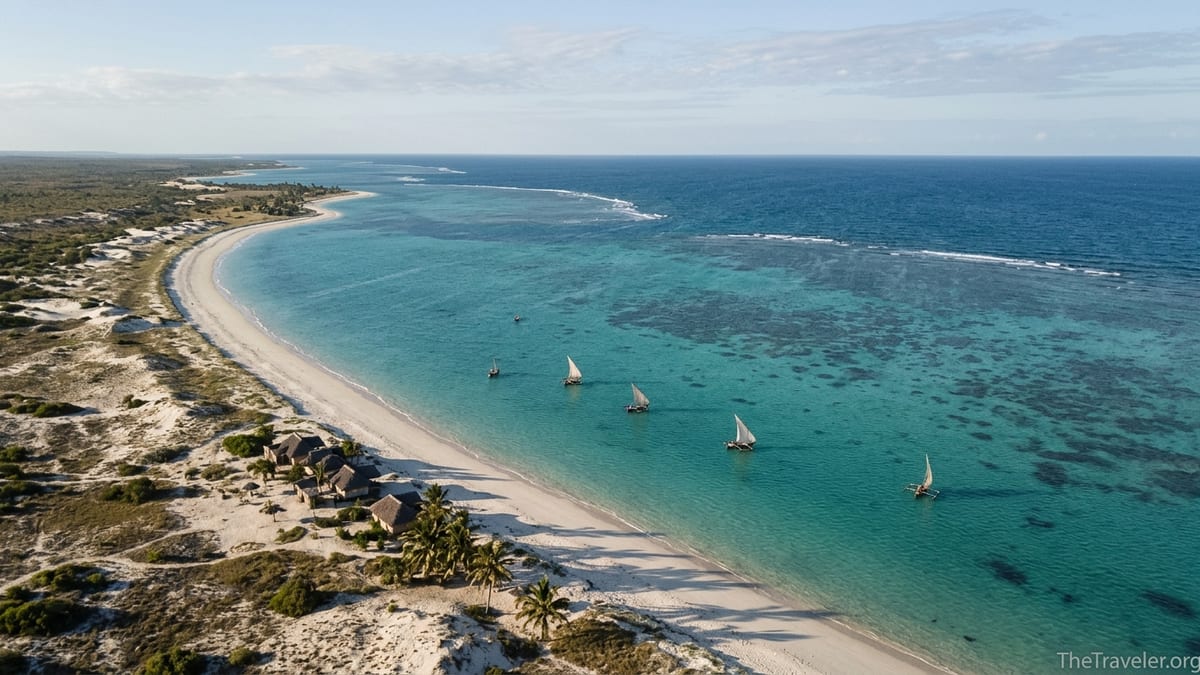
The coastline north of Toliara is a classic southwest Madagascar scene: wide white-sand beaches, low dunes, and an almost continuous reef lying a couple of kilometers offshore. This reef line, part of the same system that shelters Ifaty’s Ranobe Bay, breaks the incoming ocean swell and creates a broad, shallow lagoon ideal for small fishing pirogues and calm-water swimming at high tide. In clear, dry-season conditions, the water around Salary can show the same turquoise and deep blue bands travelers admire at Ifaty and Anakao, but with far fewer buildings and boats in sight.
Salary’s reef and lagoon are still used primarily by Vezo fishing communities who launch wooden outrigger canoes at dawn. For visitors, that means a low-key rhythm compared with more developed Indian Ocean islands. You are more likely to fall asleep to the creak of a pirogue mast than to bar music. The reefs in this part of Madagascar have suffered from warming events and fishing pressure over the years, and you should not expect pristine coral gardens everywhere. Still, local and regional dive operators continue to advertise outings to sites off Ifaty, Salary and Anakao where coral cover and fish life remain good enough to be a highlight of a trip.
The lagoon itself is one of Salary’s simple pleasures. At mid to high tide, many travelers spend hours wading out over warm, sandy shallows or kayaking when available. At low tide, you may walk over seagrass and coral rubble instead of water, with local children searching for octopus and shellfish. If you picture a classic white-sand arc with clear, swimmable water in the right conditions, Salary generally delivers, but do not expect manicured resort beaches or constant service on the sand.
Diving, Snorkeling And Sport Fishing: How Salary Compares
Southwest Madagascar’s main dive and snorkel destinations form a chain: Ifaty to the north of Toliara, Anakao and Nosy Ve to the south, and smaller, more remote spots like Salary and Morombe in between or beyond. Regional dive-focused itineraries explicitly list Salary among interesting south-west sites, alongside Anakao and Ifaty, while noting that some are very remote and best suited to experienced travelers who understand the constraints of working off small operators in isolated communities. In practice, that means you should treat diving at Salary as an add-on run by a lodge or local partner rather than the full-service dive town experience you might find in Nosy Be.
Ifaty is currently the most straightforward option for structured diving. The village of Mangily, just inland from the main beach, hosts established dive centers that offer equipment rental, introductory lagoon dives around 10 to 12 meters and trips to outer-reef sites. Recent descriptions of dives off Ifaty mention butterflyfish, lionfish, morays and abundant macro life on sandy bottoms and coral heads, with surface intervals back at simple beachside bases. That makes Ifaty a good fit if you want reliable access to guided dives with backup gear and instruction.
Anakao, about an hour by speedboat from Toliara, has emerged as a serious alternative, with small lodges and dive bases offering boat dives on reefs and around nearby islets such as Nosy Ve. Operators there promote healthy coral patches, reef fish, sea turtles and occasional dolphins, and many visitors combine diving with surfing or kite sessions when the wind is up. Anakao’s access to the Nosy Ve–Androka marine protected area also adds interest for snorkelers and birdwatchers who want to see both underwater life and red-tailed tropicbirds on the island.
Salary, by contrast, offers a more limited but intimate diving and snorkeling experience. Depending on the lodge and the season, you might find a small on-site dive operation or arrangements with a Toliara or Ifaty-based operator who brings gear and staff for specific guests. Expect fewer dive sites on regular rotation and more dependence on sea conditions and logistics. Snorkeling, however, can usually be arranged more informally, whether by pirogue across the lagoon to a shallow patch reef or straight from the beach at higher tide with your own mask and fins. Sport fishing, particularly trolling outside the reef or hand-line fishing with Vezo fishermen, is one of Salary’s strengths. Lodge staff or village contacts can help organize half-day outings. You are not likely to find glossy sport-fishing fleets, but rather sturdy local boats and simple gear, which is part of the appeal for some travelers.
Accommodation, Food And Planning For Cash In A Remote Bay
Because Salary is small and isolated, you should not expect a wide range of hotels. Typically there are just a handful of lodges and small guesthouses scattered along the beach or low dunes. Most are built from local materials such as thatch, stone and timber, with a mix of simple bungalows and a few more comfortable rooms that might offer solar-powered lights and perhaps limited hot water. Prices fluctuate, but as a working guide expect double rooms at remote coastal lodges in southwest Madagascar to run higher than budget stays in Toliara or on the RN7, reflecting fuel costs, supply runs and generator use.
Food options are also limited and usually tied to your accommodation. Many Salary lodges operate on a half-board or full-board basis, with breakfast and dinner included and a fixed or rotating menu based on what is available. Fresh fish and seafood, rice, seasonal vegetables and zebu beef are common. Travelers who have visited similar outposts on the southwest coast report that menus can feel repetitive over multiple nights, especially if supply boats or vehicles are delayed and fresh produce is scarce. If you have dietary restrictions, it is important to communicate them clearly in advance and to reconfirm on arrival, understanding that alternatives may be basic.
Cash planning is critical. Outside Toliara, ATMs become rare or nonexistent. Ifaty–Mangily still has more infrastructure, but once you leave that strip and head north along the sand tracks, you should not rely on finding a working cash machine or card terminal. The safest approach is to withdraw enough local currency in Toliara to cover accommodation balances, meals, boat or 4x4 excursions, tips and a margin for unexpected costs. Some upper-end lodges may allow card payments when their connections and systems are working, but you should treat this as a backup rather than a guarantee. Bringing crisp foreign currency for emergencies is common, though you will need to ask in advance how and whether your lodge can handle it.
Electricity and connectivity are limited, sometimes restricted to a few hours of generator or solar power in the evening. That affects everything from charging camera batteries to keeping cold drinks truly cold. If you need to work remotely, Salary is generally a poor choice compared with Ifaty or Toliara, where at least some lodges now advertise workable mobile data or Wi-Fi. In Salary, you should assume patchy or nonexistent data coverage and plan your offline maps, books and entertainment before leaving town.
4x4 Access: How Hard Is It To Reach Salary Bay?
Reaching Salary involves considerably more effort than reaching Ifaty or Anakao. From Toliara to Ifaty–Mangily, most travelers either arrange a transfer through their hotel, join a tour vehicle or hire a private car and driver. Even though parts of the access roads are sandy and potholed, the journey is relatively short, usually well under two hours in total, and local drivers make the run daily. Similarly, the standard access to Anakao is a scheduled or chartered speedboat from Toliara’s port, which takes around an hour in normal sea conditions and drops you directly on the beach.
By contrast, Toliara to Salary is described by recent travelers and local operators as a long and sometimes punishing 4x4 journey along sandy, rutted coastal tracks, with portions crossing dry riverbeds and soft dunes. Travel times vary according to road maintenance and weather. In dry-season conditions, it is common to allow most of a day to get from Toliara to Salary, especially if you are stopping in villages along the way or if your vehicle is heavily loaded. This is not a road to attempt in a small car. A high-clearance 4x4 with an experienced local driver who knows the route, tides and security situation is strongly recommended.
Costs reflect that difficulty. While prices change with fuel costs and demand, travelers booking private drivers and 4x4s for remote coastal journeys in Madagascar should be prepared for daily vehicle and driver rates that feel high compared with short city transfers. When you add fuel and any overnight stops for the driver, reaching Salary can easily cost more than multiple days of simple accommodation. Some Salary lodges bundle transfers into their packages or help coordinate shared vehicles among incoming guests on specific dates. It is worth asking in advance, as planning around a lodge-organized transfer day can simplify logistics considerably.
The track itself can be part of the adventure for those who enjoy remote overland travel: passing Vezo villages, baobab-dotted scrub and untouristed stretches of beach. For others, hours of jolting over corrugations in the heat, with limited shade and no roadside services, will simply feel exhausting. Your tolerance for this kind of travel should weigh heavily in your decision about whether Salary fits your trip.
When Is Salary Worth The Effort Compared With Ifaty Or Anakao?
Because of the time and cost involved in reaching Salary, the bay makes sense mainly for travelers who are seeking a specific type of experience. If your priority is easy access to reef dives, a choice of restaurants and the option to adjust plans at the last minute, Ifaty or Anakao will almost always be more practical. Ifaty offers a more “classic” small-beach-town feel, with a strip of simple hotels, dive centers and basic nightlife, as well as nearby spiny forest reserves for morning walks among baobabs. Anakao, for its part, blends a living Vezo fishing village with ocean-focused lodges, surfing and boat trips to Nosy Ve, and can be reached in a single boat transfer without committing to long overland drives.
Salary, by comparison, suits travelers who are comfortable accepting constraints in exchange for seclusion. If you dream of waking up to a beach with almost no other tourists in sight, watching the same handful of pirogues each morning and walking long stretches of sand where your lodge might be the only substantial building, Salary begins to earn its cost. It also appeals to photographers and writers who benefit from the absence of visual clutter and light pollution. At night, the lack of surrounding settlements means the sky can be very dark, and stargazing becomes a simple, nightly ritual.
Another factor is how much of Madagascar you have already seen. Many first-time visitors already feel pressed for time after exploring the RN7 route, rainforests and highlands. For them, adding Ifaty or Anakao as a relatively easy three or four night beach finale makes sense, with predictable transfers back to Toliara for flights. Travelers returning to Madagascar, or those with a special interest in remote coasts, may be more inclined to devote the extra days needed to make Salary worthwhile. If you come primarily for the bay itself, rather than simply to “have some beach time,” you are more likely to leave satisfied.
Security and comfort thresholds also matter. While many travelers report safe and positive experiences along the southwest coast, conditions can change, and remote roads are always more vulnerable to delays or incidents. Traveling with a reputable local operator or guide who tracks current information and arranges drivers and vehicles can mitigate some of that risk. Still, if the thought of being far from medical facilities, mechanical workshops and alternative accommodations makes you anxious, you may prefer the relative convenience of Ifaty or Anakao, where getting help or changing plans is easier.
How Much Time To Allow So The Difficult Transfer Is Worthwhile
The length of stay is one of the most concrete planning decisions where Salary differs from Ifaty and Anakao. Because the journey to Salary usually takes most of a day in each direction, staying for only one or two nights rarely makes sense. You will spend almost as much time in the 4x4 as you do enjoying the beach. For the transfer effort to feel justified, many seasoned travelers and tour designers recommend a minimum of three full days on the ground at Salary, which typically translates to four or five nights. That allows you to recover from the journey, settle into the slower rhythm, and still fit in snorkeling or diving outings and a fishing trip or village visit.
By contrast, Ifaty can work as a two or three night stop slotted onto the end of an itinerary. The short access from Toliara and the availability of activities like reef diving, pirogue outings and spiny forest walks mean that even a brief stay can feel full. Anakao is similar. Because you can often time your boat in and out with your inbound and outbound flights to Toliara, three or four nights there can deliver several dives, a day trip to Nosy Ve and some relaxed hammock time without the sense that you spent half your beach extension in transit.
If your overall trip length is around two weeks and already includes a busy circuit of national parks and towns, adding Salary on top of that may compress your schedule uncomfortably unless you extend your stay. Travelers with three or more weeks in Madagascar are usually better positioned to include a Salary detour without sacrificing too much time elsewhere. In practical terms, you might plan an itinerary where you finish the RN7, spend a night in Toliara to reorganize and draw cash, then travel a full day to Salary, stay four or five nights, and return via another full day back to Toliara before flying out.
Weather timing is also relevant. The dry, cooler months from roughly May to October tend to offer more reliable road and sea conditions in southwest Madagascar. Attempting the track to Salary at the fringes of the rainy season may add hours to the journey and increase the chance of getting bogged down or delayed. If your travel dates are fixed in a shoulder period and you have only a few extra days, it may be wiser to choose Ifaty or Anakao and keep logistics simpler.
Practical Tips For Making The Most Of A Stay At Salary
For travelers who decide that Salary Bay matches their appetite for remoteness, a few practical strategies can improve the experience. First, lock in your accommodation and transfer plans as early as possible, especially in peak dry-season months or around local holidays. Because there are so few lodges, they can fill up quickly with small groups, and coordinating shared 4x4 transfers often depends on knowing who is arriving when. Confirm not just your booking, but the specifics of the vehicle, the anticipated departure and arrival times, and any seasonal variations in the route.
Second, pack for self-sufficiency within reason. While you do not need to carry expedition-level gear, bringing your own well-fitting mask, snorkel and fins is wise if you care about time in the water, as local gear may be limited or worn. A small dry bag, basic first-aid kit, headlamp, spare power bank and sun protection make day-to-day life in a power-limited beach lodge more comfortable. Having a few favorite snacks from Toliara or your previous stop can be a welcome supplement to lodge meals, especially if you are traveling with children or have particular preferences.
Third, adjust your expectations around scheduling. In remote parts of Madagascar, boats may leave when there are enough passengers or when the wind and tide cooperate, and 4x4 departure times can slip if a mechanical issue arises. Build slack into your itinerary. Avoid planning tight same-day connections, such as attempting to drive from Salary to Toliara and board an afternoon domestic flight with only a short margin. Giving yourself an extra night in Toliara before flying out decreases stress considerably.
Finally, remember that one of Salary’s main strengths is the chance to slow down. It is tempting to fill your days with back-to-back snorkel trips and fishing outings, but many visitors find that the most lasting memories are quieter: watching the changing colors of the lagoon, walking the beach at low tide between scattered pirogues, or sitting around a simple lodge table talking with staff about life in Vezo communities. Leaving empty space in your schedule allows these unscripted moments to happen.
FAQ
Q1. Is Salary Bay safe for travelers compared with Ifaty and Anakao?
The southwest coast of Madagascar sees regular tourism, and many visitors report safe trips to Salary, Ifaty and Anakao. However, conditions can change, and remote areas like Salary rely more on local knowledge. Using reputable local operators, avoiding night travel on isolated tracks, and following current advice from your lodge or guide helps reduce risk.
Q2. Do I really need a 4x4 to reach Salary Bay?
Yes, a high-clearance 4x4 with an experienced driver is strongly recommended. The coastal track involves soft sand, ruts and occasional riverbeds that are not suitable for standard cars. Most travelers either book a private 4x4 with a driver or arrange lodge-organized transfers instead of attempting the journey on their own.
Q3. How does the beach at Salary compare with Ifaty and Anakao?
All three offer white-sand beaches protected by offshore reef, but Salary feels more remote and less developed. Ifaty’s beach has more hotels, dive centers and activity vendors, while Anakao’s shoreline combines a fishing village with small lodges. Salary’s beach is quieter, with fewer buildings and boats, suited to those who value solitude over choice of services.
Q4. Is the diving better at Salary than at Ifaty or Anakao?
Diving quality varies by site and conditions rather than by name alone. Ifaty and Anakao have more established dive centers and regular boat departures, which is helpful if diving is a main focus. Salary can offer rewarding dives but with more limited infrastructure and fewer scheduled trips. Many divers choose Ifaty or Anakao for convenience and use Salary more for snorkeling and fishing.
Q5. How many nights should I plan for Salary Bay?
Because reaching Salary usually takes most of a day in each direction, stays of four or five nights make more sense than one or two. That gives you at least three full days to enjoy the lagoon, arrange outings and recover from the journey. Shorter visits often feel rushed and may not justify the time and cost of the 4x4 transfers.
Q6. Can I pay by card at lodges in Salary Bay?
Some higher-end lodges may accept card payments when their systems and connections are working, but you should not rely on it. It is safer to bring enough local currency from Toliara to cover your stay, activities and tips, and to treat card payments as a backup rather than the primary plan.
Q7. When is the best time of year to visit Salary Bay?
The cooler, drier months from roughly May to October generally offer better road and sea conditions, clearer water and more comfortable temperatures on the southwest coast. Shoulder and wet-season months can bring heavier rain, rougher seas and muddier tracks, which makes the 4x4 journey to Salary slower and less predictable.
Q8. Is Salary suitable for families with children?
Salary can work for families who are comfortable with long drives, limited medical facilities and simple infrastructure. The calm lagoon at higher tides can be child-friendly, but there are usually no lifeguards, kids’ clubs or easy access to pharmacies. Families wanting more backup and flexibility often prefer Ifaty or Anakao, where transfers are shorter and services a bit more developed.
Q9. Will I have mobile signal or internet in Salary Bay?
Connectivity in Salary is usually weak to nonexistent. Some lodges may have intermittent mobile coverage or limited Wi-Fi, but travelers should expect to be largely offline. If you need reliable internet for work or communication, Ifaty or Toliara are better choices, with stronger mobile networks and more accommodation options advertising usable connections.
Q10. Should I choose Salary Bay, Ifaty or Anakao for a first trip to Madagascar?
For a first visit with limited time, Ifaty or Anakao are usually more practical choices. Both offer attractive beaches, reef activities and easier transfers. Salary Bay is better suited to travelers who have extra days, are comfortable with remoteness and want a quieter, less developed coastal experience after seeing more accessible parts of the country.