


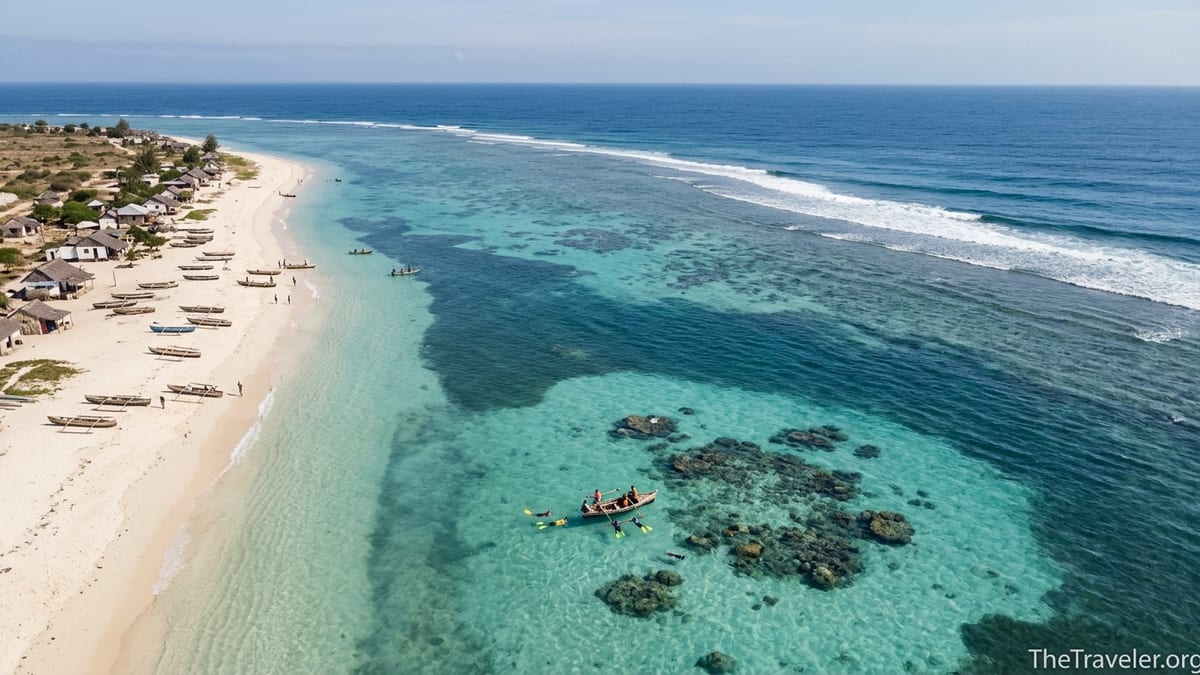
Southwest Madagascar’s coastline is a long ribbon of sand, fishing pirogues and shallow turquoise lagoons protected by one of the world’s largest coral reef systems. For divers and snorkelers, the stretch from Ifaty and the Ranobe Lagoon down to Anakao, Nosy Ve and remote Salary Bay offers a rare mix of calm beginner-friendly shallows, serious reef diving, seasonal whale encounters and barely explored coral heads where you might not see another boat all day. Choosing where to base yourself will shape what you see underwater, how often you get in the water, and how hard it is to get there in the first place.
Understanding the Southwest Reef System
The southwest coast of Madagascar is fringed by the Grand Récif de Toliara, part of what conservation groups describe as the world’s third largest coral reef system, running roughly from north of Morombe past Toliara down towards Androka. In practical terms for visitors, this continuous reef creates a protected lagoon all along Ifaty and the Bay of Ranobe, then again off Anakao, Nosy Ve and Salary Bay. Inside the barrier, shallow seagrass beds and patch reefs make easy snorkeling territory. Outside, passes in the reef open onto drop-offs and more exposed sites that attract pelagic life and offer deeper diving.
Conditions along this coast are strongly shaped by the trade winds. Mornings often bring glassy seas and clear visibility, while afternoons can turn choppy as the wind picks up. Visibility in the dry season (roughly April to November) often ranges around 10 to 20 meters, sometimes more at offshore sites, while the warm rainy months can see more suspended particles and occasional river runoff near Toliara. The dry season also coincides with the passage of humpback whales along the southwest coast between Anakao and Salary, a highlight that can place breaching whales in the background of your dive-boat ride.
Most visitors will first pass through Toliara (also written Tulear), the main gateway town with an airport and basic dive logistics. From there, the coastline splits into two distinct experiences: the more accessible Ifaty/Mangily and Ranobe Lagoon to the north, and the wilder, less developed Anakao, Nosy Ve and Salary Bay to the south. Each cluster has its own character in terms of reef health, shore access, dive-center availability and how busy the water feels.
Ifaty & Mangily: Calm Lagoon Snorkeling and Easy Dives
Ifaty and neighboring Mangily are the classic entry point for marine activities in this region. About a one-hour drive on a sandy piste from Toliara, the villages sit on the inside edge of the Bay of Ranobe. Here the barrier reef lies several kilometers offshore, creating a broad, shallow lagoon with sandy bottom, coral bommies and seagrass beds. Local operators like small PADI resorts in Mangily typically run half-day snorkeling trips by motor pirogue or simple dive skiff to patch reefs with names such as “Rose Garden,” a bommie surrounded by shallow coral gardens where non-swimmers can float in life vests and still watch sergeant majors, parrotfish and anemonefish below.
For divers, Ifaty’s lagoon sites are generally shallow and low-stress, ideal for Open Water courses, refresher dives and relaxed macro photography. Typical profiles are 8 to 18 meters, with sandy channels and coral heads sheltering nudibranchs, scorpionfish, leaf fish and small morays. The more advanced dives happen near the passes in the barrier reef where currents can be stronger and depths increase beyond 20 meters. However, most visitors use Ifaty as a place to log a few easy reef dives rather than to chase big pelagics.
From a snorkeling perspective, Ifaty is one of the best choices in the southwest for beginners and families. The inner lagoon is usually calm in the mornings, entry and exits from the boat are uncomplicated, and you are never far from shallow sand where you can stand if needed. Many small beachfront guesthouses will arrange private boat outings for the equivalent of a modest restaurant meal in the West, especially if you negotiate directly with Vezo fishermen whose wooden canoes double as snorkel taxis. The trade-off is that parts of the lagoon close to shore have suffered from overfishing and coral damage, so you should ask your lodge or dive center to target the healthier patch reefs further out.
Ranobe Lagoon: Official Diving Hotspot with Accessible Reefs
The Bay of Ranobe, of which Ifaty and Mangily form the northern hub, is specifically highlighted in official tourism material as a prime diving area. A long barrier reef, dotted with several natural passes, encloses a semi-protected lagoon where both beginners and experienced divers can find suitable sites. Dive centers based in Mangily typically offer multi-day packages that combine lagoon dives, training and occasional excursions to less visited areas of the bay, such as mangrove-fringed corners at the northern and southern ends.
Underwater, Ranobe’s appeal lies in its variety over short distances. One morning you might drop on a sloping reef at 16 meters with plate corals and clouds of anthias, and the next you could explore a more topographical site with swim-throughs and overhangs at 22 to 25 meters. While this region is not known for high-voltage shark dives, divers commonly report encounters with turtles, schools of fusiliers and jacks, and, in season, the song of distant humpback whales filtering through the water column. Night dives in the lagoon bring out octopus, crabs, shrimps and sleeping parrotfish tucked into the coral.
Ranobe is also logistically straightforward. Once you are in Ifaty or Mangily, daily boat departures are easy to join, and you can schedule two-tank mornings that return to shore for lunch. Gear rental is usually available, though quality and sizing can vary, so experienced divers may prefer to bring their own regulators and computers. Prices for a two-dive boat trip with equipment tend to be substantially lower than in Indian Ocean hotspots like Mauritius or the Maldives, which makes Ranobe attractive for travelers wanting to combine budget overland travel with several days of diving.
Anakao & Nosy Ve: Clearer Water, Wildlife and Offshore Reefs
South of Toliara, Anakao is reached mainly by fast boat, a journey of about one hour that already hints at the area’s wilder character. The village faces a long sand spit and a turquoise channel, with the barrier reef sitting a few kilometers offshore. The climate here is notably dry and stable, with frequent sunshine and months where rain is rare, which in turn supports generally good underwater visibility. Several small hotels and lodges cooperate with resident or visiting dive operations to offer boat dives on outer reef walls and snorkeling trips to nearby islands.
The real star for many visitors is Nosy Ve, a low coral island that sits inside the larger Nosy Ve Androka marine protected area. Reached by pirogue or speedboat from Anakao in around 45 minutes, Nosy Ve offers white sand, nesting seabirds and surrounding reefs that feel distinctly more isolated than those in Ranobe. Snorkelers drift over staghorn coral gardens and sandy patches where blue-spotted rays rest, while divers can explore drop-offs and more current-swept sites along the outer reef. The island lies within a vast protected zone that shelters sea turtles, a rich coral community and, in deeper waters, species like dugong, though sightings of the latter are rare.
Anakao and Nosy Ve come into their own between roughly July and September, when humpback whales arrive from Antarctic waters to breed and calve along the southwest coast. It is common at this time for morning dive boats to divert briefly when spouts are seen nearby, allowing surface observation or, where permitted and managed by trained guides, specialized whale-watching excursions. The combination of high, clear winter light, calm morning seas and breaching whales off the reef makes this stretch particularly appealing to underwater photographers and to travelers who want to combine snorkeling with topside wildlife.
Salary Bay: Remote Frontier for Experienced Divers
Further north of Toliara than Ifaty, but often reached via slow coastal tracks rather than in a straight line, Salary Bay is the choice for travelers who value remoteness over convenience. This small bay has only a handful of accommodation options and sits near relatively untouched sections of the barrier reef. Marketing material from local lodges highlights diving, whale watching and long empty beaches, and there is some truth behind the glossy posters: once you get here, boat traffic is minimal and you may have entire stretches of reef to yourself.
Diving around Salary tends to be more exposed than in the sheltered Ranobe Lagoon. Boat rides can take you through choppy chop if the wind is up, and entries are often from the side of a small launch above deeper water. Depths drop off more quickly outside the reef, and currents at the passes can be significant. This makes Salary better suited to certified divers comfortable with blue-water ascents and changing conditions. On the other hand, the rewards can include healthier coral, schooling fish and a stronger sense of frontier diving where even fairly well-traveled divers feel they are exploring somewhere off the usual circuit.
Getting to Salary is the main barrier. Overland trips from Toliara can take most of a day on rough piste, sometimes requiring a 4x4, patient negotiation with drivers and a flexible attitude to schedules. In the dry season, the journey is dusty but usually passable; in the rainy season, sections can become muddy and slow. Provisioning is limited, and there are no big dive chains, only small, often French- or Malagasy-run outfits with a couple of boats and basic compressors. You would not choose Salary as your first-ever dive holiday, but if you already know you love Indian Ocean reefs and want a more isolated base, it can be very appealing.
Conditions, Seasons and Marine Megafauna
Water temperatures in southwest Madagascar typically range from about 23 to 26 degrees Celsius in the cooler months (June to September) to around 27 to 29 degrees in the warm season. Most divers are comfortable in a 3 to 5 mm wetsuit; snorkelers can often manage with just a rash vest at the height of summer but will appreciate extra insulation during the austral winter. Seas are usually calmer in the mornings, with rising winds after midday, a pattern that heavily shapes the daily rhythm of dives and snorkel trips. It is common for operators in Ifaty, Anakao and Salary to schedule departures around 7:30 or 8:00 am to make the most of flat water.
Visibility varies with locality and season. Enclosed areas of the Ranobe Lagoon can turn a little milky after strong winds or near river mouths, while more ocean-facing sections of the reef off Anakao, Nosy Ve and Salary often hold clearer water, especially in the dry months. After heavy rain, sediment from rivers near Toliara can temporarily reduce clarity in nearshore waters, another reason many divers prefer shoulder-season months like May, June, September and October.
The southwest corridor from Anakao to Salary is recognized as an important breeding area for humpback whales. Their main season in this region generally runs from about July to September, sometimes extending into early October, depending on annual conditions. During these months, it is realistic to combine a week of reef diving with several dedicated whale-watching outings, though operators must follow local guidelines on approach distances and behavior. Other large marine life is more hit-and-miss: turtles are present year-round, occasional dolphins ride bow waves, and in very offshore waters there are records of blue and other large whales passing through, though these are not a routine tourist experience.
Choosing Your Beach Base by Snorkeling and Diving Quality
For travelers whose priority is snorkeling from boats in sheltered water, Ifaty and the wider Bay of Ranobe are still the most practical base. Official tourism materials highlight Ifaty as a flagship snorkeling area, and in practice that translates to an abundance of local pirogues and small motorboats able to shuttle you quickly to shallow patch reefs. Families, beginners and mixed-ability groups can all find something to do here: one person can stay in waist-deep water while another practices duck-dives over deeper coral heads, and non-snorkelers can simply watch Vezo fishermen sail past on dugout outriggers.
If your main goal is varied diving with professional guiding, Ranobe and Anakao offer more balanced options. Ranobe provides an accessible progression from calm lagoon dives to more advanced reef passes, with enough dive centers to find functioning gear and bilingual instructors. Anakao and Nosy Ve, by contrast, trade convenience for atmosphere and wildlife. Here you may have fewer dive shops to choose from, but the combination of offshore reefs, clear winter visibility and frequent whale activity creates a strong sense of place. For intermediate and advanced divers, a split trip that spends three or four days diving from Ifaty followed by another four or five based in Anakao can deliver a good overview of the region’s underwater character.
Salary Bay best suits divers and snorkelers who are already comfortable in small-boat settings and want a remote-feeling base with little else on the agenda. Because getting there is more involved, most visitors stay several nights and structure their days around two-tank morning dives and relaxed afternoons on the beach. The diving is likely to feel more exploratory and conditions more weather-dependent than in Ranobe. For many, this is part of the appeal, but it does mean you should build contingency days into your plan in case wind or swell make the outer reef inaccessible for a morning or two.
Practical Access, Boat Logistics and Dive Centers
Toliara is the hub for reaching all four areas. Regular domestic flights link it with Antananarivo, and from there you either drive north to Ifaty/Mangily and the Ranobe Lagoon or take the fast boat south to Anakao. Taxi-brousse services operate along sections of this coast, but for most short-stay travelers, arranging private transfers via their hotel or a local operator is the more realistic option. Vehicle quality ranges from basic bush taxis to decent 4x4s; in all cases, it is sensible to confirm whether the price includes fuel and to expect dusty conditions.
Dive-center availability is highest in Ranobe and Anakao. In Mangily, small PADI-affiliated resorts and local operators base their boats directly on the beach and can arrange both diving and snorkeling on a day’s notice in high season. Anakao has fewer operators, but lodges often coordinate with them to provide package deals including accommodation, transfers and dives. Nosy Ve is generally visited as a day trip from Anakao rather than as an overnight base in its own right, with boats departing early and returning before the wind peaks in the afternoon.
Salary Bay currently has very limited formal dive infrastructure. Typically, your diving will be arranged directly through the small hotel or campsite where you are staying, which may have its own boat and compressor or work with freelance dive guides. Because of the low density of operators, equipment servicing can be sporadic, and nitrox is unlikely to be available. Serious divers are well advised to bring personal essentials like computers, masks and even regulators, and to confirm in advance how many tanks can realistically be filled each day.
The Takeaway
Southwest Madagascar is not a hyper-developed dive destination with large liveaboard fleets and dozens of international schools, and that is precisely what many visitors like about it. Instead, the region offers a string of coastal communities where life is still shaped by the rhythm of the tides and the work of Vezo fishing families, with diving and snorkeling layered on top as a growing but still relatively low-key activity. Your choice of base will determine whether your days feel like gentle lagoon outings or small expeditions to offshore reefs.
If you are planning your first marine-focused trip to this coast and want a simple, low-stress experience, starting in Ifaty or Mangily around the Ranobe Lagoon makes sense. Those drawn to seasonal whale encounters, wilder scenery and slightly more advanced reef dives will likely gravitate towards Anakao and Nosy Ve. Travelers who already know they love quiet, isolated beaches and are comfortable with bumpy tracks and small-boat logistics may find their ideal base at Salary Bay.
Whichever you choose, the keys to a rewarding visit are to travel in the clearer, drier months, to work with local operators who know the reefs well, and to keep expectations flexible. Conditions in the Mozambique Channel can change quickly, making some days better for snorkeling than diving, or vice versa. With a bit of planning and patience, however, Southwest Madagascar’s combination of big-sky beaches, living coral and the possibility of whale song echoing beneath your dive will likely feel worth the journey.
FAQ
Q1. When is the best time of year to dive and snorkel in southwest Madagascar?
The dry season from about April to November usually offers calmer seas and better visibility, with humpback whales most likely between roughly July and September.
Q2. Which area is best for beginner snorkelers?
Ifaty and the wider Ranobe Lagoon are generally the easiest for beginners, with shallow, protected water, short boat rides to patch reefs and several operators used to hosting first-timers.
Q3. Where should experienced divers base themselves for more advanced reef dives?
Experienced divers tend to favor Anakao with day trips to Nosy Ve, or remote Salary Bay, where outer reef sites can involve more current, depth and less boat traffic.
Q4. Can I see whales while diving or snorkeling?
Humpback whales migrate along this coast in the austral winter. You are most likely to see them from the boat or on dedicated whale-watching trips rather than during an actual dive.
Q5. How difficult is it to reach Salary Bay compared with Ifaty or Anakao?
Ifaty and Mangily are about an hour’s drive from Toliara, and Anakao is usually reached by fast boat in about an hour. Getting to Salary often involves a longer, rough 4x4 track and more time.
Q6. Are there dive centers in all of these locations?
There are established dive operations in Ifaty/Mangily and Anakao. Nosy Ve is usually visited on day trips from Anakao, while Salary Bay has far fewer, more basic dive setups linked to local lodges.
Q7. Do I need my own dive gear, or can I rent locally?
You can usually rent full gear in Ifaty and Anakao, though sizes and brands may be limited. In more remote Salary Bay, it is wise to bring key items like mask, computer and possibly regulators.
Q8. Is shore snorkeling good, or do I need a boat?
Some lagoons offer casual shore snorkeling, but the more vibrant coral gardens in Ranobe, Anakao and around Nosy Ve and Salary are typically reached by small boat or pirogue.
Q9. How does Ranobe compare to Anakao for overall marine life?
Ranobe offers accessible lagoon reefs with plenty of small fish and macro life, while Anakao and Nosy Ve add clearer offshore sites and, in season, a higher chance of whale encounters.
Q10. Is this region suitable for a first dive course?
Yes, particularly around Ifaty and the Ranobe Lagoon, where calm, shallow sites are ideal for training. More advanced open-water dives can then be added around reef passes or from Anakao.