


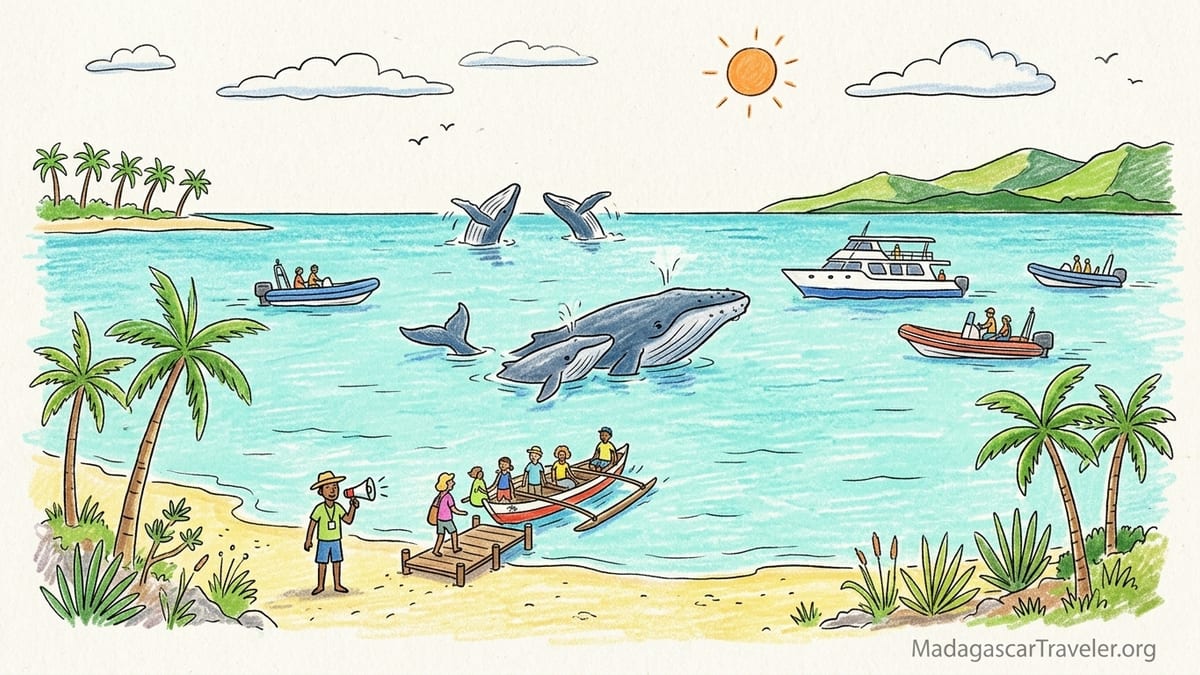
Each austral winter, humpback whales migrate from Antarctica to the warm, shallow channel off Sainte-Marie, a narrow island off Madagascar’s east coast. From late June through September, their blows, breaches and tail slaps turn this quiet island into one of the Indian Ocean’s most reliable and intimate whale watching destinations. This guide explains how the season works, what to expect on three-hour safaris, how hotel-operated trips compare with independent boats, and how to choose responsible operators for a memorable and ethical encounter.
Understanding the Sainte-Marie Whale Season
Sainte-Marie, also called Nosy Boraha, sits just off Madagascar’s northeast coast, separated from the mainland by a relatively protected channel. Humpback whales use this channel as a breeding and calving ground, arriving from the cold Southern Ocean in late June and typically remaining until late September, with some seasons stretching into early October. Most local operators build their schedules around this window, running morning and afternoon departures when sightings are most reliable.
The absolute peak usually falls between mid July and mid August, when mother and calf pairs, competitive male groups and juveniles are all present in the channel. During this period, it is common to see multiple blows at once and to hear the haunting songs of males through the hull of the boat. Outside peak weeks the experience can be quieter, but late June and September often offer calmer seas, fewer boats and more space around each whale.
Weather plays a real role in how your safari feels. Sainte-Marie’s whale season coincides with the cooler, drier months on Madagascar’s east coast. Air temperatures are often in the low to mid twenties Celsius, but the trade winds can pick up, especially in the afternoon, creating choppier seas. Morning outings are usually favored for smoother conditions, clearer light and better visibility of blows on the horizon.
Planning around the season matters. If seeing as many whales as possible is the priority, targeting a week in late July or early August and booking several outings gives you the best odds. If you prefer a quieter island atmosphere and are happy with fewer boats on the water, consider late June or the first half of September, when accommodation prices can be slightly more flexible and the island feels less busy.
What a Three-Hour Whale Safari Actually Looks Like
Most Sainte-Marie whale watching tours follow a similar pattern, with departures lasting around three hours from dock to dock. You typically meet at your hotel beach or a small jetty in the morning between 7:30 and 9:00. After a short safety briefing, the guide explains the day’s conditions, how close the boat is allowed to approach, and what behavior to watch for, such as tail slaps, pectoral fin waves and breaches. Life jackets are handed out to all passengers, and guides often carry a basic first-aid kit and seasickness tablets.
Once underway, the skipper heads toward the central channel between Sainte-Marie and the mainland, scanning for blows and splashes while staying within the responsible approach distances set by Malagasy regulations and local associations. In practice this often means slowing down 300 to 500 meters from a whale group, then letting the animals decide whether to approach the boat. On a good day you may spend the bulk of the tour drifting quietly as whales move, surface and sometimes pass surprisingly close, while the guide interprets their behavior.
Real-world itineraries vary slightly by operator. Some, such as eco lodges on the east coast of Sainte-Marie, combine the outing with basic hydrophone use so guests can listen to male songs underwater when conditions permit. Others may integrate a short coastal cruise around nearby coves or the view of Île aux Nattes at the southern tip of Sainte-Marie on the return leg. Boats used are usually rigid hull inflatables or small covered launches that can carry between 8 and 30 passengers, with hotel-operated boats sometimes being larger and more stable.
At the end of the tour, many guides give a short debrief, explaining any research data they collected, such as fluke identification photographs, and sharing general information about humpback conservation in Madagascar. Some operators partner with local NGOs so that a portion of each ticket supports ongoing research, community projects and education programs on the island.
Comparing Shared Safaris, Hotel Boats and Private Charters
Travelers to Sainte-Marie typically choose between three main formats: shared three-hour safaris run by independent operators, hotel-organized whale trips, and private charters. Shared safaris are the most common. As of 2026, prices for a standard three-hour shared outing are often in the range of 40 to 60 euros per adult, with discounts for children under 12. These trips depart with a minimum number of guests and bring together couples, families and solo travelers on one boat.
Hotel-operated outings are usually sold directly at the reception desks of midrange and upscale properties. On Sainte-Marie, establishments such as beachfront eco lodges and resorts like Princesse Bora or Soanambo typically organize whale trips either with their own boats or through preferred partners. Booking through your hotel adds convenience: charges are posted to your room, logistics are handled for you, and some hotels bundle whale safaris into multi-night packages that include transfers and half board.
Private charters appeal to small groups, photographers, or families who want flexibility. These boats are often the same size as shared safari vessels but reserved solely for your party. Expect pricing broadly in the range of what four to six shared seats would cost, making it cost effective for groups of friends or large families. Private outings allow you to set departure times within safety limits, decide when to linger with a particular group of whales, and request more space on deck for tripods and camera gear.
When choosing between formats, consider your priorities. Budget-conscious travelers often start with one or two shared trips and then upgrade to a private morning if they want more time with the whales. Families with young children may prefer hotel boats that offer shade, onboard toilets and crew familiar with family needs. Dedicated photographers or anyone prone to seasickness often appreciate the ability to choose the calmest part of the day with a private charter and to sit where motion is minimized.
What Makes a Responsible Whale Watching Operator
Sainte-Marie has become a regional leader in responsible whale watching, thanks in part to the work of Cétamada, a Madagascar-based association headquartered on the island. Cétamada helped develop guidelines for approach distances, time spent with each group, and boat behavior, and it trains captains and guides in best practices. When you book, ask whether your operator follows Cétamada or national guidelines and whether the crew has participated in formal training.
Responsible operators limit the number of boats around a single group of whales, avoid cutting across the animals’ path, and keep engine noise to a minimum when nearby. If another boat reaches a group first, your skipper may choose to observe from further away or move on rather than crowd the whales. Some companies rotate between different groups over the course of a tour so that no single mother and calf pair is followed continuously.
Another sign of a responsible safari is the presence of a guide who treats the outing as both a wildlife experience and an educational moment. Guides who can explain why mother and calf pairs are given extra space, or why boats never try to encourage breaches, help guests understand that this is not a show but a natural behavior encounter. Many local operators also work with research projects, contributing photo identification of flukes and dorsal fins, which helps track individual whales across years and regions.
For travelers, the practical implication is simple: prioritize ethics over being the closest boat. Choosing an operator that publicly emphasizes conservation, supports local communities and respects regulations does not generally reduce your chances of good sightings in Sainte-Marie, where whales are numerous in season. It does, however, help ensure that this exceptional migration remains healthy and accessible to future visitors.
Dealing With Seasickness, Safety and Weather Cancellations
The channel off Sainte-Marie can look calm from the beach, but even small swells can trigger seasickness for sensitive travelers. Most three-hour safaris use relatively small boats so you feel each wave. If anyone in your group is prone to motion sickness, choose a morning departure, when winds are typically lighter, and avoid heavy breakfasts or alcohol beforehand. Over-the-counter motion sickness tablets, ginger candies and acupressure wristbands are commonly used, though you should consult your doctor before travel if you have any concerns or take other medications.
Responsible operators make safety a clear priority. Every passenger should have access to a correctly sized life jacket, and children should be fitted with child-specific vests. Before leaving, the crew should briefly explain emergency procedures, the location of life rings and how to move safely around the boat when taking photos. Many operators also limit passenger numbers below the theoretical maximum to keep decks less crowded, which helps both safety and viewing comfort.
Weather is the main reason tours are cancelled or rescheduled. During the season there are days when strong winds, heavy rain or rough seas in the channel make whale watching uncomfortable or unsafe. In such cases, reputable companies either cancel with a full refund or offer to move your safari to another day or time. On a typical one-week stay in peak season, you might encounter one or two days when trips are not recommended.
When planning your itinerary, build flexibility into your schedule rather than counting on a single outing. Arriving with at least three or four potential safari days gives you a buffer for bad weather. Booking your first trip early in your stay leaves time to rebook if conditions are poor, and you may find that a calm, overcast morning with flat seas yields better photographic opportunities than a bright but windy afternoon.
Photography Tips and Traveling With Children
Whale watching from Sainte-Marie is highly photogenic but also unpredictable. Breaches, tail slaps and spyhops happen quickly and can be missed if you are changing lenses or reviewing images on the back of the camera. A practical approach is to bring a versatile zoom lens in the 70–200 mm or 70–300 mm range on a mirrorless or DSLR body, which lets you frame both close passes and distant action without constantly switching gear. Many travelers also carry a wider lens or use their phones for scenics and boat shots.
Light conditions vary from bright equatorial mid-morning glare to softer, hazy starts. A lens with image stabilization and a fast enough shutter speed helps to freeze motion on a moving boat. However, do not underestimate the value of simply putting the camera down and watching. Some of the most memorable moments in Sainte-Marie are acoustic, such as hearing whales exhale just off the bow or listening to songs over a hydrophone, and those cannot be captured fully even with the best equipment.
Families will find Sainte-Marie welcoming, and many boats accept children, but age policies vary. Some independent operators set a minimum age of around five or six years, while hotel boats that are larger and more stable may accept younger children, sometimes requiring that very young kids remain seated on a parent’s lap when the boat is moving. Always check in advance, and be honest about your child’s ability to sit still and follow instructions on an open deck.
Once on board, bring extra layers, hats with chin straps, reef-safe sunscreen and water for everyone. Explain to children that whales may choose not to come close and that shouting or sudden movements are discouraged when the animals surface nearby. Involving them in simple spotting games, such as looking for blows on the horizon, keeps them engaged and builds appreciation for observing wildlife respectfully rather than expecting a performance.
When No Whales Are Found and How to Plan Around It
Although Sainte-Marie is widely regarded as one of the most reliable humpback destinations in the region, sightings are not guaranteed on any particular outing. Early or late in the season, or on days when whales are resting or moving through another part of the channel, it is possible to spend hours searching with only distant blows or none at all. How operators handle this situation varies, so ask about their policy before booking.
Some companies offer a “try again” approach, allowing guests who saw no whales at all to join another shared trip at a reduced rate or, occasionally, at no additional cost when space is available. Others may provide partial refunds or credits toward future outings. Hotel-operated safaris sometimes bundle whale watching into broader activity packages, in which case the value lies in the overall stay rather than in a specific guarantee of sightings.
The most practical strategy is to plan for more than one excursion. Booking two or three outings across your stay significantly increases your chances of memorable encounters and reduces the emotional weight placed on any single trip. Many travelers report that each safari feels different: one day might feature acrobatic juveniles breaching repeatedly in the mid channel; another might offer serene time with a mother resting while her calf surfaces regularly at her side.
Even when whales are elusive, being out on the channel offers rewards. Dolphins are occasionally sighted, along with seabirds and views back to Sainte-Marie’s coconut-fringed coastline and the low green hills of Madagascar’s mainland. Thinking of whale watching as a highlight within a wider Sainte-Marie experience, which can also include snorkeling, quiet beaches and visits to local villages or the old pirate cemetery, helps keep expectations both realistic and relaxed.
The Takeaway
Planning a whale watching trip to Sainte-Marie is largely about timing, operator choice and flexibility. Aim for the main migration window between late June and late September, with July and August offering the highest density of whales. Once your dates are set, decide whether a shared three-hour safari, a hotel-organized outing or a private charter fits your budget and style, bearing in mind that all three formats can deliver excellent encounters if they follow responsible guidelines.
Put ethics at the heart of your decision. Look for operators who reference local regulations, work with conservation groups and emphasize quiet observation over close pursuit. Prepare for the realities of the channel by addressing seasickness, dressing for cool, breezy mornings and leaving room in your schedule for weather-related changes. Above all, remember that you are visiting a nursery and meeting wild animals on their own terms, which is exactly what makes Sainte-Marie’s whale season so special.
FAQ
Q1. When is the best time of year to see whales in Sainte-Marie?
The main humpback whale season runs from late June through September, with peak activity and the highest chance of multiple sightings typically in July and August.
Q2. How long do whale watching tours in Sainte-Marie usually last?
Most standard whale safaris are around three hours from departure to return, which includes time to reach the channel, search for whales and observe them calmly.
Q3. Should I book my whale watching tour in advance or on arrival?
In peak season it is wise to reserve at least your first outing in advance, especially on weekends, then you can add extra tours once you see the forecast and how you feel on the water.
Q4. What is the difference between hotel-organized outings and independent boats?
Hotel-organized trips prioritize convenience and may use larger, more stable boats, while independent operators often offer smaller groups and a more specialized whale watching focus.
Q5. Are children allowed on whale watching trips in Sainte-Marie?
Many operators welcome children, but minimum ages and safety rules differ, so families should confirm policies in advance and choose boats with shade, life jackets and experienced crew.
Q6. What happens if no whales are seen on my tour?
Sightings are not guaranteed; some operators may offer a discounted or complimentary second outing when no whales are seen, while others treat the ticket as nonrefundable, so always ask first.
Q7. How can I tell if an operator follows responsible whale watching practices?
Look for clear mention of local guidelines, trained guides, limits on the number of boats near whales and an emphasis on education and conservation rather than close-up guarantees.
Q8. Will I get seasick on a Sainte-Marie whale safari?
The channel can be choppy, especially in the afternoon, so sensitive travelers should choose morning departures, consider preventative medication and avoid heavy food or alcohol beforehand.
Q9. Do tours run in bad weather or rough seas?
Reputable operators cancel or reschedule outings when conditions are unsafe or uncomfortable, typically offering refunds or new dates, which is why building flexibility into your stay is important.
Q10. What kind of camera gear is best for photographing whales?
A zoom lens around 70–200 mm or 70–300 mm on a DSLR or mirrorless body is a versatile choice, but even a modern smartphone can capture good images when whales surface close to the boat.