


Sainte-Marie, or Nosy Boraha, is one of Madagascar’s most atmospheric islands, a narrow strip of palm-fringed coastline just off the northeast shore where humpback whales gather between roughly July and September. Reaching it, and then stitching it into a wider Madagascar itinerary, can be surprisingly complex, which is why tour operators now sell seven-day Sainte-Marie packages bundling hotels, activities and transport. This guide walks through the main types of packages on offer, what they really include in practice, and when paying extra to have someone else handle the logistics genuinely makes sense.
Understanding Sainte-Marie and the Logistics Challenge
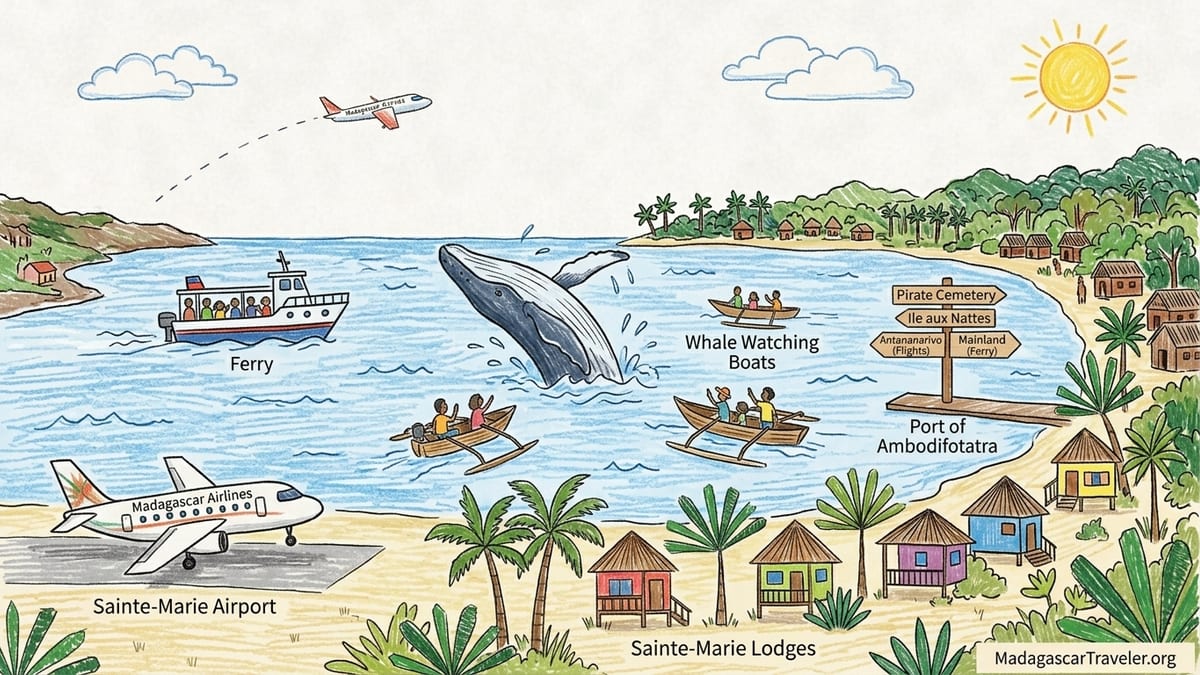
Sainte-Marie lies a short distance off Madagascar’s east coast, facing the small port of Soanierana Ivongo on the mainland. The island itself is relaxed and relatively compact, but getting there involves at least two travel legs from Antananarivo: either a domestic flight to Sainte-Marie Airport or an overland journey to Soanierana Ivongo followed by a boat crossing. Schedules change frequently, sea conditions matter, and flights can be delayed or rerouted, which is why many first-time visitors feel more comfortable booking a package where a local operator manages the moving parts.
In recent seasons, Madagascar’s domestic aviation has been reorganised under Madagascar Airlines, which has taken over the operations of Air Madagascar’s former domestic brand Tsaradia. Typical routings involve an international arrival into Antananarivo, an overnight in the capital, then a morning domestic flight of about one hour to Sainte-Marie. Ferry options run from Soanierana Ivongo to Ambodifotatra on Sainte-Marie, but departures can be affected by swell and strong winds, particularly outside the dry season.
On the island, local infrastructure is modest. Roads can be potholed, power cuts happen, and English is less widely spoken than in some other Indian Ocean destinations. This is part of the charm, especially if you stay in small beach lodges or on tiny Ile aux Nattes at the southern tip, yet it also means that pre-arranged transfers, confirmed whale-watching departures and reliable hotel partners can remove a lot of potential stress. Travel agencies that specialise in Madagascar increasingly bundle these elements into week-long stays, sometimes combined with mainland highlights such as Andasibe rainforest or the Pangalanes Canal.
When to Go: Whale Season and Weather
The main hook for Sainte-Marie vacation packages is whale season. Each southern winter, large numbers of humpback whales migrate from Antarctic waters into the sheltered channel between the island and the mainland. Most recent specialist guides describe the core viewing window as running from around mid-June to late September, with a strong focus on July, August and early September as the most reliable months for encounters. During this period, operators run daily boat trips from bays such as Ambodifotatra and Ampanihy, working under ethical guidelines for approach distances and group sizes.
Within this season, the experience shifts subtly month by month. July and August are often described as peak, with competitive male displays, frequent breaching and plenty of whale-song picked up underwater by snorkellers and divers. By late August and into September many calves have been born, and you are more likely to see mother-and-calf pairs resting or practising short breaches in calmer seas. Some local guides now quietly recommend the first half of September as a sweet spot, when the weather is settled, crowds have thinned a little compared with August and water visibility can be better for those hoping to combine whale trips with diving.
Outside the main whale window, Sainte-Marie still has appeal as a slow island of beaches, fishing villages and cycling paths. April to June and October to November are typically drier and more comfortable than the cyclone-prone months around January and February. Off-season packages tend to be priced lower and focus on snorkeling, pirate-history walks and day trips to Ile aux Nattes rather than whale excursions. If seeing humpbacks is a priority, however, you should aim your package between roughly early July and mid-September and make sure at least one or two boat outings are included or easy to add on arrival.
Flight-Inclusive Sainte-Marie Packages
Flight-inclusive packages are the most straightforward way to visit Sainte-Marie. In this format, a Madagascar-focused operator bundles your domestic flights between Antananarivo and Sainte-Marie with airport transfers, accommodation and at least some activities. For example, a current seven-day Sainte-Marie package sold to European travelers might include return domestic flights on Madagascar Airlines, six nights in a comfortable beach hotel such as Soanambo Hotel & Spa or a mid-range eco-lodge, breakfast and dinner daily, and two half-day whale-watching excursions during August.
Accommodation on these packages typically sits in the mid-range to upper-mid-range bracket. Rooms are usually in solid-built beachfront or garden bungalows with en-suite bathrooms, mosquito nets, fans or air conditioning where power allows, and a small veranda or balcony. At properties like Soanambo or a similar four-star beach lodge, you can expect a pool, direct beach access, a restaurant and bar, and sometimes a spa area. Budget-style guesthouses are usually not paired with domestic-flight packages aimed at international visitors, partly because operators need partners with stable service and capacity.
Meal plans tend to be either half board or full board. A common pattern is half board, with breakfast and dinner included, leaving guests to buy lunch in the hotel or at small local restaurants. Some seven-day whale-season offers promote full board, explicitly including picnic lunches on whale-watching days or simple two-course meals on non-excursion days. Alcoholic drinks and soft drinks are almost always extra. The convenience here is that you do not have to worry about finding a restaurant along often unlit roads at night, and you have a predictable food budget in a context where card payment is not always reliable.
The main advantage of a flight-inclusive package is reduced uncertainty. The operator secures seats on specific domestic flights, arranges any necessary overnight in Antananarivo if schedules do not connect neatly, and coordinates your meet-and-greet at Sainte-Marie Airport. In a country where domestic schedules occasionally change at short notice and online booking tools can be inconsistent, having a local company rebook or reroute you if something shifts can easily justify part of the price premium, especially for families or time-poor travelers.
Land-and-Ferry Packages: Slower Journeys and Savings
Land-and-ferry packages replace the domestic flight with a road-and-boat journey from Antananarivo via Madagascar’s east coast. The usual pattern is a drive of roughly one long day, often broken with an overnight stop, to the coastal town of Soanierana Ivongo, followed by a motorised boat or catamaran across the channel to Ambodifototra on Sainte-Marie. Some itineraries include scenic detours along the Pangalanes Canal or a visit to the port city of Toamasina, combining the journey to the island with lakeside overnights and village visits.
Because road transfers and ferry tickets are generally cheaper than domestic flights, these land-and-ferry packages can undercut flight-inclusive options, particularly for longer stays. For instance, a locally operated ten-day “East Coast and Sainte-Marie” holiday might pair Andasibe rainforest, a two-day Pangalanes boat trip and four nights on Sainte-Marie, all reached by road and ferry, for a price that is competitive with a shorter, flight-based island stay. In such offers, accommodation is usually a mix of mid-range hotels on the mainland and simple but charming bungalows on the island, often right on the beach with thatched roofs and fans rather than full air conditioning.
However, the slower journey has trade-offs. Road conditions on the east coast can deteriorate after heavy rain, and transfers that look like eight hours on paper sometimes take longer. Ferry departures from Soanierana Ivongo may be delayed or cancelled if the swell is too strong. In a package context, operators usually build in buffer time, choose reputable boat companies and arrange private transfers to and from the pier, so you are not left negotiating on the dock. This is where the value of a land-and-ferry package lies: less in luxury, more in having the long, multi-leg trip choreographed by someone who knows the current conditions.
For travelers with a taste for overland adventure and a more flexible schedule, self-arranging the road and ferry is possible and can be cheaper. But if you are combining Sainte-Marie with other remote regions, or you prefer fixed dates and minimal surprises, a land-and-ferry package that includes driver, vehicle, boat tickets and timed hotel check-ins often provides a good balance between cost and reassurance.
Hotel-and-Transfer Packages on Sainte-Marie Itself
Not every Sainte-Marie package includes domestic transport. Many beach lodges and Malagasy destination management companies market “hotel plus transfers” deals that begin once you have reached the island. These packages normally bundle a set number of nights in a particular hotel category with airport or pier transfers, breakfast and dinner, and sometimes a welcome excursion such as a half-day island tour or a boat trip to Ile aux Nattes. Travelers then book their own domestic flights or arrange the mainland journey independently.
This format suits visitors who are comfortable arranging flights but want predictability once they arrive. A typical seven-night “hotel and transfers” package at a mid-range lodge during whale season might include pick-up at the airport, seven nights in a sea-view bungalow on half board and one guided whale-watching excursion, with extra outings bookable on site. Hotels sometimes run promotional offers for shoulder months such as June or late September, where an additional night is included free or a complimentary massage or bike rental is folded into the package.
Accommodation levels in these packages vary. At the higher end, you will find modern, small-scale resorts with pools, landscaped gardens and Wi-Fi in common areas. Mid-range lodges might be more rustic but still comfortable, with hot showers, mosquito nets and fans, while budget-friendly guesthouses could feature simpler furnishings and intermittent hot water. In a package context, operators tend to steer first-time international visitors toward at least mid-range properties, as they have more consistent service and can better handle special dietary requests or early-morning departures.
Compared with assembling each element on your own, hotel-and-transfer packages on Sainte-Marie rarely cost dramatically more than paying per night and arranging taxis separately, especially once you factor in private transfers, fixed meal pricing and the time saved in communication. The main question is how much freedom you want to change hotels or dine out spontaneously. If you prefer the structure of a single base and predictable dinners on site, this type of package offers comfort without the full commitment of a flight-inclusive tour.
Whale-Season Holidays and Included Excursions
Dedicated whale-season holidays ramp up the focus on the marine experience. Tour operators that specialise in wildlife often build seven or eight-day Sainte-Marie stays with two to four whale-watching sorties included, timed for July, August or early September. These outings usually run in the early morning from small harbours, with boats crewed by skippers and naturalist guides who coordinate with local conservation groups to keep approaches responsible. Life jackets, briefings on ethical whale watching and, in some cases, hydrophones to listen to whale-song are provided.
Beyond the whales, most packages include at least one or two land-based excursions. These might be a guided visit to the old pirate cemetery and the colonial-era church, a walk through clove and vanilla plantations in the island’s interior, or a full-day circuit that ends with sunset on Ile aux Nattes. Some operators incorporate snorkeling at nearby coral reefs, village visits or cycling tours along the main coastal track. The level of inclusions varies: higher-priced wildlife-focused packages often feature more excursions built into the core price, while simpler beach-focused stays may leave optional activities to be booked and paid on the ground.
Packages designed specifically around the Whale Festival, usually held in July, tend to have a more festive atmosphere, with cultural shows, music events and conservation talks in addition to boat trips. These weeks can be busier and sometimes pricier, but they also give travelers a sense of how important the whales are to local identity and livelihoods. If you prefer quieter waters and less crowded boats, you might instead target late August or early September, choosing a package with fewer but longer excursions that emphasise respectful observation rather than festival events.
When comparing whale-season packages, it is worth asking precisely what “whale watching included” means. In some offers, this might cover two shared half-day trips in a week, with additional outings available at extra cost. In others, particularly those aimed at photographers or keen naturalists, three or four outings in small groups are standard. Clarifying this detail can change both the value and the rhythm of your week, especially if spotting whales is the main reason you are travelling to Sainte-Marie.
Mainland Madagascar and Sainte-Marie Combinations
For travelers willing to spend 10 to 16 days in Madagascar, combining Sainte-Marie with mainland highlights delivers a more rounded sense of the country. One popular structure is to begin with three nights in Andasibe-Mantadia National Park, east of Antananarivo, to seek out indri lemurs and other rainforest wildlife, then continue by road to the east coast for a two-day journey along the Pangalanes Canal before transferring by road and ferry to Sainte-Marie for three or four nights. Several operators currently promote such “East Coast and Sainte-Marie” circuits, positioning them as a way to link forest, freshwater and ocean in a single holiday.
Another common combination pairs Sainte-Marie with classic southern routes, such as the RN7 road from Antananarivo through the highlands to Isalo National Park and the southwest coast, followed by a flight back to the capital and onwards to Sainte-Marie. These more complex itineraries almost always rely on packaged logistics: a private vehicle and driver-guide for the mainland leg, pre-booked domestic flights, and coordinated handovers between drivers, hotels and domestic airlines. For a visitor unfamiliar with Malagasy roads and local language, having a single operator oversee the chain reduces the risk of missed connections or double-booked rooms.
Accommodation levels in combination packages range widely. On the mainland, you might sleep in simple rainforest lodges or functional city hotels, while on Sainte-Marie the stay often upgrades to a more relaxed beach lodge so the trip ends on a high note. Meal plans are typically half board or bed-and-breakfast on the mainland, shifting to half board or full board on the island. Excursions are also more structured: park walks, canal boat trips and village visits are usually included with local guides, while on Sainte-Marie at least one whale-watching outing is built into the program during season.
Because combination packages involve more moving pieces, their price premium over fully independent travel is more noticeable. Yet this is also where they deliver the most value. Coordinating three or four domestic flights, a sequence of hotel bookings in small towns, and a mix of park permits and boat departures is time-consuming from abroad and harder to troubleshoot if something changes last-minute. For many travelers, especially those on a once-in-a-lifetime visit to Madagascar, paying for a well-designed mainland-and-Sainte-Marie package buys not only convenience but also a higher chance that the journey runs roughly as planned.
Is a Sainte-Marie Package Worth the Premium?
Whether a Sainte-Marie vacation package justifies its added cost depends mostly on your risk tolerance, time budget and comfort with on-the-ground problem solving. Independent travelers with flexible itineraries can still piece together a rewarding visit by booking domestic flights or arranging the road-and-ferry route, choosing lodges directly and negotiating local whale-watching trips. They will generally pay less than a like-for-like package, particularly if they opt for simpler hotels or guesthouses and travel outside the absolute peak of whale season.
However, several factors tilt the scales in favour of packages for many visitors. First, domestic transport in Madagascar remains relatively fragile. Flights can shift times or days, ferry services may be cancelled in heavy seas, and information online is sometimes out of date. When you book through a tour operator that is actively working with local airlines and boat companies, you gain an advocate who can rebook, reroute or adjust your hotel nights if something changes. That support carries particular weight for families, older travelers or anyone with a tight international connection on the way home.
Second, packages simplify the financial side. Paying in advance for accommodation, most meals, transfers and excursions reduces the need to carry large amounts of cash or rely on card terminals that occasionally fail. This is especially relevant on Sainte-Marie, where ATMs and card acceptance are improving but still not as robust as in major cities. Knowing that airport transfers, whale-watching outings and at least breakfast and dinner are covered also helps you predict the real cost of your week rather than guessing at each step.
Finally, well-constructed packages can enhance the overall experience. Local operators know which whale-watching crews follow guidelines, which beach stretches are sheltered in prevailing winds, and which inland walks are worth the time. They can time your stay to overlap the liveliest days of the Whale Festival or, conversely, steer you toward quieter dates. While you pay more upfront, you are effectively outsourcing hours of research and several layers of contingency planning. For many travellers who have long dreamed of watching whales breach off Sainte-Marie, that peace of mind is a sensible investment rather than an unnecessary luxury.
The Takeaway
Sainte-Marie offers a rare mix of accessible whale encounters, gentle beaches and laid-back island life, but reaching it and weaving it into a broader Madagascar journey still requires juggling flights, ferries and rural roads. Today’s seven-day Sainte-Marie packages range from straightforward hotel-and-transfer deals based entirely on the island to more ambitious mainland-and-island combinations that include rainforest walks and canal journeys alongside whale watching. The core variables are accommodation level, meal plan, type of transport and number of included excursions.
If your main goal is to maximise time with humpback whales during the July to September season and you value predictability, a flight-inclusive package with mid-range or upper-mid-range accommodation and at least two whale-watching outings is usually worth the premium. Travelers with a stronger appetite for unscripted adventure, or those visiting in quieter months, may prefer a simpler hotel-plus-transfers package or even a mostly independent stay, using local operators for individual excursions. Either way, approaching Sainte-Marie with a clear sense of the options, and of what each package really includes, will help you match your budget and expectations to the island’s unique rhythm.
FAQ
Q1. When is the best time to book a Sainte-Marie package for whale watching? The most reliable months are usually July, August and early September, when humpback whales gather in the channel and operators run daily excursions.
Q2. Are domestic flights to Sainte-Marie included in most packages? Many week-long packages sold internationally include return domestic flights between Antananarivo and Sainte-Marie, but some hotel-plus-transfer deals start once you arrive on the island, so it is important to check.
Q3. How long should I stay on Sainte-Marie to make a package worthwhile? A seven-night stay is common and typically allows at least two whale-watching outings plus time for the beach and inland excursions, especially if you are travelling far to get there.
Q4. Is full board better than half board on Sainte-Marie? Full board simplifies budgeting and is convenient where dining options are limited, while half board suits travellers who enjoy eating some lunches or occasional dinners in small local restaurants.
Q5. Are ferry crossings from the mainland safe to book independently? Many travellers book the ferry on their own, but services can be weather-dependent and schedules may shift, so using a package or local operator helps with up-to-date information and coordinated transfers.
Q6. Can I combine Sainte-Marie with other parts of Madagascar in one package? Yes, numerous itineraries combine Sainte-Marie with mainland highlights such as Andasibe-Mantadia National Park, the Pangalanes Canal or classic southern routes, all under a single package.
Q7. What level of accommodation do Sainte-Marie packages usually include? Most packages aimed at international visitors use mid-range or upper-mid-range beach lodges or small resorts, with budget guesthouses less commonly featured in pre-packaged offers.
Q8. Are whale-watching excursions always included in whale-season packages? Many whale-season packages include at least one or two outings, but some only facilitate bookings on arrival, so you should confirm how many trips are actually built into the price.
Q9. Is it cheaper to organise everything on my own instead of buying a package? Independent travel can be cheaper, especially with simpler accommodation and flexible dates, but packages add value through coordinated logistics, flight support and pre-booked excursions.
Q10. Do I need travel insurance for a Sainte-Marie package holiday? Travel insurance is strongly recommended, as it can cover medical issues, cancellations or disruptions to flights and ferries that may affect a multi-leg itinerary involving Sainte-Marie.