


Sainte-Marie, or Nosy Boraha, looks compact on the map, but where you choose to sleep can completely change your trip. Distances are longer than they appear, roads are often slow, and evening tuk-tuk rides or boat crossings can turn simple dinners into minor expeditions. On this island, location usually matters more than star rating. This guide breaks down the main areas to stay Ambodifotatra town, the southern Ravoraha and airport strip, Île aux Nattes, the west coast and the more remote lodges to help you match your base to the trip you actually want.
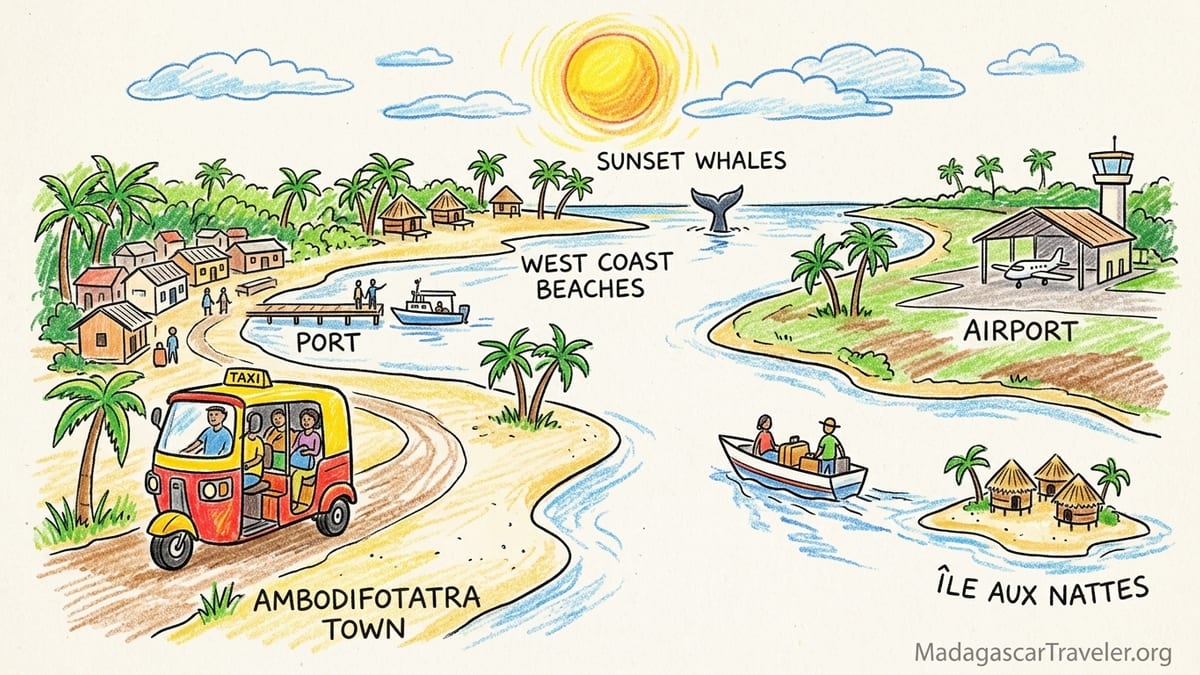
Understanding Sainte-Marie’s Layout and How You Get Around
Sainte-Marie is a narrow island running north to south off Madagascar’s east coast, with most accommodation strung along the leeward west and south-west shores. Ambodifotatra is the main town and port, roughly in the central-west section. The small airport sits near the southern tip, close to Ravoraha village and the channel that separates Sainte-Marie from tiny Île aux Nattes. This geography means you constantly balance beach atmosphere and remoteness against practicalities like boat transfers, restaurants and transport time.
Most visitors arrive either by a short domestic flight from Antananarivo or Toamasina into Sainte-Marie airport, or by boat from the mainland port of Soanierana Ivongo to Ambodifotatra. Flights take roughly one hour and are usually scheduled a few times per week in high season, with one-way fares commonly quoted in the region of 80 to 150 US dollars depending on date and availability. The boat crossing is cheaper but slower, and sea conditions on the east coast can be rough, especially outside the calmer season.
On the island itself, you will rely on tuk-tuks, motorbike taxis and hired 4x4s. The paved main road links Ambodifotatra with the airport and continues north, but potholes and occasional flooding can turn a 15 kilometre drive into a 45 minute journey. From the airport to Ambodifotatra, expect a tuk-tuk or car transfer of about 20 to 30 minutes, which many hotels such as Mantis Soanambo Hotel and Idylle Beach can arrange door to door. From Ambodifotatra up to more remote northern or eastern lodges, transfer times can stretch to an hour or more.
Boat transfers add another layer. To reach Île aux Nattes, you typically take a short tuk-tuk ride to a simple beach landing south of the airport, then board a local wooden boat for 10 to 20 minutes across the channel. Many guesthouses on Île aux Nattes, such as Sambatra Beach Lodge or La Maison Blanche, coordinate with boatmen and will quote a package price for the crossing plus luggage handling. In bad weather, crossings may be delayed or briefly suspended, which is important to factor in if you have a morning flight out.
Ambodifotatra Town: Best for Convenience, Restaurants and Port Access
Ambodifotatra is the obvious base if you want maximum convenience. It is where the island’s main port is located, and the town concentrates practical services like banks, basic pharmacies, grocery shops and local tour agencies such as Sainte Marie Travel. For short stays of two or three nights, or for travellers who want to be able to walk to dinner and shops, this is usually the most efficient place to stay.
Accommodation in or near town ranges from simple guesthouses to mid-range hotels and serviced apartments. For example, L’Héritage Hotel sits close to the waterfront and is often recommended for its on-site restaurant and easy access to tuk-tuks. La Colombine Appart’Hôtel offers apartment-style units on a hill above Ambodifotatra, with kitchenettes and space for longer stays, popular with digital nomads or families who like self-catering. At the seafront, Idylle Beach combines a small hotel, beach bar and restaurant right by the town centre, so you can step straight from a sunset cocktail onto the sand and still be a short stroll from other eateries.
Most of the island’s independent restaurants are clustered in and around Ambodifotatra. You will find simple Malagasy hotelys that serve plates of rice with fish or zebu for a few dollars, small pizzerias, and more polished spots with seafood grills and cocktails. Prices are moderate by international standards, with a fresh grilled fish main often in the range of 5 to 10 US dollars and a beer around 2 to 3 dollars. Choosing a base here means you can sample a different place each night without needing to pre-book a car.
From Ambodifotatra you can organise day trips all over the island: whale watching outings in season, excursions to the historic pirate cemetery, or motorbike rides up the coast. Tour operators and boatmen often pick up guests right at the town jetty. If your time on Sainte-Marie is limited, staying in town cuts down on transit and reduces the risk of missing a mainland boat or domestic flight due to road issues further along the island.
Ravoraha and the Southern Airport Strip: Easy Beaches and Île aux Nattes Access
About 8 to 10 kilometres south of Ambodifotatra lies Ravoraha and the strip of coastline around the airport. This area appeals to travellers who want a beach stay without giving up too much connectivity. You are close to the airport for early flights, a short tuk-tuk ride from the Île aux Nattes boat crossing, and still only about 20 to 30 minutes from town for dinners or errands.
Here you find a cluster of small to mid-size hotels and ecolodges set along a sandy beach that is usually calmer than the wind-exposed east coast. Ecolodge Le Ravoraha markets itself as the first hotel south-west of the airport and emphasises a low-key, seaside feel with bungalows under coconut palms. Mantis Soanambo Hotel and Spa, a more upscale property a little further north along the same coast, offers modern rooms, a pool, a spa and organised activities while remaining within relatively easy reach of Ambodifotatra by car.
This southern strip works particularly well if you plan to spend several days on Île aux Nattes but want to overnight near the airport at the beginning or end of your trip. Some travellers, for instance, will arrive on a late afternoon flight, stay at a place such as Le Ravoraha or Soanambo where airport transfers are straightforward, then move across to Île aux Nattes the next morning after breakfast. Others base entirely here and visit Île aux Nattes on day trips by boat, returning to the relative bustle and more reliable electricity supply of the main island at night.
In terms of eating out, most hotels and ecolodges along this stretch run their own restaurants, usually focused on fresh seafood, Malagasy staples and a few international dishes. Menus change with the catch, but you might expect langoustines grilled with garlic, coconut curries, and simple pasta dishes. Because you are outside town, you will likely dine where you sleep most nights. A tuk-tuk ride into Ambodifotatra for dinner is certainly possible and not particularly expensive in absolute terms, but road conditions, darkness and tropical showers can make it feel more effort than it appears on the map.
Île aux Nattes: Lagoon Beaches and Slow Island Life
Île aux Nattes, also known as Nosy Nato, is a tiny island just off Sainte-Marie’s southern tip, circled by shallow turquoise waters and a ring of sand. Many travellers consider it the most beautiful part of the region, with views over the lagoon, walking paths across the interior and a near-total absence of cars. If your priority is a classic tropical escape rather than quick access to urban amenities, it is hard to beat.
Accommodation here is mostly in small beachfront guesthouses and ecolodges. Places such as Sambatra Beach Lodge or La Maison Blanche typically offer a handful of bungalows or rooms right by the sand, simple but atmospheric restaurants, and hammocks facing the reef. Electricity may be limited to certain hours, usually powered by a mix of solar panels and generators, and Wi-Fi can be patchy. Night skies are dark and starry, and you fall asleep to surf on the outer reef rather than traffic noises.
Reaching Île aux Nattes adds a small layer of logistics. From the airport or a hotel in Ravoraha, you take a tuk-tuk to the southern landing point where local boatmen run small wooden boats across the passage. The crossing itself is short, roughly 10 to 20 minutes, but schedules are informal. Many accommodations bundle the transfer into their nightly rate or offer a fixed charge per person, which might be equivalent to just a few dollars. You will step ashore directly onto the beach, sometimes paddling the last few metres if the tide is low, so waterproof bags for electronics are a practical idea.
Daily life on Île aux Nattes revolves around swimming, snorkelling in the lagoon, walking the circumference of the island and lazing in the shade. You can arrange boat trips to outer sandbars, snorkelling spots or whale watching excursions in season through your guesthouse. On the flip side, getting to Ambodifotatra for shopping or a different restaurant requires repeating the boat plus tuk-tuk combination each way, meaning that dinner in town suddenly becomes a half-day outing. For most visitors, that is part of the island’s charm, but anyone who likes to change restaurants every evening or needs regular access to ATMs should consider whether they are comfortable with this isolation.
West Coast and Central Beaches: Whales, Sunsets and Balanced Access
The central west coast between Ambodifotatra and the airport offers some of the island’s most popular beach hotels. This stretch gives you long, often swimmable beaches on the leeward side of the island, sunset views over the Mozambique Channel and a front-row seat to the humpback whale migration that typically passes these waters roughly from June to September, with some variability between seasons. From here you can sometimes see whales breaching from your breakfast table and head out on dedicated whale watching trips with local operators.
Several well-known hotels take advantage of this setting. Libertalia Hotel, for instance, is set among tropical gardens on a low cliff above the sea and is frequently mentioned by travellers who have watched whales pass just offshore while eating in the open-air restaurant. Smaller lodges and boutique hotels north and south of Ambodifotatra offer similar experiences at different price points, often with bungalows facing the ocean, hammocks on porches and direct beach access.
In terms of logistics, these west coast properties typically sit within 10 to 30 minutes of Ambodifotatra by tuk-tuk, depending on exact location and road conditions. That makes it possible to enjoy relatively quiet beaches and still head into town for dinner, supplies or nightlife if you wish. Many guests adopt a flexible pattern, eating at their hotel some nights and venturing into Ambodifotatra on others. Whale watching cruises in season usually depart directly from nearby beaches or from the town port, and hotels can coordinate pick-ups and drop-offs.
Beach quality here is very good by Sainte-Marie standards. The coastline is sandy rather than rocky, water is often calm enough for relaxed swimming, and at lower tides you may see local fishermen pushing their pirogues over the shallows. Sunsets can be spectacular on clear days, with the sun dropping behind a line of palm trees and small outrigger canoes drifting across the horizon. For many visitors, this stretch delivers the best overall balance of comfort, atmosphere and access to activities without the extreme isolation of the far north or the logistical complications of Île aux Nattes.
Remote Northern and Eastern Lodges: Wild Coasts and Real Isolation
Travellers looking for solitude and a stronger sense of “end of the road” adventure gravitate toward the island’s remoter northern and eastern coasts. Here you find fewer lodges, more basic infrastructure and a wilder mix of beaches, rocky points and mangroves. The reward is the chance to stay in near-seclusion, often with long empty sands to yourself and no artificial lights at night.
Getting to these properties is where location becomes critical. Transfers from Ambodifotatra usually involve a 4x4 or motorbike taxi along rougher stretches of the coastal road, taking anywhere from 45 minutes to more than an hour depending on distance and recent rainfall. Some lodges offer private transfers as part of their packages, while others will help you negotiate a fare with local drivers. When the weather is very wet, sections of track can become muddy and slow, and returning to town for a casual dinner or spur-of-the-moment excursion is impractical.
Once at a remote lodge, you should expect to eat almost all meals on-site. Many owners run small, home-style restaurants based on the catch of the day, vegetables from local gardens and staples brought in from town in bulk. Menus are not extensive but can be excellent in quality, with grilled fish, coconut rice, seasonal fruits and occasionally homemade pastries. Because resupply involves long trips and fluctuating fuel costs, food prices may be slightly higher than in Ambodifotatra, though still moderate compared with Western standards.
The main trade-off is ease of access to activities. Some lodges can organise whale watching boat trips, fishing outings or guided hikes directly, often using a trusted network of local skippers and guides. Others may require you to start excursions from Ambodifotatra or the west coast, which can mean very early departures and late returns along dark roads. If you are the type of traveller who likes multiple different activities every day, a remote base may feel constraining. If, on the other hand, you dream of reading on an empty beach, exploring small villages on foot and listening to waves under a dense sky of stars, these remote corners of Sainte-Marie can be the highlight of your trip.
Choosing the Right Location: Matching Areas to Travel Styles
Because Sainte-Marie’s infrastructure remains relatively light, the usual idea of trading a slightly less central hotel for a higher star rating does not always work. A modern suite in a remote lodge will not help much if you find yourself budgeting an hour by tuk-tuk just to reach a restaurant or whale watching departure point. The repeated advice from both local tourism boards and recent travellers is that choosing the right area of the island is more important than chasing the most luxurious room.
For first-time visitors with limited time, Ambodifotatra or the nearby west coast is often the safest bet. You will have quick access to shops, cash machines, tour agencies and a variety of restaurants, while still being able to visit other parts of the island on day trips. Couples on honeymoon or travellers who imagine long days on the sand with occasional excursions might prefer the southern Ravoraha and airport strip, which offers a good compromise between beach life, airport convenience and boat access to Île aux Nattes.
If you are comfortable with basic logistics and happy to accept a slower pace for the sake of scenery, basing yourself entirely on Île aux Nattes can be magical. It suits travellers who enjoy walking, simple bungalows, candlelit dinners and quiet nights. Just be prepared to coordinate your arrival and departure carefully, especially if your flights are early or late, and do not plan on frequent evening outings to Ambodifotatra.
The remote northern and eastern lodges are best for repeat visitors, long stays or those who value seclusion over variety. It is sensible to split your time, for example spending three or four nights near Ambodifotatra or the west coast for activities and whale watching, then ending with several nights in a remote lodge to disconnect. Whichever combination you choose, booking transfers in advance with your accommodation and confirming how late they can reasonably operate is one of the most practical steps you can take to keep your trip smooth.
The Takeaway
On Sainte-Marie, location is the single most important factor in choosing where to stay. Ambodifotatra gives you the easiest access to restaurants, shops and the port, ideal for short visits and activity-heavy itineraries. The southern Ravoraha and airport strip offers sandy beaches and quick access to both flights and the boat landing for Île aux Nattes. Île aux Nattes itself delivers a classic lagoon-island experience, but its beauty comes with logistical isolation.
Further along the west coast you find some of the best whale watching and sunsets, where beachfront hotels like Libertalia become natural viewing platforms for the humpback migration. Push on to the northern and eastern edges of the island and you trade convenience for solitude, dark skies and empty sands. With transport slow and weather occasionally unpredictable, choosing an area that matches your personality and priorities will shape your trip far more than any extra star on a hotel sign.
When planning, picture your ideal day: are you strolling into town for an espresso, or waking up where the only footprints on the beach are your own? Do you want to be a short tuk-tuk ride from multiple restaurants, or are you content to eat whatever your host cooks from the morning’s catch? On Sainte-Marie, aligning those answers with Ambodifotatra, Ravoraha, Île aux Nattes, the west coast or a remote lodge is the real key to a memorable stay.
FAQ
Q1. Is it better to stay in Ambodifotatra or on Île aux Nattes for a first visit?
For a first short visit, Ambodifotatra or the nearby west coast is usually more practical because you are close to restaurants, ATMs and tour operators, with fewer transport complications than basing entirely on Île aux Nattes.
Q2. How long does it take to get from the airport to Ambodifotatra?
In normal conditions, the drive from Sainte-Marie airport near Ravoraha to Ambodifotatra takes about 20 to 30 minutes by tuk-tuk or hotel car, though heavy rain or roadworks can add extra time.
Q3. Are remote northern or eastern lodges suitable if I want to eat out in different restaurants?
Not really. Remote lodges are far from town, and the rough roads make evening trips to Ambodifotatra cumbersome, so you should expect to eat almost all meals at your lodge.
Q4. Where is the best area to stay for whale watching?
The central and southern west coast between Ambodifotatra and the airport is ideal, with hotels such as Libertalia and other beachfront lodges often seeing humpbacks pass close offshore in season and easy access to boat tours.
Q5. Is it easy to get from a hotel near the airport to Île aux Nattes?
Yes, that is one of the advantages of the Ravoraha and airport strip. You can take a short tuk-tuk ride to the boat landing, then a 10 to 20 minute local boat across to Île aux Nattes, usually arranged through your hotel or guesthouse.
Q6. Do I need to pre-book airport transfers on Sainte-Marie?
It is sensible to pre-book, especially if you arrive late or are staying far from Ambodifotatra. Many hotels and ecolodges include transfers or can arrange a tuk-tuk or car at a fixed price to avoid last-minute haggling.
Q7. Which area is best if I work remotely and need more reliable power and connectivity?
Ambodifotatra and the central west coast generally offer more stable electricity, generator backup and better mobile data coverage than the most remote lodges or some guesthouses on Île aux Nattes.
Q8. Can I visit Île aux Nattes as a day trip if I stay in town?
Yes, many travellers stay in Ambodifotatra or along the west coast and take a tuk-tuk plus boat combination to spend a day on Île aux Nattes, returning before dark for dinner in town.
Q9. Is it safe to travel by tuk-tuk at night between the beach hotels and Ambodifotatra?
Most visitors who use tuk-tuks at night do so without problems, but the roads are dark and sometimes potholed, so it is best to agree a fare in advance, travel with reputable drivers and avoid very late journeys after heavy rain.
Q10. How many nights should I plan on Sainte-Marie to enjoy different areas?
With about five to seven nights you can reasonably split your stay, for example combining a few nights near Ambodifotatra or the west coast for activities with several nights on Île aux Nattes or at a more remote lodge for relaxation.