


Ask Madagascar regulars whether to add Sainte-Marie when Nosy Be is already in your plans and you will spark a passionate debate. One island is a sleepy slice of east-coast Madagascar where humpback whales cruise so close you can see their breath from shore. The other is a warm, busy archipelago with resorts, sundowner bars, coral reefs and boats heading out in search of whale sharks. Both are beautiful, both are worth visiting, and most travelers will not have time for both. This guide breaks down how Sainte-Marie and Nosy Be really compare, so you can decide which island better fits your dates, budget and travel style.
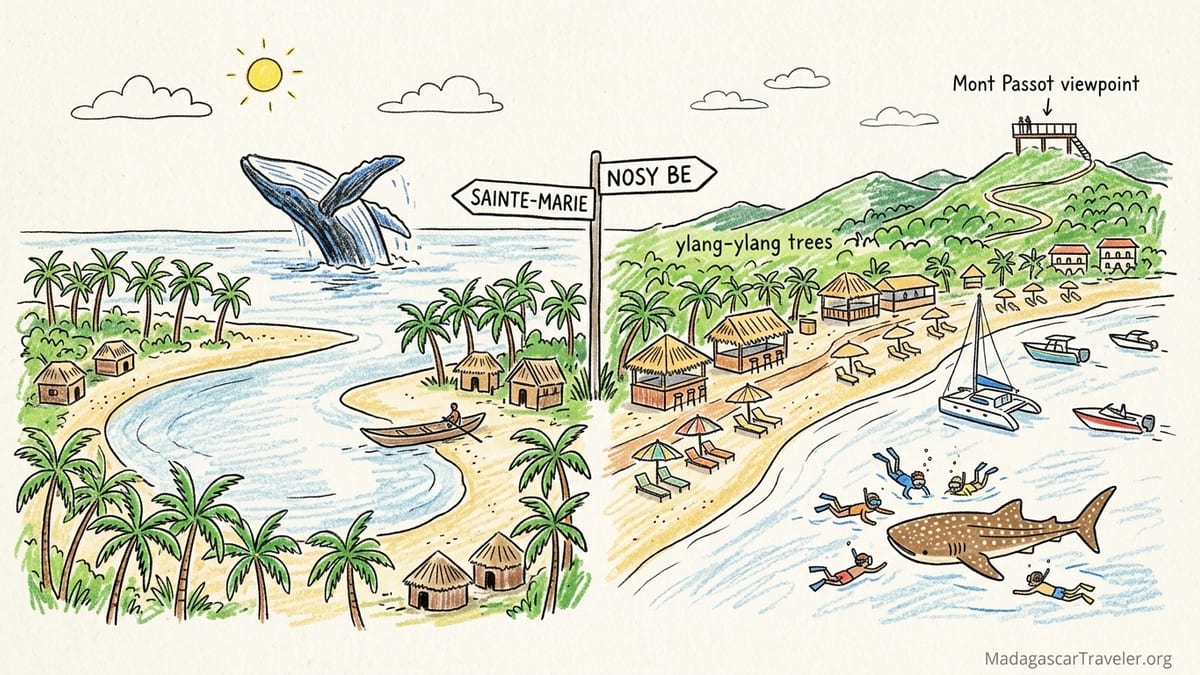
Overall Vibe: East-Coast Quiet vs Northwest Resort Hub
Sainte-Marie, officially Nosy Boraha, sits just off Madagascar’s lush east coast. The first impression is all palm-lined tracks, coconut groves and small villages strung along a narrow island. There are only a few dozen accommodation options, no real town beach strip, and nightlife is limited to soft music at your lodge bar. In the main town of Ambodifotatra you are more likely to share a beer with local fishermen than find a happy-hour cocktail list. Many visitors come here precisely for that slower rhythm and an atmosphere that still feels more like rural Madagascar than a classic sun-and-sand resort island.
Nosy Be, on the northwest coast, feels very different the moment you land. The road from Fascene Airport to Ambatoloaka and Madirokely is lined with small hotels, tour offices and beach bars. You will see quad bikes for rent, multiple dive centers and sunset catamaran ads. There are still quiet corners and upmarket boutique lodges, but Nosy Be is undeniably Madagascar’s main beach hub, with far more infrastructure and a steady flow of Italian, French and increasingly South African visitors. If you want choice of restaurants, easy boat excursions and a bit of nightlife, this is where you will find it.
In practice, this means Sainte-Marie tends to suit travelers looking for a laid-back stay built around nature, walks, bicycles and whale watching, while Nosy Be works well if you want a base that can deliver a different activity every day, from diving around Nosy Tanikely to a sunset drink in Ambatoloaka with a DJ playing. Both islands remain relatively low-key compared with mainstream Indian Ocean destinations, but in a Sainte-Marie vs Nosy Be comparison, Nosy Be is clearly the livelier, more developed choice.
Travelers who visit both often describe Sainte-Marie as a place where time slows down and Nosy Be as a place where the day fills quickly with options. The right choice for you depends on whether your ideal island week involves hammocks and quiet beaches, or a more social scene with easy access to tours and activities.
Wildlife Highlights: Whales vs Whale Sharks (and Everything In Between)
Wildlife is where the Sainte-Marie vs Nosy Be decision becomes genuinely seasonal. Sainte-Marie is famous for humpback whales that migrate along Madagascar’s east coast each southern winter. Between roughly July and September, sometimes stretching from late June into early October, large numbers of humpbacks gather in the sheltered channel between the island and the mainland to breed and calve. Local operators based in Ambodifotatra and smaller villages run simple whale watching trips in fibreglass boats, and encounters can be spectacular. It is common to see multiple breaches in a single outing and, in calm weather, you may even hear whale song through the hull.
Nosy Be’s signature wildlife experience is the chance to swim with whale sharks, typically from about October to December when plankton blooms draw these gentle giants to the warm waters off the island. Several responsible operators based in Ambatoloaka and on nearby Nosy Sakatia offer full-day excursions, combining careful boat searches with guided snorkeling at the surface. You stay at a respectful distance in small groups, and sightings are never guaranteed, but in peak season success rates are often high enough that boats will meet several individuals in a day. It is one of the Indian Ocean’s standout marine experiences.
Beyond these headline species, both islands offer rewarding nature. Sainte-Marie has pockets of lowland rainforest with endemic frogs, chameleons and orchids, and you can take guided walks to spot lemurs like the locally present subspecies of the eastern bamboo lemur. On Île aux Nattes, the small island off Sainte-Marie’s southern tip, there are almost no cars and plenty of birdlife around the coastal mangroves. Simple paddle outings through the lagoon often come with sightings of rays and turtles in shallow water.
Nosy Be, in contrast, shines underwater and across its broader archipelago. Coral gardens around Nosy Tanikely marine reserve are popular for snorkeling day trips, where you might see turtles grazing on sea grass and reef fish swirling around slopes of hard coral. Serious divers head for deeper sites around Nosy Sakatia and further offshore seamounts in the Mitsio or Radama archipelagos, where visibility can be excellent in the dry season and encounters range from schooling barracuda to occasional reef sharks. On land, Lokobe Reserve protects a remnant of original Sambirano forest, home to black lemurs, leaf-tailed geckos and a range of endemic chameleons, which you can look for on guided walks starting from the village of Ampasipohy.
Beaches, Landscape and Island Character
Sainte-Marie’s coastline feels intimate rather than grand. Many beaches are narrow but very pretty, with leaning coconut palms, soft sand and small pirogues pulled up onto the tide line. Amber-sand coves around the northern section of the island see little traffic beyond a few children playing football at sunset. The real showstopper, though, is tiny Île aux Nattes at the southern end. Reached by a short pirogue crossing, this low-lying oval of white sand and shallow blue water has some of the most photogenic lagoon scenery on Madagascar’s east coast. Most guesthouses are right on the beach, and you can walk the island’s circumference in a couple of hours.
Because Sainte-Marie is on the wetter, trade-wind coast, it is greener and more humid than Nosy Be. Rain showers can arrive at any time of year, especially from January to March, but they are part of the island’s character: pandanus trees dripping after a squall, red earth paths, and banana plants arching over the road. The sea here is often calm inside the protecting reefs, but swells and currents can be strong on more exposed stretches, so swimming is best done in bays recommended by your lodge.
Nosy Be has the more classically tropical beach look that many visitors picture before flying. Long curves like Madirokely and Ambondrona offer wide strips of sand, particularly visible at low tide, while smaller coves are tucked along the northwest coast. Sunsets here are the star turn: the sun drops behind the silhouette of neighboring islands and fishing boats, painting the sky pink and gold. Inland, volcanic hills are covered in plantations of ylang-ylang and sugarcane, and lakes fill old craters. Viewpoints such as Mont Passot look across a patchwork of greenery and small islands scattered in the Mozambique Channel.
In terms of island character, Sainte-Marie feels more linear and village based, with one main coastal road and scattered communities. It is common to cycle from your lodge into the nearest village to buy fruit or watch a football game. Nosy Be is more nodal, with clusters of development around Ambatoloaka, Madirokely, Dzamandzar and Hell-Ville, as well as satellite islands with their own small resorts. That difference matters: if you want to feel part of everyday Malagasy life, Sainte-Marie makes it easier; if you prefer to stay in a self-contained beach resort and dip into local culture on day trips, Nosy Be is more geared to that.
History, Culture and Things To Do On Land
One area where Sainte-Marie has a clear edge is historical atmosphere. The island was a notorious pirate base in the late 17th and early 18th centuries. Today, a short walk from Ambodifotatra takes you to the atmospheric Pirate Cemetery, where crumbling tombstones lie under old trees looking out across the water. Local guides recount legends of figures such as William Kidd and La Buse, and explain how the sheltered bays around Sainte-Marie sheltered pirate ships trading in plundered goods. While much of the pirate lore has been embellished over time, the setting alone gives a strong sense of the island’s layered past.
A boat ride to Île aux Forbans, or across to the small islet commonly called Îlot Madame, adds to this historical thread, with vestiges of old buildings and Madagascar’s first Catholic church nearby. Combined with the still-traditional lifestyle in many villages, these excursions create a different feel from more resort-focused islands. On non-whale days many visitors rent bicycles or scooters to explore small churches, vanilla plots and local markets, or join a guide for short rainforest hikes looking for orchids and endemic reptiles.
Nosy Be’s cultural experiences are less about dramatic history and more about everyday life and regional diversity. In Hell-Ville, the main town, you can wander through busy markets piled with spices, coffee and vanilla, or visit the waterfront where ferries leave for the smaller islands. Inland, many lodges can arrange village visits that introduce you to Sakalava traditions, including music and occasionally ceremonial dances timed with local festivals. Some travelers also time their visit for the Donia Festival, an annual music and culture event that takes place on Nosy Be, though dates and format can vary by year.
On land-based activities, Nosy Be offers more variety, particularly for families or groups. Popular outings include a half-day trip to Lokobe Reserve by pirogue and foot, quad-bike tours through the interior, ylang-ylang distillery visits and sunset drives up to Mont Passot. Sainte-Marie’s menu is shorter and simpler, focusing on whale watching in season, lagoon trips to Île aux Nattes, light hikes and cultural visits near Ambodifotatra. For some travelers that minimalism is a plus, for others it can feel limiting after several days.
Beaches, Hotels and Costs: What You Actually Get For Your Money
Accommodation on Sainte-Marie runs from basic guesthouses to comfortable mid-range boutique hotels and a small handful of more upmarket lodges. Many are owner-operated spots with a dozen or so bungalows, a restaurant focused on local seafood and a small bar. In recent seasons, typical double room rates for clean, simple beachfront lodges have often sat in the approximate range of 40 to 80 US dollars per night, with higher-end options more likely to charge above that, especially during the peak whale season. São-based travelers sometimes report slightly lower prices in the shoulder months outside July and August.
Nosy Be, by contrast, has a far wider price spectrum. In and around Ambatoloaka and Madirokely, you will find backpacker-friendly rooms and apartments in the ballpark of 25 to 40 US dollars per night, along with numerous mid-range hotels charging 70 to 120 US dollars for sea-view rooms. At the top end, several boutique beach lodges and small resorts on quieter beaches or nearby islands can easily exceed 250 US dollars per night, especially when meals and boat transfers are included. If you want a large pool, on-site dive center and a choice of room categories, Nosy Be is much more likely to deliver.
Food and day-to-day costs remain relatively reasonable on both islands compared with many Indian Ocean destinations. In Sainte-Marie, you will probably eat most meals at your lodge or in one of a handful of small restaurants in Ambodifotatra. Fresh fish, zebu brochettes and coconut-based curries are common, and a main dish might cost the equivalent of 5 to 12 US dollars. In Nosy Be, especially in Ambatoloaka, the range is wider: simple local eateries serving grilled fish and rice at modest prices sit next to Italian-run spots serving seafood pasta or wood-fired pizza at prices closer to 10 to 18 US dollars per main.
On activity costs, expect shared whale watching in Sainte-Marie to be a significant but manageable line item in your budget. Operators typically run half-day trips in small boats; exact prices vary with fuel costs and group size, but travelers often report spending in the order of tens rather than hundreds of US dollars per outing. In Nosy Be, whale shark excursions and full-day island-hopping trips, particularly those including lunch on the beach and snorkeling at Nosy Tanikely, are usually more expensive per day than a simple whale outing on Sainte-Marie, reflecting fuel consumption and longer distances. Diving packages with established centers around Nosy Be can be particularly good value compared with many other parts of the Indian Ocean, which matters if you plan multiple days underwater.
Getting There and Around: Practical Trip Logistics
Nosy Be is generally easier to access than Sainte-Marie, especially from outside Madagascar. Fascene Airport receives direct international flights from hubs such as Addis Ababa and Johannesburg in some seasons, along with charter and seasonal services from European gateways. From Antananarivo, Madagascar’s capital, Madagascar Airlines and its domestic brand typically operate multiple weekly direct flights taking around 1 hour 45 minutes. Schedules change relatively often and reliability can fluctuate, so most travelers give themselves at least one night in Antananarivo before any long-haul international departure, whether they are connecting from Nosy Be or returning from elsewhere.
Sainte-Marie, served by a small airport toward the southern end of the island, usually has fewer flights from Antananarivo. Madagascar Airlines has historically operated direct domestic services, which can become daily or near-daily in peak season and much less frequent at other times. When seats are limited or prices spike, some travelers opt for the overland alternative: a long road journey from Antananarivo to the east-coast town of Soanierana Ivongo followed by a boat crossing to Sainte-Marie. This route can take the better part of a day or longer depending on road conditions and sea state, and it is very weather dependent, especially during the cyclone season from roughly January to March.
On both islands, local transport is straightforward but basic. On Nosy Be, short taxi rides between Hell-Ville, Ambatoloaka and Madirokely are easy to arrange and inexpensive by international standards, though you should always agree the fare in advance. Many hotels can organize transfers to and from the airport. On Sainte-Marie, transport is often by three-wheeler, bicycle, scooter or the occasional 4x4 taxi. Distances are smaller, but road surfaces can be potholed after heavy rain. For most visitors, arranging point-to-point transfers through their accommodation is the least stressful approach, particularly when timing matters for flights or the Sainte-Marie ferry.
If you are already planning to visit Nosy Be and wondering whether Sainte-Marie is worth the extra travel, logistics are a key factor. Reaching Sainte-Marie from Nosy Be typically means flying back via Antananarivo, potentially with an overnight each way to buffer against domestic delays. When time is tight, many travelers choose to focus on Nosy Be and its surrounding islands instead of adding Sainte-Marie. Those who do make the extra effort generally advise treating Sainte-Marie as its own distinct leg of the trip, with at least four or five nights to justify the backtracking.
Best for Families, Couples and Different Travel Styles
For families, Nosy Be is usually the more straightforward recommendation. The combination of sand beaches with gentle gradients in many bays, a variety of hotels that understand family needs, and easy access to excursions such as Nosy Tanikely or Lokobe makes planning a week relatively simple. It is possible to base yourselves in a mid-range beachfront hotel with a pool and then cherry-pick a couple of boat days, a forest outing and some relaxed beach time. Older children and teenagers often enjoy the chance to try snorkeling, diving or paddleboarding with professional operators.
Sainte-Marie can also work well for families, particularly those traveling with nature-loving older children or teenagers, but the experience is quieter and more limited in scope. The main draw in whale season is obvious, and many kids are enthralled by their first breach. Outside those months, activities revolve around cycling, snorkeling in calm lagoons and short forest walks. There are fewer big-hotel facilities like large pools or organized kids’ clubs. That said, simple pleasures often shine here: spotting geckos on the bungalow steps, learning a few Malagasy words with local kids on the beach, and taking a pirogue to Île aux Nattes.
For couples, both islands can be romantic, but in slightly different keys. Nosy Be suits honeymooners wanting comfort and options: a private villa on Nosy Sakatia or a boutique lodge on a quiet beach, with sunset cruises, spa treatments and superb seafood dinners. Sainte-Marie, including Île aux Nattes, is more about barefoot intimacy, long walks on near-empty beaches and evenings under a thatched roof with the sound of waves and distant village music. If your idea of a romantic trip is a rustic bungalow and shared adventures in a place that still feels off the main tourist circuit, Sainte-Marie has real charm.
Solo travelers and backpackers often gravitate to Nosy Be because it is easier to meet other visitors in Ambatoloaka’s bars and on shared boats. Sainte-Marie attracts a smaller, more dispersed crowd, which can be either a blessing or a drawback depending on whether you want solitude or social energy. For serious divers and underwater photographers, Nosy Be is usually the better base thanks to the concentration of dive centers, varied sites and relatively long dry-season window. Birdwatchers and those with a special interest in humpbacks or pirate history may feel more drawn to Sainte-Marie.
When Sainte-Marie Is Worth the Detour From Nosy Be (and When It Isn’t)
Many current trip reports and forum threads revolve around a specific dilemma: if you have already built Nosy Be into a Madagascar itinerary, is it worth the additional flights and transfers to add Sainte-Marie, particularly in whale season? The answer depends mainly on timing and personal priorities. If you are in Madagascar between roughly July and September and you care deeply about humpback whales, Sainte-Marie offers one of the most reliable and intimate whale watching settings in the region. Being able to see blows from shore and take relatively short boat trips from a small island base is a powerful draw, and many whale-focused travelers consider the extra effort fully justified.
On the other hand, if your dates fall squarely into Nosy Be’s whale shark season from around October to December, and you are planning to stay several days on Nosy Be with a couple of marine excursions, the case for adding Sainte-Marie becomes weaker unless you have additional time and budget. The marine experiences are complementary rather than overlapping, but backtracking through Antananarivo for a short stay on Sainte-Marie can eat up at least two full days of your itinerary in transfers alone. In that scenario, many travelers prefer to extend their time around Nosy Be, adding visits to islands such as Nosy Komba or the Mitsio group.
Weather is another consideration. Sainte-Marie, on the east coast, is more exposed to Indian Ocean weather systems and receives heavier rainfall, especially from January to March. Cyclones are a seasonal reality. Nosy Be, in the northwest, is generally drier in the main tourist months and can feel more predictable for families or those with fixed dates. If your trip is locked into the core of the cyclone season and you cannot be flexible, most planners would recommend focusing on Nosy Be or the drier southwest coast rather than risking disruption on Sainte-Marie.
Budget also plays a role. While daily costs on the ground can be similar, the extra domestic flights required to combine both islands can considerably raise overall trip costs, particularly when booked close to departure. For travelers on a tighter budget, it often makes more sense to choose one anchor island and then invest any savings into better quality accommodation or more excursions in that region.
The Takeaway
If your heart is set on close encounters with humpback whales and you are visiting Madagascar in the middle of their migration, Sainte-Marie edges ahead. The combination of calm, village-fringed coastline, the option to stay on dreamy Île aux Nattes and the island’s pirate history creates a special atmosphere that is very different from many beach destinations. It feels like a quietly magical outpost where the main sound at night is the sea and the wind in the palms.
If you are seeking variety, convenience and a broad mix of marine life, Nosy Be is hard to beat. The island’s larger choice of hotels, restaurants and tour operators, combined with excellent diving, snorkeling and seasonal whale shark encounters, makes it a versatile base that can suit couples, families and solo travelers alike. You can fill a week easily with day trips to Lokobe, Nosy Tanikely, Nosy Komba and more, without ever feeling stuck.
For travelers already including Nosy Be, adding Sainte-Marie is most worth the extra effort when you are traveling in peak humpback season, have at least four or five spare nights to allocate, and actively want a change of pace from a resort environment. If your dates line up better with whale sharks and dry-season diving in Nosy Be, or your trip is short, it is usually wiser to commit fully to Nosy Be and its surrounding islands rather than split your time thinly.
Ultimately, there is no wrong choice. Both islands deliver warm seas, Malagasy hospitality and a sense of being somewhere far from the usual Indian Ocean circuit. Decide first whether you are more excited by humpbacks and east-coast character or whale sharks and a northwest resort hub, then build the rest of your Madagascar itinerary around that anchor. Either way, you are unlikely to regret the days you spend looking out across a Madagascar lagoon at sunrise.
FAQ
Q1. When is the best time to visit Sainte-Marie for whale watching?
The humpback whale season around Sainte-Marie typically runs from about July to September, with some variability each year, and this is when most whale-focused trips are planned.
Q2. When is the best time to see whale sharks in Nosy Be?
Whale sharks are most reliably seen off Nosy Be roughly from October to December, when plankton levels are higher, although exact timing and sightings can vary with conditions.
Q3. Is Sainte-Marie or Nosy Be better for families with young children?
Nosy Be usually suits families better thanks to a larger choice of family-friendly hotels, pools and easy day trips, while Sainte-Marie offers a quieter, more nature-focused stay with fewer big facilities.
Q4. Can I visit both Sainte-Marie and Nosy Be on a two-week Madagascar trip?
It is possible, but you should factor in additional domestic flights and at least one or two buffer nights in Antananarivo; many travelers choose one island to avoid spending too much time in transit.
Q5. Which island is cheaper: Sainte-Marie or Nosy Be?
Daily costs on the ground can be similar, but Nosy Be has a wider range of budget and mid-range options, while combining both islands often increases overall costs because of extra domestic flights.
Q6. Do I need to be an experienced swimmer to enjoy wildlife activities on these islands?
For whale watching in Sainte-Marie, boat trips are mostly surface-based and suitable for non-swimmers, while whale shark excursions and snorkeling in Nosy Be require basic water confidence and comfort with a mask.
Q7. Is it safe to travel to Sainte-Marie and Nosy Be independently?
Most independent travelers report feeling safe on both islands when using common-sense precautions, arranging reliable transfers and avoiding isolated areas late at night, especially around busier beach bars.
Q8. Which island is better for diving?
Nosy Be is generally the stronger choice for divers, with multiple established dive centers, a range of reefs and seasonal pelagic encounters, whereas Sainte-Marie offers more limited but still pleasant local diving and snorkeling.
Q9. How many days should I spend on each island?
For a relaxed stay, many travelers aim for at least four or five nights on Sainte-Marie and a similar or slightly longer stay on Nosy Be, particularly if you want time for several marine excursions.
Q10. Do I need to book tours and accommodation in advance?
Advance booking is strongly recommended in peak seasons, especially for whale watching in Sainte-Marie and whale shark or diving trips in Nosy Be, when flights and popular lodges can sell out well ahead of time.