


Sainte-Marie, or Nosy Boraha, sits just off Madagascar’s east coast, a slender island known for coconut-lined beaches, humpback whale migrations and a slow, barefoot rhythm. With around 50 places to stay listed on major booking sites, choosing a hotel here is less about star ratings and more about matching location, beach quality and comfort levels with how you actually want to experience the island.
How Sainte-Marie’s Areas Shape Your Stay
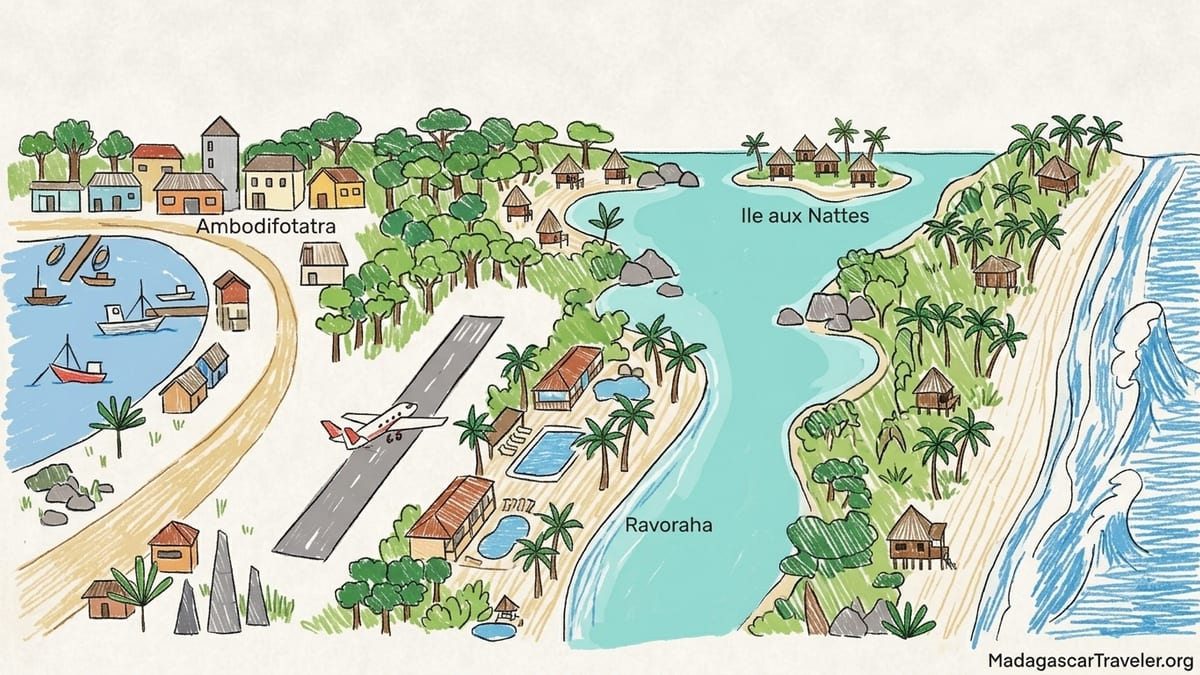
Before you pick a hotel, it helps to understand how Sainte-Marie is laid out. The main town of Ambodifotatra in the central-west is the island’s small hub, with banks, markets and the port. South of town, the airport area and Ravoraha beach form a compact belt of midrange resorts and ecolodges with easy transfers and organized whale excursions in season. Farther south, the channel facing tiny Ile aux Nattes is one of the most scenic stretches of lagoon on the island. On the east coast, long surf-washed beaches and quieter ecolodges appeal to travelers who want space and seclusion more than nightlife.
Distances are short but road conditions are slow, so a resort 15 to 25 kilometers from town can feel quite remote. That is part of the charm if you want a nature escape, but it also means onsite dining, whale-watching logistics and reliable Wi-Fi become decisive. Travelers who plan to move around the island on scooters or by taxi can happily base themselves a little farther out, while those who prefer to stay put and book day excursions should favor the airport and south-coast area where pick-ups are easiest.
Beach character also changes subtly from one zone to the next. West-coast bays facing the Madagascar mainland are typically calmer, with more swimmable water at mid to high tide, while the east coast has a wilder Indian Ocean feel and more dramatic surf. Budget guesthouses may sit across a sandy lane from the beach, while many midrange ecolodges and boutique hotels occupy direct beachfront, sometimes with their own small natural cove.
Best Beachfront Hotels near the Airport and Ravoraha
If you want to step off the plane and be in a lounger by the lagoon within minutes, focus on the stretch between the airport and Ravoraha village. Here, Princesse Bora Lodge & Spa functions as one of Sainte-Marie’s reference points for quality and location. This upscale lodge sits on a long, pale-gold beach shaded by palms, with a large pool just back from the sand and villas spaced in a coconut grove. Rooms use a mix of traditional materials and modern comforts, with individual air-conditioning, mosquito nets and hot showers, and many villas facing directly onto the lagoon.
Princesse Bora’s restaurant is one of the strongest arguments for staying here on half-board. The open-sided terrace overlooks the pool and beach, and dinners typically combine local seafood and produce with more international presentations. Because you are a short drive from town yet still somewhat isolated, having breakfast and dinner included is practical. The lodge is also well placed for whale excursions during the July to September season, often arranging trips directly from its beach or nearby jetty, and staff can coordinate transfers between the airport, the hotel and local operators.
Just south of the airport, Ecolodge Le Ravoraha offers a more intimate alternative with an eco-focused personality. Set above a curve of beach near Ravoraha, this lodge uses thatched bungalows with fans rather than full air-conditioning in many units, encouraging natural ventilation and sea breezes. There is a compact pool, lush gardens and a small restaurant that serves Malagasy dishes and grilled fish, often eaten with a view across the lagoon. Because it is one of the first hotels south of the airport and about 10 kilometers from Ambodifotatra, half-board makes sense for most guests, although you can still reach town by taxi for variety.
Further along this belt you will find classic seaside hotels such as Soanambo Hotel, which positions itself as a four-star beachfront resort with a sizable pool, landscaped grounds and ocean-view rooms. Here the emphasis is on comfort and amenities: air-conditioning, a spa area, a full restaurant and bar, and organized activities from snorkeling to island tours. If you are traveling with older relatives or children who value a conventional resort feel and reliable services, this part of the south-west coast offers the best compromise between beach, access and infrastructure.
Romantic Hideaways and Boutique Lodges
Couples often come to Sainte-Marie for honeymoons or low-key celebrations, and the island delivers romance best through small-scale lodges rather than big, busy resorts. Princesse Bora Lodge & Spa is again a front-runner for couples who want a full-service setting: private villas, four-poster beds, a good pool and a spa that offers aromatic massages and treatments in simple wooden cabins behind the beach. In season, the ability to head out at dawn from the lodge and watch humpback whales breaching offshore is a genuine highlight that turns a beach stay into a once-in-a-lifetime memory.
More discreet and eco-oriented, properties such as Aurora Lodge on the quieter coast appeal to couples looking for space and intimacy rather than high polish. Aurora mixes Scandinavian-influenced design with Malagasy materials, offering a handful of bungalows, including a larger family unit, scattered among tropical vegetation. The atmosphere leans more towards a stylish beach house than a hotel, with an emphasis on slow evenings, good food and long walks. Rooms are typically cooled with fans and sea breezes rather than strong air-conditioning, a point to note if you are sensitive to heat in the wetter, warmer months.
For those who prize isolation above all, Riake Resort & Villa on the east coast has become a byword for getting away from it all. Guests describe waking up to an almost private expanse of beach and listening to the surf roll in at night, with nothing but coconut palms between their bungalow and the Indian Ocean. The resort labels itself an ecolodge, with beachfront villas and bungalows built in wood and thatch, ceiling fans, mosquito nets and large verandas. Without nearby restaurants or villages, the onsite kitchen is central to the experience, serving set menus that lean heavily on fresh fish, local fruit and vegetables.
Because of its remote position along a largely undeveloped shoreline, Riake works best for travelers who are happy to trade quick access to town for solitude. There is no pool here, but the attraction is the natural beach, which is often empty apart from a few fellow guests. Whale-watching excursions and island tours can still be arranged, but expect them to involve slightly longer transfers by 4x4 compared with south-coast hotels.
Ecolodges and Off-Grid Nature Retreats
Sainte-Marie’s ecolodges are scattered mostly along the less built-up coasts, where forest, village life and sea meet with fewer concrete structures in between. Properties such as Masoandro Lodge on the western tip of the island offer an appealing blend of sustainability and comfort. This 3-star ecolodge has wooden bungalows set on a hillside above a small private beach, with direct access to nearby forests like Ikalalao and Ampatsy for walks among endemic plants and birdlife. Rooms tend to have fans and natural ventilation rather than powerful air-conditioning, keeping energy use lower and aligning with the eco ethos.
In this style of lodge, half-board is often the default because you are too far from town for spontaneous dinners elsewhere. Masoandro’s restaurant, for example, focuses on Malagasy staples, local seafood and simple international dishes, eaten at shared or separate tables overlooking the water. Wi-Fi is usually available in common areas but can be unreliable inside the bungalows, a common pattern across the island. Travelers who need to work remotely should confirm coverage in advance, while those who welcome the chance to disconnect often find the digital limitations part of the experience.
East-coast ecolodges such as Riake Resort & Villa take the off-grid feeling a step further. Solar power, limited generators and careful water use are typical here, and in exchange you get miles of quiet shoreline and night skies practically free of light pollution. Showers are usually hot but water pressure can vary, and electricity may be reduced in the small hours, so keeping devices charged earlier in the evening is wise. Whale excursions, village walks and lagoon trips are still on offer, but transport costs may be higher than from more central hotels because drivers have to cover longer distances on partly rough roads.
For travelers willing to combine a couple of nights near the airport with several nights at a more remote ecolodge, Sainte-Marie works well as a twin-center beach break. Start with a night or two at a resort with strong Wi-Fi and air-conditioning to recover from international flights, then transfer to a quieter lodge where the soundtrack is mostly waves and wind in the palms.
Family-Friendly Hotels and Relaxed Beach Stays
Families traveling to Sainte-Marie often look for safe swimming, flexible room configurations and food that keeps children happy while still feeling local. South-coast resorts near the airport area, such as Soanambo Hotel and some midrange beachfront properties around Baie des Forbans, offer wide lawns, shallow sections of beach and pools where parents can supervise kids without constant stress about currents. Many rooms in this zone can take an extra bed, and some hotels offer dedicated family bungalows or interconnecting rooms.
Aurora Lodge, mentioned earlier for its boutique feel, specifically highlights a Family Bungalow, giving parents and children space to spread out without booking multiple units. The setting encourages shared activities like beachcombing, kayaking or simple card games on the veranda rather than kids’ clubs or organized entertainment. Because these small lodges often have compact menus, families with picky eaters should check whether simple dishes like grilled chicken, pasta or plain rice and vegetables can be prepared on request, in addition to the more typical seafood.
Budget-friendly beachfront guesthouses like Chez Nath or Lakana Hotel offer another family-friendly path for those who do not need polished resort facilities. Lakana, one of the island’s older hotels, stretches along a pleasant beach with simple bungalows, some built on stilts over the lagoon, and a relaxed restaurant where dinner can be a mix of zebu steak, grilled fish and rice, or fresh fruit for dessert. Rooms often rely on fans and sea breezes rather than air-conditioning, and Wi-Fi, when available, is usually strongest in the restaurant area.
These simpler properties shine for families who care more about atmosphere and cost than about spa menus or designer bathrooms. With room rates often meaningfully lower than luxury lodges, it becomes feasible for a family of four to stay a week, arranging occasional excursions to Ile aux Nattes, the pirate cemetery or natural swimming pools while spending most days on the beach or by the hotel pool.
Good-Value Bungalows, Guesthouses and Local-Style Stays
Not every traveler to Sainte-Marie is seeking a pool and a spa. The island also has a healthy layer of good-value accommodation where you sleep in simple bungalows, often constructed from wood and local materials, and eat at a communal table or modest restaurant. Guesthouses and locally run hotels around Ambodifotatra give you the most direct access to daily life, shops and street food, though many of these sit a short walk or scooter ride from the best beaches.
Along the beaches south of town and near Ravoraha, midrange guesthouses such as Chez Nath pair basic but comfortable seafront rooms with genuinely friendly staff and easy access to the sand just across a small road or garden path. Travelers consistently highlight the sense of safety and warmth in these smaller places, something solo visitors particularly appreciate. Fans and mosquito nets are standard, air-conditioning is not, and bathrooms may be compact and simple, but you wake to the sound of the sea and can order fresh fish for dinner without needing a taxi.
Value on Sainte-Marie is less about ultra-low nightly rates and more about what is included. Some bungalows come with breakfast and afternoon coffee, others with free airport transfers or complimentary use of kayaks. Since the island’s supply chains can make imported goods expensive, even modest-seeming half-board supplements can be good value when you factor in the cost and time of getting into town for every meal. It is worth checking whether tap water is safe for brushing teeth and whether filtered water is provided or sold, as this can affect your daily budget.
For longer stays of two weeks or more, a mix of very simple bungalows and a few nights at a more comfortable resort can stretch your budget while still allowing for a touch of indulgence. Many repeat visitors build relationships with small guesthouse owners, arranging whale excursions or scooter hire directly through them, which often leads to more authentic experiences than booking everything through a resort desk.
Comparing Practicalities: Beach, Pool, Dining, Comfort and Connectivity
When comparing Sainte-Marie hotels, start first with the beach. Ravoraha and the south-west coast offer relatively calm lagoon water at higher tides, good for relaxed swimming and paddle-boarding. East-coast ecolodges like Riake trade calmer water for wilder, more photogenic surf and miles of nearly empty sand. West-coast places around Masoandro’s headland sometimes have small, natural coves that feel almost private, particularly at mid-tide. For families with younger children or less confident swimmers, a pool is a helpful safety net, which is why properties such as Princesse Bora, Soanambo and some midrange hotels near the airport score highly.
Restaurant quality and meal plans make a bigger difference on Sainte-Marie than in many beach destinations, simply because there are fewer alternatives within walking distance of most hotels. In isolated ecolodges, half-board is practical rather than luxurious, covering breakfast and dinner while you buy lunch as needed. Menus typically revolve around rice, seasonal vegetables, local fish, calamari and sometimes zebu beef, with vegetarian options available if requested in advance. At more central hotels, you can decline half-board and eat some meals in town, but you may still appreciate returning to a reliable onsite restaurant after a long whale excursion.
Air-conditioning versus fans is another key comparison point. Higher-end resorts on the south-western side and near the airport generally offer individually controlled air-conditioning in at least some room categories, a real benefit in the sticky months between January and March. Ecolodges and traditional bungalows more often rely on fans and natural airflow, which many travelers find adequate in the cooler, drier season from June to September. If you know you sleep poorly in the heat, prioritize properties that clearly mention in-room air-conditioning rather than assuming it will be there.
Wi-Fi on Sainte-Marie is widely available but seldom fast. Larger resorts near the airport and Ambodifotatra tend to have the most reliable connections, though even there speeds can drop when the island is busy or during storms. In many ecolodges, Wi-Fi is intentionally limited to public areas or turned off at certain hours to reduce generator use. If you plan to work online, clarify expectations with your chosen hotel in writing before you book. For pure holidaymakers, leaning into the patchy connectivity can be liberating, as evenings shift from scrolling to watching sunsets and listening to geckos on the walls.
Finally, consider transfers and excursions. Resorts clustered around the airport can often include pick-up and drop-off in their rates or arrange them at a modest surcharge, making arrival after a domestic flight from Antananarivo relatively simple. More distant ecolodges will quote higher transfer costs because vehicles must cover longer, slower roads. For whale watching, hotels on both coasts can connect you with licensed operators, but those near Ravoraha and Ambodifotatra tend to have the widest choice and shortest boat rides out to the migration corridor.
The Takeaway
Choosing the best hotel on Sainte-Marie is less about chasing luxury labels and more about aligning three things: how remote you want to be, how much comfort you need to sleep well and whether you prefer calm lagoon or wild ocean. The airport and Ravoraha belt suits most first-time visitors, offering swimmable beaches, easy transfers, solid whale-watching logistics and a spectrum of stays from polished resorts like Princesse Bora and Soanambo to smaller ecolodges such as Le Ravoraha. Couples and honeymooners might blend a few nights of full-service comfort with a stint at a quieter boutique lodge or east-coast ecolodge like Riake for long walks on nearly empty sand.
Families will appreciate hotels with pools, lawns and straightforward room layouts, plus dependable onsite restaurants where dinner is as simple as walking down from the bungalow. Budget-conscious travelers can lean into guesthouses and older beachfront hotels that favor charm and location over designer finishes, knowing that even the simplest bungalow often comes with million-dollar ocean views. Whatever your style, aim to visit during the drier, cooler months between June and September if you can, when humpback whales gather off the island and sea breezes make nights more comfortable even in fan-cooled rooms.
In the end, Sainte-Marie rewards those who slow down. Pick a base that fits the way you like to travel, accept that Wi-Fi may lag and sand will get into your shoes, and focus on the essentials: warm water, palm-shaded beaches, evening rum cocktails and the possibility of spotting a whale tail breaking the surface just beyond the reef.
FAQ
Q1. Which part of Sainte-Marie is best for first-time visitors?
For a first stay, the south-west coast near the airport and Ravoraha works best. You get easy transfers, good beaches, a choice of hotels and straightforward access to whale excursions and day trips.
Q2. Do I need half-board at my Sainte-Marie hotel?
In remote ecolodges on the east coast or western tip, half-board is very practical because there are few independent restaurants nearby. Around the airport and town you can mix hotel meals with local eateries, so half-board is optional rather than essential.
Q3. Is the sea safe for swimming around Sainte-Marie?
Many west-coast and south-coast beaches offer relatively calm conditions at mid to high tide, and hotels usually indicate safer swimming zones. On the east coast the ocean is rougher and better for walks and scenery than for everyday swimming, so a pool becomes more important.
Q4. When is the best time for whale watching from Sainte-Marie?
The humpback whale season typically runs from around July to September, sometimes stretching into early October. During this period many hotels can arrange boat trips with local operators to view whales offshore in suitable weather.
Q5. Are there family-friendly hotels on Sainte-Marie?
Yes. Resorts near the airport and Ravoraha, along with several midrange beachfront hotels, offer pools, family rooms or bungalows and flexible dining. Some smaller lodges also have dedicated family units and are happy to adapt meals for children.
Q6. Can I work remotely from Sainte-Marie with reliable Wi-Fi?
Wi-Fi can be adequate for email and light tasks at larger resorts and hotels near Ambodifotatra and the airport, but speeds and stability vary. If you must work online, confirm coverage with your chosen hotel and expect occasional slow periods or dropouts.
Q7. Do most hotels on Sainte-Marie have air-conditioning?
Higher-end resorts and some midrange hotels on the south-west coast usually offer air-conditioning in at least part of their room inventory. Many ecolodges and budget bungalows rely on ceiling fans and sea breezes, which are comfortable for many travelers in the cooler season.
Q8. How do I get from Antananarivo to my hotel on Sainte-Marie?
Most visitors fly from Antananarivo to Sainte-Marie’s small airport, then use a pre-booked transfer arranged by their hotel. Some properties include this in their rates, while others charge a separate fee depending on distance from the airport.
Q9. Is Sainte-Marie suitable for solo travelers?
Sainte-Marie suits solo travelers who enjoy quiet beaches and a relaxed pace. Smaller guesthouses and ecolodges are often very welcoming, and staff can arrange excursions so you do not need to organize everything yourself, though nightlife is limited.
Q10. How far in advance should I book hotels in whale season?
For stays from July to September, it is sensible to book well in advance, especially at popular beachfront resorts and small ecolodges with limited rooms. Outside whale season, you usually have more flexibility and can find good-value options closer to arrival.