


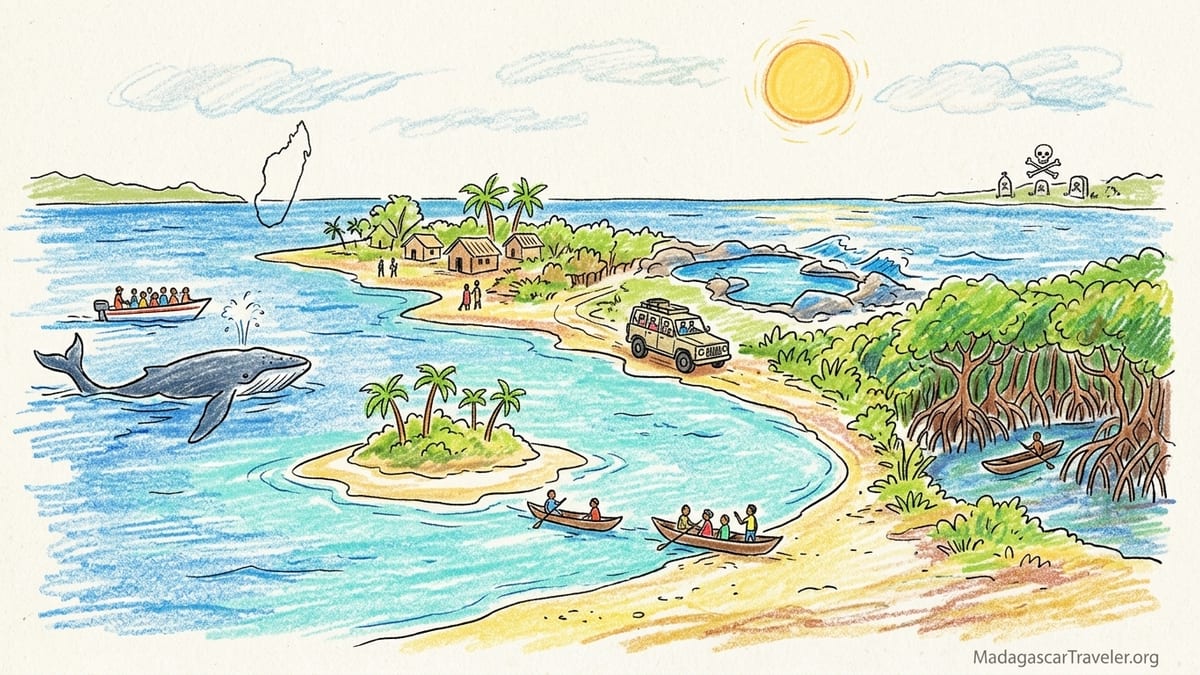
On Madagascar’s east coast, the island of Sainte-Marie, or Nosy Boraha, has quietly become one of the country’s most rewarding beach destinations. Here, you can watch humpback whales breach just offshore, drift in a pirogue through mangroves, snorkel over bright sandbars, or wander among the headstones of real pirates. Many of these highlights are marketed as separate excursions, often by the same small group of local operators. Understanding how the offers overlap, which ones need a boat or specialist guide, and what you can reasonably fit into a few days will help you spend more time in the water and less at hotel desks comparing flyers.
How Sainte-Marie Excursions Work in Practice
Most travelers base themselves along Sainte-Marie’s west coast, between the main town of Ambodifotatra and the southern airport strip at Ravoraha. From this thin lagoon side of the island, hotels and lodges work with a small pool of local skippers and guides who sell the same core excursions under slightly different names: whale watching in season, Île aux Nattes, natural pools and the northern coast, Ampanihy mangroves on the east side, the pirate-history circuit, and boat trips to Îlot aux Sables. A few agencies, such as Ma’Tour Guide Madagascar and independent guides attached to hotels like Riake Resort or Ravoraha Ecolodge, package several of these into half-day or full-day outings, but you can usually book each experience separately once you arrive.
Excursions fall into two broad categories. The first are road-based island tours, often done by car, tuk-tuk or quad, such as the pirate-history loop around Ambodifotatra or the drive up to the northern natural pools. The second are boat-based days anchored around the southern lagoon, lagoon islets or the eastern mangroves. Shared outings are common for whale watching and some Île aux Nattes crossings, while many sandbank and mangrove trips are arranged privately by default simply because group demand is lower. In high season, especially July to September, it is worth reserving one or two key trips a day or two in advance; outside those months, same-day bookings through your hotel are usually fine.
Prices fluctuate with fuel costs and the strength of the local currency, but as of mid-2026 most short excursions start at the rough equivalent of 20 to 30 US dollars per person for a shared half-day and 60 to 100 dollars for a private boat or vehicle for a small group. Hotels will typically quote in euros or ariary; it is reasonable to expect a premium when arranging through an upmarket lodge compared with negotiating directly on the beach, but you gain better safety oversight, English or French-speaking guides and easier problem-solving if weather forces changes.
Whale Watching: Sainte-Marie’s Seasonal Star
From around early July to late September, humpback whales gather in the channel between Sainte-Marie and mainland Madagascar to breed and calve. Local and national tourism boards consistently promote Sainte-Marie as one of the country’s most reliable whale-watching spots, with multiple operators running 3 to 4 hour outings most mornings when the sea is calm. Dedicated whale boats or large motorized pirogues leave from jetties near Ambodifotatra, from hotel beaches south of town and from the southern tip opposite Île aux Nattes, allowing you to choose the most convenient departure point to your accommodation.
Many hotels, including midrange lodges along the west coast, sell whale trips directly: you put your name down at reception, pay in cash or card, and the hotel staff coordinate with a licensed skipper. Some properties partner with specialist outfits that focus solely on whale excursions, placing a strong emphasis on keeping appropriate distances from the animals and limiting the number of boats that approach a pod at any one time. If your hotel works with one of these operators, it is usually worth paying slightly more for a better safety brief, life jackets that fit, and a guide who interprets whale behavior rather than just chasing the nearest spout.
On Sainte-Marie, whale watching is marketed strictly as a separate product from other excursions. Even if your boat passes near Île aux Nattes or sandbars on the way back, you will not stop to swim or snorkel; the outing’s focus remains squarely on the whales, and timings are dictated by sea conditions rather than photo stops. Shared whale trips tend to be the norm, with prices scaled per person, and departures confirmed once a minimum number of guests sign up. Private whale charters exist but cost significantly more and are mostly of interest to photographers or families seeking a quieter boat. Because the experience is unique and entirely seasonal, it does not overlap meaningfully with other tours and is worth prioritizing if you visit in season.
Île aux Nattes: Classic Lagoon Escape at the Southern Tip
Immediately south of Sainte-Marie’s main island lies Île aux Nattes, or Nosy Nato, a small, almost perfectly rounded sand-fringed isle cut off from the airport area by a shallow channel. In practice, visiting involves a road transfer to the southern village of Agnalahaza or the airport end of the island, followed by a short pirogue or motorboat crossing of five to ten minutes. Basic local pirogues shuttle residents and guests throughout the day, while hotels and lodges often arrange their own transfers directly with familiar boatmen. Many visitors will cross once and stay several nights on Île aux Nattes itself, but day trips from the main island are also common.
Local operators and hotel desks typically sell an “Île aux Nattes discovery” excursion that bundles the crossing with a guided walk around the island, visits to small villages, viewpoints and lighthouse, and time on quiet beaches where you can swim or snorkel in the lagoon. Some programmes include a simple seafood lunch in a beachside restaurant or arranged with a local family, while others return you to your own hotel for meals. The whole experience comfortably fills a half-day and can stretch to a relaxed full day if you add time in a hammock or at a beach bar.
Because Île aux Nattes is so accessible and its beaches overlap with what you might find on other sandbar or lagoon excursions, you do not normally need to combine it with Îlot aux Sables in a single day. Travelers with limited time should choose one main “turquoise lagoon and white sand” outing, either staying on Île aux Nattes or taking the longer boat ride out to Îlot aux Sables, rather than booking both as separate full days. Shared crossings by public pirogue are very affordable and pay-as-you-go, while private boat transfers or guided tours sold through hotels cost more but remove the need to negotiate on the beach or worry about return times.
Îlot aux Sables and Natural Pools: Understanding the Overlap
South and south-east of Sainte-Marie, a cluster of tiny sand islets known as Îlot aux Sables sits in the open ocean, reachable only by motorboat in calm weather. Many hotels and excursion desks promote this as an “island of sand” or “desert islet” trip, promising time on a sandbank that appears and vanishes with the tide. Boats usually leave from the southern lagoon or, less frequently, from mid-island jetties, taking around 45 to 90 minutes depending on weather and departure point. Because the islets are considered sacred and usually do not allow picnics or loud gatherings, most tours include snorkeling, swimming and beach walking at Îlot aux Sables but serve meals back on Sainte-Marie at a quieter beach.
These sandbank excursions are almost always fully boat-based and sell primarily as private trips for couples, families or small groups, with pricing based on the boat rather than per person. A few higher-end hotels may group guests to reduce costs, but departures are more sensitive to wind and swell than whale trips because of the exposed route. Operators will usually decide by early morning whether conditions are safe. If you are on a short stay and the sea is unsettled, it may be wiser to switch to an island-based tour than to push for Îlot aux Sables at all costs.
North of the main town, a separate set of attractions is marketed under names like “natural pools” or “piscines naturelles.” These are rock-fringed lagoons, often near Ambodiatafana or similar bays, where waves break on the outer reef but the inner basins remain calm at mid to high tide. They typically require a drive or quad ride up the northern coast followed by short walks along the shoreline. The experience here is more about cliff views, swimming in protected rock basins and exploring wilder coves than about boat travel or sandbanks in open water.
In terms of what you actually do, Îlot aux Sables and the natural pools both deliver clear water, coastal scenery and swimming, though in very different settings. If your time or budget is limited, you can safely choose just one of these as your main “wild sea” day and not feel that you missed an essential second version. Many visitors who are not comfortable with open-sea crossings prefer the northern pools, which can be entirely land-based and are easy to combine with a wider northern-coast tour.
Northern Coast Circuits and Ampanihy Mangroves on the East Side
Several local agencies and hotels promote full- or half-day circuits along Sainte-Marie’s northern half, sometimes called “northern coast tour” or simply “natural pools and waterfalls.” These usually start from Ambodifotatra or nearby hotels, heading north up the island’s spine. Depending on road conditions, you might travel by 4x4, quad bike or a mix of vehicle and walking. Along the way, guides stop at viewpoints, small fishing villages, beaches on the wilder east-facing shore and the natural pools themselves. Some itineraries add modest waterfalls or short forest walks; others focus almost entirely on coastline and swimming.
On the opposite side of the island, the remote Ampanihy Bay and its mangroves sit on the east coast and feel more isolated than the popular west lagoon. Tourism authorities describe Ampanihy as a broad bay protected by a coral reef, with extensive mangrove forests threading the shoreline. To reach it, many tours drive east across the island, often on rough tracks, then switch to a dugout or small motorized pirogue to glide under arching mangrove roots and into still backwaters. Some resorts, such as Riake Resort on the east coast, advertise tailored Ampanihy outings combining inland drives, pirogue time and quiet beach stops facing the Indian Ocean.
Ampanihy mangrove trips are strongly boat dependent. Even if marketed as “mangrove walk,” the heart of the experience is drifting through channels on a pirogue, watching birds and crabs and learning about how local communities use the mangroves. Group sizes are usually small, with flexible timing, and pricing is per pirogue or per small group rather than mass shared departures. Because reaching Ampanihy requires a longer drive, this excursion is best treated as a stand-alone full day rather than bolted onto a northern coast tour or natural pool visit.
From a planning perspective, the northern coast circuits and Ampanihy excursions share some elements: both show you wilder, less developed parts of Sainte-Marie, and both can involve modest walks and time on uncrowded beaches. However, only Ampanihy offers the mangrove ecosystem experience, so if that is your priority it is worth dedicating a separate day to it. Travelers with four or more full days on the island often allocate one day to the northern natural pools and another to the eastern mangroves, but if your stay is shorter you will likely need to choose one based on your interest in either coastal views or wetland habitats.
Pirate History and Town Circuits around Ambodifotatra
Long before it became a quiet holiday island, Sainte-Marie was a notorious pirate base in the seventeenth and eighteenth centuries, with English and other privateers using its sheltered bays as havens. Modern tours trade on this reputation through “pirate cemetery” or “island history” circuits based around Ambodifotatra, the main town on the west coast. Typical itineraries include the pirate cemetery on a small offshore island or peninsula, the first Catholic church in Madagascar and sites associated with local royalty such as Queen Betty or Betsy, a ruler often linked to colonial-era stories of pirates and traders.
These pirate-history tours are usually arranged as half-day road and walking excursions. You will travel by car, tuk-tuk or on foot from your hotel into town, cross a short stretch of water by pirogue or bridge if needed to reach the cemetery island, and then wander among stone tombs engraved with skulls and crossbones. Guides often frame these visits with stories of shipwrecks, rumored treasure and the evolution of the town from pirate port to regional hub. While the details sometimes blur legend and fact, the cemetery itself is a tangible and unusual site, as it is widely promoted as one of the world’s only dedicated pirate graveyards.
Because pirate-history circuits stay mostly near Ambodifotatra and require only short boat hops, they are relatively inexpensive compared with full island or sea days, and they can often be combined with other light activities. Some operators pair them with an afternoon on a local beach or with a sunset cocktail stop at a west-facing viewpoint. This can work well if you want to avoid spending an entire day in transit. However, you should avoid coupling a morning pirate tour with a same-day whale outing in peak season, as both depend on tides and boat availability and schedule clashes are likely. Pick one major excursion per day to reduce stress.
There is also some thematic overlap between pirate-history tours and broader “island discovery” circuits that loop around Ambodifotatra, the Queen’s palace site and historical churches before continuing to rural villages or beaches. If you are short on time, choose either a focused pirate cemetery visit or a wider town and history loop; you generally do not need both, as their core storytelling and sites are similar.
Shared Boats vs Private Charters and How to Book
For most visitors, the practical question is less where to go and more how to travel: shared or private. Whale watching and some Île aux Nattes crossings are the main opportunities for shared boats, where you pay per seat and join other travelers. This keeps costs down and provides a social atmosphere, but you lose some control over timing and how long the boat lingers at particular spots. Shared whale trips, for example, may continue cruising even if you feel you have had your fill of sightings, while private charters might allow you to return early if the sea gets rough or a child becomes tired.
Private arrangements, which are the norm for sandbank excursions, Ampanihy mangroves and many natural-pool trips, are quoted by the boat or vehicle. A couple might find these relatively expensive per person, while a family of four or a small group of friends will often find that a private pirogue or speedboat costs only marginally more than four or five seats on a shared tour. In exchange, you get more flexible departure times, the ability to adjust the day around your interests and, in some cases, easier communication with a guide who can focus on your questions rather than addressing a mixed-language group.
Most bookings are made locally. Midrange and higher-end hotels maintain lists of trusted boatmen and drivers, often people they have worked with for years. Arranging through your hotel usually means that safety standards, such as carrying life jackets and respecting whale-watching distances, are loosely vetted, and any issues can be resolved through a manager who knows the operators personally. Independent travelers on tighter budgets sometimes negotiate directly with captains at the beach, particularly for straightforward crossings to Île aux Nattes, but it is important to ask about fuel surcharges, return times and what is or is not included in an agreed price.
Regardless of how you book, always clarify whether the quoted price covers park or site entry fees, lunches, snorkeling gear and drinks, as inclusions vary from one operator to another even for similar-sounding trips. Ask directly how long you will spend at the core attraction: time with whales, hours actually on Île aux Nattes rather than in transit, or duration inside the mangroves at Ampanihy. These details make the difference between a rushed circuit and a relaxed, rewarding day.
Which Excursions Pair Well and Which to Skip Doubling
With so many overlapping offers, it is easy to overbook. A practical itinerary for a four or five night stay usually includes one whale-watching outing in season, one lagoon or islet day (either Île aux Nattes or Îlot aux Sables), and one wilder coast or mangrove experience (northern natural pools or Ampanihy). On top of that, you might add a half-day pirate-history circuit around Ambodifotatra. Anything more risks feeling repetitive unless you are particularly keen on one theme, such as birding in the mangroves or multiple days searching for whales.
Certain pairings offer diminishing returns. Doing full-day trips to both Île aux Nattes and Îlot aux Sables, for example, means two different but similar-feeling days focused on sand, turquoise shallows and lagoon swimming. If your budget is tight, choose one: Île aux Nattes if you prefer easier logistics and village life, Îlot aux Sables if the idea of a transient sandbar in open sea appeals and you are comfortable with longer boat rides. Likewise, the natural pools and Ampanihy both showcase rougher coastline and uncrowded beaches; you do not need both unless you have at least a week or a specific interest in mangroves.
Other excursions stand apart and are worth prioritizing on their own merits. Whale watching in season is one; even if you have taken boat trips elsewhere, seeing humpbacks in the Sainte-Marie channel is a defining experience. The pirate cemetery and history circuit is another, because it taps into a unique historical layer that you will not encounter on purely nature-focused tours. If you already plan a broad island discovery drive with a guide who includes the pirate sites, you can safely skip the separate pirate tour line item, but if not, giving the cemetery a dedicated half-day is rarely regretted.
When planning, be realistic about travel time. Roads on Sainte-Marie can be rough and slow, and sea conditions change quickly. Booking a morning whale trip and an afternoon Ampanihy excursion on the same day is almost never a good idea, even if an operator suggests it. Build in slack for weather, and remember that some of the best moments on the island come from unscheduled hours on your hotel’s own beach, not just from ticking off every available activity.
FAQ
Q1. When is the best time of year to visit Sainte-Marie for whale watching?
The main whale season typically runs from early July to late September, when humpback whales gather in the channel between Sainte-Marie and mainland Madagascar. Outside those months, excursions continue but are usually rebranded as general boat trips or dolphin outings with only occasional whale sightings.
Q2. Can I arrange all my Sainte-Marie excursions through my hotel?
Most midrange and upscale hotels can arrange the core excursions for you, including whale watching, Île aux Nattes, natural pools, Ampanihy mangroves and pirate-history tours. Budget travelers can also book directly with local guides in town or on the beach, but arranging through your hotel often brings better coordination and a basic safety filter.
Q3. Do I need to book whale-watching tours in advance?
During peak whale season and school holidays, it is wise to reserve a spot one or two days ahead, especially if you need an English-speaking guide or prefer a particular departure time. Outside the busiest weeks, many visitors book on arrival and secure a place without difficulty, provided they are flexible about the exact day.
Q4. Is Île aux Nattes better as a day trip or an overnight stay?
Both work well. A day trip gives you a taste of its beaches and lagoon while keeping your base on the main island, which is useful if you are also doing whale trips and town excursions. Staying one or more nights on Île aux Nattes, however, allows you to enjoy quieter evenings and early-morning swims without having to cross the channel each time.
Q5. How challenging are the boat rides to Îlot aux Sables and Ampanihy?
The crossing to Îlot aux Sables is longer and more exposed, so it can feel bouncy in windy conditions and is best attempted when the sea is calm. Ampanihy mangrove tours involve a shorter open-water section followed by sheltered channels, which many visitors find gentler, although the overall day can still be long due to road transfers.
Q6. Can I visit the natural pools without joining a guided tour?
In theory you can hire a local driver or motorbike and navigate north on your own, but tracks can be confusing, and knowing the right tide window is important for safe swimming. For most travelers, a guided northern-coast or natural-pools tour is the easiest option, as the guide manages timing, access points and alternative stops if conditions change.
Q7. Are pirate-history tours suitable for children?
Yes, most pirate circuits are child-friendly. The cemetery and stories capture many children’s imaginations, and walking distances are relatively short. Parents should be prepared to explain that some tales mix legend with history, and younger children may need supervision around uneven paths and old stone steps.
Q8. How much should I budget for excursions on Sainte-Marie?
Costs vary, but as a rough guide you might allow the equivalent of 70 to 150 US dollars per person across a three- to five-day stay if you plan to do a whale trip in season, one lagoon or islet outing, a wilder coast or mangrove day and a pirate-history visit. Private boats and premium services will increase that figure, while negotiating directly for basic transport can reduce it.
Q9. Do I need special equipment for snorkeling or mangrove trips?
Most operators provide basic snorkeling masks and life jackets, though quality varies. If snorkeling is important to you, bringing your own mask and snorkel is a good idea. For mangrove and natural-pool excursions, reef-safe sunscreen, a sun hat, water shoes or sandals that can get wet and a light waterproof bag for electronics are all helpful.
Q10. How many days should I spend on Sainte-Marie to enjoy the main excursions?
A stay of three full days allows time for a whale outing in season, one lagoon or islet experience and a short history or town tour. Four to five full days are better if you also want to visit the northern natural pools or Ampanihy mangroves without rushing, and a week is ideal for those who value rest days between excursions.