


Rising quietly above the rice terraces north of Antananarivo, the Royal Hill of Ambohimanga is where Madagascar’s highland history, spiritual life and landscape converge. Recognized by UNESCO as a royal city, burial site and sacred cultural landscape central to the identity of the Central Highlands, it is one of the most important stops any traveler can make in and around the capital. This guide explains why Ambohimanga matters, how to experience it respectfully and practically, and how to weave it into a wider exploration of Antananarivo’s sacred hills.
The Royal Hill and the Making of the Merina Kingdom
To understand Ambohimanga, you need to picture the highland kingdom that grew around it. From around the 16th century, Merina rulers consolidated power across the Imerina plateau, using fortified hilltop royal compounds called rova as both political centers and symbols of authority. Ambohimanga became one of the most important of these hills, associated with early Merina dynasties and later with Andrianampoinimerina, the king who in the late 18th and early 19th centuries laid the foundations for a unified Malagasy state across much of the island.
For a time in the late 1700s, Ambohimanga was effectively the political capital of Imerina. Royal decisions that shaped the highlands were taken here, from military campaigns to land management. When Andrianampoinimerina moved his court back to Antananarivo, he declared that city the political capital while Ambohimanga retained its role as the spiritual capital. Many Malagasy visitors today still speak of Ambohimanga in terms similar to a national shrine, even if the modern state now functions from downtown Antananarivo offices and ministries.
This dual role helps explain why UNESCO describes the Royal Hill as both a royal city and a sacred landscape. The palaces, courtyards and gateways are the visible legacy of the Merina monarchy. The sacred forest, ritual stones and royal tombs express a deep continuity of ancestor veneration and ritual practice that predates the kingdom and still continues. When you walk here, you are entering both a former seat of power and an active religious site.
Visiting with that perspective makes individual features more meaningful. For example, when a guide explains that circumcision ceremonies for royal children once involved processions between specific stones on the hill, or that certain trees mark historic oaths between clans, you are seeing how a precolonial kingdom anchored its authority in both built structures and the land itself.
Exploring the Royal City: Palaces, Gates and Viewpoints
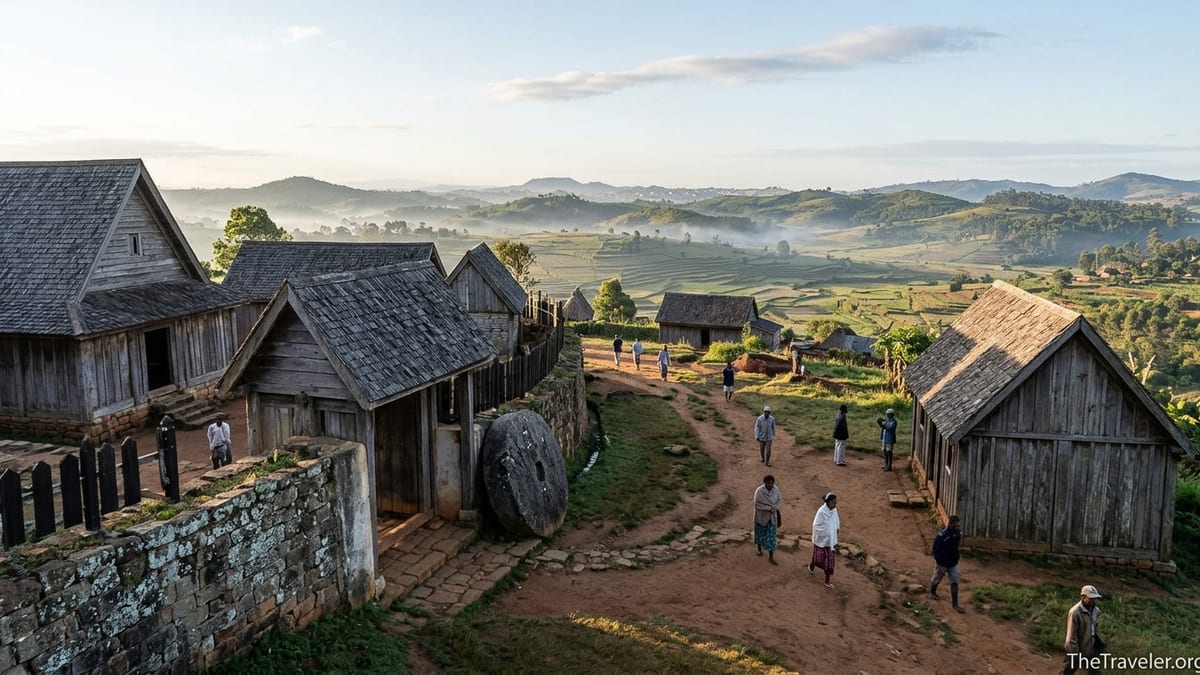
The heart of the site is the royal city, enclosed within walls and accessed through heavy stone gateways. One of the most striking sights on arrival is a massive circular stone slab that once rolled in front of the main gate as a kind of movable barricade. A guide may invite you to try nudging it to appreciate how many men once needed to work together to seal the entrance during times of threat.
Inside, the main royal residence is a tall, steep-roofed wooden palace in traditional highland style, sometimes complemented by a later stone-and-glass pavilion reflecting 19th century European influence. Visitors typically follow a route that leads through the courtyard, into the king’s house with its dark polished wooden interior, and then into side buildings associated with queens or royal relatives. Floorboards creak underfoot, and the smell of old wood and smoke lingers, making the experience feel closer to living memory than to distant ruins.
From the upper parts of the rova, terraces open onto superb viewpoints. On a clear dry-season morning, you might see the pale sprawl of Antananarivo about 20 kilometers to the south, with its own royal hill at Analamanga, while nearer slopes step down in a geometric mosaic of rice paddies. Photographers often spend time here in the late afternoon, using a mid-range lens to frame the combination of palace rooftops, sacred trees and the patterned fields below.
Do not rush the defensive features either. Encircling the hill is a system of earthen ditches and a chain of fortified gates that once controlled access for traders, messengers and pilgrims. Walking a short stretch of the outer paths with a guide, you can imagine how knowledge of these approaches would have been vital for both defenders and would-be attackers during regional conflicts in the 17th and 18th centuries.
Sacred Spaces, Royal Tombs and Living Rituals
Beyond its architecture, Ambohimanga is one of Madagascar’s most important living sacred landscapes. Several Merina kings and queens are buried here, including Andrianampoinimerina. Their tombs, grouped within the necropolis area, are more than historical monuments. For many Malagasy visitors, they are powerful focal points for asking ancestral blessing on family health, business ventures or travel.
You may witness small family groups arriving with offerings such as rum, soft drinks, rice, or a zebu shoulder bone. A local elder might pour a libation at a tomb or sacred stone, speaking softly in Malagasy to invoke the ancestors. On certain commemorative days, crowds swell and the atmosphere becomes almost festival-like, with pilgrims in their best lambahoany wraps, young children in tow and portable speakers playing Malagasy gospel or traditional hira gasy music outside the core sacred zones.
The sacred forest that clings to parts of the hilltop is just as significant as the tombs. Only fragments of the original highland forest survive in the region, and the groves here are protected as much for their spiritual value as for ecology. Many paths skirt around venerable trees that locals point out as sites where oaths were sworn or where the first Merina rulers are said to have communed with their ancestors. Cutting wood, gathering plants or even picnicking inside these groves is strictly avoided.
This ongoing ritual life is one reason Ambohimanga differs from the reconstructed royal compound in central Antananarivo. While the Queen’s Palace in the capital is steadily rebuilding after the 1995 fire, its activity today is mostly touristic and ceremonial. By contrast, Ambohimanga feels inhabited by invisible presences. As a visitor, it is crucial to remember that you are stepping into a place where local families may be engaged in serious spiritual business, not simply sightseeing.
Practical Access from Antananarivo and How Much Time to Allow
The Royal Hill of Ambohimanga lies roughly 20 to 24 kilometers north of central Antananarivo. Travel time varies widely with traffic and road conditions. In light city traffic early on a Sunday morning, a private taxi can make the trip in about 45 minutes. On a weekday afternoon, especially in the rainy season, the same journey from the downtown neighborhoods of Analakely or Isoraka can easily stretch to 1.5 hours each way.
Most independent travelers choose between three main options. A private taxi hired from a city hotel for a half-day excursion is the simplest. In 2026, visitors commonly report paying the equivalent of about 25 to 35 US dollars in local currency for a return trip that includes the driver waiting 2 to 3 hours at the site. Negotiating the total price and waiting time in advance is important, as meters are rarely used and fuel prices fluctuate.
Another option is arranging a car and driver through a local agency or guesthouse, often as part of a broader city tour that might also include the upper town, the Queen’s Palace area or a handicraft market. These day tours typically cost more per person but may bundle in guide services and lunch stops. Budget travelers occasionally use shared taxi-brousse services running toward Ambohimanga from northern districts of Antananarivo, but routes and departure points change often, and vehicles are crowded. For most short-stay visitors, this is less practical unless accompanied by a local friend.
To visit Ambohimanga without feeling rushed, allow at least 3 to 4 hours at the site itself, on top of travel time. That gives you space for a guided circuit of the royal compound, some unhurried moments at viewpoints, and quiet time to observe ritual spaces respectfully. If you have an intense interest in history, anthropology or photography, blocking out most of a day allows you to walk more of the outer fortifications and perhaps return to certain spots when light has changed.
Guides, Tickets, Opening Times and On-site Facilities
Entrance fees are modest by international standards, though they increase from time to time. Recent travelers generally report paying a few US dollars in local currency per adult, with a camera fee sometimes collected separately. It is wise to bring small notes and some coins, as card payments are not always possible and change can be limited. Children and Malagasy nationals often benefit from reduced rates, and school groups are a common sight.
Official opening hours typically run from morning to late afternoon, for example 8:00 to 17:00, but these can shift slightly with season, holidays or maintenance. If you are booking a driver or guide, plan to arrive no later than mid-afternoon so that you are not hurrying through the palaces before closing. Many travelers aim for a mid-morning arrival to take advantage of softer light, then return to Antananarivo mid-afternoon before traffic hits its peak.
At the main entrance, local guides are usually available. Hiring one is strongly recommended even if you have read extensively in advance. For a standard 1.5 to 2 hour tour, current informal rates often fall somewhere in the equivalent of 8 to 15 US dollars for a small group, depending on language, group size and your bargaining comfort. Look for guides who present an official badge or who are recommended by your driver or accommodation. A good guide will not only recount royal lineages but also explain which courtyards are still used for ceremonies, or why certain paths are avoided during specific months.
Facilities are basic but adequate for a half-day visit. There are simple toilets near the entrance and occasionally small stalls selling bottled water, soft drinks and packaged snacks, although supply can be irregular. It is sensible to bring your own water and perhaps a light snack purchased in Antananarivo, especially if traveling with children. Comfortable walking shoes are essential: paths inside the compound can be uneven, and in the rainy season they become slick with mud and moss.
Cultural Etiquette and Respectful Behavior
Much of the power of Ambohimanga lies in its continuing importance to local devotees, so etiquette is not an abstract set of rules but a way to avoid disturbing real spiritual practice. Dress modestly. For both men and women, this usually means shoulders covered and shorts or skirts that reach at least to the knee. Lightweight long trousers or a long skirt, paired with a T-shirt or light blouse, are practical in the highland climate and show consideration.
Photography is generally allowed in most outdoor areas, but flash and interior photography may be restricted in certain rooms or near tombs. When in doubt, ask your guide or a guardian with a simple “Azafady, afaka maka sary eto ve?” which means “Please, may I take a photo here?” in Malagasy. If a family is engaged in ritual at a tomb or sacred stone, it is best to keep a respectful distance and avoid photographing them without explicit permission. Many visitors choose instead to photograph architectural details or landscape views until the area is quiet.
Removing shoes before entering some interior spaces is customary. Follow your guide’s lead and watch what local visitors do. Smoking, loud music and eating inside the core sacred areas are inappropriate. If you are carrying a small speaker or using your phone for music, keep it off while on the hill. Even casual behaviors like leaning against tomb walls or sitting on ritual stones can be hurtful to local sensibilities, so treat anything that looks like a grave, altar or carefully arranged stone as off-limits for touching.
Finally, be prepared for small but meaningful interactions. An elderly caretaker might sprinkle a few drops of water at a threshold or quietly touch a doorframe before unlocking a palace room. Your guide may pause for a few seconds of silence at a tomb. Joining those moments by standing quietly instead of fidgeting or checking your phone is a simple but profound sign of respect, and many travelers later describe these as some of their most moving memories of the site.
Combining Ambohimanga with Other Sacred Hills and Sights Around the Capital
Geographically, Ambohimanga is just one of the traditional twelve sacred hills of Imerina that encircle Antananarivo and its surrounding valleys. Historically, these hills formed a symbolic network through which Merina rulers anchored their legitimacy. Today, a few of them are accessible enough to weave into a multi-day exploration from the capital, creating a deeper sense of context than a single site visit can offer.
A straightforward pairing is to visit Ambohimanga in the morning and then spend an afternoon in Antananarivo’s upper town. There you can tour the Queen’s Palace complex on Analamanga hill, walk past noble houses and churches that once served the court, and stop at the Museum of Photography to see archival images of both Ambohimanga and the capital’s rova. This contrast between the still forested spiritual hill and the denser, increasingly urban royal hill in the capital sharpens your understanding of how power shifted and modernized in the 19th century.
Travelers with extra time sometimes add another sacred hill such as Ilafy or Ambohitrabiby. These sites are less polished for tourism than Ambohimanga and may require a 4x4 vehicle, a local fixer and a flexible schedule. In return, they offer a chance to walk among quieter ruins, rural churches and village fields, seeing how elements of Merina royal history have been absorbed into everyday highland life. Specialized local agencies in Antananarivo occasionally advertise “twelve hills” themed itineraries for historically inclined visitors.
If your interests are broader than history, you can fold Ambohimanga into a mixed cultural and nature program. A common pattern is a three-day Antananarivo base that includes one day for Ambohimanga and the upper town, one for markets and craft centers such as the Digue artisanal market, and another for a day trip east to Andasibe for rainforest and lemurs. This provides a balanced snapshot of the highlands: spiritual landscapes, colonial and royal urban fabric, contemporary Malagasy city life and the island’s celebrated biodiversity.
The Takeaway
There are few places in Madagascar where political history, living spirituality and landscape come together as completely as on the Royal Hill of Ambohimanga. For the Merina kingdom, it was once both a royal capital and, later, a spiritual counterweight to the bustling court in Antananarivo. For today’s Malagasy visitors, it remains a place to seek ancestral blessing and to reconnect with highland identity. For travelers, it is an accessible yet deeply layered introduction to the cultural heart of the Central Highlands.
Planning a thoughtful visit asks a little more of you than simply booking a taxi. It means allowing enough time, hiring a knowledgeable local guide, respecting rules around photography and dress, and being ready to slow your pace when you encounter rituals or quiet moments. Approached in this spirit, Ambohimanga can transform from a checklist World Heritage stop into one of the most memorable experiences of a Malagasy journey, and an essential counterpart to the capital’s other sacred hills.
FAQ
Q1. How long do I need to visit the Royal Hill of Ambohimanga?
Most visitors should plan at least 3 to 4 hours on site, plus travel time from Antananarivo. This allows for a guided tour, time at the viewpoints and space to absorb the atmosphere without rushing.
Q2. How do I get to Ambohimanga from Antananarivo?
The simplest way is to hire a private taxi or car with driver from your hotel. The drive is roughly 20 to 24 kilometers and usually takes 45 minutes to 1.5 hours each way, depending on traffic and road conditions.
Q3. Do I need a guide at Ambohimanga?
Guides are not mandatory but are highly recommended. A local guide can explain the significance of the palaces, tombs and sacred spaces in a way that signs alone cannot. Their fees are modest and usually negotiated at the entrance.
Q4. What should I wear when visiting the site?
Dress modestly out of respect for local customs. Covered shoulders and shorts or skirts that reach at least to the knee are advisable. Comfortable walking shoes are important, as paths can be uneven and slippery in the rainy season.
Q5. Are there any restrictions on photography?
Photography is generally allowed in outdoor areas, but flash and interior photos may be restricted. Always ask before photographing people, rituals or tombs, and follow any instructions from your guide or site staff.
Q6. Can I visit Ambohimanga with children?
Yes, children are welcome and often enjoy exploring the palaces and viewpoints. Just be prepared to supervise them closely near steep drops, uneven steps and sacred areas where running or loud play would be inappropriate.
Q7. What facilities are available on site?
Facilities are basic. There are usually simple toilets near the entrance and occasional small stalls selling drinks and snacks, although these are not guaranteed. It is sensible to bring your own water and a light snack from Antananarivo.
Q8. Is Ambohimanga safe to visit independently?
The site itself feels calm and generally safe during opening hours. As in any large city region, use normal precautions when traveling to and from Antananarivo, keep valuables discreet and avoid walking isolated stretches after dark.
Q9. Can I combine Ambohimanga with other sights in one day?
Yes, many travelers combine a morning at Ambohimanga with an afternoon exploring Antananarivo’s upper town, the Queen’s Palace area or a handicraft market. With an early start, this makes a full but manageable day.
Q10. Why is Ambohimanga considered so important compared to other hills?
Ambohimanga was once a royal capital, later the spiritual heart of the Merina kingdom, and remains an active site of pilgrimage. Its combination of intact royal architecture, sacred forest and living ritual life gives it a unique status among the highland’s sacred hills.