

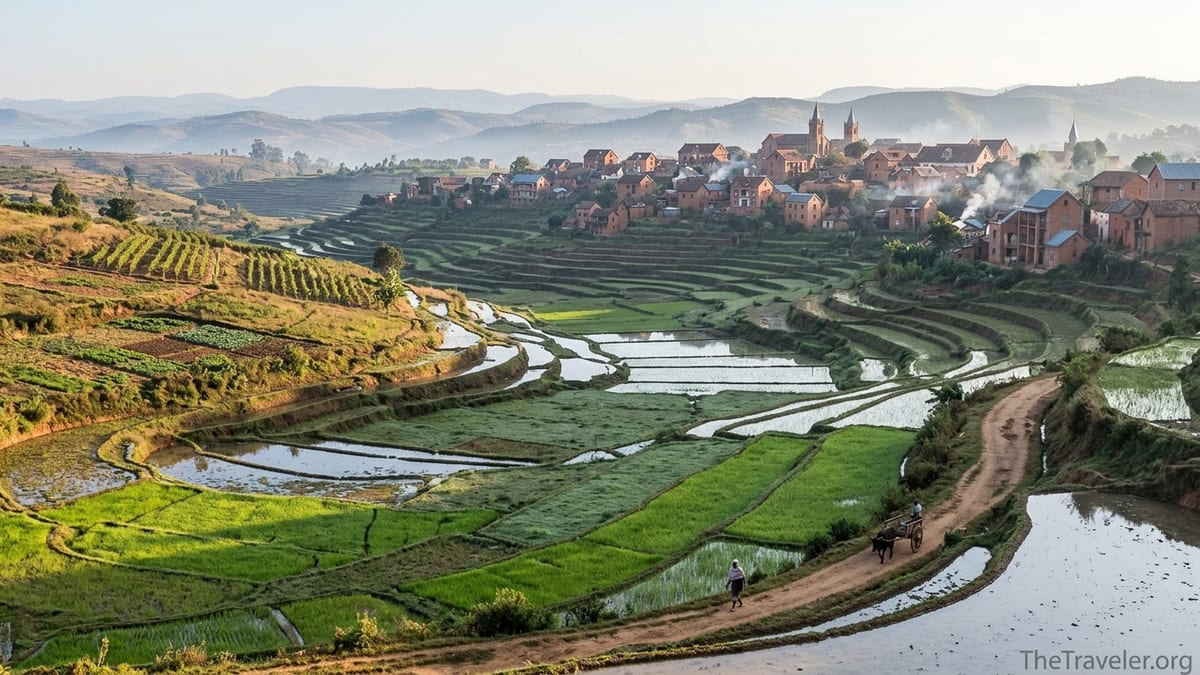
Most travelers on Madagascar’s famous RN7 road trip race straight past Fianarantsoa, overnighting on the way from Ranomafana to Isalo or Tuléar. That is a missed opportunity. Perched above a patchwork of rice terraces, ringed by vineyards and tea plantations, and rooted in the traditions of the Betsileo people, Fianarantsoa is one of the most rewarding bases in the southern Highlands if you know how to use it.
Understanding Fianarantsoa’s Role on the RN7
Fianarantsoa sits roughly 400 kilometers south of Antananarivo on Route Nationale 7, the backbone road that many first-time visitors follow from the capital down to the southwest. For most organized tours, the city appears as a simple line on the itinerary: "overnight in Fianarantsoa" between Ranomafana National Park and the canyons of Isalo. In reality, Fianarantsoa is the cultural capital of the Betsileo people and the gateway to some of Madagascar’s most atmospheric highland scenery, with terraced rice valleys, vineyard-dotted hills and tea-clad slopes spreading in every direction.
Travel times here are key to planning. Ranomafana to Fianarantsoa is usually 2.5 to 3 hours by private car or driver, depending on roadworks and traffic through the hills. Fianarantsoa to Ambalavao, the next main town on RN7 and a traditional wine and zebu-trading center, takes about 1.5 to 2 hours for the 55 to 60 kilometer stretch. Farther south, the long Fianarantsoa to Ranohira/Isalo leg is often quoted around 8 to 9 hours including stops. These distances mean Fianarantsoa can work either as a simple staging post or as a short base for day trips, provided you build the time in.
For independent travelers, it helps to think of Fianarantsoa less as a standalone "must-see city" and more as a hub that opens up the southern Betsileo highlands. The charm lies as much in the countryside as in the streets themselves: children wading in irrigation channels between bright green terraces, brick farmhouses reflected in flooded paddies, and small wineries or tea factories tucked into rolling hills. Used well, one or two full days based here can balance the forest walks of Ranomafana with a quieter, more cultural slice of highland life.
Haute-Ville: Historic Quarter Above the Rice Terraces
Fianarantsoa’s Haute-Ville clings to the upper slopes of the Ivoenana hill, a compact historic quarter about 300 meters higher than the bustling lower town. It was first laid out in the early 19th century, when the Merina kingdom established Fianarantsoa as its administrative center for the conquered Betsileo lands. Today the upper town still feels like a small, lived-in highland village: narrow cobbled alleys, rows of red-brick and stone houses with tiled roofs, and a string of churches along Rue du Rova that speak to the city’s reputation as a religious and intellectual center.
Most visitors explore Haute-Ville on foot, often in the late afternoon when the light turns soft and the terraced valleys below glow green and gold. A common route, followed by many local guides, starts from a small square near the cathedral, then zigzags uphill past wooden balconies and laundry lines to a belvedere with panoramic views over the rice fields and the newer town below. From here, on clear days, you can see the classic Betsileo landscape: neatly stepped paddies filling the valley floor, clay houses perched on knolls, and distant granite inselbergs on the horizon.
A guided walk of Haute-Ville typically takes 2 to 3 hours and can be arranged through guesthouses or small agencies in town. Expect to pay a modest fee that directly supports local guides; recent travelers report paying the equivalent of around 10 to 20 US dollars for a half-day private walking tour, especially if it includes a stop in a family courtyard or a small handicraft workshop. While you can wander alone, a guide will help you interpret details that are easy to miss, such as the layout of traditional Betsileo houses, church history, or the significance of nearby tombs on the hillsides.
Haute-Ville also works well as an evening destination even if you are just passing through. Many RN7 itineraries now include a quick sunset stop at the upper-town viewpoint, often after checking into a hotel in the lower town or on the outskirts. Even if you only have a single night, making time for this short climb connects the city’s skyline with the wider countryside you will explore the next day.
Terraced Rice Country and Surrounding Betsileo Villages
Beyond the city limits, Fianarantsoa quickly gives way to classic Betsileo countryside where rice is both staple crop and cultural anchor. The highland valleys are carved into terraces that catch and reflect the sky: in the rainy season they shimmer silver, in the growing months they glow a lush green, and after harvest they turn a textured patchwork of browns and ochres. Small villages sit on ridges between the fields, their red earth houses and tiled roofs almost the same color as the soil.
Several agencies in Fianarantsoa offer half-day and full-day walks into these rice-growing valleys, often billed as "Betsileo village" or "rice terrace" excursions. A typical half-day outing might take you 15 to 20 kilometers out of town by car before you start walking between paddies, visiting a hamlet where families dry rice or cassava in front of their homes and perhaps meeting local artisans such as potters at Ambatomainty or small-scale silkworm breeders in neighboring villages. Prices vary by group size and itinerary, but recent packages that include a vehicle, guide and village contributions frequently fall in the range of 30 to 60 US dollars per person for small groups.
Cultural etiquette matters in these landscapes. The Betsileo place strong importance on ancestor tombs, which dot the hillsides as whitewashed or stone structures, sometimes capped with zebu horns signifying wealth. Guides will point these out and explain why it is not appropriate to walk too close, sit on them or photograph ceremonies. They will also help you navigate more practical questions, such as when to remove shoes to cross irrigation channels or how to offer a small payment when asked before photographing people working in the fields.
If you have more time, it is possible to arrange multi-day treks that link Fianarantsoa with Ambalavao or run through the rural Betsileo heartland between the two. These routes often include homestays in villages, encounters with farmers, and chances to see seasonal events like savika, a traditional form of bull-wrestling that is especially associated with the Betsileo. Such treks are typically sold through specialist operators and are best reserved in advance, particularly if you are traveling in the dry-season high months from June to October.
Wine Country and the Sahambavy Tea Estate
One of the most distinctive features of the Betsileo Highlands is that this is Madagascar’s main wine region and also home to the country’s only large tea plantation. The hills around Fianarantsoa and Ambalavao have hosted vineyards since Jesuit missionaries planted vines here under French colonial influence. Today labels such as Lazan’i Betsileo, Clos Malaza, Coteaux d’Ambalavao and others from Famoriana and Isandra appear on restaurant tables throughout the region, even if production remains modest by global standards.
Wine experiences here are relaxed and rural rather than highly polished. A common day trip from Fianarantsoa visits a vineyard such as Clos Malaza or a producer in the Famoriana area, where you might walk through low trellised vines, peek into simple fermentation rooms and taste a glass or two of dry red or rosé while overlooking the surrounding valleys. Some RN7 group tours now build in a vineyard lunch stop near Ambalavao, often at lodges with terraces facing the vineyards and granite hills. Expect tastings to be informal and inexpensive by international standards, with a bottle sometimes costing roughly what a glass might cost in Europe.
For many travelers, though, Sahambavy is the standout agricultural visit. Around 20 to 25 kilometers east of Fianarantsoa, reached by a winding 35 to 40 kilometer drive on small roads, the Sahambavy tea estate spreads over hundreds of hectares of manicured tea bushes wrapped around a small lake. Established in the 1970s using cuttings imported from Kenya, it remains Madagascar’s only major tea plantation. Weekday visits usually include a walk among the rows of tea, a look at the processing facilities if they are operating, and tastings of the strong, malty black tea that locals compare to English breakfast blends.
Several lodges near the lake and in the surrounding hills make Sahambavy a pleasant half-day or full-day excursion from Fianarantsoa. Many organized itineraries, especially those marketed in Europe, now include a stop here on the day they drive between Ranomafana and Fianarantsoa or between Fianarantsoa and Ambalavao. If traveling independently, a private driver will typically wait while you tour the estate, with day rates commonly calculated to include a number of hours on call rather than just point-to-point transfers. A combined tea estate and rice terrace outing can easily fill a day and offers one of the clearest windows onto the Betsileo relationship with land, crops and water.
Ambalavao and the Southern Edge of the Highlands
South of Fianarantsoa, the road to Ambalavao marks the transition towards the drier south and the edge of the Betsileo highlands. Ambalavao itself, about 55 to 60 kilometers away, is regarded as one of Madagascar’s most attractive small towns, framed by rocky hills and surrounded by vineyards. It has long been a trading hub for zebu cattle, silk and rice, and in modern times is famous for producing Antaimoro paper, a handmade paper decorated with pressed flowers, along with its proximity to the Anja Community Reserve and the Andringitra and Tsaranoro massifs.
From Fianarantsoa, Ambalavao is realistic both as a half-day excursion and as an onward stop. If you leave Fianarantsoa early with a private driver, you could visit a vineyard en route, explore Ambalavao’s old streets and market, and continue a short distance to the community-run Anja Reserve to see ring-tailed lemurs clambering over granite boulders and basking in the sun. Many travelers choose to stay overnight at a lodge near Ambalavao or in the Tsaranoro Valley to break the journey to Isalo and to enjoy late-afternoon light on the cliffs, but it is technically possible to do Ambalavao as a there-and-back day from Fianarantsoa if your schedule does not allow a full relocation.
Beyond Ambalavao, the scenery changes again as you drop gradually out of the cool highlands towards the warmer savanna. For trekkers, this stretch opens Andringitra National Park and the Tsaranoro Valley, known for multi-day hikes and rock-climbing, often approached via Ambalavao with logistics arranged in Fianarantsoa or Antananarivo. Even if you do not plan serious trekking, a short detour into the foothills gives a striking sense of how the Betsileo highland terraces yield to the Bara and southern landscapes further down RN7.
When deciding whether to treat Ambalavao as just another stop on your way south or as an extension of your Fianarantsoa base, consider how interested you are in landscapes versus city time. If your priority is highland villages, rice terraces and tea fields, two nights centered on Fianarantsoa with a day trip towards Ambalavao may suffice. If you also want to experience the shift into the more dramatic granite massifs, distinct crafts like Antaimoro paper and the lemur-rich Anja Reserve at gentle pace, planning at least one night closer to Ambalavao makes more sense.
Transport, Drivers and How Long to Stay
Transport logistics often determine whether Fianarantsoa works best as a quick overnight or as a proper base. Public options exist in the form of bush taxis and minibuses along RN7, but schedules are fluid, vehicles are frequently crowded, and they do not easily accommodate side trips to tea estates, vineyards or remote villages. For travelers with limited time who want to explore the countryside around the city rather than just transit, hiring a driver with a car is usually the most practical choice.
Private drivers are commonly engaged for multi-day segments of RN7, starting in Antananarivo and continuing as far as Tuléar or vice versa. In this model, Fianarantsoa becomes one stop among many and the same vehicle can be used for day outings such as the Sahambavy tea estate, rice terrace walks or vineyard visits. Daily rates depend on the vehicle, fuel prices and negotiations, but many recent independent travelers report all-inclusive costs in the broad region of 60 to 100 US dollars per day for car and driver along RN7, shared between passengers. Local agencies based in Antananarivo, Antsirabe or Fianarantsoa can arrange this, as can many guesthouses along the route.
For those on tighter budgets, it is still possible to use Fianarantsoa as a base by combining public transport with local guides and short taxi rides. For example, you might arrive from Ranomafana by taxi-brousse, then hire a local guide to organize a half-day hike into nearby rice valleys starting directly from town. Another day, you could negotiate a one-off car hire or shared taxi to Sahambavy, returning on the same vehicle once your visit is finished. This piecemeal approach demands more time and flexibility, and you should always allow a buffer for delays, but it can make a two- or three-night stay in Fianarantsoa workable without a dedicated driver.
In terms of length of stay, a single night in Fianarantsoa is enough to see Haute-Ville briefly and perhaps fit in a quick photo stop at a rice terrace viewpoint on your way in or out. Two nights, giving you one full day, allows time for a proper walking tour of Haute-Ville plus a short countryside outing. Three nights unlock the best balance: you can combine Haute-Ville, a day trip to Sahambavy and rice terraces, and at least a partial excursion towards Ambalavao without rushing, all while remaining based in one guesthouse and using a local driver or guide.
Markets, Everyday Life and Betsileo Culture
While many visitors fixate on landscapes, Fianarantsoa’s markets and everyday scenes offer a clear window onto Betsileo culture. The lower town hosts busy markets where rice is sold in tall sacks, heaps of leafy greens spill over from woven baskets, and women in lamba wraps haggle for dried fish, beans and seasonal fruits. Arrive early in the morning and you will see farmers who have walked in from nearby villages unload cassava, sweet potatoes and poultry. Even if you are not shopping, wandering these markets with a guide can help you understand how central rice remains to Betsileo identity and diet.
Language and faith are important cultural markers here. The Betsileo speak their own dialect of Malagasy and have long been associated with both Protestant and Catholic missions, which is why Fianarantsoa is sometimes described as a spiritual capital of the highlands. The concentration of churches in Haute-Ville reflects this, and on Sundays it is common to see streets fill with worshippers in their best clothes, sometimes walking in from outlying settlements. With a guide’s help, you may be able to respectfully observe part of a service or hear local choral singing, which is a highlight for many culturally curious travelers.
Handicrafts also feature in the regional economy. Around Fianarantsoa and Ambalavao, workshops produce items such as Antaimoro paper, woven straw hats and bags, hand-dyed silk scarves and small carved wooden objects. Visiting a paper workshop, for example, typically involves watching bark pulp being spread on wooden frames, pressed with flowers and dried in the sun before being cut into lampshades, notebooks or cards. These visits offer a chance to support local artisans directly; prices are modest, but asking your guide to confirm fair rates and to steer you towards community-based initiatives can help ensure your spending benefits local families.
Understanding cultural norms is as important as appreciating crafts and food. The Betsileo, like many Malagasy groups, place strong emphasis on respect for elders and ancestors. This manifests in practices such as famadihana, the turning of the bones, where families periodically rewrap their ancestors’ remains in fresh shrouds and celebrate with music and feasting. Visitors are sometimes invited to witness, but such invitations should be treated with sensitivity and only accepted if accompanied by a trusted local intermediary to ensure that your presence is genuinely welcome.
The Takeaway
Fianarantsoa is not a big-hitting city in the sense of Antananarivo’s palaces or Isalo’s canyons, yet it is one of the most strategic and rewarding bases in the southern Highlands. The Haute-Ville historic quarter offers a compact slice of 19th-century highland architecture, set above a sea of rice terraces that define the Betsileo landscape. Within a short drive lie tea fields at Sahambavy, small vineyards in Famoriana and Isandra, village potters and farmers, and the first steps towards the dramatic granite country around Ambalavao and Andringitra.
Whether Fianarantsoa functions best as an overnight stop or a multi-day base depends on your priorities. If your main focus is wildlife and headline landscapes further south, one night to break the journey and a brief stroll through Haute-Ville may suffice. But if you want to understand how the Betsileo shape and live in their land, to walk between terraced paddies, sip tea where it is grown and taste locally made wine in sight of the vines, then planning two or three nights here with a driver or well-organized local guides will significantly enrich your RN7 journey.
Used thoughtfully, Fianarantsoa connects forest with savanna, tea with wine, and sacred hills with everyday markets. Rather than a mere dot between Ranomafana and Isalo, it can be the place where southern Madagascar’s Highlands begin to make cultural and geographic sense, turning a long transit route into a layered travel experience.
FAQ
Q1. Is Fianarantsoa worth more than a one-night stop on the way along RN7?
Yes, if you are interested in culture and landscapes. One night allows only a quick look at Haute-Ville, while two or three nights open time for rice terrace walks, Sahambavy tea estate and nearby vineyards.
Q2. Do I need a private driver to explore the Betsileo Highlands from Fianarantsoa?
A private driver is not strictly essential, but it makes visiting Sahambavy, vineyards and remote villages far easier. Public transport covers RN7 but rarely works well for side trips within a tight itinerary.
Q3. How many full days should I plan in Fianarantsoa itself?
One full day is the minimum to see Haute-Ville and a bit of the surrounding countryside. Two full days give time for both a rice terrace or village walk and a visit to Sahambavy or a vineyard.
Q4. Can I visit Sahambavy tea plantation as a day trip from Fianarantsoa?
Yes. Most travelers visit Sahambavy as a half-day or full-day excursion from Fianarantsoa, combining a short drive, estate tour and tea tasting before returning to their hotel in town.
Q5. Is Ambalavao realistic as a day trip from Fianarantsoa?
It is possible with an early start and a private car, allowing a few hours in Ambalavao and perhaps a quick stop at a nearby vineyard or Anja Reserve, but many travelers prefer to stay overnight near Ambalavao instead of backtracking.
Q6. Are there good guided walks in the rice terraces around Fianarantsoa?
Yes. Local agencies and guesthouses arrange half-day and full-day walks into Betsileo rice valleys and villages, usually including a guide, small community fees and sometimes a simple picnic.
Q7. What is the best season to use Fianarantsoa as a highland base?
The dry, cooler months from roughly May to October are often preferred, with clearer skies for views and more comfortable walking temperatures, though nights can be chilly and warm layers are needed.
Q8. Is Fianarantsoa safe to walk around, especially in Haute-Ville?
During daylight, walking in Haute-Ville and central areas with basic precautions is generally considered reasonable. As in most Malagasy cities, avoid carrying valuables openly and use taxis or go with a guide after dark.
Q9. Can I arrange treks to Andringitra or the Tsaranoro Valley from Fianarantsoa?
Yes. While most trekkers overnight closer to Ambalavao or in the valleys themselves, tour operators and guides can organize multi-day trekking logistics that start or finish in Fianarantsoa.
Q10. Are there English-speaking guides available in Fianarantsoa?
English-speaking guides exist but are fewer than French speakers. It is wise to pre-arrange guides through agencies, hotels or driver-guides, especially in high season, if you prefer explanations in English.