


A couple of hours west of Antananarivo, the highland fields suddenly give way to volcanic hills, mirror-flat water and hot springs. This is Ampefy and the Lake Itasy region, a long-time weekend escape for Antananarivo residents and an increasingly popular stop on Central Highlands tours. With waterfalls, cold-water geysers, village walks and easy viewpoints, it works equally well as a one-night side trip or a gentle link in a wider Highlands circuit.
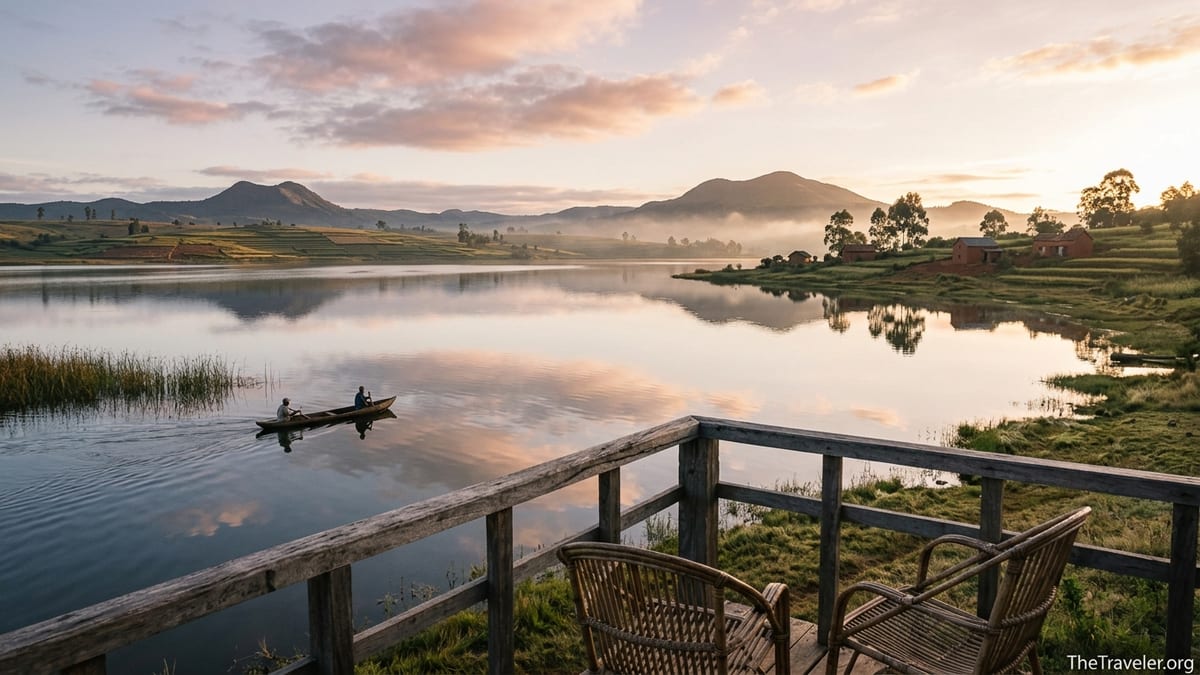
Why Ampefy Belongs on a Central Highlands Itinerary
Ampefy sits on the shores of Lake Itasy, roughly 120 kilometers west of Antananarivo, in the heart of Madagascar’s Central Highlands. In practical terms that means about 2.5 to 3.5 hours by car from the capital, depending on traffic leaving town and the state of the road around Analavory. The elevation, around 1,200 meters, keeps temperatures relatively mild compared with the coast. Days can feel warm in the sun, but evenings call for a light jacket even in summer.
Instead of rainforest or beaches, this is a landscape of rolling hills, terraced rice fields and old volcanic cones. Lake Itasy itself is one of Madagascar’s largest lakes, ringed by farmland and small villages. The appeal for travelers is not one single blockbuster sight, but the chance to slow down, walk or ride between viewpoints, visit the Lily Waterfall and the geyser field, then sit on a lodge terrace watching cattle being driven home along the lakeshore at dusk.
For visitors doing a classic Highlands route from Antananarivo towards Antsirabe and beyond, Ampefy is a natural first stop rather than a detour. Many operators now weave it into 7 to 10 day circuits that continue south via RN43 and RN7 towards Antsirabe, Ranomafana or even Morondava. Independent travelers can do the same by driving or hiring a car with driver from the capital to Ampefy, then continuing on to Soavinandriana and Antsirabe instead of returning to Antananarivo.
Ampefy also works well as a pressure-valve if you are in Antananarivo for work. Several local agencies advertise two-day “weekend in Ampefy” packages including transport, a night in a mid-range lodge, and visits to Lily Waterfall, the geysers of Analavory and a boat trip on the lake. For travelers with limited time, this is one of the easiest ways to get a taste of rural Highlands life without committing to a long overland journey.
Getting to Ampefy and Around the Lake
The most straightforward way to reach Ampefy from Antananarivo is by private car with driver. Local agencies and drivers who work with international visitors typically charge a daily rate that covers the vehicle, the driver and fuel. Expect to pay in the region of 250,000 to 350,000 ariary per day for a standard sedan used on paved roads, rising for larger 4x4s or if your itinerary continues further south. That can feel high by regional standards, but transport is often the most expensive part of travel in Madagascar.
The drive generally leaves Antananarivo on Route Nationale 1 towards Analavory before branching onto the regional road that heads south to Ampefy. This road has been improving, but you should still budget extra time for slow trucks, potholes and occasional roadworks. Agencies commonly quote three hours for the journey, but in practice it may be closer to 3.5 hours, especially on a Friday afternoon when many city residents are also leaving for weekend breaks.
Once in Ampefy, local movements are short but spread out enough to justify a vehicle. Lily Waterfall lies a short drive from the village, reached on a combination of paved and dirt roads. The geysers are typically approached via Analavory, about 10 kilometers from Ampefy, then along a 10 to 12 kilometer dirt track. In the dry season most sedans can manage with care, but in the rainy months a higher-clearance vehicle is far more comfortable. Some lodges can arrange local 4x4 transfers or motorcycle taxis to the geysers for an additional fee.
Public transport does run between Antananarivo, Analavory and Ampefy in the form of bush taxis, but departures are irregular and vehicles are often crowded. For budget travelers with time, this can be an adventure, but do not expect to comfortably fit Lily Waterfall and the geysers into a single day trip using only public transport. If you are short on time, it is worth pooling with other travelers to hire a car and driver through your guesthouse or a local agency.
Lake Itasy: Views, Boat Rides and Rural Life
Lake Itasy dominates the region both visually and economically. As you approach, the first impression is often the contrast between the dark, fertile soils and the reflective surface of the lake, framed by low volcanic hills. The lake supports fishing, small-scale irrigation and pockets of tourism, but it is still overwhelmingly a working rural landscape rather than a resort area.
Several lodges are set directly on the lakeshore or slightly above it on low bluffs. From these you can usually arrange a short pirogue trip with local boatmen, lasting 45 minutes to an hour. These outings rarely follow a fixed route; your boatman might steer you past the small Îlot de la Vierge topped by a white statue, along reed beds where herons and egrets feed, or close to shallower areas where fishermen set their nets at dawn and dusk. Prices are negotiable, but many travelers report paying an amount roughly equivalent to a simple restaurant meal for two for a private small-boat excursion.
Swimming in the lake is not widely recommended, partly because of health concerns such as bilharzia that affect many fresh water bodies across Madagascar. Even some local residents advise visitors to enjoy the lake from boats, lodges and viewpoints rather than entering the water. If you want to cool off, ask your lodge about safe options; some higher-end properties have small pools or outdoor showers where you can rinse off after a walk.
For photographers and walkers, the best times to appreciate Lake Itasy are the soft early mornings and the golden hour before sunset. In the dry season, light dust in the air can produce hazy, pastel sunsets behind the hills. During the rains the clouds themselves become the show, building over the ridges above the lake and sometimes clearing suddenly to reveal sharp reflections on the water. Either way, it is worth setting aside at least one unstructured afternoon simply to wander along the lakeshore footpaths or sit with a coffee on a terrace and watch village life unfold.
Lily Waterfall and the Geysers: Classic Day Circuit
Most visitors to Ampefy join a classic local circuit that links the Lily Waterfall, known as Chute de la Lily, with the geyser field near Analavory. Both can be comfortably visited in one day if you stay overnight in Ampefy and set out after breakfast, either in your own vehicle or with a local guide. Many hotels and guesthouses can connect you with guides who know the current state of the tracks and can help negotiate small entrance fees along the way.
Lily Waterfall is a broad, photogenic cascade around 20 to 25 meters high, fed by the Lily River, which drains Lake Itasy. A short trail leads from the parking area down to viewpoints opposite the falls. In the dry season, rocks around the main pool are exposed and you can scramble closer for photos. In the wet season, spray rises high and paths can be muddy, so sandals with good grip or light hiking shoes are helpful. Local guides often share the story that the waterfall was named after a girl who, according to legend, disappeared in the river; whether or not you believe the tale, it adds a layer of local color to the visit.
The geysers, reached via Analavory, are not towering geothermal jets but a set of low, cold-water springs that bubble up through mineral-encrusted mounds near the river. The site feels more like a curious open-air geology classroom than a spa, with rust-colored and white mineral deposits forming terraces around the vents. Simple wooden stalls sometimes sell snacks, drinks or local crafts. When the track is dry, it is a short walk between the main vents; in the rainy season, expect mud and bring shoes you do not mind getting dirty.
Combined, the waterfall and geysers make a varied excursion with enough walking and driving to fill four to six hours at a relaxed pace. Entrance fees are modest and often paid directly to local communities or site managers. Tour operators and lodges frequently bundle these fees into half-day packages with transport, so ask in advance whether the price you are quoted is all-inclusive or whether you should carry small bills in local currency for tickets and informal payments.
Village Experiences, Viewpoints and Outdoor Activities
Ampefy’s appeal lies in the wider landscape as much as in its two headline attractions. Even without a formal tour, you can easily spend a day exploring small roads and footpaths that lead to viewpoints over patchwork fields and volcanic hills. Some ridges above the lake offer wide panoramas that take in terraced rice paddies, scattered eucalyptus trees and the deep green of the lake itself. In practice, your driver or lodge host can usually suggest a couple of short walks that suit your time and fitness level.
Village life is very present. Children walk to school along the roadside, women wash clothes at communal taps or springs, and Zebu cattle are driven home in the late afternoon. Travelers who want a more structured village experience can arrange guided visits through lodges or local agencies, typically including a walk through fields, a stop at a small farm and sometimes a visit to a craft workshop. Fees are often modest but provide meaningful support to households that participate, especially when tips are handled transparently through a village committee or guide association.
Horse riding is another way to experience the highland scenery. A few ranch-style properties and riding-focused tour companies now include stages around Lake Itasy and Ampefy, using local horses accustomed to the terrain. Day rides may follow trails that contour above the Lily Valley or skirt small crater lakes, with picnic lunches in the shade of a eucalyptus grove. Organized multi-day highland riding trips sometimes include an overnight near the lake, before continuing towards other rural regions. If you are an experienced rider, it is worth asking operators in Antananarivo whether they can slot a day in Ampefy into a longer route.
Simple hikes are possible almost everywhere, but it is wise to take a local guide when leaving the main roads. This is partly for navigation, since many footpaths branch or cut across private land, and partly for safety. Guides can also interpret what you see, from crop choices and irrigation methods to local folklore attached to particular hills or streams. Typical guide fees for half a day in the Ampefy region are roughly equivalent to eating out once at a mid-range restaurant in the capital, and they can often be shared among two or three travelers.
Where to Stay and Eat in Ampefy
Accommodation around Lake Itasy has diversified in recent years. You will find a mix of long-established mid-range lakeside lodges, newer boutique properties positioned as highland retreats, and a handful of simple guesthouses in or near the village center. Rooms facing the water are in highest demand, especially on weekends and national holidays, so advance booking is important if your dates are not flexible.
Typical mid-range lakefront lodges offer en-suite rooms, hot water, and a restaurant that serves Malagasy and simple international dishes. Menus often feature freshwater fish, zebu steaks, rice in generous portions, and seasonal vegetables from nearby farms. Meal prices are generally lower than in Antananarivo’s tourist restaurants but higher than at basic roadside eateries, reflecting both the setting and the cost of bringing supplies in from the capital and regional centers.
Newer higher-end properties have begun to position Ampefy as a destination for domestic luxury tourism, with landscaped gardens, small pools and more design-focused interiors. These can be attractive for travelers who want comfort without flying to the beach, but they remain relatively few. At the other end of the spectrum, budget travelers can look for in-town guesthouses that offer simple rooms, shared facilities and a more local feel. In all cases, power cuts and patchy Wi-Fi are a reality, so come prepared with offline maps and a willingness to disconnect.
Dining options outside hotel restaurants are limited but growing. In the village, you may find small grills serving skewers and rice, or simple eateries selling daily specials at very modest prices. If you have dietary restrictions, discuss them with your lodge or guesthouse in advance. Many will happily adapt dishes, but availability of specific ingredients, especially imported items, can be unpredictable. Carrying a small stash of snacks from Antananarivo is always a good idea, particularly if you plan to be out walking or riding most of the day.
Day Trip or Overnight: Planning Your Short Break
In theory, Ampefy can be visited as a long day trip from Antananarivo. Agencies sometimes advertise itineraries that leave the capital early, drive directly to Lily Waterfall, continue to the geysers and return to town in the evening. On paper, this is possible, but it involves six to seven hours in the car for only a few hours on the ground. You are also at the mercy of traffic leaving and re-entering the city, as well as any delays on the rural roads.
In practice, Ampefy works better as at least an overnight stay, and ideally a two-night escape. With one night, you can arrive around lunchtime, enjoy a relaxed afternoon walk or boat ride on Lake Itasy, have dinner overlooking the water, then visit the waterfall and geysers the following day before returning to Antananarivo or continuing south. With two nights, you gain a full free day to add village walks, horseback riding or simply downtime on the lakeshore, which is exactly what draws many residents of the capital here on weekends.
For travelers planning a longer Central Highlands circuit, the most efficient pattern is often Antananarivo to Ampefy to Antsirabe, continuing onwards on RN7. This avoids backtracking and turns Ampefy into a scenic stepping stone between the capital and the southern highlands. Several tour operators already structure 10 to 14 day itineraries along these lines, combining Ampefy with Antsirabe’s crater lakes, Ranomafana’s rainforest and, in some cases, the dry forests and baobabs of the west coast. Independent travelers can mirror this structure while retaining flexibility over how long they linger at each stop.
Seasonally, the region is visitable year-round, but experiences vary. In the cool dry season from roughly May to October, skies are often clear and paths less muddy, but evenings can be quite chilly and the waterfall’s flow slightly reduced. In the warmer rainy months from November to April, hillsides are luminous green and the waterfall at its most powerful, but some dirt tracks, especially to the geysers and more remote viewpoints, can become slippery or rutted. If you plan to visit in the wet season, factor some flexibility into your schedule in case you need to swap activities between days.
Practical Tips for a Safe and Responsible Visit
Although Ampefy is a gentle destination compared with some of Madagascar’s more remote parks, it still pays to prepare. Cash is important. Outside of higher-end lodges, card payments are rare, and ATMs in small towns can be unreliable or absent. Bring sufficient local currency from Antananarivo to cover entrance fees, boat rides, guide services, meals and tips. Keeping a mix of smaller and larger bills makes routine transactions smoother and helps avoid uncomfortable situations when change is scarce.
Health-wise, talk to a travel medicine specialist before arriving in Madagascar about general vaccinations and malaria prevention. The highlands, including Ampefy, may have lower malaria risk than the coastal lowlands, but you should still take mosquito precautions. Pack repellent, long sleeves for evenings and, if you are particularly sensitive, a light sleeping bag liner or travel net, even if your lodge provides one. As noted, avoid swimming in fresh water unless a reliable local medical source specifically confirms it is safe, and stick to bottled or filtered water for drinking and teeth brushing.
Respectful behavior goes a long way in small highland communities. Ask before photographing people, especially children or anyone engaged in religious or ceremonial activities. Dress modestly in villages and at viewpoints, even if your lodge feels relaxed. When negotiating guide fees or boat rides, remember that the amounts may be small in foreign currency terms but significant locally; bargaining is part of the culture, yet aggressive haggling over the equivalent of a few dollars can sour interactions.
Finally, consider the environmental impact of your visit. Stick to established paths around Lily Waterfall and the geysers to avoid trampling vegetation or damaging fragile mineral formations. If your lodge offers the chance to support local conservation or community projects, such as tree planting or school initiatives, ask how contributions are managed and what outcomes they support. Choosing operators who prioritize local employment and fair wages helps ensure that Ampefy’s growing popularity as a Highlands excursion benefits the people who call Lake Itasy home.
FAQ
Q1. Is Ampefy realistic as a day trip from Antananarivo?
It is technically possible as a long day trip, but expect six to seven hours of driving for only a brief visit. Most travelers find that staying at least one night in Ampefy makes the journey far more rewarding and less tiring.
Q2. How long should I stay in Ampefy and the Lake Itasy area?
One night allows for a quick taste of the lake, Lily Waterfall and the geysers. Two nights provide a full day for walks, village visits or horse riding and are ideal if you want to relax.
Q3. What is the best way to get from Antananarivo to Ampefy?
The most practical option is to hire a car with driver through a local agency or your hotel in Antananarivo. The journey usually takes around three hours each way, depending on traffic and road conditions.
Q4. Can I swim in Lake Itasy or at Lily Waterfall?
Swimming is not recommended because of potential health risks in fresh water, including parasites. It is safer to enjoy the lake from boats, viewpoints and lodge terraces rather than entering the water.
Q5. Are the geysers near Ampefy hot like in other volcanic areas?
No, the geysers near Analavory are cold-water springs that bubble up through mineral deposits. They are interesting geological features to see and photograph, but not hot pools for bathing.
Q6. Do I need a guide to visit Lily Waterfall and the geysers?
You can reach both sites by vehicle, but hiring a local guide is recommended. Guides help with navigation, local fees, safety on muddy paths and cultural context, and your payment supports the community.
Q7. What kind of accommodation is available in Ampefy?
You will find mid-range lakeside lodges, a few higher-end retreats and simple guesthouses in or near the village. Lakeside rooms are popular on weekends, so advance reservations are advisable.
Q8. When is the best time of year to visit Ampefy?
The region is visitable year-round. The dry season from about May to October offers clearer skies and easier road conditions, while the rainy months bring greener landscapes and a more powerful waterfall but muddier tracks.
Q9. Can Ampefy be combined with other Highlands destinations?
Yes. Many travelers travel from Antananarivo to Ampefy and then continue south to Antsirabe and beyond along RN7. This makes Ampefy a natural stop in a wider Central Highlands circuit rather than an isolated excursion.
Q10. Is Ampefy suitable for families or first-time visitors to Madagascar?
Ampefy is well suited to families and first-time visitors. Distances are manageable, activities are gentle, and the landscape offers a soft introduction to rural Madagascar before tackling more remote parks or longer road journeys.