


The Pangalanes Canal on Madagascar’s east coast is less a single waterway than a chain of lakes, rivers and man-made channels, stitched together behind the surf of the Indian Ocean. For travelers it offers a slow, close-up look at rainforest, fishing villages and palm-fringed lakes that road travel on the busy RN2 can never match. This guide focuses on how to experience the canal in practice, especially the popular Manambato to Akanin’ny Nofy and Akanin’ny Nofy to Toamasina sections that now anchor many two and three day eastern itineraries.
Understanding the Pangalanes Canal Today
The Pangalanes Canal stretches for more than 600 kilometers along Madagascar’s east coast, linking a chain of freshwater lakes and lagoons between Toamasina in the north and towns such as Mananjary and Farafangana in the south. In colonial times it was engineered to shelter river traffic from the rough Indian Ocean, and today it remains a vital transport corridor for local communities as well as an increasingly popular route for visitors. Travelers sharing the water with barges loaded with timber, dugout canoes full of bananas and schoolchildren commuting between villages quickly see that this is a living waterway, not a theme-park cruise line.
From a visitor’s perspective, the canal is best thought of in sections rather than as one continuous trip. The northern and most visited stretch runs between Manambato, Akanin’ny Nofy and Toamasina, where lakes Rasoabe and Ampitabe open out into broad, calm expanses framed by traveller’s palm, pandanus and low rainforest. This is the area most tour operators feature, often as a two or three day side trip combined with Andasibe-Mantadia National Park or Sainte Marie Island. South of Toamasina the canal becomes more remote and less regularly maintained, suited mainly to expedition-style trips.
Official regional tourism information for the east coast highlights short to medium journeys on well-maintained portions of the canal rather than full-length expeditions. In practice that means focusing on boat transfers and excursions around Manambato and Akanin’ny Nofy, and day or overnight journeys linking Akanin’ny Nofy to Toamasina. These sections offer a good mix of scenery, practical logistics and reasonably reliable boat services, making them the logical choice for most first-time visitors.
Because the canal is used primarily by local residents, facilities along the banks are still limited compared with better-known river journeys in other parts of the world. Travelers should expect a mix of simple village landings and a small number of established lodges, and should be prepared for flexible schedules rather than fixed departure times. The reward for embracing that slower rhythm is the sense of moving through an everyday Malagasy landscape rather than a packaged attraction.
Key Sections and Embarkation Points
Most travelers access the Pangalanes via two main gateway towns. From Antananarivo, the standard route follows the RN2 east to the Andasibe area, then continues to the lakeside hamlet of Manambato, which functions as the principal southern embarkation point for trips to Akanin’ny Nofy. Manambato itself is a small, sandy settlement on the shore of Lake Rasoabe, with a handful of lakeside bungalows and basic restaurants. Vehicles cannot reach the canal directly, so drivers typically drop guests at the lakeside landing where motorboats wait for scheduled and charter transfers.
The boat ride from Manambato to Akanin’ny Nofy takes around one and a half hours in normal weather. Operators based at Manambato and at lodges on Lake Ampitabe run small covered motor launches, usually seating between 8 and 20 passengers. Departures are often coordinated with arriving vehicles from Antananarivo and Andasibe. Travelers who arrive without a pre-booked transfer can often negotiate directly with local skippers at the lakeside, but should not rely on late-afternoon departures, since most boats aim to travel in daylight.
Akanin’ny Nofy, also known as Palmarium, is the main overnight hub in the northern canal. It sits on a peninsula between Lake Ampitabe and the canal itself, with a cluster of lodges offering wooden bungalows, small jetties and private boats for excursions. Most itineraries use Akanin’ny Nofy either as a base for two nights of exploration or as a stepping stone on a longer journey north to Toamasina. The fact that established lodges maintain their own boats makes arranging onward navigation considerably easier than in more remote sections.
Toamasina, Madagascar’s largest port and the principal city of the east coast, forms the northern anchor of mainstream canal travel. A small river station several kilometers from the city center serves as the canal terminal, where commercial barges and passenger boats depart for Akanin’ny Nofy, Ambila-Lemaitso and occasionally as far south as Manambato when water levels allow. Travelers arriving in Toamasina by domestic flight or road can either join a scheduled boat or charter a smaller vessel through a local agency or hotel. Two and three day programs that combine Toamasina, Akanin’ny Nofy and Manambato have become a standard suggestion from both official tourism offices and private operators.
Boat Types, Comfort Levels and Typical Costs
On the Pangalanes Canal travelers encounter three broad categories of boat. The most common are narrow wooden pirogues, some still paddled, others motorized, used by local residents to move between villages. Visitors may ride in these for short hops to markets or for a quick crossing to a nearby settlement, but they are rarely used for longer tourist itineraries because of comfort and safety considerations.
For regular transfers between Manambato, Akanin’ny Nofy and Toamasina, small motor launches are the norm. These fiberglass or wooden boats often have outboard engines of 40 to 75 horsepower, a partial canopy and simple bench seating with lifejackets on board. When booked through a lodge or agency, the journey is usually priced per person, with approximate rates for Manambato to Akanin’ny Nofy commonly falling in the range of the equivalent of 15 to 30 euros each way depending on group size and whether the transfer is private. Akanin’ny Nofy to Toamasina, which is longer, typically costs more, and is often bundled into multi-day packages rather than sold as a standalone ticket.
A smaller number of operators run larger, slower wooden barges or houseboat-style vessels for multi-day cruises. These boats may offer a shaded upper deck, simple cabins or sleeping mats, and a small galley, aiming at groups who want to spend several days on the water, stopping at villages and lakeside beaches along the way. Because these cruises are usually on a charter basis, prices vary widely, but a private two or three day trip for four to eight travelers is often quoted in the low hundreds of euros per day including crew and basic meals. These options are best arranged in advance through specialized agencies who know current water levels and local conditions.
Regardless of boat type, standards of maintenance and safety equipment can vary. Travelers should check for the presence of lifejackets in usable condition, a sun canopy and, where possible, communications equipment. Basic questions about fuel reserves and estimated travel time are reasonable to ask. Boatmen are generally experienced with local currents and weather, and will often adjust departure times during the rainy season to avoid afternoon storms. Tipping a helpful skipper at the end of a journey is appreciated but not obligatory.
Short Excursions vs Multi-Day Journeys
The official tourism board’s messaging and most current itineraries emphasize two and three day journeys on portions of the canal rather than full-length expeditions. In practice, travelers choose between short day trips and immersive multi-day routes. Day excursions usually operate out of Akanin’ny Nofy or Toamasina. From Akanin’ny Nofy, for instance, a lodge boat might take guests to a nearby fishing village in the morning, stop at a lakeside beach for swimming and picnic lunch, and return via a detour through reed beds where herons and kingfishers hunt.
From Toamasina, half-day trips often head south along the canal to visit small riverside settlements, clove and lychee plantations or simple lakeside resorts accessible only by water. These outings are well suited to travelers who have limited time on the east coast or who prefer to keep their base in the city. They also offer a useful introduction to canal life before committing to longer journeys with more basic facilities.
A classic two day itinerary links Manambato, Akanin’ny Nofy and Toamasina in one direction. One example sees travelers drive from Antananarivo to Manambato in the morning, transfer by boat to Akanin’ny Nofy in the afternoon, then spend the night at a lakeside lodge. The following day is devoted to a longer navigation up the canal to Toamasina, with stops at villages and sand spits where the freshwater canal runs within a narrow strip of dunes from the Indian Ocean. By early afternoon the boat reaches the river station near Toamasina, from where travelers continue to city hotels or onward flights.
Those with more time might opt for three days, which allows two nights at Akanin’ny Nofy with a full day dedicated to local exploration. This usually includes a guided walk in the palm-rich forest of the peninsula, a night excursion to look for nocturnal lemurs, and additional time on the water among the surrounding lakes. For more adventurous travelers, some agencies arrange longer, less predictable trips south of Toamasina towards Vatomandry or Mananjary, using village homestays or very simple lakeside camps. These routes require flexibility over comfort and are best considered only with a reputable guide who knows the canal intimately.
Villages, Lakes and Rainforest Scenery Along the Way
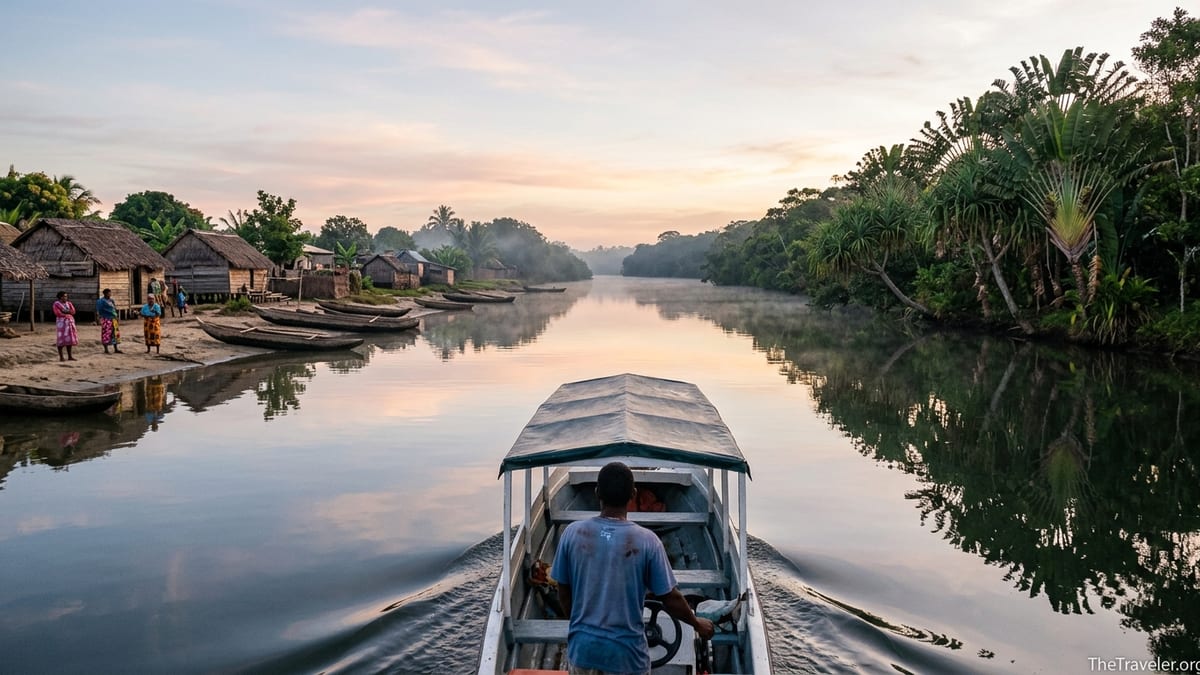
One of the defining pleasures of the Pangalanes is the variety of landscapes and human scenes that unfold along even a short journey. As boats leave Manambato, for example, they pass fishermen standing waist-deep in Lake Rasoabe, casting nets in the soft early light. A little further on, reed-fringed channels give way to open sections where the opposite bank is just a slim ribbon of sand separating the calm canal from the pounding surf of the ocean beyond. In these places it is often possible to step ashore and hear both the quiet slap of water against the boat and the distant roar of waves.
Approaching Akanin’ny Nofy, the scenery becomes greener and more enclosed. Stands of ravenala, the traveller’s palm that has become a symbol of Madagascar, mix with pandanus, coconut palms and low coastal forest. On misty mornings, the far shore of Lake Ampitabe can vanish into grey, with only the silhouettes of pirogues moving slowly across the water. Travelers frequently report sightings of kingfishers, herons and the occasional fish eagle, particularly around quieter inlets where boats idle at low speed.
Villages along the canal vary from tiny clusters of thatched huts to larger settlements with simple wooden churches, school buildings and small kiosks selling biscuits, soft drinks and phone credit. Many of these communities rely almost entirely on the waterway for transport. Children paddle to school in narrow canoes, women wash clothes on the banks, and men haul bundles of firewood or sacks of charcoal onto low barges. With a guide’s help, visitors can arrange short walks ashore to visit local markets or see how traditional wooden pirogues are carved from single logs.
Respectful behavior is important in these settings. Asking permission before photographing people, dressing modestly when visiting villages and avoiding gifts that might encourage begging all help maintain good relations. Buying fruit, handmade mats or simple snacks provides a direct benefit to local families. In some areas, lodges have partnerships with nearby communities to support school projects or environmental initiatives, and guests may be invited to visit these as part of their stay.
Weather, Seasons and What to Pack
The east coast of Madagascar is humid and receives significant rainfall throughout the year, with the wettest months generally falling between December and March. During this period heavy showers and occasional cyclones can disrupt travel, raise water levels and increase the strength of currents in some sections of the canal. Outside this core rainy season, conditions are usually more stable, with drier weather from roughly April to November and slightly cooler temperatures in the austral winter months of June to August.
Even in the drier months, travelers should expect at least some showers and high humidity. Light, quick-drying clothing is preferable to heavy fabrics, and a compact waterproof jacket or poncho is useful for sudden downpours during boat rides. Sun exposure can be intense on open stretches of water, so a wide-brimmed hat, sunglasses and high-factor sunscreen are essential, especially on longer legs such as Akanin’ny Nofy to Toamasina. Sandals with a secure strap or light walking shoes are practical for clambering in and out of boats on muddy banks.
Luggage works best when kept compact and easy to handle. Soft duffel bags or backpacks are more practical than hard suitcases, which can be awkward to load into narrow boats or carry along sandy paths to lakeside bungalows. Many travelers leave large bags in Antananarivo or Andasibe and take only smaller overnight bags to the canal. Within boats, luggage is often stacked at the front under a plastic sheet or tarp, so valuables such as cameras and passports should be kept in a daypack that stays with you.
Because departures and arrivals may involve some waiting at informal landings, it is sensible to carry drinking water, insect repellent and a small snack. Mosquitoes are present along the canal, particularly around dusk, so long sleeves and repellent help reduce bites when sitting outside at lodges or on deck. Travelers should seek medical advice before arrival about malaria prophylaxis and other vaccinations, and ensure they carry any personal medication in original packaging.
Accommodation on and Around the Canal
Accommodation along the Pangalanes Canal ranges from simple village stays to mid-range lodges with private bungalows and direct water access. In the Manambato area, a small group of lakeside hotels and guesthouses provides basic but comfortable rooms, often in individual bungalows set among gardens or along a sandy lakeshore. Facilities here typically include ensuite bathrooms with solar-heated or gas-heated water, mosquito nets and on-site restaurants serving grilled fish, rice and seasonal fruit. These properties are popular with both Malagasy families and international visitors, so advance bookings during school holidays are advisable.
Akanin’ny Nofy, perched between Lake Ampitabe and the canal, has become the best-known accommodation hub on this stretch. Several lodges offer wooden chalets or bungalows on stilts, some with direct views over the water, connected by sandy paths through palm and bamboo groves. Most places include half-board or full-board arrangements in their rates, which simplifies logistics on a peninsula reachable only by boat. Typical inclusions are breakfast and dinner, with lunch available a la carte or as part of an excursion. Prices are generally moderate by international standards but high relative to local incomes, reflecting the cost of transporting supplies by boat.
In Toamasina, travelers find a wider range of hotels from simple city guesthouses to more polished business-style properties. Many people choose to stay in town before or after canal trips to take advantage of better road connections, ATMs and shops. Some Toamasina hotels have established relationships with boatmen and agencies, and can help arrange transfers to Akanin’ny Nofy or day trips along the canal. When evaluating options, it can be useful to ask about secure storage for excess luggage and the possibility of early breakfasts to match morning boat departures.
Overnighting on the water itself remains relatively uncommon in this region compared with some Asian or African river systems, but a few operators offer basic live-aboard experiences. These can be appealing to small groups who want maximum time on the canal and are comfortable with rustic conditions such as shared facilities and simple mattresses under mosquito nets. Anyone considering such a trip should check how meals, drinking water and sanitation are handled, and clarify whether bedding is provided or if sleeping bags are required.
Practical Tips for a Smooth Canal Experience
Because infrastructure on the Pangalanes is limited, a little preparation goes a long way toward avoiding frustration. One of the most important decisions is whether to book services independently on the ground or through a tour operator. Confident, French-speaking travelers with flexible schedules may enjoy negotiating directly with lodges and local boatmen, especially outside peak travel periods. Others, particularly those on tight timelines or with limited language skills, often find it easier to arrange a package that includes road transfers, boat journeys and accommodation as a single itinerary.
Timing is another key factor. Boating is safest and most enjoyable during daylight hours, both for navigation and for views. Early morning departures are common, not only because the water is often calmer but also because storms are more likely to develop in the afternoon during the rainy season. Travelers should avoid planning tight same-day connections with domestic flights or long road journeys, as delays caused by weather, mechanical issues or loading of cargo can easily push arrival times back by an hour or more.
Cash management deserves special attention. Outside Toamasina and the larger towns along the RN2, there are few ATMs and many lodges on the canal do not accept cards or may experience connectivity problems. Carrying enough local currency to cover drinks, tips, small purchases and any activities not already included in your package is advisable. When budgeting, remember that fuel costs have a direct impact on boat prices, so fares quoted in guidebooks may lag behind current reality.
Language and communication also shape the experience. Malagasy and French are the dominant languages along the canal, and English is not widely spoken outside guides and some hotel staff. Learning a few basic Malagasy greetings and phrases of thanks is appreciated, and can open doors during village visits. Mobile phone coverage is patchy but generally improves near towns. Some lodges provide limited Wi-Fi, though connections are often slow. Travelers who treat connectivity as a bonus rather than a necessity tend to enjoy the canal’s slow rhythm more fully.
The Takeaway
For travelers willing to slow down and adapt to local rhythms, the Pangalanes Canal offers one of Madagascar’s most atmospheric journeys. Rather than racing from sight to sight, visitors drift between lakes and lagoons, watching everyday life unfold along the banks and catching glimpses of coastal forest that has disappeared elsewhere. The presence of established embarkation points at Manambato, Akanin’ny Nofy and Toamasina makes it possible to explore this world in bite-sized sections that fit comfortably into a two or three day itinerary.
Choosing between a simple day excursion and a multi-day journey depends largely on time, budget and appetite for rustic conditions. Even a single transfer from Manambato to Akanin’ny Nofy can give a strong sense of the canal’s character, while a longer route to Toamasina adds extra layers of scenery and village encounters. With realistic expectations about comfort levels, weather and logistics, the experience can be both memorable and relatively straightforward to arrange.
Above all, the canal rewards travelers who see it as more than a scenic backdrop. Taking time to talk with boat crews, buy fruit at a village landing or walk a few hundred meters inland from the water’s edge reveals how closely intertwined the canal is with the daily lives of the communities it serves. In return, visitors gain a window into an east coast landscape that still feels far removed from the main currents of global tourism.
Building your route around the Manambato to Akanin’ny Nofy and Akanin’ny Nofy to Toamasina sections matches current recommendations from local tourism bodies and on-the-ground operators, and offers a practical, rewarding way to experience the Pangalanes. From there, more adventurous travelers can push further along the canal’s quieter reaches, while others can carry on to Andasibe’s rainforests or the beaches of Sainte Marie, carrying with them memories of early morning mist over still water and the low thrum of a boat engine cutting a path through reeds.
FAQ
Q1. How many days do I need to experience the Pangalanes Canal?
Most travelers find that two or three days on the canal is enough for a satisfying experience, especially when combining Manambato, Akanin’ny Nofy and Toamasina. Shorter day trips are possible from Akanin’ny Nofy or Toamasina, while longer expeditions south of the main tourist stretch suit those with more time and a taste for adventure.
Q2. Is it better to start from Manambato or Toamasina?
Starting from Manambato works well if you are coming overland from Antananarivo or Andasibe, as you can drive in the morning and reach Akanin’ny Nofy by afternoon. Beginning in Toamasina is convenient if you fly to the east coast or want a city base before and after your canal trip. Many itineraries combine both, traveling in one direction by boat between Manambato, Akanin’ny Nofy and Toamasina.
Q3. Do I need to book boat trips in advance?
For high season, school holidays or if you are on a tight schedule, advance booking through a lodge or tour operator is strongly recommended, especially for the Manambato to Akanin’ny Nofy and Akanin’ny Nofy to Toamasina segments. Outside peak times it is sometimes possible to arrange transfers on the spot, but travelers should be flexible about departure times and boat types.
Q4. What level of comfort should I expect on the boats?
Most tourist boats are small motor launches with bench seating, a sun canopy and basic safety equipment. They are functional rather than luxurious. Multi-day cruise boats, where available, may offer simple cabins or sleeping mats and basic onboard meals, but standards are generally rustic. Travelers who value air conditioning and upholstered seats may find conditions spartan but still manageable for the relatively short travel times involved.
Q5. Is it safe to travel on the Pangalanes Canal?
The canal is a routine transport route for local communities, and accidents are relatively rare. That said, safety standards vary, so it is wise to choose reputable operators, check for lifejackets and avoid traveling in poor weather or after dark. As with any water-based activity, travelers who cannot swim should inform their guide and wear a lifejacket throughout the journey.
Q6. What is the best time of year to visit?
Conditions are usually most pleasant from around April to November, outside the peak rainy and cyclone season. During these months there is still some rain, but generally fewer heavy storms and more comfortable temperatures. Visiting in the wettest period, typically December to March, can still be rewarding but involves a higher chance of disrupted schedules and rougher conditions.
Q7. Can I visit villages along the canal?
Yes, many itineraries include short stops in fishing or farming villages to walk through markets, watch canoe building or buy fruit and handicrafts. These visits should always be arranged with a guide who knows local customs. Asking permission before taking photographs, dressing modestly and supporting local businesses rather than giving handouts helps keep interactions respectful and sustainable.
Q8. What should I pack specifically for the canal portion?
For the canal itself, prioritize light clothing, a waterproof layer, sun protection, insect repellent, a hat, and secure footwear for stepping on and off boats. A small dry bag for phones and cameras is useful during sudden showers. Soft luggage is much easier to handle than hard suitcases, and keeping a daypack with valuables and essentials separate from checked bags simplifies boarding and disembarking.
Q9. Are there options for higher-end accommodation?
While the east coast is not as developed as some other regions, a handful of lodges around Akanin’ny Nofy and better hotels in Toamasina offer comfortable rooms with private bathrooms, hot water and decent dining. These would be considered mid-range by international standards rather than luxury in the strict sense, but they provide a good level of comfort after a day on the water.
Q10. Can I combine the Pangalanes Canal with other Madagascar highlights?
Yes, and many itineraries do exactly that. A common combination links Antananarivo, Andasibe’s rainforest and lemur reserves, the Pangalanes Canal around Manambato and Akanin’ny Nofy, and then flights or road transfers onward to Sainte Marie Island or other coastal destinations. This mix offers wildlife, culture, slow water travel and beach time within a two to three week trip.