


Andasibe-Mantadia National Park is the easiest place in Madagascar to step straight into a living rainforest and meet the country’s most iconic resident: the haunting, whale-voiced indri. Just three to four hours by road from Antananarivo, this lush protected area combines accessible trails, memorable wildlife encounters and comfortable lodges, making it a natural anchor at the beginning or end of any eastern Madagascar circuit.
Understanding Andasibe, Analamazaotra and Mantadia
When travelers talk about “Andasibe,” they are usually referring to a cluster of protected forests on the eastern escarpment, about 140 to 150 kilometers east of Antananarivo. The official protected complex is Andasibe-Mantadia National Park, which has two main sections: the Analamazaotra Special Reserve in the south, near the village of Andasibe, and the larger, wilder Mantadia National Park about 20 kilometers to the north. On the ground, you will see all three names used interchangeably, which can be confusing when you start planning.
Analamazaotra, also known by its old name Périnet, is the compact, heavily visited section right above most lodges. Trails here are shorter and more maintained, and several family groups of indri are habituated to people, which gives this sector a reputation for near-guaranteed sightings on a morning walk. Mantadia covers a much bigger block of higher, rougher forest accessed by a rough track that usually requires a 4x4 vehicle; its appeal lies in fewer people, wilder forest and better chances for rare birds and shy lemurs.
The village of Andasibe itself forms the practical base for both areas. A small strip of roadside restaurants, grocery stalls and simple hotels serves as the gateway, while the more comfortable lodges tend to sit back from the main road along side tracks facing the forest. Whichever property you choose, plan on driving or being driven to the relevant park entrance each day and arranging your walks through the official park guide association or your tour operator.
For itinerary planning, it helps to think of Analamazaotra as the introduction: easier trails, predictable indri and a first taste of humid-forest wildlife. Mantadia is the logical follow-up for travelers who want one or two longer, tougher hikes in more pristine habitat, focusing on birds, orchids and less commonly seen lemurs.
Indri Encounters and Other Lemurs
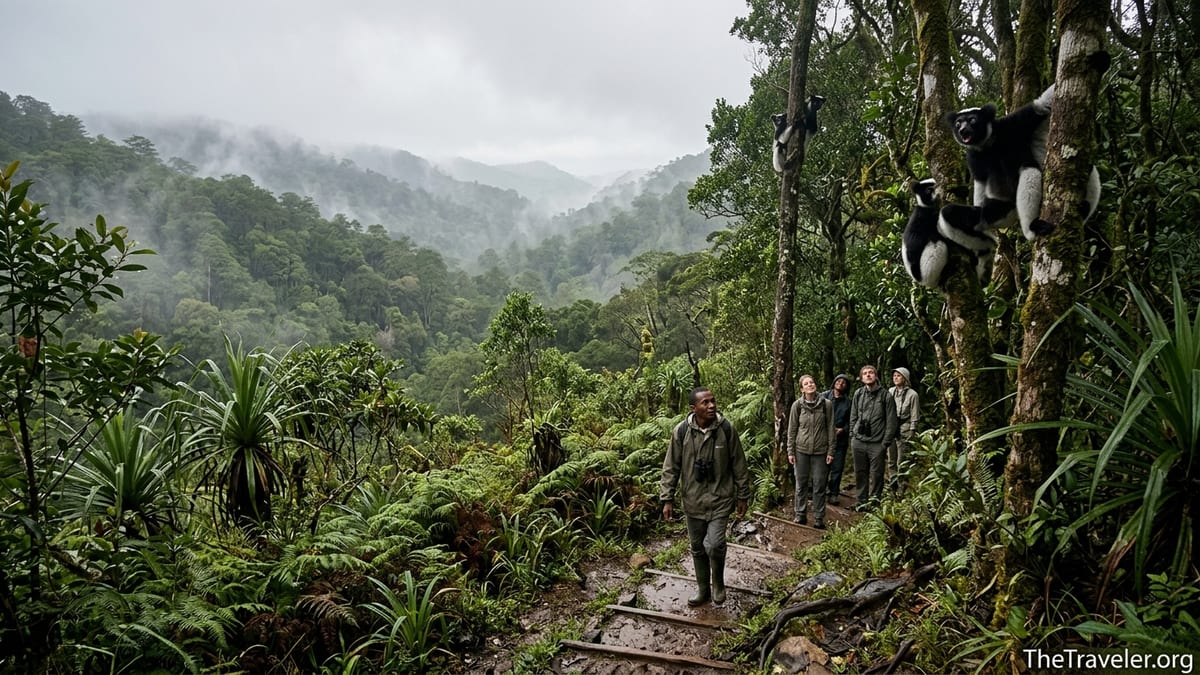
The star attraction of Andasibe-Mantadia is the indri, the largest living lemur. Standing nearly waist-high on an adult human when fully upright and patterned in striking black and white, these animals are famous for their long, eerie, siren-like calls that echo across the valley from around 7:00 to 11:00 in the morning. Many travelers report hearing indri from their lodge balconies at dawn before seeing them, an experience that often becomes the emotional highlight of a trip to Madagascar.
Analamazaotra offers some of the most reliable indri sightings in the country. Local spotters and guides keep track of several habituated family groups and generally lead visitors on one to three hour circuits, adjusting the route based on the current location of the animals. While nothing in wildlife travel is ever fully guaranteed, arriving at the park gates at opening time during the dry season gives you a very high chance of both hearing and seeing indri at relatively close range, sometimes as they leap between trunks or feed quietly in mid-canopy.
Beyond indri, the park protects a rich lemur community, with around a dozen species recorded. Common brown lemurs are often seen in mixed groups moving through the mid-level foliage, while eastern bamboo lemurs browse near streams and forest edges. Mantadia is especially known for diademed sifaka and, with luck, the black-and-white ruffed lemur. On night walks along the road margins or community-managed forests, you may encounter tiny Goodman’s mouse lemurs, woolly lemurs clinging to trunks, and occasionally rarer species like dwarf lemurs.
Concrete trip reports suggest that on a standard two-night stay with one morning in Analamazaotra, one longer day in Mantadia and at least one night walk, many visitors see three to six lemur species. Those traveling with specialist wildlife operators sometimes add visits to neighboring community reserves such as Mitsinjo or VOIMMA, which further increase the diversity of lemur and frog encounters, especially after dark.
Rainforest Trails, Morning Walks and Night Walks
Andasibe’s trail system is deliberately structured around short, flexible circuits, which makes it suitable for a wide range of fitness levels. In Analamazaotra, classic morning walks last from about one and a half to three hours, beginning shortly after the park opens around 7:30. Some routes loop around small lakes and clearings, others climb gently into denser forest. Gradients are usually moderate, but the clay underfoot becomes slippery when wet, so even the easiest paths feel more like real forest walks than manicured paths.
Longer circuits in Analamazaotra can take up to five hours and are useful if you want more time away from the busiest areas near the gate. On these routes, your guide may focus less on “ticking off” a particular family of indri and more on slowly working through the forest for mixed bird flocks, orchids, leaf-tailed geckos and less confiding lemurs. In high season, some operators will suggest starting at or even before opening time to beat the group traffic and enjoy the forest before it gets noisy.
Mantadia’s trails tend to be steeper, narrower and more root-filled. A typical day trip involves a one-hour 4x4 transfer from your lodge along a rough track, a three to five hour hike broken into morning and early afternoon sessions, and a picnic lunch by a stream or small waterfall. Visitors frequently mention that Mantadia “feels” like genuine primary rainforest, with bigger trees, more epiphytes and a sense of remoteness that Analamazaotra lacks, even though the two are only separated by a short drive.
Night walks are a central part of the Andasibe experience. These do not usually take place inside the formal national park but along the main road verges, on side tracks or in adjacent community-managed forests where nocturnal wildlife is abundant. Sets of visitors leave just after dusk with a specialist night guide, scanning the vegetation for the eye-shine of mouse lemurs, chameleons and frogs. It is common on a single evening to see several chameleon species, including tiny leaf chameleons on low branches, along with tree frogs and sleeping birds perched conspicuously on exposed twigs.
Local Guide Requirements, Fees and Trail Difficulty
Guides are mandatory for all official trails in Analamazaotra and Mantadia, and in practice they are what turn a walk in the woods into a wildlife experience. You can arrange a guide in several ways: through your tour operator, through your lodge reception, or by going directly to the park entrance where the local guide association maintains a roster. English- and French-speaking guides are common, and several have spent decades working in the forest, developing a remarkable ability to detect movement or calls that would escape most visitors.
Park entry fees and guiding costs change periodically, but recent traveler reports indicate that a combined daily entry ticket for Analamazaotra and Mantadia is typically paid once per day per person, with separate guide fees charged per group depending on trail length and time. As a rough, current indication, visitors in 2026 report paying the equivalent of around 15 to 35 US dollars per person for a half-day guided walk when costs are shared, plus an additional 10 to 25 dollars for an evening night walk, with private 4x4 transfers to Mantadia adding another substantial supplement. Always confirm the latest figures with your lodge or operator before arrival.
Trail difficulty in Analamazaotra is generally rated from easy to moderate. Altitude is relatively modest, and most circuits involve short ascents and descents on clay paths with steps cut into steeper sections. The main challenge is footing: after rain, expect mud, puddles and slick roots. Mantadia’s longer circuits can be more demanding, with steeper slopes, stream crossings and less-defined footpaths. If you can comfortably hike for four to five hours with frequent stops and walk on uneven ground, you should be fine, especially if you bring trekking poles.
For practical planning, consider your own mobility and interest in photography. Travelers who prefer unhurried, easy walks can do two or three short circuits in Analamazaotra over two days and still enjoy multiple indri encounters. More active visitors might book one long Analamazaotra loop on day one and a Mantadia excursion on day two, using a third half-day for a second night walk or a visit to a nearby community reserve for comparison.
Weather, Rainfall, Clothing and Field Gear
Andasibe sits in Madagascar’s eastern escarpment rainforest belt, which means it is humid and receives significant rainfall year-round. Climate data indicate annual precipitation of roughly 1700 millimeters, spread over more than 200 rainy days a year, so you should expect at least some showers during your visit regardless of season. The dry season from about May to October is relatively cooler and less wet, with July, August and September often recommended for comfortable walking and good road access. The wetter months from November to March coincide with the cyclone season and bring heavier downpours, greener foliage and an uptick in leeches and insects.
Temperatures in Andasibe are milder than many travelers expect from a tropical island. Nights can drop into the low teens Celsius in the June to August period, and early morning walks often feel chilly when you first step off the vehicle. During the day, temperatures usually climb into the low to mid-20s Celsius, which is pleasant for hiking as long as you dress in breathable layers. Humidity, rather than heat, is the main factor to prepare for, especially if you are carrying a camera or binoculars that can fog up when moving from an air-conditioned vehicle into the forest.
Packing for Andasibe should focus on staying dry, staying upright and staying flexible. A lightweight waterproof jacket with a hood is essential at any time of year. Quick-drying hiking pants or leggings work better than jeans, which tend to stay wet and heavy. Footwear is critical: sturdy trail shoes or light hiking boots with good tread are adequate for Analamazaotra, but for Mantadia’s steeper, rougher trails a boot with ankle support is preferable. Many lodges can arrange rubber boots if conditions are very muddy, and some visitors bring collapsible trekking poles specifically for the slippery descents.
In terms of extras, a compact daypack lined with a dry bag or plastic liner protects your camera and spare clothing during showers. Bring a reliable headlamp for night walks; while guides have strong spotlights, having your own light helps you navigate roots and puddles. Insect repellent is advisable in the warmer, wetter months, though mosquito densities are often lower than on the coast. A small microfiber towel and spare socks can make an unexpectedly wet morning much more comfortable.
How Long to Stay and Fitting Andasibe into an Eastern Circuit
Because Andasibe-Mantadia lies on Madagascar’s main RN2 highway, it slots neatly into most eastern itineraries, whether you are heading onwards to the Pangalanes Canal, the port city of Toamasina or the island of Sainte-Marie. The drive from Antananarivo tends to take three to five hours depending on traffic, roadworks and weather. Recent traveler accounts note that while the tarmac is in relatively good condition compared with other Malagasy routes, delays from trucks and congestion are common, so it is wise to treat the transfer as most of a day rather than a short hop.
Two nights in Andasibe is generally considered the minimum to justify the journey. With this schedule, you arrive from Antananarivo in the afternoon, enjoy a night walk on your first evening, then dedicate the next morning to Analamazaotra for indri, and the following day to either a second Analamazaotra circuit or a visit to Mantadia before driving onward. This pattern works particularly well at the beginning of a longer trip: you recover from your international flight in cooler air, adjust to Malagasy landscapes at a manageable pace and immediately tick off one of the country’s signature wildlife experiences.
For travelers whose main focus is wildlife and photography, three nights is often ideal. That gives you at least two full mornings for indri, which is useful if heavy rain interferes with one of them, plus one full day in Mantadia and two or three opportunities for night walks. Photographers often appreciate the extra time to experiment with different light and to seek out specific subjects such as diademed sifaka or particular chameleon species.
At the end of an eastern circuit, Andasibe can also serve as a quiet decompression stop on the way back to Antananarivo. If you are returning from the coast or islands, one or two nights here allow you to re-enter the rainforest, revisit favorite trails and dry gear before long-haul flights. In this context, you might skip Mantadia and focus on shorter Analamazaotra circuits and relaxed evenings listening to indri calls from your lodge veranda.
Practical Wildlife-Planning Tips on the Ground
To get the most out of Andasibe-Mantadia, it pays to think like a naturalist when shaping each day. Schedule indri-focused walks as early in the morning as possible: indri are more active and vocal in the early hours, and the forest atmosphere before 9:00 feels calmer, cooler and better for photography. If you only have one prime morning, prioritize Analamazaotra because of the habituated groups. Mantadia outings can work well on the second morning or as a full day that begins slightly later, especially for birders who want the mid-morning canopy activity.
Use your lodge or tour operator to coordinate guides who match your interests. Some guides are particularly strong on birds, able to pick out vangas, ground-rollers and asities by call; others excel at herpetology, spotting tiny leaf chameleons on eye-level branches or finding colorful tree frogs in pandanus clumps. If you have a serious photographic agenda, say so in advance so that pacing and positioning on the trail can reflect your priorities. Many lodges are accustomed to arranging specialized guiding for guests booked on international wildlife tours.
On the financial side, bring sufficient cash in ariary to cover park fees, tips and incidental expenses. There are no reliable ATMs in Andasibe, and most small restaurants and shops are cash only. Lodges at the higher end sometimes accept card payments for accommodation but may still ask for cash for extras such as packed lunches, transfers or additional night walks. Restaurant meals in the village typically range from simple rice-and-stew plates to more elaborate French-Malagasy dishes, with prices that many visitors compare favorably to small-town restaurants in Europe or North America.
Finally, remember that weather and wildlife can be unpredictable even in a generally reliable park. Building an extra morning or afternoon into your schedule gives you a buffer if heavy rain forces trails to close temporarily or if a key species proves elusive. Many travelers who rush through in a single full day regret not having one more unhurried walk among the indri calls.
FAQ
Q1. How many nights should I spend in Andasibe-Mantadia?
Most travelers should plan on two to three nights. Two nights lets you fit in an Analamazaotra indri walk, at least one night walk and either a second forest circuit or a Mantadia day trip. Three nights is better if wildlife is a main focus.
Q2. What is the best time of year to visit for indri sightings?
Indri can be seen year-round, but the drier, cooler months from roughly May to October usually offer more comfortable walking and more predictable morning activity. September and October are often cited as particularly good for loud calling and active family groups.
Q3. Are guides really mandatory in Analamazaotra and Mantadia?
Yes. An accredited local guide is required on all official park trails. In practice, this is a benefit rather than a burden, as guides dramatically improve your chances of seeing lemurs, chameleons and birds and can tailor the route to your fitness and interests.
Q4. How difficult are the trails for someone with average fitness?
Analamazaotra circuits are generally easy to moderate, with short climbs, some slippery clay and roots but frequent stops. Mantadia trails are more demanding, involving steeper sections and rougher footing. If you can comfortably hike for several hours on uneven ground, you should be fine with appropriate footwear.
Q5. What clothing and gear should I pack specifically for Andasibe?
Bring a lightweight waterproof jacket, quick-drying long pants, sturdy trail shoes or hiking boots with good grip, and a warm layer for cool mornings. A headlamp, insect repellent, a small daypack with rain cover and, if you have them, trekking poles are also very useful.
Q6. Can I do a night walk inside the national park?
Official night walks usually take place just outside the park boundaries, along the road or in adjacent community-managed forests, rather than inside the core national park zones. These areas are excellent for seeing mouse lemurs, chameleons, frogs and other nocturnal species with a specialist night guide.
Q7. How do I get from Antananarivo to Andasibe?
Most visitors travel by private vehicle with driver along the RN2 highway, a journey that typically takes three to five hours depending on traffic and road conditions. Some tour operators include this transfer in their packages, while independent travelers can arrange a driver through guesthouses or local agencies.
Q8. Is Andasibe-Mantadia suitable for children or less experienced hikers?
Yes, Analamazaotra in particular suits families and less experienced hikers thanks to its short, flexible circuits and high chance of seeing indri without long or steep climbs. You can work with your guide to choose shorter routes and take frequent breaks, although trails can still be muddy and uneven.
Q9. How does Andasibe fit into a longer eastern Madagascar itinerary?
Andasibe often serves as the first or last stop on an eastern circuit. Many itineraries go from Antananarivo to Andasibe for two or three nights, then continue east toward the Pangalanes Canal, Toamasina or Sainte-Marie. Others stop at Andasibe on the way back to the capital as a final rainforest experience before flying home.
Q10. Do I need to book accommodation and guides in advance?
In the main dry-season months and around school holidays, it is wise to reserve lodges ahead of time, especially mid-range and higher-end options. Guides can usually be arranged on arrival, but if you have specific interests such as bird photography, it is worth asking your lodge or tour operator to pre-book an experienced specialist.