


Akanin’ny Nofy, the “nest of dreams,” sits on the shores of Lake Ampitabe along Madagascar’s Pangalanes Canal, reachable only by boat and wrapped in low, whispering forest. For many travelers it is the gentlest, most atmospheric stop on the east coast: lemurs leap through lakeside palms, motorboats glide past tiny fishing hamlets, and at night guides ferry visitors to a small island in search of the eerie, elusive aye-aye. This guide explains exactly how to get there, what to expect at the Palmarium Reserve, how long to stay, and how to combine Akanin’ny Nofy with Andasibe and Toamasina without wasting precious time backtracking.
Understanding Akanin’ny Nofy and Lake Ampitabe
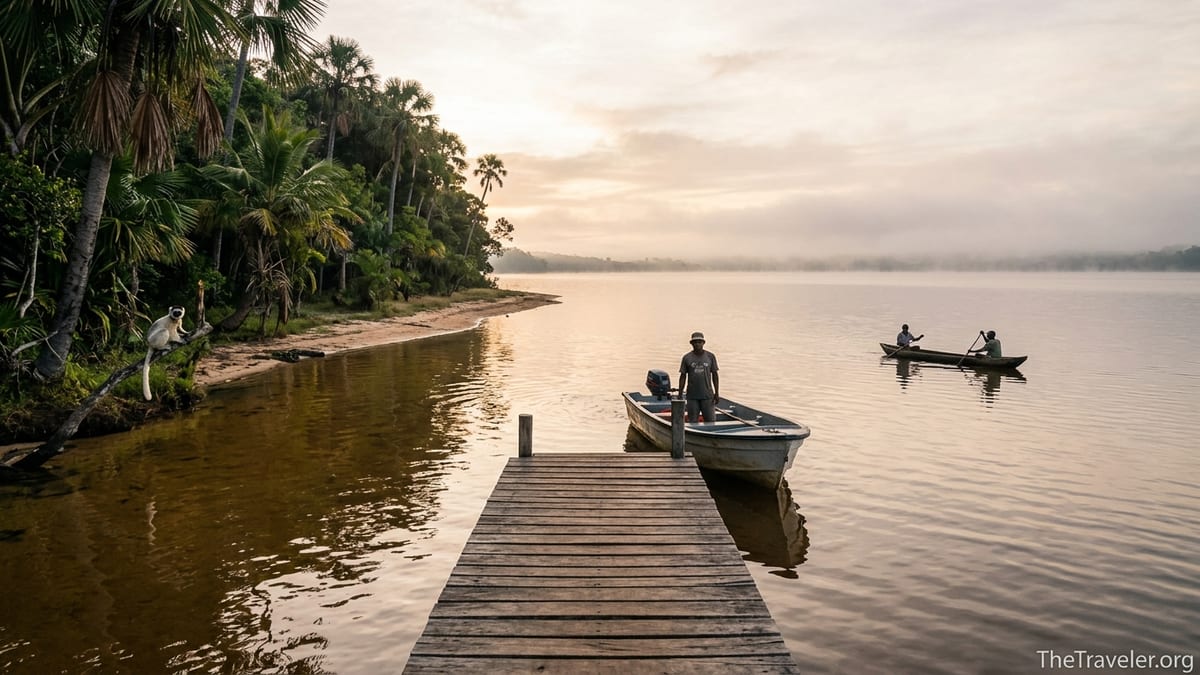
Akanin’ny Nofy is a small settlement set on a sandy peninsula between Lake Ampitabe and the Pangalanes Canal on Madagascar’s east coast. In Malagasy, its name means “nest of dreams,” and that describes the mood accurately: there are no cars, only sandy paths, simple jetties, and boats coming and going across still, tea-colored water. The main draw here is the Palmarium Private Reserve, a patch of coastal rainforest and palm-rich woodland dotted with lakeside bungalows and crisscrossed by easy forest trails.
Lake Ampitabe itself forms part of the larger Pangalanes Canal system, a chain of natural lakes and man-made waterways that runs roughly parallel to the Indian Ocean. The lake’s wide bays, white-sand beaches and calm water make it feel almost like a vast inland lagoon. For travelers who have just come from the traffic and noise of Antananarivo or the rainforest humidity of Andasibe, arriving here delivers a noticeable drop in pace. Afternoons are often spent lazing in hammocks, watching dugout canoes paddle past while children play on the sand.
The area is not a wilderness in the strictest sense. Villages line sections of the canal, small-scale agriculture shares space with forest, and several of the lemurs in the Palmarium Reserve have been introduced rather than being entirely wild. Yet it remains one of the easiest and most rewarding places in Madagascar to observe lemurs up close, enjoy a classic east-coast boat journey, and experience a softer side of Malagasy village life without long, punishing drives.
Because Akanin’ny Nofy is water-access only, it has a self-contained feel. Once you have arrived by boat, you are largely committed to staying at least a couple of nights. That remoteness is part of the attraction: there are no bars pumping music, no roadside traffic, and power in most lodges is still managed carefully. For travelers seeking a quiet interlude between more demanding national parks, it is an ideal pause.
Boat Access from Manambato and Toamasina
Reaching Akanin’ny Nofy involves at least one boat journey. The most common route is via Manambato, a small lakeside village reached by vehicle from the RN2 highway. From the Andasibe area or Antananarivo, drivers typically follow RN2 east to the town of Brickaville then turn onto a rougher track for the final stretch to Manambato. In practice, this road can feel long because of potholes and mud, so most visitors arrange a 4x4 with a driver rather than relying on public transport all the way. Tour operators and hotels in Andasibe frequently package the transfer and boat crossing together, which helps avoid delays and confusion.
From Manambato’s sandy lakeshore, covered motorboats run across Lake Rasoabe and then follow a calm section of the Pangalanes Canal before entering Lake Ampitabe. Recent tourism board information suggests that dedicated transfer boats take roughly 45 minutes to 1 hour to reach the Akanin’ny Nofy peninsula, depending on boat size, lake conditions, and how heavily loaded the boat is. In practice, small groups on a private boat may complete the journey in under an hour, while shared boats making additional village stops can take a bit longer. The ride itself is a highlight, passing floating reed beds, small wooden jetties, and villagers paddling dugout canoes.
It is also possible to reach Akanin’ny Nofy by boat directly from Toamasina (Tamatave), the main port city on the east coast. This route follows a longer section of the Pangalanes Canal and typically takes close to two hours or more with a motorboat, again depending on conditions and how direct the service is. In reality, boats from Toamasina are often arranged through local agencies or hotels and may not run on a fixed daily schedule. Because of this, travelers who value certainty and shorter transfer times tend to prefer the Manambato route, especially when combining Akanin’ny Nofy with Andasibe.
Whichever route you choose, it is sensible to confirm departure times in advance through your lodge, and to avoid planning tight same-day connections. Boat departures can shift with weather, fuel delivery, and guest arrivals. As a rough reference point, independent travelers in recent seasons report paying the equivalent of several tens of euros per person for the Manambato–Akanin’ny Nofy crossing on a shared boat, with private charters costing more but offering flexibility in timing. Cash is preferred and there are no ATMs at Manambato or on Lake Ampitabe, so carry enough local currency for your transfers and tips before leaving the RN2 corridor.
The Palmarium Reserve and Lemur Encounters
The Palmarium Reserve is a privately managed, roughly 50-hectare patch of lowland coastal forest and palm-rich woodland bordering Lake Ampitabe. Trails thread through dense vegetation, past stands of traveler’s palm and pandanus, with occasional clearings where lemurs come down from the canopy. The reserve is particularly known for its variety of semi-habituated lemurs, which are far easier to see here than in most national parks. While the exact species list may shift slightly over time, travelers commonly encounter indri, black-and-white ruffed lemurs, crowned lemurs, black lemurs, and at least one sifaka species wandering relatively close to the lodge.
Guided walks are typically organized directly by the lodge staff and are easy enough for most travelers, including families with school-age children. A standard day walk might last one to two hours along gentle forest paths, with frequent stops to watch lemurs feeding or jumping between branches. Because some of the animals are used to people and occasionally come down to ground level, it is possible to take close-up photographs. Responsible guides will ask you not to touch them or offer food, and this is worth respecting, as even semi-habituated lemurs can be stressed or made ill by inappropriate snacks.
One of the unusual features of Palmarium is the amount of contact guests can have with lemurs around the accommodation. At certain times of day, rangers may place fruit in discrete locations, which draws lemurs out to the edges of the clearings. This can feel magical to many visitors, particularly those who have struggled to spot distant silhouettes in larger parks. At the same time, it is important to understand that this is not a pure wilderness encounter. For travelers who care deeply about seeing only fully wild, non-provisioned wildlife, other parks may be a better fit, while Palmarium works well as an accessible introduction to lemurs for first-time visitors to Madagascar.
Beyond lemurs, the reserve shelters diverse birdlife, orchids and carnivorous plants in damp areas near the lake. Some itineraries include a short excursion to a nearby “lake of nepenthes,” where insect-eating pitcher plants grow in surprising numbers among the reeds. Serious birders sometimes spend extra time scanning the canopy and lake margins for kingfishers, herons, and endemic forest species. Because the forest here is lower and more open than in Andasibe-Mantadia, photography can actually be easier, especially in the softer light of early morning.
The Nocturnal Aye-aye Excursion
For many travelers, the defining experience at Akanin’ny Nofy is the nocturnal excursion to see aye-ayes, Madagascar’s strangest and most secretive lemur. The aye-aye is a nocturnal species with large ears, wide eyes and an elongated finger that it uses to tap on wood and extract insects. In most of the country it is extremely hard to see, even for researchers. Around Palmarium, however, a small island in the lake has become known as “Aye-aye Island,” where guides know the favored feeding trees and can almost guarantee sightings on a good night.
The typical excursion starts just after dinner, when guests gather at the lodge jetty. Small motorboats then cross the dark, calm water, usually in 10 to 20 minutes depending on conditions. On arrival, guides lead the group along a short forest path by torchlight to a series of trees where aye-ayes are known to come to feed. Visitors stand quietly while the guides scan the branches with red-filtered lamps to reduce disturbance. When an aye-aye appears, it may move slowly along a branch, tap-testing for hollows before working its way into the wood. Patience is still required, but compared with national parks where you might never see the species, the chances here are significantly higher.
Prices for the aye-aye night walk are typically quoted per person in Malagasy ariary and can change with seasons and inflation, but recent guidebooks and local listings suggest that the fee for a small group walk is broadly in the range of an affordable evening excursion by international standards. The cost usually includes the boat ride, guide, and access to the island. As always, it is wise to check the current rate when booking your stay, and to confirm whether payment is taken in cash on-site or can be added to your lodge bill. Tipping your guide in local currency is appreciated, especially if they have worked hard to ensure everyone gets a good view.
While the experience is popular, it is worth approaching it with realistic expectations and sensitivity. Groups may include other guests from nearby lodges, and path sections can be narrow or muddy. Wearing closed shoes, long trousers and light, long-sleeved layers helps protect against mosquitoes and minor scratches. Flash photography rules vary; many guides now ask guests to avoid direct flash into the animals’ eyes and to use lower-intensity settings. Checking your camera and headlamp before departure, and carrying a small dry bag for electronics in case of spray, will help the night feel like an adventure rather than a scramble.
Lakeside Activities and Village Life
Beyond organized wildlife walks, much of the pleasure of Akanin’ny Nofy lies in simple, low-key activities around Lake Ampitabe. The water near most lodges is generally calm, and in good weather guests often swim from the sandy shoreline, keeping a respectful distance from moored boats. Some accommodations provide kayaks or canoes for short paddles along the edge of the lake, which is an easy way to spot kingfishers, egrets, and village life without engine noise. Always ask lodge staff about currents and safe swimming zones before entering the water, as conditions can shift after heavy rains.
Boat excursions along the Pangalanes Canal are another highlight. A half-day outing by small motorboat might visit nearby fishing villages, cross narrow canal sections shaded by overhanging trees, and stop at patches of white-sand beach where you can walk between lake and ocean. In these communities you are likely to see pirogues carved from single tree trunks, children playing along the shore, and fishermen tending nets. Bringing small, practical purchases such as local snacks or handicrafts can benefit the village economy more sustainably than handing out loose gifts, and asking before taking photos remains a vital courtesy.
On quieter days, simply walking the sandy paths between lodges and nearby hamlets provides insight into daily life around the lake. You may pass small shops selling basic provisions, school buildings, and family houses raised slightly above the sand. Because Akanin’ny Nofy receives a steady trickle of visitors, locals are generally accustomed to tourists, but French is still more widely spoken than English, and a few words of Malagasy are always appreciated. Many travelers mention relaxed afternoons spent reading on bungalow verandas, listening to gentle wavelets and the occasional lemur call drifting from the forest.
Those looking for more structured experiences can ask their lodge about arranging a traditional pirogue ride, basic fishing outings, or cultural visits timed to local markets. Options vary by season and by lodge, and are often more informal than in heavily touristed regions. This is part of the charm: rather than a rigid menu of activities, Akanin’ny Nofy offers a flexible, slower rhythm where you choose each day how much or how little you want to do.
Where to Stay and What to Expect
Accommodation at Akanin’ny Nofy revolves around a small number of lodges and guesthouses set in or near the Palmarium Reserve. The best-known properties sit directly on the lakeshore with wooden bungalows raised on stilts or low platforms, connected by sandy paths. Rooms are usually simple but atmospheric, with mosquito nets, private bathrooms with solar-heated or generator-supported hot water, and decks overlooking the lake or forest. Power is often available for limited hours in the evening, so charging electronics is a matter of planning ahead rather than leaving devices plugged in all day.
Rooms usually include breakfast, with lunch and dinner served as set or limited-choice menus. Dishes often feature fresh fish from the lake or nearby coast, rice, vegetables, and tropical fruits. Vegetarian options are possible but should be requested in advance, especially if you have specific dietary restrictions. Because all supplies come by boat, menus tend to be simpler than in major cities and prices higher than in roadside eateries. As a very broad guideline, a main dish at a lodge restaurant might cost the equivalent of a modest mid-range meal in a European or North American café, reflecting both transport costs and the limited competition in such a remote location.
When booking, pay close attention to property names and descriptions. Around Lake Ampitabe there are separate but similarly branded accommodations, some directly bordering the main section of the lemur reserve and others several kilometers away, reached by boat or a walk. Recent traveler reports highlight occasional confusion where guests believed they were staying inside the primary reserve but found themselves booked into a sister property without lemurs on the grounds. To avoid disappointment, confirm in writing whether your chosen lodge gives immediate access to the core Palmarium trails or whether additional transfers are needed for visits.
Service standards are generally friendly and informal rather than polished. Staff often juggle multiple roles, acting as boat handlers, waiters and porters depending on the day. English proficiency varies, but between French, basic English, and gestures, most visitors manage comfortably. Given the remoteness, you should not expect reliable mobile data or strong Wi-Fi; any connection that exists may be slow and limited to common areas. For most travelers this becomes an unexpected benefit, encouraging a deeper disconnect from everyday notifications and a stronger focus on the lake, forest and sky.
How Long to Stay and How to Combine With Andasibe and Toamasina
Because getting to Akanin’ny Nofy involves at least a few hours of driving and a boat transfer, it makes sense to stay long enough to absorb the atmosphere rather than just ticking a box. For most travelers, a stay of two to three nights works well. Two nights allows for a daytime lemur walk and the aye-aye excursion, with some downtime by the lake. Three nights gives you a buffer for rainy weather, extra walks in the reserve, or a half-day boat trip along the canal without feeling rushed. Shorter one-night stops are technically possible but can feel hurried, especially if your arrival is delayed by traffic or road conditions.
A practical east-coast circuit from Antananarivo might run as follows: drive to Andasibe for two or three nights, then continue to Manambato and take the boat to Akanin’ny Nofy for two or three nights, and finally exit by boat and road either back toward Antananarivo or onward to Toamasina. This sequence minimizes backtracking: you travel east along RN2 from Antananarivo to Andasibe, then further east and slightly south to Manambato, and from Akanin’ny Nofy you can choose whether to head north to Toamasina by canal or return westward to the highway via Manambato.
If you want to include Toamasina without unnecessary repetition, one efficient approach is to travel Antananarivo to Andasibe, then Andasibe to Manambato and across to Akanin’ny Nofy, and from there continue by boat up the Pangalanes Canal toward Toamasina. Many tour operators already offer variations of this flow, with a night or two in Toamasina at the end for rest or flight connections. In contrast, trying to visit Toamasina first, then doubling back south to Manambato and across to Akanin’ny Nofy, and then returning once more through Toamasina can add long road and boat hours without much extra benefit.
Independent travelers relying on public transport need to factor in less predictable schedules. Taxi-brousse services and private shuttles like those operating along RN2 can carry you between Antananarivo, Moramanga, Andasibe and Toamasina, but reaching Manambato usually still requires either a chartered vehicle from Brickaville or arranging transport through a local agency. For this reason, many budget-conscious travelers choose a hybrid approach: using public transport along RN2 where services are frequent, then combining with a pre-arranged private transfer to Manambato and a pre-booked boat to Akanin’ny Nofy.
The Takeaway
Akanin’ny Nofy and the Palmarium Reserve offer one of Madagascar’s most approachable combinations of gentle adventure and real comfort. You travel by boat through a watery landscape that still feels off the main tourist grid, then spend days walking easy forest trails, watching lemurs at close range, and floating across a quiet lake under a sky full of stars. The aye-aye excursion provides a rare chance to see one of the world’s strangest primates, while village visits and canal trips reveal everyday life along the Pangalanes.
With thoughtful planning, you can weave Akanin’ny Nofy into a wider east-coast itinerary that includes Andasibe’s lush rainforest and the coastal bustle of Toamasina, all without doubling back unnecessarily. A stay of two or three nights is enough to feel the rhythms of the lake without compromising time in other parks. For travelers willing to embrace a little logistical complexity in exchange for big rewards in atmosphere, wildlife and quiet, this “nest of dreams” more than lives up to its name.
FAQ
Q1. How do I actually get from Andasibe to Akanin’ny Nofy?
From Andasibe you normally drive east along the RN2 to Brickaville, then follow a rougher track to Manambato. From there, pre-booked motorboats cross lakes and canal to Akanin’ny Nofy in roughly 45 to 60 minutes.
Q2. Is it better to access Akanin’ny Nofy from Manambato or from Toamasina?
For most travelers combining Andasibe, Manambato is more convenient because it keeps your route linear along RN2. Toamasina boat transfers work well if you are already based in the city or heading north along the coast afterward.
Q3. How many nights should I stay at Akanin’ny Nofy?
Two to three nights is ideal. This lets you do at least one daytime lemur walk, the nocturnal aye-aye excursion, and still have time to enjoy the lake and canal without rushing.
Q4. Can I see truly wild lemurs at Palmarium, or are they all habituated?
You will encounter a mix. Many lemurs are semi-habituated and sometimes visit lodge clearings, which makes viewing easy but less “wild” than in big national parks. Forest walks still offer more natural behavior than lodge areas.
Q5. How reliable is the aye-aye excursion for sightings?
While no wildlife encounter is guaranteed, local experience and the use of a dedicated island mean that sightings are frequent by Madagascar standards. Travelers should still be prepared for a night walk and patient waiting in the dark.
Q6. Is swimming safe in Lake Ampitabe?
In calm weather, many lodges allow swimming in designated zones close to shore, which are generally safe for confident swimmers. Always ask staff about current conditions and avoid busy boat lanes.
Q7. What kind of budget should I expect for boats and activities?
Boat transfers and guided walks are more expensive than local buses but moderate by international standards. Expect to pay the equivalent of a modest excursion in Europe or North America for major activities like the aye-aye trip.
Q8. How can I avoid backtracking when combining Andasibe, Akanin’ny Nofy and Toamasina?
A practical route is Antananarivo to Andasibe, then on to Manambato and by boat to Akanin’ny Nofy, and finally by canal boat to Toamasina. This keeps you moving primarily east and north without repeating long road sections.
Q9. Do I need to book accommodation and boats in advance?
In high season it is strongly recommended to book both your lodge and boat transfers ahead, especially if you have fixed dates. Outside peak months, last-minute arrangements are sometimes possible but less predictable.
Q10. Is Akanin’ny Nofy suitable for children or less active travelers?
Yes. Trails are generally short and not steep, boat rides are calm in normal conditions, and there are plenty of opportunities to rest by the lake. Families and older travelers often find it one of the easiest wildlife stops in Madagascar.