


Northern Madagascar packs a rare mix of volcanic forest, coral-studded bays and razor-sharp limestone into a relatively compact corner of the island. With a bit of planning, you can turn Diego Suarez, Amber Mountain, Red Tsingy, Ankarana and the Ambanja–Ankify corridor into a logical road circuit, with beach time on Nosy Be as an optional finale rather than the focus. This guide lays out realistic routes for roughly one week and for travelers with more time, with clear overnight stops and driving days that match what you will actually find on the RN6 and the side tracks that branch off it.
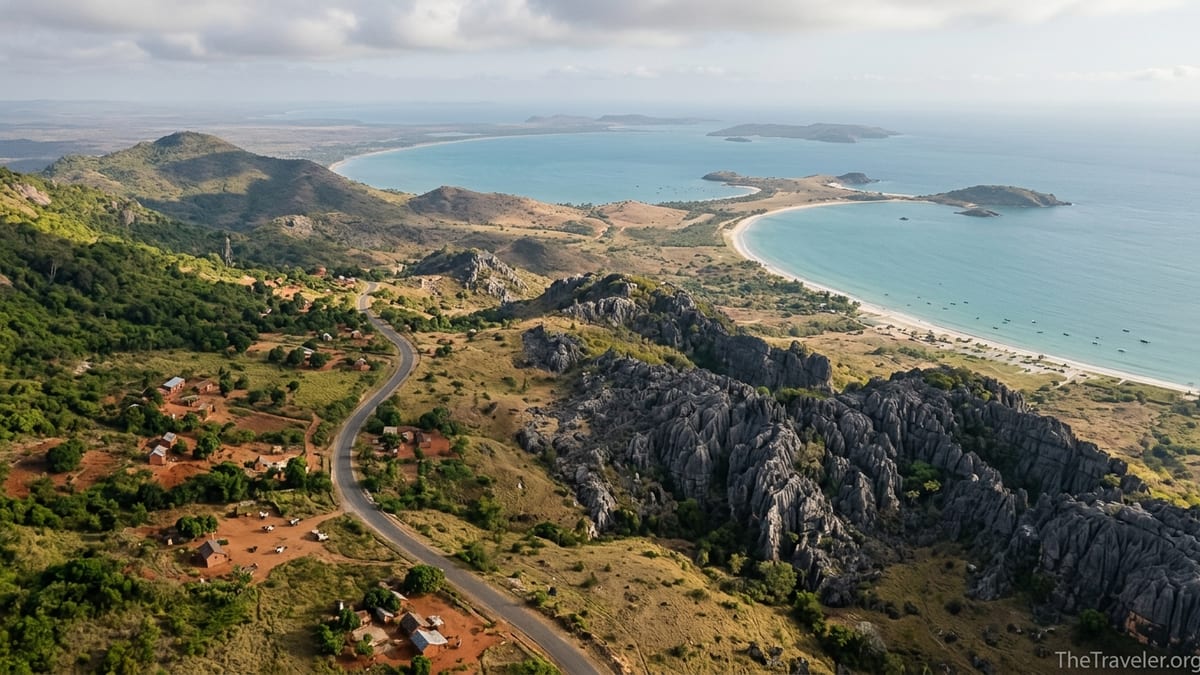
How the Northern Madagascar Circuit Fits Together
Most trips in this part of Madagascar orbit around the port city of Diego Suarez, also known by its Malagasy name Antsiranana. The city sits at the northern tip of the RN6 highway, which then snakes south through dry forest, villages and sugarcane fields toward Ambilobe, Ambanja and finally the tiny coastal village of Ankify. Amber Mountain National Park lies inland and uphill from Diego, Red Tsingy sits off a rough side road further south, and Ankarana National Park hugs the RN6 midway to Ambilobe. Viewed on a map, this forms an almost linear north–south route that avoids backtracking, which is important given road conditions.
Distances look short on paper but progress is slower than many first-time visitors expect. Diego to Amber Mountain is roughly an hour by paved road, but Diego to Red Tsingy is closer to two hours one way, including a bumpy section where only 4x4s regularly go. From Red Tsingy to the main Ankarana entrances you should count a further one-and-a-half to two hours depending on weather. South of Ankarana, the RN6 improves again but you should still expect around four hours from Ankarana to Ankify, including the scenic stretch around Ambanja and the plantations of the Sambirano valley.
Because of this, the most practical circuits start or finish in Diego Suarez and finish or start in Ankify. Many travelers fly into Diego from Antananarivo, then travel overland to Ankify for a boat across to Nosy Be. Others do the trip in reverse, crossing from Nosy Be to Ankify first and then working north to Diego to catch a domestic flight back to the capital. Both directions work; the choice often comes down to flight schedules and whether you prefer to end with nature and hiking or with beach time.
In terms of services and logistics, Diego Suarez, Ambanja and Nosy Be have the widest choice of hotels and tour agencies. Joffreville, at the edge of Amber Mountain, and the villages near Ankarana offer comfortable ecolodges and bungalows but fewer budget options. Ankify itself is a cluster of beachside guesthouses and small hotels, mostly oriented to people in transit to or from Nosy Be, but some travelers now choose to linger here as a quieter alternative to the island.
A Realistic One-Week Northern Madagascar Itinerary
If you have roughly one week in northern Madagascar, focus on Diego Suarez, Amber Mountain, a Red Tsingy and Ankarana combination day, and the road south to Ankify. With current road conditions, trying to also include remote parks like Marojejy in a single week will leave you mostly in vehicles. A more concentrated circuit lets you actually walk the trails and enjoy evenings in the villages.
One workable seven-day version starts in Diego Suarez. Day 1 is arrival and a gentle exploration of the city’s colonial-era center, its wide bay and the lively market where you will see Antankarana women with faces painted in ochre paste, and stalls selling lychees, rice and dried fish. Overnight in Diego, where you can find everything from simple guesthouses to more polished hotels with sea views. On Day 2, transfer one hour inland to Joffreville at the edge of Amber Mountain and spend the afternoon exploring the lower forest trails, then overnight in a lodge there to be closer to the park gate for an early start.
Day 3 is a full day inside Amber Mountain National Park, a rare pocket of montane rainforest in this otherwise dry region. With a local guide, you can follow a circuit that takes in crater lakes, waterfalls and viewpoints looking back towards the Diego Suarez bay. Expect to see leaf-tailed geckos, crowned lemurs and a variety of chameleons. Return to your Joffreville lodge for a second night so you are not driving in the dark. On Day 4, you check out after breakfast, drive back down toward the RN6 and continue south to the Red Tsingy. Here you walk among fragile red laterite pinnacles carved by the Irodo River, typically in late morning or early afternoon light. After the visit, carry on to Ankarana, arriving by late afternoon to overnight at a lodge near the park gates.
Day 5 is devoted to Ankarana’s limestone tsingy, underground rivers and dry forest. Most visitors choose a medium-level hike to suspension bridges and viewpoints over the grey pinnacles, which gives you a taste of the landscape without requiring technical gear. Accommodation is once again near the park entrance. On Day 6, depart Ankarana after breakfast for the drive south through Ambilobe and Ambanja to Ankify. With a private vehicle, the trip typically takes about four hours, though it can easily stretch to five or more if there are delays at narrow bridges or you stop to photograph rice paddies and roadside villages. Overnight in Ankify in a small beach hotel, enjoying views across to Nosy Be.
On Day 7, you can either take a morning speedboat to Nosy Be for onward flights or extra beach days, or use Ankify as your end point and return by road to Ambanja for an overnight before catching a domestic flight from nearby Nosy Be or backtracking north if needed. If you prefer to travel slower, you can simply add an extra night to Amber Mountain, Ankarana or Ankify in this framework. The key for a one-week plan is to limit yourself to two or three different park bases and allow entire days for the Diego–Amber–Red Tsingy–Ankarana–Ankify progression.
Two-Week and Longer Routes with Extra Time
With ten to fourteen days in northern Madagascar, you can build in more flexibility and linger in places that many one-week itineraries rush through. A ten-day version might still follow the same Diego to Ankify route but add an extra full day in Amber Mountain and an extra day for side trips from Diego, for example to the Emerald Sea lagoon near Ramena village, which usually involves a 45-minute drive followed by a fisherman’s pirogue ride over the reef.
For a classic two-week route, consider starting in Diego Suarez with two nights in town to adjust and explore Montagne des Français, a limestone hill and forest area that overlooks the bay and offers shorter hikes. Then plan three nights in Joffreville for Amber Mountain, giving you time for both the popular crater lake circuits and longer full-day routes that climb to higher viewpoints. Returning briefly to Diego between park stays is possible but will cost you extra time on the road.
From Amber Mountain, a slower trip could devote two nights near the Red Tsingy area rather than treating it simply as a stop on the way to Ankarana. A handful of simple accommodations now exist on or near the track to Red Tsingy, which means you can arrive in the afternoon, visit in soft evening light, overnight nearby and then return early the next morning for a second, quieter visit before driving on to Ankarana. Photographers in particular appreciate this flexibility, since the color of the formations changes dramatically with the sun’s angle.
In Ankarana, three nights rather than two allow you to combine different trail networks, for example one day focused on the suspension bridge circuit over the main tsingy fields and another day dedicated to cave systems and bat roosts. People with a specific interest in karst landscapes sometimes arrange a third day to access more remote sections of the park, which can require longer walks on sharp rock and basic scrambling. After Ankarana, you could still reach Ankify in a single drive and choose whether to spend two or three nights in the Ambanja–Ankify corridor and on Nosy Be, or to turn your attention inland.
Diego Suarez and Amber Mountain: Where to Base and How Long
Diego Suarez itself is more than just a gateway. Many travelers who rush straight up to Joffreville miss the faded but atmospheric waterfront promenade, the colorful morning market, and the mix of Creole, Malagasy and Indian influences in the local cuisine. If you arrive on a midday flight from Antananarivo, two nights in Diego gives you at least one full day to adjust, walk the grid of streets in the center and scout day trips like Ramena beach or the Emerald Sea.
Joffreville, about 30 kilometers south of Diego and around 700 meters higher, feels cooler and greener. The village was once a French hill station and still has colonial villas in various states of decay alongside small Malagasy houses. Most visitors stay here rather than in Diego when their main goal is Amber Mountain National Park, because the park entrance is just above the village on a decent paved road. Accommodation ranges from rustic bungalows with shared bathrooms to mid-range ecolodges offering hot showers, fireplaces for cool evenings and home-cooked meals based on local produce.
To properly see Amber Mountain, plan at least one full day and ideally two. On the first day, a guide may lead you on a circuit that includes the Sacre, Antomboka or Mahasarika lakes and a waterfall such as Cascade Sacrée. These walks rarely exceed four to five hours on well-defined forest paths but the terrain can be muddy, especially in or just after the wet season, so walking shoes and a light rain jacket are useful. A second day can be tailored to your interests, perhaps focusing on birdwatching in the early morning or searching for smaller creatures like the tiny Brookesia chameleons that live on the forest floor.
In terms of logistics, you can either keep a private vehicle and driver with you in Joffreville, paying for their board and lodging at your guesthouse, or arrange to have a car from Diego pick you up and drop you off at set times. Having a vehicle on standby offers flexibility if you want to visit Amber Mountain across different days at short notice, but budget travelers often prefer to hire a 4x4 and driver only for long transfer days and use local taxis or shared cars for shorter hops between Diego and Joffreville.
Red Tsingy and Ankarana: The Heart of the Tsingy
The Red Tsingy site lies about 60 kilometers south of Diego Suarez, reached by turning off the RN6 onto a dirt track that follows the Irodo River valley. In the dry season, sturdy high-clearance vehicles can reach the main parking area in roughly two hours from Diego; in the wet season, sections can become deeply rutted, and local drivers may suggest rescheduling. Entry fees and local guide rates are usually paid in cash on arrival, with prices quoted in Malagasy ariary and small notes appreciated.
Most visits to Red Tsingy last one to two hours, as the area is compact. A guide leads you down a short path to platforms overlooking the red pinnacles, then into the basin itself where you can walk on predefined routes between the formations. The structures are made of relatively soft laterite rather than the harder limestone of Ankarana, so walking off-trail or climbing on spires is discouraged to avoid damaging them. It is common to arrive here while transferring between Diego and Ankarana, though as noted, travelers with more time sometimes arrange an overnight nearby for better light and a less rushed experience.
Ankarana National Park, sometimes referred to as Ankarana Special Reserve, is one of Madagascar’s great karst landscapes. The park protects more than 100 square kilometers of limestone pinnacles, canyons, caves and pockets of dry forest. Accommodation and park access are concentrated near Mahamasina on the RN6, where you will find small lodges, basic bungalows and a cluster of local restaurants serving dishes like zebu stews, rice and seasonal vegetables. Wildlife here includes crowned lemurs, Sanford’s brown lemurs, and birds such as crested drongos and couas, but for many people the main draw is the terrain itself.
From Mahamasina, day hikes vary from easy one-hour strolls to viewpoints on the edge of the tsingy to more demanding routes that cross suspension bridges and descend into caves whose ceilings drip with stalactites and overhangs of roots. Heat can be intense by midday in the dry season, and the rock underfoot is sharp, so closed shoes, a hat and generous water supplies are essential. Local guides are mandatory and their knowledge of which sections are safe at different water levels is a genuine safety asset. At least one full day in Ankarana is recommended, and two if you want to explore beyond the core suspension bridge circuits.
Ambanja, Ankify and Nosy Be as an Optional Finale
South of Ankarana, the RN6 continues towards the town of Ambilobe and then on to Ambanja, where the landscape shifts again. The Sambirano valley around Ambanja is famous for cacao and spices; signs for plantations appear along the roadside, and some estates open part of their grounds to visitors. A handful of ecolodges and guesthouses in or near plantations let you sleep amid cacao trees and ylang-ylang, with optional estate tours that show how cacao beans go from harvest to fermentation and drying.
From Ambanja, a side road leads to Ankify, a fishing village and small port strung along a sandy peninsula. The drive from Ambanja to Ankify generally takes around an hour, passing villages with roadside stalls selling bananas, seasonal mangoes and fresh river fish. In Ankify itself, lodging ranges from simple beach bungalows with mosquito nets and solar-powered lights to more comfortable small hotels with en-suite bathrooms and open-air restaurants. Electricity supply can be unpredictable in this area, so carrying a power bank for cameras and phones is wise.
Ankify is the departure point for speedboat crossings to Nosy Be, with small fiberglass boats and larger wooden vessels making the run across the strait several times a day, schedules flexing with sea conditions and demand. The crossing usually takes around 45 minutes to an hour. Many visitors treat Nosy Be as a place for snorkeling, diving and boat trips to smaller islands such as Nosy Komba and Nosy Tanikely, as well as for catching domestic and sometimes regional flights. Still, you do not have to commit to the island to feel that your northern circuit is complete. A night or two in Ankify itself offers a slower rhythm, with late afternoon walks along the beach and views across to Nosy Be without leaving the mainland.
If you decide to include Nosy Be, it is common to spend three to five nights on the island at the end of a longer northern route. Mid-range hotels near Ambatoloaka and Madirokely beach cater to divers and independent travelers, while quieter lodges lie along the west coast. When you are ready to leave, boats carry you back to Ankify, where a prearranged car can return you to Ambanja or further south if your plans continue along the west coast. For most travelers, though, the practical choice is to use Nosy Be’s airport to connect back to Antananarivo.
Transport, Budget and Practical Considerations
Getting around northern Madagascar is as much about time management as distances. Private 4x4 hire with a driver is the most flexible option and will significantly reduce transit stress on the Diego–Amber–Red Tsingy–Ankarana–Ambanja–Ankify route. As a rough indication, many agencies quote per-day rates that include the vehicle, driver and fuel, with additional costs for the driver’s accommodation and meals on overnight trips away from Diego or Nosy Be. Because of the condition of the RN6 in some sections and the unpaved tracks to Red Tsingy, using a regular sedan is not recommended for most visitors.
For budget travelers, shared taxis known as taxi-brousse run between larger towns, for example Diego to Ambilobe, Ambilobe to Ambanja and Ambanja to Ankify. These are cheaper but slower, often waiting until full before departing and stopping frequently en route. From Ambanja, local pickups and shared cars run to Ankify when there are enough passengers. The trade-off is that you will have much less control over timing, making it harder to squeeze in Red Tsingy or to arrive at park gates early for full-day hikes. Some people mix both approaches, using a private vehicle on the days that include park visits or long detours and taxi-brousse between larger towns.
Park entry fees and mandatory guiding fees at Amber Mountain and Ankarana are normally paid in cash at the official park offices. Guides’ rates are posted, and you can choose routes based on your fitness and interest. Tipping is customary for good service but not obligatory. Food costs vary: in towns like Diego and Ambanja you will find simple Malagasy restaurants offering large plates of rice with a meat or fish dish for a modest price, while lodges catering to international visitors often operate on a half-board basis with dinner included in the nightly rate.
Weather should also shape your itinerary decisions. The dry season, typically from May to October, is the most popular time for this northern circuit, as roads are more reliable and leeches and mud are less of an issue in the rainforest. The wet season brings richer green landscapes but also higher risk of travel disruption, particularly around river crossings and on the dirt track to Red Tsingy. Cyclones occasionally affect the north between January and March, damaging bridges and requiring temporary ferry crossings; in these months, build extra days into your plan or consider focusing on one area rather than attempting the full Diego–Ankify sweep.
The Takeaway
Northern Madagascar rewards travelers who can match ambition with realism. On a map it is tempting to tick off Diego Suarez, Amber Mountain, Red Tsingy, Ankarana, Ambanja, Ankify and Nosy Be in one sweeping gesture. On the ground, the quality of the experience depends on how many nights you allow in each place and how much transit time you are prepared to accept on the RN6 and its side roads.
A one-week trip can comfortably link Diego with Amber Mountain, Red Tsingy, Ankarana and Ankify, with Nosy Be as a short add-on at the end. With ten to fourteen days, you can start to linger, adding extra nights in Joffreville, a double visit to Red Tsingy, longer treks in Ankarana and genuine downtime in the Sambirano valley or on Nosy Be’s beaches. In both cases, the most satisfying itineraries are those that build around a few key bases rather than constant motion.
For many visitors, the highlight of this circuit is the contrast: cool rainforest mornings in Amber Mountain, midday sun striking grey limestone blades in Ankarana, red dust on the track to the tsingy, and evenings watching the sun set beyond Nosy Be from a quiet stretch of beach in Ankify. Build your route around those moments, accept the limits of the roads, and northern Madagascar becomes not just a list of parks but a coherent journey from the high volcanic ridges above Diego to the warm waters of the Mozambique Channel.
FAQ
Q1. Is one week enough to see Diego Suarez, Amber Mountain, Red Tsingy and Ankarana?
One week is enough if you keep a tight focus, spending two nights around Amber Mountain, one full day at Red Tsingy and at least one full day in Ankarana before continuing to Ankify.
Q2. Do I need a 4x4 for this northern Madagascar circuit?
A 4x4 is strongly recommended, especially for the track to Red Tsingy and for comfort on the RN6. Standard cars may struggle with ruts, potholes and muddy sections.
Q3. Can I travel this route by taxi-brousse instead of a private car?
Yes, you can link major towns like Diego, Ambilobe, Ambanja and Ankify by taxi-brousse, but it will take longer and make it harder to visit Red Tsingy or arrive early at park gates.
Q4. Where are the best places to overnight along this circuit?
Common overnight bases are Diego Suarez, Joffreville for Amber Mountain, lodges near the Ankarana park entrance, Ambanja or a nearby plantation lodge, and Ankify or Nosy Be on the coast.
Q5. How many nights should I spend in Amber Mountain National Park?
Plan at least one full day and two nights around Amber Mountain, and consider a third night if you are keen on longer hikes or focused wildlife watching.
Q6. Is Red Tsingy worth visiting if I am short on time?
Yes, Red Tsingy is compact and can be included on a transfer day between Diego and Ankarana. Even a one- to two-hour visit provides very different scenery from the grey tsingy of Ankarana.
Q7. How long is the drive from Ankarana to Ankify?
In normal dry-season conditions, the drive from Ankarana to Ankify typically takes around four hours, but you should allow extra time for roadworks, traffic or photo stops.
Q8. When is the best time of year to do this northern Madagascar itinerary?
The dry months from May to October are usually best, with cooler temperatures in Amber Mountain and more reliable roads to Red Tsingy and along the RN6.
Q9. Should I end my trip on Nosy Be or in Diego Suarez?
Many travelers choose to end on Nosy Be for beaches and easier onward flights, but ending in Diego works well if you prefer city atmosphere and want to avoid extra boat transfers.
Q10. Is it possible to self-drive this route without a local driver?
Experienced drivers sometimes rent 4x4s to self-drive, but most visitors prefer a local driver who knows the RN6, current road conditions and how to handle unexpected delays or diversions.