


Most travelers racing between the limestone tsingy of Ankarana and the beaches of Nosy Be barely slow down as they cross the Sambirano Valley. Yet the stretch of countryside around Ambanja, lined with cacao, coffee, vanilla, pepper and ylang-ylang plantations, is one of northern Madagascar’s most rewarding places to stop. With a little planning, it can become the agricultural and cultural heart of a Diego Suarez to Nosy Be itinerary rather than a blur outside the car window.
Ambanja and the Sambirano Valley at a Glance
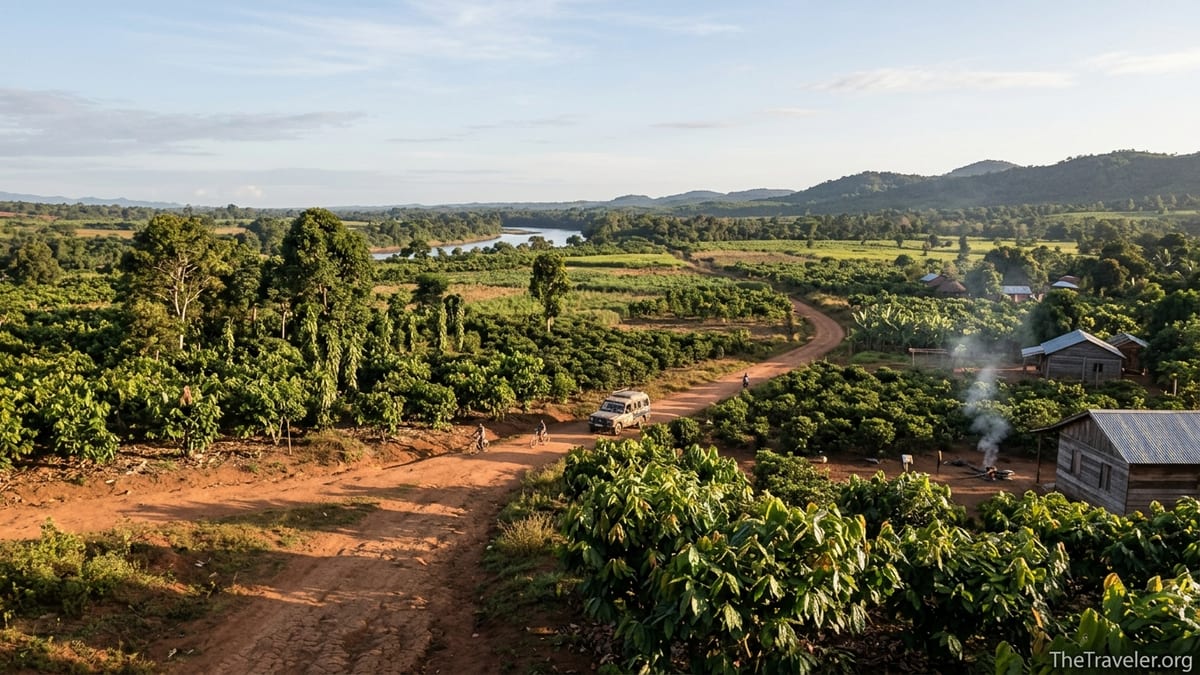
Ambanja sits on the Sambirano River in northwest Madagascar’s Diana Region, roughly three and a half to five hours by road south of Diego Suarez (Antsiranana) and about 30 kilometers from the port of Ankify. The town is modest, low-rise and humid, surrounded by an almost continuous carpet of plantation green that runs toward the sea. This is the core of Madagascar’s cacao country and a major growing area for vanilla, coffee and perfume plants such as ylang-ylang and vetiver.
The Sambirano region has a wetter, more tropical microclimate than the drier savannas you have likely crossed around Ankarana. Rainfall around Ambanja is high, which explains the dense vegetation and the intense shade under cacao trees. As you approach by road, the scenery shifts clearly: red laterite soil, banana trees, coffee shrubs and rows of cacao extending into the distance. Even without leaving the main highway, you will see workers carrying sacks of beans or bunches of vanilla vines, bicycles heavily loaded with firewood or produce, and schoolchildren walking along the verges between villages.
Historically, colonial-era estates carved up much of the fertile land, and that plantation structure still shapes the landscape. Large domains produce cacao, coffee, vanilla and cashew nuts for export, while smallholder farmers cultivate rice, cassava and fruit in the lowlands and around villages. For travelers, this creates a compact area where you can see multiple cash crops within a single walk and understand how they are interlinked in local livelihoods. Rather than just reading that Madagascar exports fine cacao and vanilla, you can stand among the trees, feel the humidity and watch beans drying before they are shipped to chocolate makers abroad.
Why Stop Here on the Northern Circuit
The classic northern circuit links Diego Suarez, Montagne d’Ambre National Park, Ankarana and the Nosy Be archipelago. Almost every route between Diego Suarez and the coast passes near or through Ambanja along the RN6, before branching onto the RN30 to Ankify. That makes Ambanja a natural pause point in both directions, whether you are descending from Ankarana to catch a boat to Nosy Be or returning from the islands toward the highlands or back to Diego Suarez.
In practice, many organized itineraries already include Sambirano in outline. Recent tour programs from several Madagascar-focused operators describe driving from Ankarana to Ambanja with a plantation visit in the afternoon, then continuing to Ankify the next morning to board a speedboat to Nosy Be. Others schedule a morning boat from Nosy Be to Ankify, a cacao plantation tour near Ambanja, and then an onward drive north to Montagne d’Ambre or Diego Suarez. If you are planning independently, you can mimic this pattern and easily adapt it to your timing.
Because travel days in Madagascar are long and tiring, the Sambirano Valley works well as a way to break up the journey. Turning a four to six hour Ankarana–Ankify or Diego–Ankify leg into two shorter hops with an overnight in Ambanja makes the trip more manageable and more interesting. Instead of simply arriving at the coast exhausted, you reach Ankify or Diego with fresh impressions of village life, agricultural work and river scenery. For food-focused travelers, it also adds a rare chance to see where high-quality cacao and spices originate before you taste them again in chocolate bars or desserts back home.
Ambanja as a Practical Base
Ambanja itself is a working town rather than a resort, but that is part of its appeal. The center clusters around the market and the taxi-brousse station, where minibuses and pick-ups depart to Ankify, Diego Suarez and smaller villages in the Sambirano Valley. Accommodation options are modest but adequate: simple guesthouses, small hotels and a few more comfortable lodges around the outskirts or attached to plantations. Rooms are usually fan-cooled, with a limited number of air-conditioned options.
Most visitors stay one night, occasionally two. For example, travelers coming from Ankarana might drive roughly three hours to reach Ambanja by early afternoon, drop bags at a hotel, then join a guided plantation visit before dinner. The next morning, it is an easy one to one and a half hour drive to Ankify to catch a mid-morning or early afternoon boat to Nosy Be. In the reverse direction, those arriving from Nosy Be often overnight in Ambanja after a morning boat from Nosy Be, a transfer from Ankify and an afternoon plantation tour, then continue on to Ankarana or Diego Suarez the following day.
Daytime life in town revolves around the market, where sacks of cacao beans, green vanilla pods when in season, and fragrant bundles of ylang-ylang flowers share space with fish, rice and everyday supplies. It is worth taking an hour to walk the streets around the central square and observe daily rhythms: children in school uniforms, women wearing brightly patterned lambas, and stalls serving mofo gasy (rice cakes) and coffee. Many travelers pick up small quantities of local spices here, though for high-end cacao or traceable vanilla you are better off buying directly from plantations or specialist shops in larger cities.
From Ambanja, small roads and tracks radiate into the countryside toward villages and estates. If you have your own vehicle with a driver, you can easily reach plantation gates and trailheads. Without private transport, it is still possible to arrange half-day excursions through local hotels, tour agencies or the regional tourism office, which maintain relationships with plantation managers and village associations. In all cases, it is worth confirming timings at least a day ahead, as guides or boats on the Sambirano River may not always be available at short notice.
Cacao, Coffee, Vanilla, Pepper and Ylang-Ylang in Context
The Sambirano Valley is often described as Madagascar’s cacao capital, and with reason. A large proportion of the country’s exported cacao is grown here, with beans transported downriver or by road to Ambanja before making their way toward the port and international buyers. On plantation visits, you are likely to see cacao trees grown under the shade of taller species such as banana or taller forest remnants, with football-shaped pods in varying shades of green, yellow and red hanging directly from trunks and branches.
Typical tours walk you through the full chain: from harvesting pods and extracting the wet beans to fermentation in wooden boxes, drying on racks or concrete patios, sorting and bagging. The smell in the fermentation sheds is earthy and fruity; drying yards radiate a warm, chocolatey aroma under the sun. Some plantations demonstrate how different fermentation times affect flavor profiles, and a few may offer basic tastings or sell small quantities of beans or sample chocolate bars produced in collaboration with specialty makers abroad. While this is not a polished chocolate tourism circuit, it offers a rare window into the raw side of a luxury product.
Alongside cacao, coffee bushes fill many lower slopes. You may see farmers hand-picking red coffee cherries during the harvest season and spreading them to dry near their homes. Vanilla, often grown in more humid pockets or intercropped with shade trees, appears as a climbing vine with pale flowers and long green pods that require hand-pollination. This manual work, done carefully flower by flower, explains why vanilla remains one of the world’s most expensive spices. Pepper vines and fragrant plants such as ylang-ylang, vetiver and patchouli complete the mosaic, some destined for international perfumeries.
Smaller producers and village cooperatives also play a role. In some communities along the lower Sambirano, you might be shown small drying structures, simple wood-fired stills for extracting essential oils from ylang-ylang flowers, or family plots where vanilla is tended under mixed-canopy gardens. Guides often explain how fluctuating global prices for vanilla or cacao affect local income and why farmers hedge risk by growing multiple crops and staple foods like rice and cassava alongside export-oriented plants. For travelers interested in ethical consumption, seeing these trade-offs on the ground can be eye-opening.
Key Plantation and Village Experiences
A number of large plantations in the Sambirano Valley welcome visitors by advance arrangement, often with guided walks, explanations of cultivation and processing, and occasional tastings. The best-known include a historic cacao estate located between Ambanja and Ankify, where visitors can tour fermentation and drying facilities, walk shaded cacao alleys and learn how beans are selected before export. Some tours are organized through local lodges or tour operators, who coordinate with the plantation to ensure staff are available to guide English or French speakers around.
Closer to Ambanja, excursions into rural villages allow you to combine agriculture and everyday life. Near the Sambirano River, for example, there are communities that organize dugout canoe trips and plantation walks. A typical half-day outing might involve a short drive from Ambanja, a pirogue crossing of a calm river channel, and a guided walk past cacao, vanilla and pepper plants interspersed with rice paddies and simple wooden houses. Villagers may demonstrate how cacao is split with a machete or how vanilla is scalded and dried during the curing process, then offer lunch or snacks based on local ingredients.
Some smaller estates and eco-lodges in the valley have developed multi-hour interpretive trails through their land, explaining not only commercial crops but also medicinal plants and native trees. You might follow a path that begins in a ylang-ylang grove, continues past coffee shrubs and ends on a ridge overlooking the Sambirano lowlands, with lemurs occasionally heard or seen in nearby forest patches. These walks are usually gentle rather than strenuous, accessible to most visitors with basic fitness, and can be scheduled in the cooler early morning or late afternoon to avoid midday heat.
Village visits should always be arranged respectfully, ideally through recognized intermediaries such as the regional tourism office or long-established lodges that have clear agreements with local communities. Contributions from visit fees typically support communal projects such as school repairs or water points. Visitors are expected to dress modestly, ask before taking photos of people, and avoid handing out sweets or money directly to children, which can encourage begging. A good local guide will brief you on these points beforehand and help translate conversations.
How to Arrange Visits and Typical Costs
The simplest way to organize plantation and village visits in the Sambirano Valley is through your accommodation in Ambanja, a lodge on a nearby estate, or a tour operator handling your northern circuit. Many hotels in town have standing arrangements with specific plantations or communities and can book a half-day excursion with a day’s notice, subject to availability. If you prefer to organize independently, the regional tourism office in Diego Suarez and local agencies in Nosy Be often know current conditions and contact persons.
Private drivers commonly include a plantation stop in their quotes for Diego–Ankarana–Ambanja–Ankify transfers, especially if you request it in advance. Typical arrangements might involve leaving Ankarana after breakfast, arriving near Ambanja around midday, touring a plantation in the afternoon and overnighting in town. Prices for private vehicle transfers vary widely depending on vehicle type and negotiation, but are usually significantly higher than public transport while offering far greater flexibility for stops. Some operators bundle transport, guiding and entrance fees into a per-day rate for the northern circuit.
If you are traveling by taxi-brousse, you can still enjoy shorter visits, but you will need more time and patience. Public minibuses connect Diego Suarez, Ankarana, Ambanja and Ankify, though timetables are approximate and departures often depend on filling seats. Many independent travelers opt to overnight in Ambanja, then ask their hotel or a local guide to arrange a motorbike or car for a two to three hour plantation visit in the morning before continuing by taxi-brousse to Ankify in the afternoon. Costs for short excursions in this style tend to be modest by international standards but can feel high relative to local incomes, so agreeing on a price beforehand is essential.
Entrance fees for plantations and village experiences help support staff, maintenance and community projects. While exact amounts change over time, you can expect a guided visit to be priced at a level that remains accessible to foreign visitors while significantly supplementing local earnings. It is common to tip guides at the end of a visit, especially if they have taken time to explain complex processes, translate conversations with villagers or adjust the route to your interests, such as focusing on vanilla curing or essential oil distillation.
Fitting Sambirano Into a Diego Suarez to Nosy Be Itinerary
In a northbound itinerary starting from Nosy Be, a typical pattern is to take a morning boat from Nosy Be to Ankify, meet your driver at the port, then travel inland toward Ambanja. After dropping your luggage at accommodation, you can spend the afternoon exploring a nearby cacao estate or village. The next day, you continue along the RN6 to Ankarana or Montagne d’Ambre, reaching your lodge in time for a late lunch or an afternoon walk. This way, the Sambirano Valley softens the transition between beach life and the dry forests and limestone formations of the interior.
In the opposite direction from Diego Suarez or Ankarana to Nosy Be, Ambanja works equally well as a final inland stop. Many travelers leave Ankarana after breakfast, reach Ambanja around lunchtime, visit a valley plantation in the afternoon and overnight in town. The following morning, it is a relatively short drive to Ankify, where you can board a boat to Nosy Be by late morning or midday and arrive on the island with enough time for a swim or sunset drink. This schedule also offers some buffer for road delays, which are common on the RN6, and avoids having to rush directly to a boat after a long drive.
For those with more time, two nights in and around Ambanja allow a deeper look at rural life. You might dedicate one day to cacao and spice plantations and another to exploring the river environment by pirogue or visiting nearby waterfalls and swimming holes used by local families. Some multi-day tour programs already follow this rhythm, integrating Sambirano between Ankarana and Nosy Be or pairing it with visits to Montagne d’Ambre and Diego Suarez to create a broader picture of northern Madagascar’s landscapes and economies.
Regardless of direction, it is wise to avoid night driving in this region. Roads can be potholed, lighting is minimal, and livestock or pedestrians may appear suddenly. Plan travel so that you arrive in Ambanja or Ankify well before dark and schedule plantation or village activities between roughly 8 am and 4 pm. Boats between Ankify and Nosy Be typically operate during daylight hours only, so securing your crossing time in connection with your road journey is another reason to keep the Sambirano stop structured but unhurried.
Stopover Length: Few-Hour Taste or Overnight Immersion
If your schedule is tight, a short, focused stop can still give you a meaningful sense of the valley. For example, travelers in a hired car might leave Ankarana mid-morning, reach a plantation near Ambanja around early afternoon, spend two to three hours walking through cacao and vanilla fields, then continue to Ankify and catch a late-afternoon boat to Nosy Be. In this scenario, you will not see the town itself or spend much time with villagers, but you will at least understand how cacao and spices grow and are processed.
A more relaxed option is to plan a full afternoon and night in the area. Arrive in Ambanja around midday, have lunch in town or at a plantation lodge, then join a guided walk that might combine cacao fields, ylang-ylang groves and a village visit. After dinner and a night’s rest, you can stroll through Ambanja’s market in the morning, buy some local coffee or pepper, and depart late morning for Ankify. This pacing suits travelers who prefer unhurried conversations with guides and residents, and who appreciate seeing the town in daylight rather than just driving around it.
Spending two nights opens even more possibilities. You could dedicate one day primarily to agricultural visits and the other to river-based or nature excursions. Some itineraries include a pirogue trip on the Sambirano, visiting riverside hamlets and watching how goods and people move along the waterway that historically carried cacao toward Ambanja. Another day could focus on a nearby waterfall, small forest fragment or scenic viewpoint over the valley, offering a counterpoint to the more touristed national parks of Ankarana and Montagne d’Ambre.
Even travelers primarily focused on wildlife or beaches stand to gain from a short stay. Understanding how people farm, process crops and organize village life adds context to the protected areas you visit and the resorts where you relax. It turns the road between Diego and Nosy Be from a mere transfer into an integral chapter of your northern Madagascar story.
Responsible Travel in a Working Agricultural Landscape
Traveling through the Sambirano Valley means entering a landscape where people live and work, not a purpose-built attraction. Fields and plantations represent livelihoods, and many workers earn modest incomes from demanding physical labor. Approaching visits with sensitivity is therefore essential. Asking guides about appropriate behavior, seeking permission before stepping into fields or taking close-up photographs, and greeting farmers you meet along the way all help set a respectful tone.
Buying local products with care is another dimension of responsible travel. At plantations that sell beans, vanilla or spices directly, you can ask staff about how sales are structured and whether any premiums support community projects. In markets, be cautious of offers that seem too cheap, particularly for vanilla, as the quality and origin can vary and intense global demand has sometimes fueled theft and unstable prices. Purchasing small quantities from reputable vendors and focusing on items you can legally and safely take home is a sensible approach.
Environmental considerations matter too. While cacao plantations in Sambirano are typically grown under shade, which can preserve some biodiversity compared to full-sun agriculture, there is still pressure on remaining natural forests. Choosing tour providers who demonstrate respect for protected areas, avoid disturbing wildlife and favor low-impact activities such as walking or paddling over motorized excursions can make your visit lighter on the landscape. Simple habits like carrying a refillable water bottle, packing out any waste and avoiding single-use plastics make a difference in rural areas where waste management is limited.
Finally, consider language and communication. French is widely spoken in and around Ambanja, and Malagasy dialects dominate in villages. English is less common, though some guides, hotel staff and tourism office personnel speak it. Learning a few Malagasy greetings and phrases is appreciated and can help break the ice during plantation or village visits. Patience, humor and openness go a long way when schedules shift, vehicles break down or sudden rain showers make tracks muddy, all of which are possible in this tropical, road-dependent region.
The Takeaway
For travelers drawn to more than beaches and baobabs, the Sambirano Valley and Ambanja provide a vivid look at how northern Madagascar earns much of its income from the land. This fertile corridor between Ankarana and Ankify is where cacao pods turn into exportable beans, where vanilla flowers are hand-pollinated, and where ylang-ylang blossoms destined for perfume stills fill baskets before dawn. With even a short stop, you can walk those fields, talk to the people who tend them and taste products at their source.
In practical terms, building an Ambanja stopover into a Diego Suarez to Nosy Be journey is straightforward. Whether you have only a few hours for a plantation tour or the flexibility to spend one or two nights in town, the detour repays the effort. It breaks up long road days, adds depth to your understanding of Madagascar’s economy and food culture, and turns a transfer route into a highlight of your northern circuit.
Most importantly, not simply driving through the Sambirano Valley means recognizing the human and agricultural stories underlying the landscapes you see. Instead of remembering only national parks and islands, you carry home the smells of fermenting cacao, the sight of vanilla pods drying in the sun and the memory of conversations in village courtyards. For many travelers, these are the details that make a trip to northern Madagascar feel complete.
FAQ
Q1. Can I visit cacao and spice plantations around Ambanja without a tour operator?
You can, but it is usually easier to arrange visits through a local hotel, lodge or regional tourism office, which have contacts with plantations and village associations and can organize guides and transport.
Q2. How much time should I plan for a Sambirano Valley stopover between Ankarana and Ankify?
A minimum of two to three hours allows a basic plantation visit, but most travelers find that one overnight in Ambanja offers a far richer experience and a more relaxed travel day.
Q3. Is it possible to do a plantation visit when traveling by taxi-brousse?
Yes, but you will need to be flexible. Many travelers overnight in Ambanja, then arrange a short plantation trip by motorbike or car in the morning through their accommodation before catching an afternoon taxi-brousse to Ankify.
Q4. What is the best season to see cacao and vanilla activities in the Sambirano Valley?
Harvests and processing vary by crop and year, but in general cooler, drier months offer more comfortable walking, while certain periods of the year coincide with visible cacao fermentation and vanilla curing. Local guides can advise what is happening when you visit.
Q5. Do plantations near Ambanja offer chocolate-making demonstrations?
Some estates explain fermentation and drying in detail and may offer tastings or sell sample products, but full bean-to-bar demonstrations are less common. The focus is usually on cultivation and primary processing for export.
Q6. How do I fit a Sambirano Valley visit into a Diego Suarez to Nosy Be itinerary?
Many itineraries schedule a drive from Diego Suarez or Ankarana to Ambanja with an afternoon plantation visit, an overnight in town and a short transfer the next morning to Ankify to catch a daytime boat to Nosy Be.
Q7. Is Ambanja safe for independent travelers?
Ambanja is generally considered safe during daylight hours for visitors who take normal precautions, keep valuables secure and avoid walking in poorly lit areas at night. As in many towns, it is wise to follow local advice.
Q8. Can I buy vanilla and spices directly in the Sambirano Valley?
Yes, plantations and markets sell vanilla, pepper and other spices, though quality and origin vary. Buying modest quantities from reputable vendors and respecting customs regulations for food imports is recommended.
Q9. Do I need to speak French or Malagasy to enjoy a plantation visit?
French is widely used and some guides speak English, but knowing a few French or Malagasy phrases helps. Booking in advance increases the chance of finding an English-speaking guide if you need one.
Q10. Why is it worth stopping in Ambanja instead of just driving through to Ankify?
Stopping turns a long transfer into a highlight, letting you walk among cacao and vanilla plants, meet growers and understand how this agricultural landscape supports northern Madagascar’s people and exports.